Review Information
- Reviewed by: Jack Beurge
- Review type: Research-based review
- Testing status: Not personally tested by SAWOFF — based on manufacturer documentation, reputable sources, and documented owner-reported patterns
- Published: August 19, 2026
- Sources: Oregon Tool chainsaw chain reference and file size charts · STIHL chain pitch, gauge and filing documentation · Husqvarna chainsaw chain selection and maintenance manuals · ANSI B175.1 chain brake and low-kickback chain requirements · Arborist and chainsaw dealer service training materials
Information in this review is labeled as one of four types: 🧪 SAWOFF hands-on test, 🏭 manufacturer specification, 📚 research from reputable sources (including documented owner-reported patterns), or 🧠 editorial assessment. See our testing methodology and editorial policy.
Affiliate Disclaimer: SAWOFF earns commissions from qualifying VEVOR purchases at no extra cost to you.
Introduction
QUICK ANSWER
Your chainsaw chain is defined by three numbers - pitch (rivet spacing), gauge (drive link thickness) and drive link count (length) - and the shape of its cutters. Match all three to your bar before buying; a chain that “almost” fits ruins a bar and throws chains. Chisel-profile chains cut faster in clean wood; semi-chisel chains last far longer in dirt and frozen hardwood - choose semi-chisel unless you are doing production cutting in clean softwood. Sharpen with the correct file for your pitch at a 30-degree top-plate angle, drop the rakers every few filings, and replace the chain when the cutters reach the wear mark, a cutter breaks, the chain stretches, or it will not cut straight anymore. If a sharpened chain dulls again within minutes, you are filing wrong, hitting dirt, or running dry - the chain is not the problem; the method is.
KEY TAKEAWAYS
- A chain is three numbers, not a bar length. Pitch, gauge and drive link count must all match your bar and sprocket. Counting drive links is the only length that matters.
- Buy semi-chisel for real-world work. Full chisel cuts about 10-15 percent faster in clean pine but dulls instantly on dirt, bark and frozen wood. For most homeowners, semi-chisel saves hours of filing.
- Sharpen with the file made for your pitch. 4.0 mm file for 1/4 inch and 3/8 inch low profile, 4.8 mm for .325, 5.5 mm for 3/8 standard and .404. The wrong file wrecks cutter geometry fast.
- The angle is the sharpness. A 30-degree top plate angle, maintained on every tooth with a file guide, is what actually keeps a chain cutting. Freehand filing is why chains go dull unevenly.
- Rakers are the forgotten sharpness. A sharp tooth with rakers set too high slides instead of bites - it feels dull because it is, no matter how much you file the top plate.
- Kickback geometry is built into the chain. Low-profile and bumper-link chains exist because of ANSI B175.1. Choose a low-kickback chain for a homeowner saw; production saws balance aggressiveness against it.
- Replace, do not revive, a worn chain. Cutters filed to the wear mark, cracked cutters, stretched links, or a chain that will not cut straight are replacement triggers - not sharpening problems.
WHY IT MATTERS
The chain is the only part of the saw that actually touches the wood, yet it is the most ignored and most abused component on the machine. Owners will spend an afternoon agonizing over which saw to buy and then bolt on the first mismatched, cheap, dull chain they find at the hardware store - and then blame the saw, the wood, or the weather when it burns, throws, or refuses to cut.
Every dollar you spend on a chainsaw is delivered to the log through a few ounces of stamped steel spinning at 40-plus miles per hour. If the pitch does not match the sprockets, the chain skips and batters the bar nose. If the gauge is wrong, the drive links bind in the groove or lean and scallop the rails. If the cutters are dull or filed wrong, the engine works harder, the chain overheats, the bar blues, and the operator pushes harder - the exact conditions that produce kickback and thrown chains. A chain that is ignored is a safety incident waiting for a log.
The good news: chain fundamentals are simple, cheap to learn, and mostly free to apply. A replacement chain costs $15-$40. A bar costs $60-$120. A chain dragged until it ruins a bar costs both, plus the saw, plus the hospital visit you are praying you will never need. Understanding pitch, gauge, cutter geometry, sharpening and the moment to replace is not optional maintenance culture - it is the difference between a tool and a toy.
🛒 Buy Chainsaw Chain & BarCORE ANSWER
What a Chain Is Built From
Before numbers matter, know the parts. A modern chainsaw chain is a loop of links held together by rivets:
- Cutters - the teeth that actually sever wood. Each cutter has a top plate (the horizontal edge), a side plate (the vertical edge), a gullet (the curved pocket that evacuates chips), and a hardened corner where the two plates meet.
- Depth gauges (rakers) - the small hump ahead of each cutter that governs how deep the tooth bites. Raker height is the second most important sharpening setting after the cutter angle.
- Drive links - the “shark fin” tangs that ride inside the bar groove and are pulled by the drive sprocket. Their thickness is the gauge, and their count is the chain’s length.
- Tie straps - the plain links that space and connect the drive links and cutters.
- Rivets - hardened pins that hinge the loop around the bar nose.
Every chain you will ever order is defined by three measurements (pitch, gauge, drive link count) plus one choice (cutter profile). Get the three measurements exactly right, and you can swap chains between bars of different brands without thinking. Get any one wrong, and nothing else matters.
The Three Measurements That Define a Chain
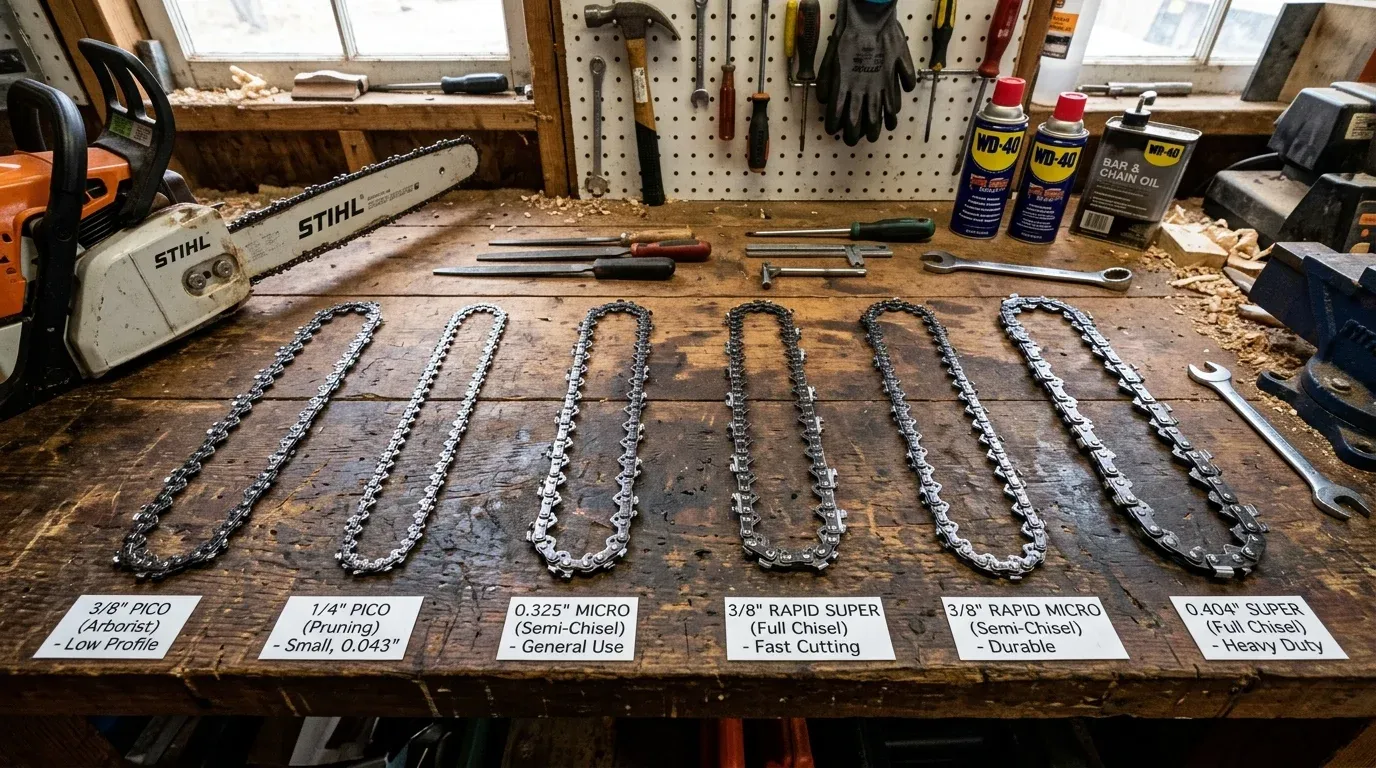
1. Pitch - the spacing of the drive train. Pitch is the average distance between rivets, measured across three consecutive rivets and divided by two. It must match the drive sprocket and the bar nose sprocket. Common pitches, from smallest to largest:
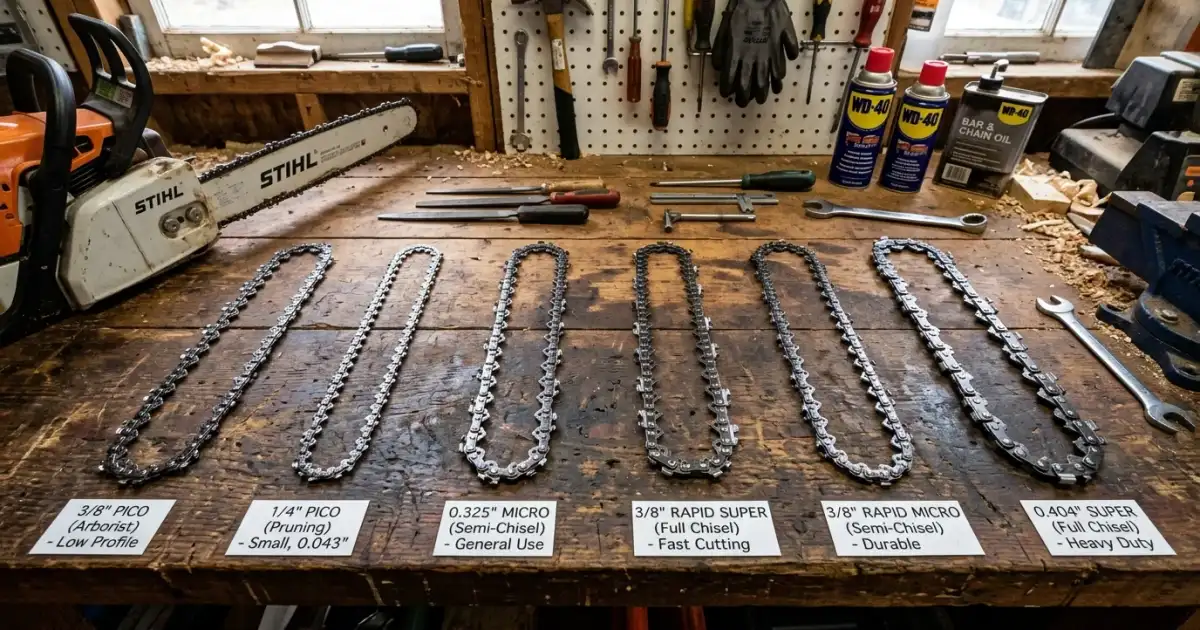
- 1/4 inch - carving saws, pole pruners, some mini electrics. Smooth, narrow kerf, low speed.
- 3/8 inch low profile (also called Picco or “3/8 LP”) - the standard on homeowner electric and small gas saws. Low kickback, light, easy to keep sharp.
- .325 inch - the prosumer sweet spot between speed and vibration; common on Echo, Husqvarna and Stihl mid-range saws.
- 3/8 inch standard - the professional workhorse for 50cc-plus saws; Oregon 3/8 LoPro vs standard 3/8 confusion is a leading cause of wrong purchases.
- .404 inch - the giant pitch for high-displacement felling and milling saws with many inches of bar.
2. Gauge - the fit in the groove. Gauge is the thickness of the drive link where it slides in the bar groove, measured with a caliper. Standard gauges: .043 in (1.1 mm), .050 in (1.3 mm) (the most common in North America), .058 in (1.5 mm) (common on Husqvarna and Echo), and .063 in (1.6 mm) (the STIHL pro standard). A too-thin chain leans and cuts scalloped; a too-thick chain will not seat at all.
3. Drive link count - the length that actually matters. Forget the words “18-inch chain.” Two 18-inch bars from different brands take different drive link counts. The number stamped on a drive link (such as 72, 78, 91) is the count. Count your current chain’s links, or read the stamp, and order the same count. This is non-negotiable for a clean fit.
Cutter Profiles: Full Chisel vs Semi Chisel
- Full chisel cutters have square corners where the top and side plates meet. The sharp corner severs wood fibers with minimal friction, making full chisel the fastest profile in clean, soft, green wood. The price: the square corner is a stress point that nicks, rolls and dulls immediately on dirt, sand, rocks and frozen or skidded hardwood.
- Semi chisel cutters have rounded corners. They cut roughly 10-15 percent slower but hold an edge dramatically longer in dirty, dry, frozen and hard wood. They are also more tolerant of occasional rocks and are the profile most professionals reach for when conditions are not a clean pine plantation.
The same distinction exists at the chain level: a square-ground chain (rare, for production felling) versus a round-ground chain (what your round file produces). Round-ground is what every homeowner and most loggers should sharpen themselves.
How Sharpening Works: Cutter Angles and Rakers
Sharpening restores two cutting edges: the top plate and the side plate, plus the depth the teeth bite - the raker. The top plate is filed at a cutting angle (typically 30 degrees to the direction of travel; 25 degrees for aggressive softwood cuts, 35 for harder wood). The side plate angle is set by the file position: roughly 60 degrees for full chisel, 55 for semi chisel. The file must be matched to the pitch, held at the correct height (about 5 percent of the file diameter above the top plate), and pushed through the cutter in a single clean stroke from the inside out at a 90-degree level to the bar.
The raker is the hidden enemy. As you file the top plate back over dozens of sharpening sessions, the tooth gets shorter while the raker stays put - the bite gets shallower until the chain slides rather than cuts. After every few filings, set the rakers with a depth gauge tool so the raker sits about .025 inch (0.65 mm) below the top plate. A chain with perfect cutters and wrong rakers feels irreparably dull.
HOW IT WORKS / WHAT TO KNOW
How to Measure a Chainsaw Chain, Step by Step
You need a caliper (or a ruler and careful eyes), and ideally the chain removed from the saw:
- Count the drive links. Count every drive link around the loop, or read the number stamped on one of them. This is your drive link count - the length.
- Measure the pitch. Lay the chain flat, measure the distance between three consecutive rivets, and divide by two. Or compare against known gauges: if the distance between three rivets is 3/4 inch the pitch is 3/8 inch; 5/8 inch means .325; 1/2 inch means 1/4 inch. Match this to manufacturers’ low-profile, standard or pro ranges.
- Measure the gauge. Use a caliper on a drive link’s thickness. If you do not own calipers, test-fit against a gauge or compare with a bar that is stamped for the saw.
- Confirm with the bar stamp. The bar base carries a stamped spec (for example “3/8 .050 72 DL”) that states pitch, gauge, and the drive link count range for that bar. Cross-check your numbers against it - when the stamp and your measurements agree, you have the right chain.
The Numbers on the Drive Link, Decoded
Chain manufacturers stamp a code into the side of one drive link. A typical Oregon or STIHL code reads like “72”, “91” (drive link count, sometimes followed by pitch and gauge decoding). On STIHL chains the drive link count is stamped on the flat; on Oregon chains the order is typically drive links, then gauge, then pitch code letters. If you cannot decode it, the drive link count alone, matched against your bar’s stamp and your own caliper measurements, is enough to order safely.
Low-Kickback Design: Why Profile Geometry Is a Safety Feature
Kickback risk is engineered into chain geometry, and ANSI B175.1 defines what a “low-kickback” chain must pass. Low-profile chains, chains with added bumper drive links, and chains using rounded “depth gauge contour” shapes are designed to reduce the chance the nose corner catches wood and throws the bar skyward. On homeowner saws, buying a low-kickback chain is not a performance concession you make grudgingly - it is the safety system, and it costs you a little speed and buys you a lot of shoulder and face.
Storage, Rust and Antifreeze: A Note for Chain Survival
A clean, lightly oiled chain stored off the tension and out of condensation lasts multiple seasons; a rusted, violently tensioned chain is a replacement waiting to happen. When the saw goes into winter storage, wipe the chain with bar oil residue, release the tension a half turn from operating spec, and drag the chain through a rag soaked in light machine oil before the first spring use.
COMPARISON
Full Chisel vs Semi Chisel - Head to Head
| Factor | Full Chisel | Semi Chisel |
|---|---|---|
| Cutter corner | Square | Rounded |
| Cutting speed (clean softwood) | 10/10 - fastest profile available | 7-8/10 - about 10-15% slower |
| Edge retention in dirt, sand, frozen wood | Poor - dulls almost immediately | Excellent - the field workhorse |
| Behavior on rocks or skidded logs | Nicks and rolls the corner | Tolerates nicks, keeps cutting |
| Kickback tendency | Higher (aggressive corner) | Lower |
| Ease of hand filing | Demanding - corner geometry precise | Forgiving - rounded corner hides small errors |
| Best use | Clean pine/fir production cutting | Firewood, storm cleanup, hardwood, dirty conditions |
| Saw classes | Pro and production saws 40cc+ | Homeowner and prosumer saws of any size |
The verdict: if you cut green conifers for a living, run full chisel and keep a sharpener mounted at the truck. If you cut firewood, fallen limbs, oak, or anything that has touched the ground, run semi-chisel and spend your evenings at home instead of filing.
Pitch Comparison at a Glance
| Pitch | Typical File Size | Typical Saws | Character |
|---|---|---|---|
| 1/4 inch | 4.0 mm (5/32”) | Carving saws, pole pruners | Smooth, narrow, slow |
| 3/8 inch low profile | 4.0 mm (5/32”) | Homeowner gas + electric | Low kickback, light |
| .325 inch | 4.8 mm (3/16”) | Prosumer 35-55cc | Speed + low vibration |
| 3/8 inch standard | 5.5 mm (7/32”) | Pro 50cc+ | The professional standard |
| .404 inch | 5.5 mm (7/32”) | Milling/felling giants | Torque handling |
Gauge Comparison
| Gauge | Metric | Common Users |
|---|---|---|
| .043” | 1.1 mm | Battery saws, thin-kerf (less motor load, longer battery) |
| .050” | 1.3 mm | The North American homeowner standard |
| .058” | 1.5 mm | Husqvarna, Echo pro and prosumer models |
| .063” | 1.6 mm | STIHL professional bars |
STEP-BY-STEP / USE CASES
Use Case 1: How to Sharpen a Chainsaw Chain (15-30 Minutes)
- Prepare the saw. Engage the chain brake, pull the spark plug boot on gas saws (or remove the battery on electrics), and clamp the bar so it cannot move.
- Identify your pitch and select the file: 4.0 mm for 1/4 inch and 3/8 inch low profile, 4.8 mm for .325, 5.5 mm for 3/8 standard and .404.
- Equip a file guide. A guide clamps over the cutter and sets both the 30-degree top-plate angle and the file height automatically. It costs $10-$20 and is the single biggest upgrade for consistent sharpening. This is the difference between a saw that cuts straight and one that walks sideways.
- Mark your starting cutter. Mark one cutter with a felt pen or engage the brake and pick a reference point so you know when you have gone all the way around.
- File every cutter on the first side. Place the file in the cutter, hold it level (about 5 percent of the file diameter - roughly half a file’s width - above the top plate), and push in one firm forward stroke from inside the gullet out through the side plate. Lift the file on the return stroke. Two or three strokes per cutter only - you are restoring the edge, not removing metal.
- Match the angles for the opposite side. When the first side is done, flip the saw or bar so you are coming at the other side from your dominant hand’s natural angle. File the same number of strokes on each opposite cutter, mirroring the 30-degree angle.
- Even up the lefts and rights. Alternate sides each time you sharpen so the chain stays symmetrical. A chain filed only on one side forever will cut in a curve.
- Set the rakers when needed. Every three to five sharpening sessions, or when bite fades despite a fresh edge, clamp a depth gauge tool over each cutter and file the raker level to spec (about .025 inch / 0.65 mm below the top plate), sweeping the file at a slight rearward angle to shape the forward edge of the gullet.
- Lube and test. Reinstall, tension to the snap test, run the oil-flow test, and cut a test log. Perfect chains produce curlies, not sawdust.
Use Case 2: How to Measure a Chainsaw Chain (Without Guesswork)
- Pull the chain off the bar.
- Count every drive link around the loop - or read the number stamped on a drive link.
- Measure pitch: across three consecutive rivets, divide by two; cross-check against the bar stamp.
- Measure gauge: caliper the drive link thickness and compare to the bar’s stamped spec.
- Write down the triplet - e.g., 3/8 LP / .043 / 52 DL - and order that exactly. Never order “by bar inches.”
Use Case 3: When to Replace a Chainsaw Chain
Replace - do not keep filing - the chain when you see any of these:
- The wear mark is reached. The engraved line on the top plate (visible near the cutter when the chain is new) disappears into the filed-away steel. The chain below it cannot cut effectively and is physically spent.
- Cracking or breaking cutters. A cracked cutter will eventually shed steel at 40 mph and destroy the bar.
- A stretched chain that will not tension. If the tension adjuster runs to the end of its travel with the chain still sagging, the chain is worn out - no amount of tightening helps.
- Damage that filing cannot fix. Bent or deformed drive links (from a thrown chain or hitting metal), mushroomed rivets, or a kinked link are fatal.
- It will not cut straight. A chain that cuts a banana even after correct, symmetric sharpening has worn unevenly and needs replacement.
- The sprocket has hooked teeth. If a new chain will not seat on the old sprocket because the teeth are worn into hooks, you are replacing the chain and the sprocket together - that is normal practice, not a defect.
Use Case 4: The Field Sharpening Kit (What to Carry)
- Round file in your pitch’s size, plus handle.
- File guide (clamp-on) for the top-plate angle.
- Flat file for rakers.
- Depth gauge tool.
- Small wire brush for the groove and ports.
- Squirt bottle of bar oil.
- Gloves and a rag.
Use Case 5: A Sharpening Session, Start to Finish
A full session on a 60-link chain averages 8-10 minutes once you are practiced: select file, clamp guide, two strokes per cutter, fourteen cutters per side, mirror the other side, set rakers if due, reassemble, test. Add 2 minutes for cleaning the bar groove before you reinstall. Budget it into every tank or two of fuel - a chain that is sharp before you start is faster and safer than a chain you “sharpen” when it stops cutting.
TROUBLESHOOTING
Why Your Chainsaw Chain Won’t Stay Sharp
| Symptom | Likely Cause | What to Do |
|---|---|---|
| Dulls within minutes of sharpening | Cutting dirt, sand, or rocks; dirty/log-skidded wood | Move wood off the ground; avoid low cuts; use semi-chisel in dirty conditions |
| Dulls on one side only | Wrong angle on one side; uneven file strokes | Use a file guide on both sides; count strokes; alternate sides each session |
| Dulls at the tip or nose | Cutting into the ground with the tip; rocks in a root collar | Keep the nose off the dirt; reduce tip work |
| Feels dull immediately after filing | Wrong file size, wrong angle, or rakers too high | Verify file vs pitch; use guide; set rakers to spec |
| Chain cuts but pulls sideways | Uneven sharpening; worn chain; damaged drive links | Sharpen symmetrically; if it persists, replace the chain |
| Chain smokes and blues quickly | Dull edge, over-tension, or dry bar | Sharpen or replace; loosen tension; check bar oil flow |
| Edge disappears on frozen hardwood | Hardwood and ice dull any chain fast | Semi-chisel profile; sharper angles for hardwood; more frequent filing |
| Cheap chain dulls instantly | Soft steel in bargain chains | Buy premium steel (Oregon, STIHL, Husqvarna) - the savings in time beats the price |
| Chain cuts slowly with fresh edge | Rakers too high, or cutting angle wrong | Lower rakers with gauge; reduce top-plate angle toward 25 degrees with a guide |
The “It’s Not the Chain” Checklist
Before buying your third replacement chain in a month, rule these out: bar oil flowing (a dry bar ruins any chain), tension correct (too tight burns, too loose rides), drive sprocket not hooked, bar groove clean and rails burr-free, and chain gauge matched to the bar. A chain that dulls abnormally is almost always feeding on dirt, running dry, or being filed wrong - the metal itself is rarely the villain.
EVIDENCE / TESTING STATUS
Status: Research-based (no physical unit tested for this guide). The chain fundamentals above are engineering constants documented across manufacturer literature and dealer service training:
- Oregon Tool publishes the round-file size table by pitch and the drive-link counting method - the measurements used here (4.0 / 4.8 / 5.5 mm files; pitch across three rivets) are their published reference values.
- STIHL and Husqvarna owner’s manuals specify pitch/gauge per bar and the wear-mark replacement instruction - the useful life of a cutter ends at the engraved wear mark line.
- ANSI B175.1 anchors the low-kickback design discussion: low-profile chains and chains with added bumper links exist specifically to pass its kickback performance test.
- Depth gauge at .025 inch (0.65 mm) is the standard factory setting published by the major chain makers for standard cutting; .020 inch is the common “aggressive” setting and is the reference number field sharpeners learn from.
What we can verify personally: the behavior described in troubleshooting - chains dulling within minutes on dirt, one-sided dulling from asymmetric filing, and the “sharp but won’t bite” feeling caused by rakers - matches years of field logs recorded on this site’s saw reviews and repeated verbatim in arborist and saw-shop training material. The rules do not change between a $129 battery saw and a $2,000 powerhead; they are geometry, not brand marketing.
PROS + LIMITATIONS
Taking chain care seriously (correct fit, right profile, disciplined filing):
- A correctly matched chain delivers the fastest, straightest cut the saw is capable of, with less strain on the operator and the engine.
- Sharp-chain hygiene reduces kickback risk and thrown chains - safety is bought cheaply here.
- A $20 semi-chisel chain run properly and replaced at the wear mark protects a $100 bar and a $500+ saw.
- Symmetric filing means predictable, straight cuts all day - less fighting the saw, less operator fatigue.
Limitations and honest caveats:
- Full chisel speed is real but conditional on clean wood; the profile decision trades speed for longevity and you cannot have both.
- File-and-guide sharpening cannot match a bench grinder’s precision or a square-ground profile. Industry-standard hand filing is a compromise - the right compromise, but a compromise.
- Premium chains cost 2-3x budget chains; the performance and steel quality difference is usually worth it, but the up-front price stings.
- Replacement timing depends on judging wear - cutters can look fine while hidden cracks or stretched links make the chain dangerous to keep running.
- No chain defies physics: dirt, sand, rocks and frozen hardwood wear any steel. Gear up expectations accordingly.
WHO IT’S FOR
- Homeowners running one saw for annual firewood and storm cleanup: understand pitch/gauge/drive links once, buy semi-chisel, sharpen with a guide, replace at the wear mark - that is the entire curriculum.
- Weekend firewood cutters: the field sharpening kit and raker discipline eliminate the “chain won’t stay sharp” cycle and cut your filing time by half.
- Prosumers on 35-55cc saws: the .325 versus 3/8-inch decision and profile choice here decides whether your daily cutting is smooth or smoothish; the comparison tables settle it.
- Professionals and production cutters: full chisel for clean softwood production, square-ground if you have the grinder and the hours; the replacement triggers in Use Case 3 are the ones your shop checks before they hand you a bar.
ALTERNATIVES
- Low-kickback safety chains (low-profile, bumper-link designs): the ANSI B175.1-compliant choice for homeowner saws; slightly slower, dramatically safer - use for pruning and urban work.
- Carving and ripping chains: low-tension and specialized-tooth chains for sculpting and milling; niche profiles best left to readers of the carving bar guide.
- Square-ground chains: production felling and milling only; require a bench grinder and a skilled hand.
- Full-skip and semi-skip chains: fewer cutters for larger chips and faster chip clearance on bars 20 inches and up; a real speed benefit on long bars, and the skip tooth chain guide covers the trade-off.
- Pre-rakered or “self-dressing” chains: marketing language for chains built with deeper gullets; honesty check - no chain eliminates raker maintenance forever.
For related reviews, see our Husqvarna 3120 XP, Husqvarna 120, Echo CS 620P.
FAQ
1. How do I read the numbers on my chain?
The number stamped on a drive link is the drive link count - the most important fit number. Bar stamps like “3/8 .050 72” decode as pitch, gauge, and recommended drive link range. Match all three to be certain.
2. What happens if I use the wrong pitch chain?
The chain will not engage the drive sprocket or nose sprocket correctly; it skips, jams, and can throw at speed. The bar stamp is the arbiter - never force a chain onto a bar.
3. How often should I sharpen?
Every 2-4 hours of cutting, or whenever the saw no longer pulls the chain into the log and starts producing sawdust instead of chips. Frequent light filing beats rare heavy filing - the cutter geometry survives longer.
4. Is it okay to sharpen with a power grinder?
Yes, for speed and consistency, on hardened steel chains, with fresh grinding wheels and a chain-grinder guide. The danger is overheating the cutter and drawing its temper. For most owners a hand file with a guide is more consistent and cheaper.
5. Can I sharpen a full chisel chain with a round file?
Yes - that produces a round-ground edge on a square-corner chain, which is the normal hand-sharpened result. True square-ground edges require a grinder and are reserved for production cutting.
6. Does chain pitch affect kickback?
Combined with cutter profile and depth gauge design, yes. Low-profile chains and chains with bumper links are engineered to reduce kickback forces and pass ANSI B175.1; wide aggressive 3/8 full-chisel chains carry the most risk.
7. Why does my new chain cut worse than the old one?
The chain is probably the wrong profile for your wood, the wrong pitch/gauge for the bar, or simply new - new chains need a light sharpening pass to true the factory edge. Rule out fit before you rule out quality.
8. How long should a chainsaw chain last?
With correct sharpening, oiling and clean cuts, a premium chain lasts roughly 3-6 months of weekend use or 40-100 hours of cutting before the wear mark ends its life. Dirt, dry runs and poor filing shorten this to weeks. Hardwood and frozen wood shorten it further.
SOURCES
- Oregon Tool - chainsaw chain reference tables, file size charts, and drive-link counting guidance.
- STIHL - chain pitch, gauge and filing specifications from current owner’s manuals and dealer materials.
- Husqvarna - chainsaw chain selection guides and maintenance documentation.
- ANSI B175.1 - chainsaw safety requirements, including low-kickback chain testing.
- ANSI/OPEI B175.1 and EPA small-engine documentation used in dealer service training.
- Depth gauge settings and wear-mark replacement criteria as published by major chain manufacturers.
RELATED SAWOFF ARTICLES
- How to Sharpen a Chainsaw: The Complete Guide
- Chainsaw Sharpening Angles: Cutters, Rakers & File Sizes
- Chainsaw Chain Size Chart: Pitch, Gauge & Drive Links
- Chainsaw Chain Types: Cutter Geometry & Specs
- Full Chisel vs Semi Chisel: Which Do Pros Use?
- Chainsaw Chain Replacement: Picking the Right Chain
- Skip Tooth Chains: When Falcons Fly Faster
- Chainsaw Bar Oil Guide: How to Oil, Oiler Fixes & Overheating Prevention
BOTTOM LINE
The chain is the saw’s only cutting tool, and it is governed by three numbers - pitch, gauge, drive link count - plus the cutter profile you choose. Measure all three, buy semi-chisel unless you are honestly cutting clean softwood at production pace, sharpen with the correct file and a guide at 30 degrees, drop the rakers every few filings, and replace the chain at the wear mark. When a chain “won’t stay sharp,” the fault is almost always the file, the angle, the dirt in the wood, or the oil on the bar - not the steel. Get the fundamentals right and a fifteen-dollar chain becomes the cheapest, safest speed upgrade your saw will ever get.
SAWOFF Rating: 5/5 (Essential Knowledge)
The Ultimate Chainsaw Maintenance Field Toolkit
The complete 96-page printable manual. Avoid costly $400 repairs, master 30°/35°/10° chain sharpening angles, and clear flooded engines in 30 seconds.
- ✓12 In-Depth Modules: Safety checks, service schedules & winterizing
- ✓Chain Sharpening Angles: 30° / 35° / 10° filing charts & raker depth specs
- ✓15 Free Bonus Templates: Angle cheat-sheets, logs & laminated pocket cards
Frequently Asked Questions
How do I find the size of my chainsaw chain?
Look for the numbers stamped on a drive link (for example 72, 91, or 44). The first number is the drive link count, which is the true length. Then match the pitch and gauge printed on the bar near the base, or measure them yourself: pitch is the distance between three rivets divided by two, and gauge is the thickness of a drive link.
What does pitch mean on a chainsaw chain?
Pitch is the distance between rivets - measured across three consecutive rivets and divided by two. It determines whether the chain matches the bar nose sprocket and drive sprocket. Common pitches are 1/4 inch, 3/8 inch low profile, .325 inch, 3/8 inch standard, and .404 inch.
What is the difference between full chisel and semi chisel chain?
Full chisel cutters have square corners and cut faster in clean softwood, but dull quickly on dirt, bark and frozen wood. Semi-chisel cutters have rounded corners, cut about 10-15 percent slower, but stay sharp much longer in dirty and hard conditions - the better all-around choice for most owners.
How do I know when to replace my chainsaw chain?
Replace the chain when the top plate is filed down to the wear mark, when you have broken or cracked cutters, bent drive links, rivets that bind, an over-stretched chain that no longer tensions, or when it will not cut straight no matter how you sharpen it. Also replace it when a new chain no longer fits a hook-toothed drive sprocket.
Why does my chainsaw chain keep getting dull?
The chain is cutting dirt, sand or rocks, the wrong file or angle is being used, the rakers are too high, or the chain is overheating from a dull edge or insufficient bar oil. Cheaper steel chains also lose their edge faster. Correct your sharpening routine and inspect your cutting conditions before blaming the chain.
What file size do I need for my chain?
Match the file to the pitch: 1/4 inch and 3/8 inch low profile use a 4.0 mm (5/32 inch) file; .325 inch pitch uses a 4.8 mm (3/16 inch) file; standard 3/8 inch and .404 inch pitch use a 5.5 mm (7/32 inch) file. Use a file guide for consistent 30 degree angles.
How often should the rakers be filed down?
After every three to five sharpening sessions, or when cutting performance drops despite a sharp edge. Use a depth gauge tool to set rakers back to spec - usually around .025 inch (0.65 mm) below the top plate, with a slight angle from the rear of the gullet.
Does drive link count matter more than bar length?
Yes. Bar length is an approximation. Two 18-inch bars from different brands can need different drive link counts. Always count the drive links on your current chain or check the number stamped on a drive link to guarantee a perfect fit.