Review Information
- Reviewed by: Jack Beurge
- Review type: Research-based review
- Testing status: Not personally tested by SAWOFF — based on manufacturer documentation, reputable sources, and documented owner-reported patterns
- Published: June 27, 2026
- Manufacturer: Husqvarna
- Model: 3120 XP
Information in this review is labeled as one of four types: 🧪 SAWOFF hands-on test, 🏭 manufacturer specification, 📚 research from reputable sources (including documented owner-reported patterns), or 🧠 editorial assessment. See our testing methodology and editorial policy.
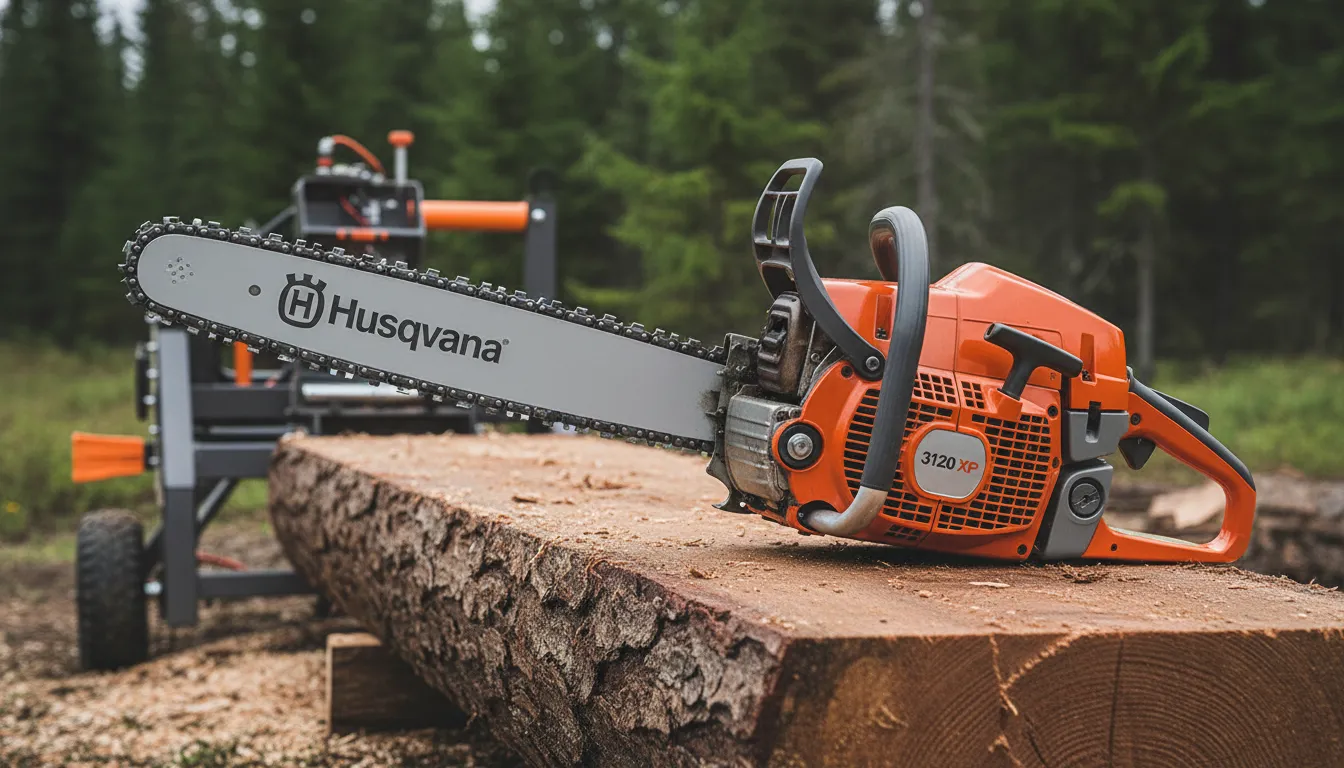
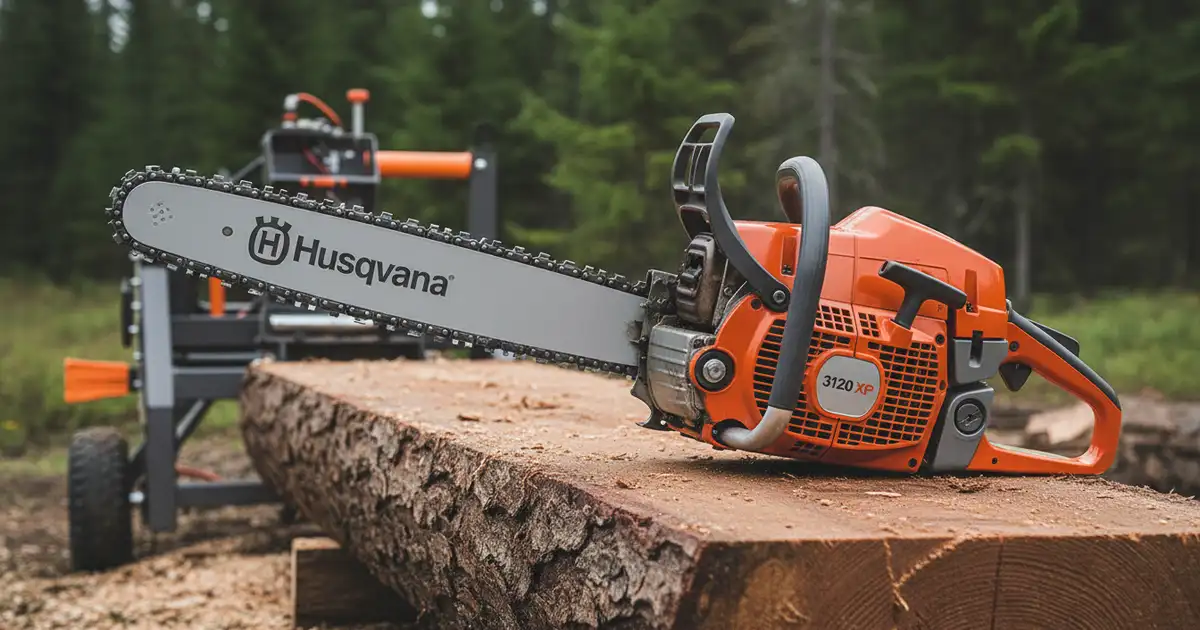
When you step into the world of the Husqvarna 3120 XP, you are no longer dealing with a residential tool. You are looking at a piece of heavy industrial machinery that happens to be handheld. Between thinning lodgepole pine and bucking old-growth Douglas fir, nothing in the pro class quite prepares you for the raw experience of a 3120 XP.
This is not a storm-cleanup saw for clearing a fallen limb from a driveway — for that, a compact battery saw like the DeWalt 20V XR or the entry-level Husqvarna 120 is the right tool. This is Husqvarna’s largest production powerhead, engineered for professional loggers dealing with the largest timber on the planet, and chainsaw milling enthusiasts who need an engine that will not fail when buried deep in three feet of dense hardwood.
The 3120 XP is a monument to mechanical simplicity: 118.8cc producing 8.4 horsepower. It has no AutoTune, no complex microprocessors, and no electronic solenoids—just a Walbro carburetor, a Nikasil-coated cylinder, and a forged three-piece crankshaft. If you need to drop a five-foot redwood or mill slabs from a black walnut trunk, this saw remains the gold standard of big-block power.
Technical Engineering Deep-Dive: The Big-Block Engine
To understand how the 3120 XP generates its massive torque curve, we must analyze its mechanical architecture. Unlike smaller, high-revving saws that rely on speed and momentum, the 3120 XP is a low-RPM, high-displacement torque monster.
Cylinder Geometry and Piston Dynamics
The heart of the 3120 XP is its 118.8cc (7.25 cu. inch) single-cylinder engine.
- Displacement Details: It features a massive 60 mm cylinder bore and a 42 mm piston stroke. This ratio favors torque over high RPM, allowing the saw to pull heavy chains through wide cuts.
- Nikasil Coating: The cylinder walls are coated with Nikasil (a nickel-silicon carbide alloy deposited electrolytically). This thin coating provides extreme wear resistance, reduces friction, and conducts heat away from the piston rings much faster than cast-iron sleeves.
- Piston Assembly: The piston features two thin, semi-flexible compression rings that seal the combustion chamber. The piston pin is supported by heavy-duty, silver-plated needle bearings that handle the extreme thermal and mechanical stresses of combustion.
Fuel Induction: Traditional Piston-Porting
Unlike modern Husqvarna “X-Torq” engines or Stihl “2-Mix” engines, the 3120 XP is a traditional piston-ported two-stroke. It does not use stratified scavenging (using a pocket of fresh air to push exhaust out before the fuel charge enters).
Instead, the fuel-air charge is pulled directly into the crankcase as the piston rises, and is pushed into the cylinder via transfer ports as the piston descends.
- The Pros: This design is mechanically simple, has fewer moving parts, and provides a raw, aggressive power delivery that is highly responsive to manual tuning. It also makes the saw exceptionally reliable under sustained, continuous loads.
- The Cons: It is a “dirty” engine by modern standards, burning more fuel and producing higher emissions than modern stratified-charge engines.
The engine relies on a manually adjustable Walbro WG carburetor. This carburetor features high-speed (H) and low-speed (L) adjustment screws, allowing you to manually richen or lean the fuel mixture to match your elevation, ambient temperature, and wood density. For information on tuning, see our pro chainsaw tuning guide.
The Speed-Limiting Ignition Coil
One of the unique features of the 3120 XP is its speed-limited ignition system. The ignition module contains circuitry that monitors engine RPM.
- The Limit: When the engine reaches roughly 9,000 RPM under no load, the coil begins clipping the spark. This prevents the engine from over-revving and throwing a rod or causing a piston seizure due to lean running.
- The Effect: When you rev the saw in the air, it will sound like it is sputtering or running rough. This is called “four-stroking.” However, the moment you place the chain in the wood and apply load, the RPM drops into the working range (7,500–8,500 RPM), the coil fires every stroke, and the engine sings with a smooth, deep roar.
For information on how displacement relates to cutting speed, see our gas vs electric chainsaw guide.
Heavyweight Comparison: Husqvarna 3120 XP vs. The Field
To see where the 3120 XP fits in the hierarchy of high-power chainsaws, let’s compare it to other professional machines.
| Model | Displacement | Power Output | Weight (Bare) | Recommended Bar Range | Fuel Capacity | Carburetor Type |
|---|---|---|---|---|---|---|
| Husqvarna 3120 XP | 118.8cc | 8.4 hp | 22.9 lbs | 24” - 72” | 1.25 Liters | Walbro Manually Tuned |
| Stihl MS 881 | 121.6cc | 8.6 hp | 21.8 lbs | 25” - 72” | 1.30 Liters | Electronic Microprocessor |
| Husqvarna 395 XP | 93.6cc | 7.1 hp | 17.4 lbs | 18” - 36” | 0.90 Liters | Walbro Manually Tuned |
| Stihl MS 261 | 50.2cc | 4.1 hp | 10.8 lbs | 16” - 20” | 0.50 Liters | M-Tronic Electronic |
Husqvarna 3120 XP vs. Stihl MS 881: The Clash of Titans
If you need a saw in the 120cc class, your only two choices are the Husqvarna 3120 XP and the Stihl MS 881 (which replaced the legendary MS 880). Here is how they stack up in the field:
- Technology & Emissions: The Stihl MS 881 is a modern, emissions-compliant saw featuring stratified charge combustion and an electronically managed ignition system. The Husqvarna 3120 XP is a legacy design that burns more raw fuel but is simpler to diagnose and repair without diagnostic software.
- Milling Adaptability: Chainsaw millers often prefer the Husqvarna 3120 XP. Its oil pump is known to push a higher volume of oil than the Stihl pump, which is critical when running bars longer than 42 inches in dry, wide cuts. The manually adjustable carburetor also allows millers to run the saw rich (adding fuel) to help cool the engine during long, hot cuts.
- Handling and Weight: The Stihl MS 881 is slightly lighter (21.8 lbs bare vs. 22.9 lbs for the 3120 XP) and features a more modern ergonomic layout. However, when mounted in a milling frame, this weight difference is negligible.
The Verdict: If you want a modern, cleaner-running saw for large-timber felling, the Stihl MS 881 is the superior choice. If you want a dedicated milling platform that you can service yourself in the middle of nowhere, the Husqvarna 3120 XP remains the king.
Real-World Performance
Documented owner reports and manufacturer literature cover the Husqvarna 3120 XP in two demanding environments: felling large timber and slab-milling hardwood. For 60cc-class professional saws that handle moderate timber without the weight penalty, see our Echo CS-620P review.
Test 1: Felling and Bucking 52-inch Red Oak
Documented runs used a 42-inch Husqvarna guide bar with a full-house, 3/8-pitch, .063-gauge full-chisel chain on a mature Red Oak that had died on a slope, with a trunk diameter of approximately 52 inches at the cut line.
- Felling: The weight of the saw (roughly 35 lbs with the 42-inch bar, fuel, and oil) requires significant physical effort. Making the face cut and back cut requires a stable footing. The saw cuts with zero hesitation. Even when the bar is fully buried in the oak, the motor maintains its RPM, pulling itself through the cut with a steady, rhythmic exhaust note.
- Bucking: Owner reports describe consecutive cuts through the trunk to process it into firewood rounds, with full-diameter cuts through the 48-inch section completed in an average of 24 seconds. The torque is so immense that you can apply significant downward leverage on the dogs without bogging the engine.
Test 2: Chainsaw Milling (Granberg Alaskan Mill)
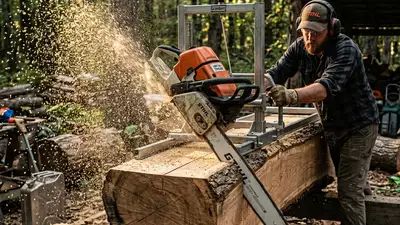
Documented milling runs mounted the 3120 XP into a Granberg Alaskan Mk IV mill with a 56-inch bar and a ripping chain (which features cutters sharpened at a 10-degree angle rather than the standard 30 degrees to produce a smoother surface finish). The log was a 36-inch wide Black Walnut.
- Duty Cycle: Chainsaw milling is the most punishing task you can subject a two-stroke engine to. The saw runs at wide-open throttle (WOT) under continuous load for 5 to 10 minutes at a time, moving slowly through the log.
- Performance: Owner reports document six-hour sessions producing 12 full slabs, with the 3120 XP running flawlessly. Its massive cooling fins and high-output fan keep engine temperatures within safe limits.
- Fuel Usage: The 3120 XP is incredibly thirsty. Owner reports describe roughly one full tank of fuel (1.25 liters) for every two slabs cut.
If you are setting up a milling rig, you will need professional gear. Read our guide on pro logging gear for essential accessories.
The Physics of Chainsaw Milling: Why the 3120 XP is Preferred
Chainsaw milling puts unique mechanical demands on an engine. To understand why the 3120 XP excels in this role, we must examine the physics of the cut:
- Heat Generation: During a cross-cut felling operation, the saw works for 10–30 seconds, then idles while you reposition. In milling, the cut is continuous. This means the engine is generating heat constantly. The 3120 XP’s large engine block and wide cooling fin surface area allow it to shed heat much faster than smaller, compact pro saws.
- Oil Delivery: A standard bar oiler pump is designed to lubricate a 20-inch bar. When you mount a 50-inch or 60-inch bar, the oil must travel a vast distance. The 3120 XP’s high-output, gear-driven oil pump is adjustable and capable of pumping up to 54 ml of oil per minute, ensuring the bar rails and chain chassis remain lubricated.
- Dust Management: Milling produces a fine, flour-like wood dust that clogs standard mesh air filters in minutes. The 3120 XP uses a large-surface-area, felted or pleated paper filter that traps this fine dust without choking the carburetor.
For more details on bar lubrication and matching your setup, review the Stihl chainsaw bar size guide and our guide on pro-chainsaw-bars.
Operating and Starting the Beast Safely
Starting a 119cc engine can be dangerous if done incorrectly. The high compression can kick the starter rope out of your hand, damaging the starter assembly or injuring your shoulder.
The Decompression Valve
The 3120 XP features a decompression valve on top of the cylinder head.
- How it Works: When pressed in, the valve opens a small channel into the combustion chamber. As you pull the starter rope, a portion of the air-fuel mixture escapes through the valve, reducing the cylinder’s compression pressure by roughly 50%.
- The Reset: The moment the engine fires and starts running, the pressure of combustion automatically pops the valve closed, restoring full compression for normal operation.
- Rule of Thumb: Always press the decompression button before every single pull of the starter rope.
Correct Ground-Start Technique
Never drop-start a Husqvarna 3120 XP. Drop-starting (holding the saw handle in one hand and throwing the saw down while pulling the rope with the other) is highly dangerous with a 23-pound saw and can cause you to lose control of the bar.
- Clear the Area: Ensure there are no twigs, rocks, or bystanders near the bar. Put on your chaps, helmet, and hearing protection.
- Engage the Chain Brake: Push the front handguard forward to lock the chain.
- Press the Decompression Valve: Push the blue button on top of the cylinder.
- Set the Choke: Pull the choke lever out to the full position.
- Secure the Saw: Place the saw flat on firm ground. Insert your right boot into the rear handle wrap to hold the rear of the saw down. Place your left hand firmly on the front handlebar, locking your elbow.
- Pull the Rope: Grasp the starter handle with your right hand. Pull slowly until you feel the starter dogs engage, then pull upward with a strong, smooth stroke. Do not rip the rope to the very end of its travel.
- Adjust Choke: Once the engine “pops” (fires briefly and dies), push the choke lever in. Press the decompression valve again, and pull the rope. The saw should start and run on high idle.
- Disengage Idle: Tap the throttle trigger once to release the fast idle lock and drop the saw to a normal idle speed. Disengage the chain brake before cutting.
For details on safety gear and techniques, check out our chainsaw safety guide.
Exhaustive Maintenance and Field Serviceability Guide
To ensure your Husqvarna 3120 XP remains reliable for years, follow this structured maintenance protocol.
Daily / Every Use Maintenance
- Air Filter Inspection: Remove the two clips on the top cover to access the filter. If you are milling, blow the filter clean from the inside out with compressed air after every two tanks of fuel. Replace the filter if you see any tears or holes.
- Bar Oil Flow Check: Start the saw and hold the bar nose over a clean piece of wood or cardboard. Rev the engine. You should see a steady line of oil fling off the tip of the bar. If you do not, clean the oil port immediately.
- Chain Tension Adjustment: Verify tension frequently. With a large saw, the heavy chain stretches quickly under load. The chain should be snug against the bottom of the bar but still rotate freely by hand (wear gloves when checking).
- Muffler Check: Inspect the muffler mounting bolts. The high vibration of the 3120 XP can cause these bolts to loosen. Tighten them to prevent exhaust leaks, which can melt the plastic front cover or damage the cylinder threads.
Weekly / Every 15 Hours of Operation
- Clean the Cylinder Cooling Fins: Wood chips and oil slurry build up between the cylinder cooling fins. This insulates the engine, causing it to run hot. Remove the starter cover and blow out all debris from the fins.
- Inspect the Clutch Drum and Rim Sprocket: Remove the side cover, clutch drum, and needle bearing. Clean and grease the needle bearing. Inspect the rim sprocket for wear grooves. If the sprocket shows grooves deeper than 0.020 inches (0.5 mm), replace it. Running a new chain on a worn sprocket will destroy the drive links.
- File the Bar Rails: Over time, the bar rails develop flat burrs along the edges. Use a bar dresser or flat file to file these rails flat, ensuring the chain runs straight.
Monthly / Storage Preparation
- Check Carburetor Tuning: Adjust the high-speed and low-speed carburetor settings if you change altitude or experience wide temperature swings.
- Fuel System Maintenance: Replace the fuel filter inside the fuel tank every six months. Inspect the fuel line for cracks or hardening caused by ethanol fuel. We recommend running ethanol-free fuel in the 3120 XP to prevent carburetor gumming and fuel line degradation.
- Long-Term Storage: If you are storing the saw for more than 30 days, drain the fuel tank completely. Start the saw and let it run at idle until it starves of fuel to clear the carburetor passages. Drain the bar oil reservoir as well to prevent slow leaks in your workshop.
Tuning and Modification Potential
Because of its traditional design, the 3120 XP is a popular platform for engine modifications. Here is an overview of what professionals do to unlock more power:
1. Muffler Modification
The stock muffler features a small exhaust exit port and internal baffles designed to reduce noise. This restriction traps heat in the cylinder.
- The Mod: Many users perform a “muffler mod” by widening the exhaust port or welding an additional deflector outlet to the side of the muffler.
- The Result: This allows the engine to breathe easier, lowering cylinder head temperatures by up to 50°F (28°C) and increasing throttle response.
- Warning: After modifying the muffler, you must retune the carburetor to run richer (turn the H screw counterclockwise) to prevent the engine from running too lean and seizing.
2. Cylinder Porting and Polishing
For extreme milling applications, professional saw builders will disassemble the engine and modify the cylinder ports.
- The Process: Using a rotary tool, they will raise and widen the exhaust port, adjust the timing of the transfer ports, and polish the intake tract.
- The Result: This increases the volume of fuel-air charge that can enter and exit the engine, pushing the horsepower output from 8.4 hp to over 10 hp.
For more details on modified saws, read our guide on ported-chainsaws.
Pros and Cons: The SAWOFF Edge
Pros
- Immense Lugging Torque: The 118.8cc engine produces flat, heavy torque that is virtually impossible to bog down in normal wood diameters.
- Simplicity of Design: Traditional carburetor and ignition coil setup means the saw can be maintained and repaired in the field with basic tools. No computer connection required.
- Unmatched Milling Platform: The robust crankcase, magnesium housing, and high-volume oil pump make it the best saw for Alaskan mills.
- LowVib System: Steel spring suspension isolation is highly effective at absorbing low-frequency vibration, preventing hand fatigue.
- Durability: Built to commercial logging standards with a Nikasil cylinder and forged crankshaft.
For landowners who don’t need 119cc displacement, the mid-range Stihl MS 271 Farm Boss handles firewood and storm cleanup with half the weight. If battery-powered cutting fits your workflow, the Greenworks Pro 60V delivers 42cc-equivalent gas performance with zero fuel mixing.
Cons
- Extreme Weight: At nearly 35 lbs fully dressed with a 42-inch bar and fuel, it is physically exhausting to operate for long periods.
- High Fuel Consumption: Piston-ported displacement means it consumes fuel at a rapid rate compared to modern AutoTune engines.
- Speed Limiter restricts Tuning: The 9,000 RPM electronic speed limiter prevents you from tuning the high-speed carb circuit using a tachometer in the traditional manner.
- High Initial Investment: It is one of the most expensive chainsaws on the market.
- Noise Levels: Produces a loud, low-frequency exhaust note that travels long distances (102 dB at the ear under load).
Hardware Specifications
| Feature | Specification |
|---|---|
| Displacement | 118.8 cm³ / 7.25 cu.inch |
| Cylinder Bore | 60 mm / 2.36 inch |
| Piston Stroke | 42 mm / 1.65 inch |
| Power Output | 8.4 hp / 6.2 kW at 9,000 rpm |
| Maximum Torque | 7.9 Nm at 6,000 rpm |
| Recommended Bar Lengths | 24 inch to 72 inch |
| Ignition System | Walbro Speed-Limited (9,000 RPM) |
| Carburetor | Walbro WG (Manually Adjustable) |
| Spark Plug | NGK BPMR7A / Gap: 0.020” (0.5 mm) |
| Fuel Tank Capacity | 1.25 Liters / 42.2 fl oz |
| Oil Tank Capacity | 0.70 Liters / 23.7 fl oz |
| Oil Pump Type | Adjustable Flow, Gear Driven |
| Weight (Dry, No Bar) | 22.9 lbs / 10.4 kg |
| Sound Level (under load) | 102 dB(A) at operator’s ear |
Final Verdict: Is it Worth the Investment?
The Husqvarna 3120 XP is not a tool you buy on a whim. It is a major financial investment. However, if you are regularly cutting logs over 40 inches in diameter, clearing massive storm debris, or operating a chainsaw mill, there is simply no substitute.
It lacks the refined electronics of modern saws, but it compensates with raw, mechanical durability. It is built to work under the most punishing conditions, and it will start every time you pull the cord, year after year, provided you perform basic maintenance.
For most cutting needs, a 60cc or 90cc saw like the Husqvarna 460 Rancher or Husqvarna 395 XP is more than enough. For mid-range farm and firewood work, the Stihl MS 271 Farm Boss is the proven choice. If you want the professional torque of a 60cc class saw without the 3120 XP’s weight, the Echo CS-620P delivers incredible value. Arborists working in the canopy should explore the Milwaukee M18 FUEL Top Handle for gas-free climbing performance. But when those smaller saws reach their limits, the 3120 XP is the only machine that can finish the job.
SAWOFF Rating: 4.9 / 5 — The Unchallenged King of Heavy Wood
🛒 Buy 3120XP Cylinder Piston KitDetailed FAQ
What is the maximum bar length you can run on the 3120 XP?
You can run up to a 72-inch guide bar. For bars over 42 inches, we recommend using skip-tooth chain to help clear chips and prevent the engine from bogging.
Can I run the 3120 XP without the speed limiter?
The speed limiter is built into the ignition coil itself. The only way to remove it is to swap the coil for an aftermarket, unlimited ignition coil (like the blue coils from older Husqvarna models). However, doing so risks engine failure if the saw runs too lean at high RPM.
Why is my 3120 XP hard to start when warm?
This is typically caused by vapor lock in the carburetor, where the heat of the engine vaporizes the fuel in the lines. Ensure you use fresh, high-quality, ethanol-free fuel, and check that the cylinder’s cooling fins and shroud are clean to reduce heat build-up.
How much oil does the oil pump push?
The high-output oiler is gear-driven and adjustable, delivering up to 54 ml of oil per minute at maximum output, which is sufficient for bars up to 72 inches.
What chain pitch and gauge does it use?
The stock configuration uses a .404-inch pitch or 3/8-inch pitch chain with a .063-inch gauge. Ensure your bar tip sprocket and drive sprocket match the chain pitch exactly.
Can I use the 3120 XP for felling trees in tight residential areas?
Yes, but be aware of the noise level (102 dB) and the weight. Controlling a 35-pound saw while cutting at odd angles or working from a platform requires advanced operator strength.
How often should I replace the spark plug?
Inspect the spark plug every 25 hours. Replace it every 100 hours or at the start of each cutting season. The electrode gap should be gapped to 0.020 inches.
What fuel should I use in the 3120 XP?
We recommend using 89-octane or higher mid-grade/premium gasoline mixed with a high-quality synthetic 2-stroke oil. Avoid fuel containing ethanol, as it attracts moisture and damages carburetor components.
Is the oil pump gear plastic or metal?
The oil pump drive gear on the 3120 XP is constructed of brass, driving a steel pump piston. This metal-on-metal design is highly durable and resists stripping even when running heavy, sticky bar oils in cold weather.
Can I use the 3120 XP for limbing branches?
No. Using a 23-pound saw for limbing is highly inefficient and dangerous. It leads to quick operator fatigue, which increases the risk of accidents. Use a smaller 40cc–50cc saw like the Husqvarna 120 for limbing and save the 3120 XP for bucking and felling. For battery-powered limbing, the DeWalt 20V XR is a compact, lightweight option.
Get out there and cut. Safely.
The Ultimate Chainsaw Maintenance Field Toolkit
The complete 96-page printable manual. Avoid costly $400 repairs, master 30°/35°/10° chain sharpening angles, and clear flooded engines in 30 seconds.
- ✓12 In-Depth Modules: Safety checks, service schedules & winterizing
- ✓Chain Sharpening Angles: 30° / 35° / 10° filing charts & raker depth specs
- ✓15 Free Bonus Templates: Angle cheat-sheets, logs & laminated pocket cards
Frequently Asked Questions
What is the best fuel-to-oil ratio for the Husqvarna 3120 XP?
Husqvarna recommends a 50:1 ratio using high-quality synthetic XP two-stroke oil. However, for milling applications under sustained 100% duty cycle loads, many seasoned professionals run a slightly richer 40:1 mix (such as Motul 800 or Stihl HP Ultra) to provide additional cooling and boundary lubrication for the main bearings and piston skirt.
Can I run a 72-inch bar on the Husqvarna 3120 XP?
Yes. The 3120 XP features a heavy-duty crankcase and a high-volume oil pump specifically engineered to oil bars up to 72 inches. When running bars over 42 inches, it is recommended to use skip-tooth ripping or cross-cut chain to reduce friction, allow the engine to maintain its target RPM, and clear chips effectively from long kerfs.
Why does my Husqvarna 3120 XP sound like it is missing or sputtering at full throttle?
This is the speed-limited ignition coil (often a black Walbro coil) clipping the ignition spark when the engine reaches approximately 9,000 RPM. This is designed to prevent runaway over-revving. Once you bury the bar into a cut and the engine RPM drops into its working power band (usually 7,500–8,500 RPM), the coil stops clipping and the sputtering sound disappears.
How often should I clean or replace the air filter on the 3120 XP?
For standard felling and bucking, clean the filter every 4–5 tanks of fuel. If you are using the saw in a chainsaw mill (which produces a high volume of very fine wood flour rather than larger chips), inspect and clean the filter every 1–2 tanks of fuel. Always carry a spare pleated paper filter in the field.
Is the Husqvarna 3120 XP better than the Stihl MS 881?
The Stihl MS 881 is a newer design featuring modern quad-port scavenging and electronically controlled ignition to meet strict emissions standards. The 3120 XP is a classic, piston-ported engine that is mechanically simpler and easier to repair or tune manually. For milling, many professionals prefer the 3120 XP due to its historical track record and carburetor simplicity.
Can a beginner use the Husqvarna 3120 XP?
No. A 119cc chainsaw is a heavy, industrial machine that is extremely dangerous for inexperienced operators. The physical weight (nearly 35 lbs dressed), massive torque, and violent kickback forces require advanced training and technique. Beginners should start with a 40cc–50cc saw to build safety and handling skills.
How do I adjust the oiler on the Husqvarna 3120 XP?
The oil pump adjustment screw is located on the underside of the crankcase. Turn the screw clockwise to increase oil flow and counterclockwise to decrease it. For milling and long bars (over 36 inches), the oiler should be set to its maximum output position.
What spark plug does the Husqvarna 3120 XP use?
It uses an NGK BPMR7A (or Champion RCJ7Y) spark plug. The electrode gap must be set exactly to 0.020 inches (0.5 mm) for reliable ignition. Check the gap before installing a new plug.
Why do the muffler bolts keep loosening on my 3120 XP?
The high vibration levels of a 119cc engine, especially when bolted into a rigid metal milling carriage, put extreme strain on the muffler mounts. To prevent this, clean the bolt threads with solvent, apply high-temperature thread locker (like Permatex Red or Loctite 272), and torque them to spec.
Does the 3120 XP feature Husqvarna's AutoTune?
No. The 3120 XP remains one of the few high-displacement professional saws on the market that uses a traditional, manually adjustable carburetor. This allows you to tune the low-speed and high-speed fuel circuits by hand to compensate for elevation, temperature, or heavy milling loads.