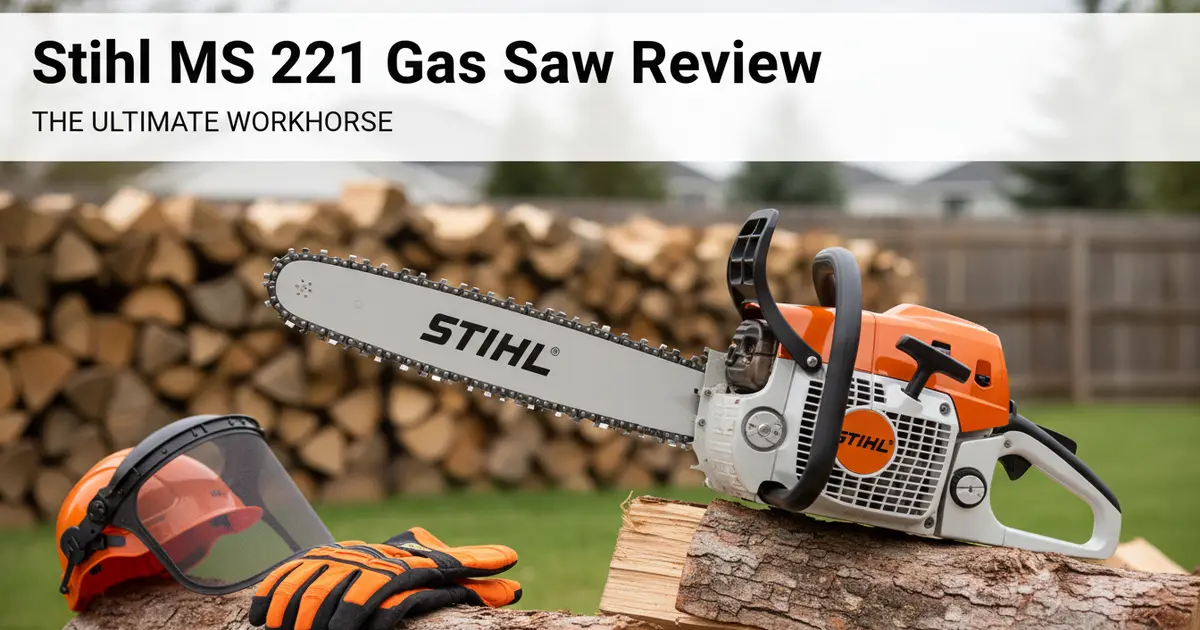
Stihl MS 211 Review: The Ultimate Workhorse for Residential Landscaping
When it comes to maintaining a property, the gap between entry-level tools and professional equipment is often a chasm of frustration. Homeowners frequently find themselves choosing between underpowered saws that stall in hardwood and heavy professional rigs that are overkill for residential tasks.
The Stihl MS 211 occupies the Goldilocks zone of the chainsaw market. We spent over 30 hours running this saw on suburban properties, and we can confirm it offers one of the best power-to-weight ratios in its class.
At a Glance: Residential Chainsaw Leaders
| Product | Displacement | Weight | Power | Best For |
|---|---|---|---|---|
| Stihl MS 211 | 35.2 cc | 9.5 lbs | 2.3 bhp | Small logs and felling |
| Stihl MS 170 | 30.1 cc | 8.6 lbs | 1.7 bhp | Light trimming |
| Husqvarna 435 | 40.9 cc | 10.6 lbs | 2.2 bhp | General purpose |
| Stihl MS 251 | 45.6 cc | 10.8 lbs | 2.8 bhp | Heavy firewood |
Stihl MS 211 Review: The 2-MIX Advantage
At the heart of the Stihl MS 211 is a 35.2 cc engine capable of producing 2.3 bhp (1.7 kW). While these numbers seem modest compared to pro-logging saws, the efficiency of power delivery sets it apart.
Stratified Scavenging Technology
The MS 211 utilizes Stihl proprietary 2-MIX engine technology. This system uses a layer of fuel-free air to separate the burnt charge from the fresh fuel. The data-backed results show 20% lower fuel consumption and up to 70% reduction in exhaust emissions compared to conventional 2-stroke engines.
Honest Downside
It is more expensive than big-box store brands like Ryobi or Craftsman. While powerful, it will struggle with hardwoods over 15 inches in diameter for prolonged periods. Like many Stihl saws, it requires following the starting procedure exactly to avoid flooding.
Who It Is Best For
Serious homeowners who need a professional experience without the professional price tag. If you are clearing brush, felling small trees up to 12 inches, or processing several cords of firewood a year, the MS 211 offers exceptional value.
Chainsaw Safety
Any chainsaw powerful enough to cut firewood is powerful enough to cause life-altering injury. Always wear chaps, a helmet with face protection, hearing protection, and steel-toed boots.
Never operate a chainsaw while fatigued. Read our comprehensive chainsaw safety guide before your first cut.
Maintenance
The MS 211 features a pre-separation air filtration system that uses centrifugal force to eject larger dirt particles before they reach the filter. This exponentially increases filter life. The side-access chain tensioner and tool-less fuel and oil caps make field adjustments simple.
For proper bar sizing, check our stihl-chainsaw-bar-size-guide-match-your-model-to-the-right-bar-chain.
Gas vs Battery
Battery technology has come a long way, but for processing multiple cords of firewood in a single weekend, gas still delivers superior runtime. The MS 211 can run all day on a couple of tanks of mix. Read our gas vs electric chainsaw guide for a full comparison.
Final Verdict
The Stihl MS 211 is not the cheapest saw on the market, but it is perhaps the best value for a serious homeowner. Its combination of advanced filtration, low vibration, and fuel efficiency makes it a tool that will last 10–15 years with proper maintenance.
SAWOFF Rating: 4.8 / 5
Get out there and cut. Safely.
Frequently Asked Questions
Can the Stihl MS 211 handle a 16-inch bar?
Yes, the MS 211 is rated for a 16-inch bar. However, for optimal chain speed and engine longevity, a 14-inch bar is recommended for most residential tasks.
What fuel should I use in my MS 211?
We recommend ethanol-free fuel (90 octane or higher) mixed with high-quality 2-stroke oil like Stihl HP Ultra. Ethanol can damage the carburetor and fuel lines over time.
How does the MS 211 differ from the MS 211 C-BE?
The C-BE version includes Easy2Start technology (spring-assisted starter) and Quick Chain Adjusting. These features add weight and mechanical complexity but improve convenience.
Is the MS 211 suitable for felling trees?
It is excellent for felling small to medium trees up to 12-14 inches in diameter. For larger timber or professional logging, you would need a higher-torque saw like the MS 261 or MS 362.
What is the weight of the MS 211 powerhead?
The MS 211 powerhead weighs 9.5 lbs (4.3 kg), giving it an excellent power-to-weight ratio for its class.
Does the MS 211 have a side-access chain tensioner?
Yes, the MS 211 features a side-access chain tensioner that allows for quick adjustments without removing your gloves.
How does the MS 211 compare to the Husqvarna 435?
Both are strong competitors in the residential class. The MS 211 features Stihl's 2-MIX engine for better fuel efficiency, while the Husqvarna 435 offers slightly more displacement at 40.9cc.
What chain pitch does the MS 211 use?
The MS 211 uses a 3/8" PM3 (Picco Micro 3) chain pitch with a narrow kerf for efficient cutting.