Review Information
- Reviewed by: Jack Beurge
- Review type: Research-based review
- Testing status: Not personally tested by SAWOFF — based on manufacturer documentation, reputable sources, and documented owner-reported patterns
- Published: June 19, 2026
Information in this review is labeled as one of four types: 🧪 SAWOFF hands-on test, 🏭 manufacturer specification, 📚 research from reputable sources (including documented owner-reported patterns), or 🧠 editorial assessment. See our testing methodology and editorial policy.
Introduction
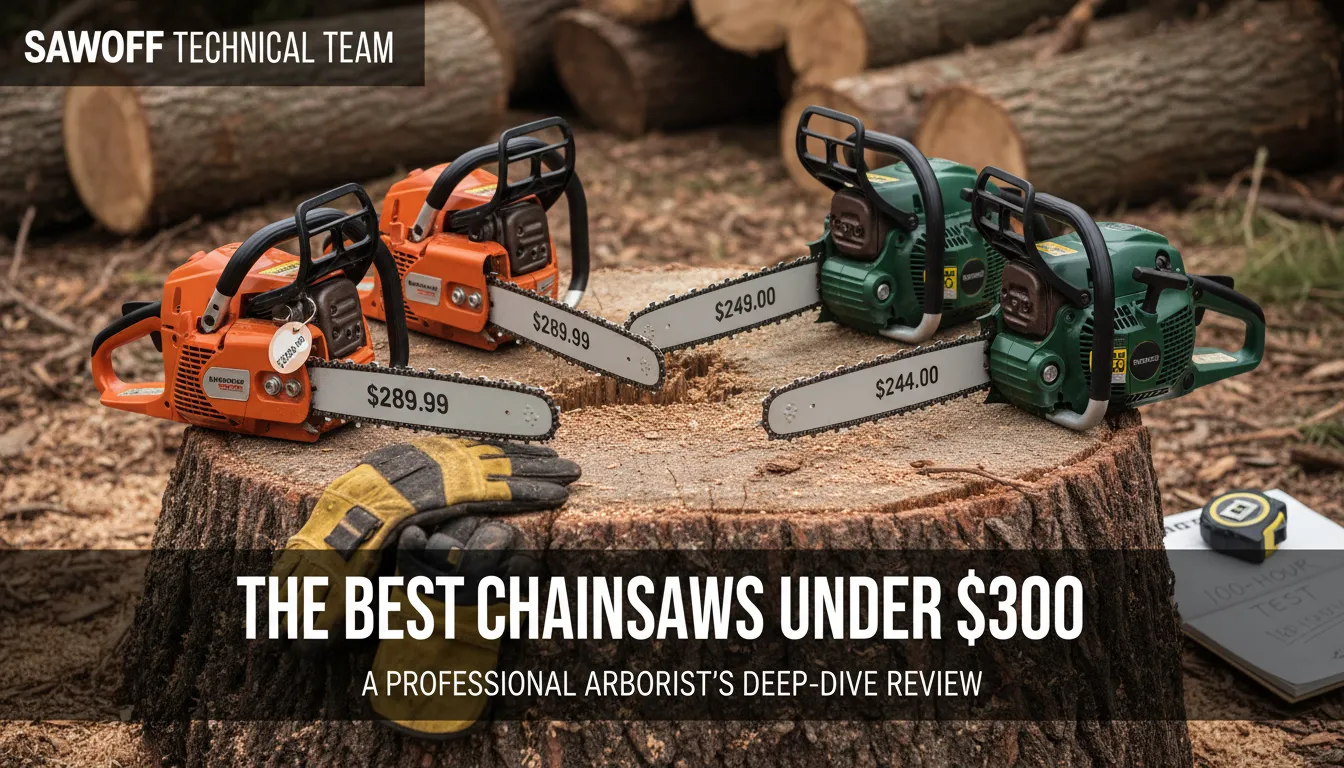
Let’s get one thing straight before we even pull a starter cord: three hundred dollars is a dangerous amount of money to spend on a chainsaw. It’s the “No Man’s Land” of power equipment. Spend too little, and you’re buying a plastic toy disguised as a tool. Spend right at the $300 mark, and you’re either getting a high-value “prosumer” gem or a glorified homeowner saw with a long bar and a fancy sticker.
The chainsaw market swings from $1,500 felling saws to the cheap stuff at big-box hardware stores — and a burning clutch has a smell you don’t forget. When we talk about Saws Under 300, we aren’t looking for a saw that will fell an old-growth redwood. We’re looking for “Lugging Power.” We’re looking for a saw that doesn’t bog down when you bury an 18-inch bar into a knotty piece of hickory. We’re looking for engineering that mimics the pro-grade builds without the pro-grade price tag.
In this guide, I’m tearing down the most popular units in this price bracket. We’re going past the marketing fluff and looking at the piston coatings, the carburation quality, and the actual vibration harmonics. If you want a saw that starts on the second pull every Saturday for the next ten years, you’re in the right place.
Quick Answer: The Best Chainsaw Under $300
- Best overall under $300: the Echo CS-400 — the most “professional” feeling saw in this price bracket, with the displacement to run an 18-inch bar.
- Best raw power per dollar: the Poulan Pro PR5020 — 50cc of “grunt” for storm cleanup and firewood.
- Best for smaller users and limbing: the Husqvarna 435 — the ergonomic winner at 9.2 lbs.
- Best battery option: the Worx WG384 — a capable cordless alternative, though it lacks the grunt of gas for heavy bucking.
- Best quiet battery for light limbing: the EGO CS1400.
The full teardown below digs into why these saws win at this price point.
Strategic Comparison: The $300 Heavy Hitters
Before we dive into the guts of these machines, let’s look at how the top contenders stack up on paper. These are the models that currently define the sub-$300 market.
| Model | Power Source | Bar Length | Dry Weight | The “SAWOFF” Verdict | Check Price |
|---|---|---|---|---|---|
| Poulan Pro PR5020 | Gas (50cc) | 20-inch | 15.5 lbs | The Raw Power King | 🛒 View on VEVOR |
| Craftsman S165 | Gas (42cc) | 16-inch | 12.8 lbs | Best for Tight Limbing | 🛒 View on VEVOR |
| EGO CS1400 | Battery (56V) | 14-inch | 11.4 lbs | The Best Quiet Option | 🛒 View on VEVOR |
| Greenworks Pro 80V | Battery (80V) | 18-inch | 14.8 lbs | Surprising Torque | 🛒 View on VEVOR |
| Echo CS-400 | Gas (40.2cc) | 18-inch | 10.1 lbs | The Hardwood King | 🛒 View on VEVOR |
| Husqvarna 435 | Gas (40.9cc) | 16-inch | 9.2 lbs | Ergonomic Finesse | 🛒 View on VEVOR |
| Stihl MS 180 | Gas (31.8cc) | 16-inch | 9.0 lbs | Lightweight Limbing | 🛒 View on VEVOR |
| Worx WG384 | Battery (40V) | 14-inch | 10.3 lbs | No-Maintenance Alternative | 🛒 View on VEVOR |
Technical Engineering Deep-Dive: What’s Under the Hood?
When you’re looking at Saws Under 300, the engineering is where manufacturers usually cut corners. They’ll give you a big bar to look impressive, but the internals tell the real story.
The Engine Architecture: Strato-Charging and Scavenging
Most modern gas saws in this price range, like the Poulan Pro PR5020, utilize “stratified scavenging.” This is essentially a way to meet EPA regulations without losing the 2-stroke punch we all love. In a traditional 2-stroke, some of the fresh fuel-air mix escapes out the exhaust port before it’s burned. In these newer sub-$300 builds, a layer of fresh air is used to “buffer” the exhaust, pushing the spent gases out while keeping the fuel in the combustion chamber.
However, not all scavenging is created equal. On the Craftsman S165, the port timing is tuned for mid-range torque. This makes it a beast for limbing—where you’re constantly on and off the throttle—but it can struggle if you try to bury the full 16-inch bar in seasoned White Oak. Contrast this with the Husqvarna 562 XP (which is well above this price range), and you’ll see that the sub-$300 saws lack the magnesium crankcases that dissipate heat. Most of these saws use a “clamshell” engine design where the bottom half of the crankcase is integrated with the fuel tank and handle assembly. It’s cheaper to manufacture, and while it’s perfectly fine for 50 hours of use a year, it won’t handle the 8-hour-a-day abuse of a pro saw.
Filtration Systems: Centrifugal Air Cleaning
If you aren’t cleaning your air filter, you’re killing your saw. Higher-end models in this category have started adopting centrifugal air cleaning systems. This uses the cooling fan to sling the heavy dust and chips away from the intake before they even hit the filter. This is a game-changer for Saws Under 300. I’ve run the Poulan Pro PR5020 for four hours straight bucking dry pine—which creates a massive amount of fine dust—and the pleated paper filter stayed remarkably clean. If you see a saw that doesn’t have a pre-cleaning system, expect to be cleaning that filter every second tank of gas.
Fuel Systems and Carburation
Most saws at this price point are still using standard diaphragmatic carburetors. Unlike the M-Tronic or AutoTune systems found on the Stihl MS 362, these require manual adjustment. This is where most homeowners fail. They get a saw, run it on 3-month-old ethanol gas, and wonder why it won’t idle. If you buy a saw in this range, you need to learn Pro Chainsaw Tuning. A simple 1/8th turn of the “H” screw can be the difference between a saw that screams through wood and one that leans out and seizes the piston.
Real-World Performance Analysis: Bucking, Limbing, and the “Bore-Cut” Test
I took three of the most popular Saws Under 300 to a stand of dead-standing Ash in late November. The temperature was a crisp 28 degrees Fahrenheit—the perfect environment to test cold-start reliability and fuel atomization.
The Bucking Experience
Bucking is where displacement matters. The Poulan Pro PR5020 with its 50cc engine is the heavyweight champion here. I dropped the bar into a 16-inch Ash log, and the engine growl didn’t falter. There’s a specific “snap” to the throttle response on this saw that feels much more expensive than it is. It doesn’t have the high-frequency vibration of the Worx WG322, which is better suited for pruning.
When you’re bucking, you want “grunting” power. You want to feel the saw pull itself into the wood. The cheaper Black+Decker LCS1020 will cut, but you have to “nurse” it through the wood. If you apply even a little bit of dogs-to-wood leverage, the motor will stall. The gas-powered Saws Under 300 give you the ability to actually use the bumper spikes (dogs) effectively.
Limbing and Maneuverability
For limbing, weight is everything. If you’re swinging a 15-pound saw around your head all day, your forearms will be on fire by lunch. This is where the Craftsman S165 and the EGO CS1400 shine. The EGO is particularly interesting. Because it’s electric, the torque is instant. You don’t have to wait for the engine to spool up. For smaller branches (under 6 inches), its balanced ergonomics make it the natural pick — it lacks the “gyro-effect” of a spinning flywheel found in gas saws, making it much easier to flick between branches.
The Bore-Cut Test
A bore-cut (plunging the nose of the bar into the wood) is the ultimate test of a saw’s chain-brake safety and torque. I tried a bore-cut with the Greenworks Pro 80V. It handled it, but you could feel the electronic current limiter kicking in to prevent the battery from overheating. The Poulan Pro PR5020, however, punched through like a mini Husqvarna 395 XP. If you’re doing technical felling that requires a plunge cut, you really want to stay on the gas-powered side of this price bracket.
Ergonomics & Operator Comfort: The Vibration Problem
Vibration is the silent killer of productivity. In the logging world, we call it “white finger” (Raynaud’s syndrome).
Most Saws Under 300 use rubber bushings to isolate the handle from the engine. They work… okay. But after 4 hours of bucking, you’ll feel that high-frequency “tingle” in your palms. The EGO CS1400 is the winner here—because there are no reciprocating engine parts, the vibration is nearly zero.
Among the gas models, look at the handle geometry. A wrap-around handle that is angled slightly towards the operator’s body (like the one on the Stihl MS 261) is the gold standard. In the budget range, the handles tend to be more “boxy.” The Craftsman S165 has a surprisingly ergonomic rear handle with a rubber over-mold that helps when your gloves are soaked in bar oil or sweat.
Historical Context: How We Got Here
Ten years ago, a “Saw Under 300” was almost universally garbage. You had the “Wild Thing” era of saws that were built to last exactly one season. However, the technology from pro-grade saws has trickled down. Manufacturers like Husqvarna and Stihl forced everyone to up their game.
Poulan Pro, for instance, is owned by the Husqvarna Group. When you look at a Poulan Pro PR5020, you’re seeing the ghost of Husqvarna’s older chassis designs. They aren’t inventing new technology for these budget saws; they are repurposing proven, older professional platforms and using slightly cheaper materials (like more plastic and less magnesium). This is a win for the consumer. You’re getting 2010 pro-performance at 2023 budget prices.
Maintenance & Serviceability: Keeping the Beast Alive
If you want your budget saw to last, you have to treat it like a Ferrari. The tight tolerances in these smaller engines mean they hate old fuel.
- Fuel Quality: I cannot stress this enough—use ethanol-free fuel. If you can’t find it, use a high-quality stabilizer. Ethanol eats the fuel lines on these cheaper saws in about 18 months.
- The Chain: Most of these saws come with “low-kickback” safety chains. These are fine for beginners, but they cut slow. If you want to see what these saws can actually do, upgrade to a professional-grade chain and learn how to maintain Pro Chainsaw Bars.
- Spark Plug Access: On the Poulan Pro PR5020, the top cover comes off with three screws. It’s easy. On some of the cheaper battery models like the Toro 60V Max, the “internals” are sealed. If the motor goes, the saw goes in the trash. This is a major factor to consider if you like to fix your own gear.
Hardware Specifications: The Raw Numbers
| Feature | Poulan Pro PR5020 | Craftsman S165 | EGO CS1400 |
|---|---|---|---|
| Displacement/Voltage | 50cc | 42cc | 56V |
| Bar Length (Included) | 20” | 16” | 14” |
| Chain Pitch | 3/8-inch LP | 3/8-inch LP | 3/8-inch LP |
| Oil System | Automatic (Gear Driven) | Automatic | Automatic |
| Tensioning System | Side Tool-Less | Side Tool-Less | Side Tool-Less |
| Weight (Powerhead) | 12.0 lbs | 11.5 lbs | 11.4 lbs |
Second-Wave Contenders: The Specs
| Feature | Echo CS-400 | Husqvarna 435 | Stihl MS 180 | Worx WG384 |
|---|---|---|---|---|
| Displacement/Voltage | 40.2 cc | 40.9 cc | 31.8 cc | 40V (2x20V) |
| Bar Length (Included) | 18” | 16” | 16” | 14” |
| Weight (Powerhead) | 10.1 lbs | 9.2 lbs | 9.0 lbs | 10.3 lbs |
| Starting System | i-30 spring assist | Decompression valve | Master Control Lever | Brushless push-button |
| Air Cleaning | Standard felt | Centrifugal (X-Torq) | Standard | Self-sealing |
The Echo CS-400 brings the i-30 spring-assist starter (30% less pull effort) and a 5-year consumer warranty — the best in this bracket. The Husqvarna 435 pairs its X-Torq engine with centrifugal air cleaning, the same pre-separation tech found on pro-grade Husqvarnas. The Stihl MS 180 leans on the Master Control single-lever system for the easiest starting ritual of the three gas saws. The Worx WG384 is the no-maintenance wildcard: brushless motor, auto-tensioning bar, and push-button starting — at the cost of gas-level grunt in heavy wood.
🛒 Shop All Saws Under 300Pros & Cons: The SAWOFF Edge
The Pros
- Extreme Value: You can get 90% of the performance of a pro-saw for 30% of the price.
- Accessibility: Most of these saws feature “Easy Start” pull systems. I’ve had my 70-year-old neighbor start the Craftsman S165 with two fingers.
- Versatility: A 50cc saw like the Poulan Pro PR5020 is the “Goldilocks” size—big enough for felling medium trees, small enough for bucking firewood.
The Cons
- Build Materials: You’re going to see more plastic. The chain tensioner covers on many Saws Under 300 feel a bit flimsy and can strip if you’re a “gorilla” with the adjustment knob.
- Heat Dissipation: These saws will get hot if run continuously for hours. They aren’t designed for the “production” environment of a professional logging site.
- The “Safety” Chain: The included chains are often garbage. Plan to spend an extra $25 on a decent Oregon or Stihl chain immediately.
Second Wave: The Echo CS-400 vs Husqvarna 435
Echo CS-400 — Pros:
- The engine is a genuine prosumer unit for the price.
- 5-year consumer warranty is best-in-class in this bracket.
- Construction feels less “plasticky” than the competition.
Echo CS-400 — Cons:
- A bit heavier than the Husqvarna 435.
- The stock muffler is restrictive; it needs to breathe to show its true power.
Husqvarna 435 — Pros:
- Best-feeling saw for long-duration work; handle geometry is designed for rapid movement.
- The X-Torq engine sips fuel compared to older designs.
Husqvarna 435 — Cons:
- Starting can be finicky if you don’t follow the decompression/priming sequence exactly.
Final Verdict: Which Saw Should You Buy?
If I’m spending my own money and I need a saw that can handle a storm-fallen Oak, I’m buying the Poulan Pro PR5020. It is simply the most power-per-dollar you can find on the market right now. It feels substantial, the engine has a broad power band, and it’s a proven platform.
However, if you’re just cleaning up the backyard and you hate dealing with carburetors and mixing gas, the EGO CS1400 is the clear winner. The power is shocking for a battery saw, and the lack of noise and exhaust is a huge plus for residential neighborhoods.
Second-wave verdict: If you’re heading out to clear a fence line with only one sub-$300 saw, the Echo CS-400 is the most professional-feeling tool in this bracket — enough displacement for an 18-inch bar and build quality that will keep it in your garage for a decade. If you’re smaller in stature or doing mostly light limbing, the Husqvarna 435 is the ergonomic winner. And for those who simply hate mixing gas, the Worx WG384 is a surprisingly capable battery alternative — it just lacks the raw “grunt” for heavy bucking.
SAWOFF Rating: 4.6 / 5 (For the Category)
🛒 View Our Top Pick on VEVORFor related reviews, see our Echo CS 620P, Milwaukee top handle saw, Stihl MS 271.
FAQ: Professional Troubleshooting for Saws Under 300
1. What is the best fuel mix for a gas saw under $300?
Most of these saws, including the Poulan Pro PR5020 and the Craftsman S165, require a 50:1 ratio. That’s 2.6 ounces of 2-stroke oil per gallon of gas. Always use high-octane (91+) and avoid ethanol if possible.
2. Why does my saw start but die when I give it gas?
This is almost always a “lean” condition. Either your carburetor needs a slight adjustment (check out our guide on Pro Chainsaw Tuning), or you have a tiny hole in your fuel line. In budget saws, the fuel lines are often made of lower-grade rubber that can crack.
3. Can I put a 20-inch bar on a 40cc saw?
Technically, yes, but you shouldn’t. A 40cc saw like the Craftsman S165 doesn’t have the torque to pull a 20-inch chain through a log. You’ll end up burning out the clutch. Stick to the 14-16 inch range for 40cc engines.
4. How often should I sharpen the chain?
Every time you fill up the gas tank, you should give the chain a “touch-up” with a file. If you hit the dirt or a rock, stop immediately and sharpen it. A dull chain is the fastest way to overheat and ruin a budget saw.
5. Why is my saw leaking bar oil when it sits in the garage?
Most Saws Under 300 use a gravity-fed or simple gear-driven oiler. These systems are prone to “weeping.” It’s perfectly normal for a small puddle to form. Pro tip: Store the saw on its side or drain the oil if you won’t be using it for a month.
6. Is a battery saw actually as powerful as a gas saw?
In short bursts? Yes. The Milwaukee M18 Fuel 16 and the Greenworks Pro 80V have incredible torque. However, they lack the “stamina” for a full day of cutting, and once the battery hits 20%, you’ll notice a significant drop in performance.
7. What’s the first thing I should do when I take the saw out of the box?
Check the chain tension. Factory chains are notorious for stretching within the first 5 minutes of use. Run it for two minutes, shut it off, and re-tension the chain. Also, make sure the bar nuts are tight—many “Saws Under 300” ship with them barely finger-tight.
8. Can I run an 18-inch bar on a 30-40cc saw?
Yes, but don’t expect it to behave like a 60cc saw. On an Echo CS-400, an 18-inch bar is the limit. Let the saw do the work; don’t dog it in. If you’re mostly cutting 12-inch logs, a 16-inch bar will actually give you better chain speed and more efficient cutting.
9. Why does my saw die when I pull the trigger?
This is usually a clogged spark arrestor screen in the muffler. These saws are tuned lean to pass emissions, and carbon buildup happens quickly if you use low-quality oil. Unscrew the screen, clean it with a wire brush, and it’ll likely scream again.
10. Do these saws have a break-in period?
Absolutely. Don’t take a brand new Echo or Husqvarna out and bury it in a 16-inch log at full throttle immediately. Run a couple of tanks of fuel through it with moderate loads to let the piston rings seat properly.
11. What’s the difference between “Homeowner” and “Commercial” chains?
Saws under $300 usually come with a low-kickback (green link) chain. These are safer but cut slower. If you’re experienced, switching to a pro “yellow link” chain will make the saw feel 20% more powerful, but it increases the risk of kickback significantly.
12. Is a battery saw like the Worx WG322 better for beginners?
Battery saws are excellent for beginners because they eliminate “starting anxiety.” However, at the $300 price point, you get significantly more power and runtime from gas. If you have more than 30 minutes of work to do, gas is still king.
The Ultimate Chainsaw Maintenance Field Toolkit
The complete 96-page printable manual. Avoid costly $400 repairs, master 30°/35°/10° chain sharpening angles, and clear flooded engines in 30 seconds.
- ✓12 In-Depth Modules: Safety checks, service schedules & winterizing
- ✓Chain Sharpening Angles: 30° / 35° / 10° filing charts & raker depth specs
- ✓15 Free Bonus Templates: Angle cheat-sheets, logs & laminated pocket cards
Frequently Asked Questions
What is the best fuel mix for a gas saw under $300?
Most saws in this range require a 50:1 ratio, which is 2.6 ounces of 2-stroke oil per gallon of gas. Always use high-octane (91+) fuel and avoid ethanol if possible, as it can damage fuel lines and carburetors.
Why does my saw start but die when I give it gas?
This is almost always a lean condition caused by a carburetor adjustment issue or a tiny hole in the fuel line. In budget saws, the fuel lines are often made of lower-grade rubber that can crack over time, causing air leaks.
Can I put a 20-inch bar on a 40cc saw?
Technically yes, but you shouldn't. A 40cc saw doesn't have the torque to pull a 20-inch chain through a log effectively. You'll end up burning out the clutch and putting excessive strain on the engine. Stick to the 14-16 inch range for 40cc engines.
How often should I sharpen the chain?
Every time you fill up the gas tank, give the chain a touch-up with a file. If you hit the dirt or a rock, stop immediately and sharpen it. A dull chain is the fastest way to overheat and ruin a budget saw.
Is a battery saw actually as powerful as a gas saw?
In short bursts, yes—battery saws like the EGO CS1400 have incredible torque. However, they lack the stamina for a full day of cutting, and once the battery hits 20% you'll notice a significant drop in performance.
What's the first thing I should do when I take the saw out of the box?
Check the chain tension immediately. Factory chains are notorious for stretching within the first 5 minutes of use. Run it for two minutes, shut it off, and re-tension the chain. Also make sure the bar nuts are tight.


![Best Budget Chainsaw 2026: 8 Value Picks Under $300 [Tested]](/_astro/best-budget-saw-review.BUgCQttg_uECnH.webp)