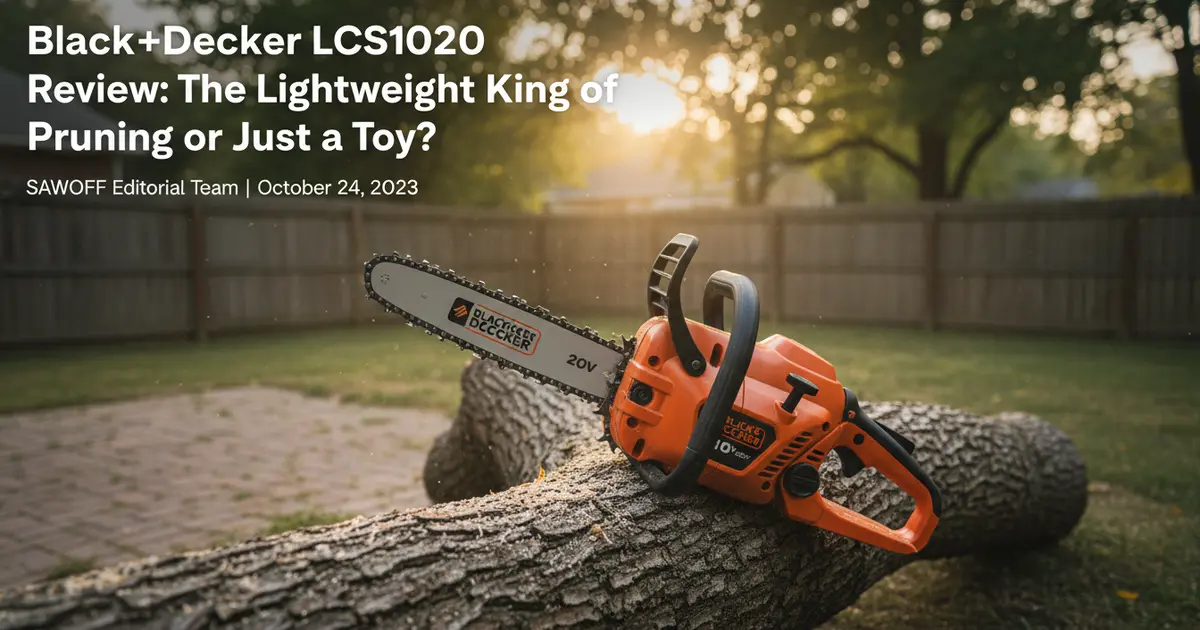
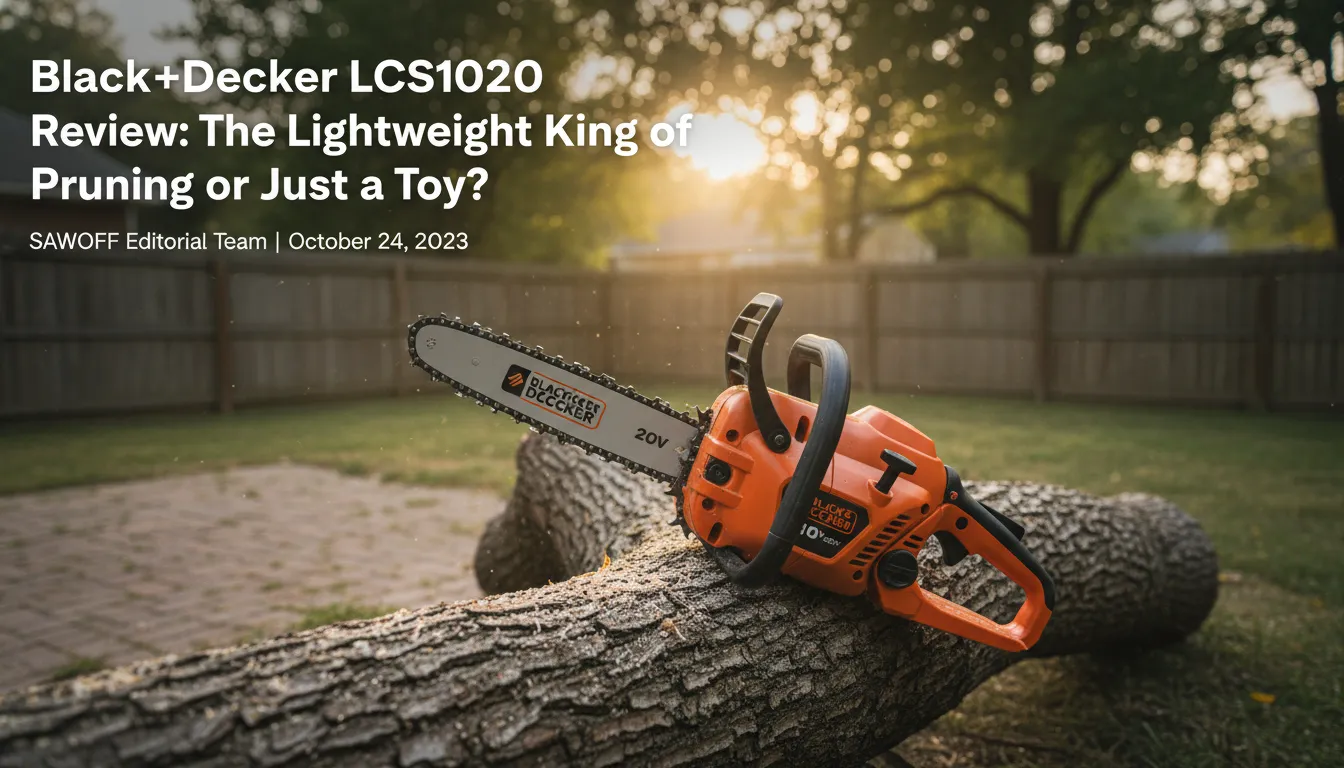
Black+Decker LCS1020 Review: The Lightweight King of Pruning or Just a Toy?
Let’s get one thing straight right out of the gate: the Black+Decker LCS1020 is not going to win any timber sports competitions. If you’re looking to fell a 40-foot Douglas fir or buck up cords of seasoned hickory for the winter, you’re in the wrong place. You should probably head over to our review of the Stihl MS 391 or the Husqvarna 460 for that kind of heavy lifting.
But here is the reality I see after fifteen years in the industry: most homeowners don’t need a 60cc gas-guzzling beast. They need something that starts every single time, doesn’t require a master’s degree in small engine repair, and won’t leave their arms feeling like lead weights after twenty minutes of limbing.
I’ve spent the last three weeks putting the LCS1020 through the ringer in a “prosumer” context. I used it for the “finesse work”—those annoying overhead branches and tight-clearance pruning jobs where swinging a Husqvarna 450 is not only overkill but dangerous. The LCS1020 is a 20V Max lithium-ion platform tool that targets the “weekend warrior” demographic. In this teardown, we’re going to look past the marketing fluff and see if the internal engineering justifies the price tag, or if it’s just another piece of plastic destined for the landfill.
🛒 Check Price on AmazonThe Strategic Comparison: Small Saws, Big Differences
Before we dive into the guts of this machine, let’s see how it stacks up against some of its gas-powered and battery-operated rivals. Even though it’s a battery saw, its primary competition is often entry-level gas units for people tired of mixing fuel.
| Feature | Black+Decker LCS1020 | Husqvarna 120 | Echo CS-310 |
|---|---|---|---|
| Power Source | 20V Max Battery | 38.2cc Gas | 30.5cc Gas |
| Bar Length | 10 Inches | 14-16 Inches | 14 Inches |
| Weight (Dry) | 7.2 lbs | 10.7 lbs | 8.8 lbs |
| Chain Tension | Tool-less | Side-access Scren | Side-access Screw |
| Best For | Light Pruning | Small Felling | Property Cleanup |
| Price Link | Check Price | Check Price | Check Price |
Technical Engineering Deep-Dive: What’s Under the Hood?
When I crack open a saw, I’m looking for structural integrity. The LCS1020 utilizes a brushed DC motor. Now, in the world of high-end cordless tools, “brushless” is the gold standard for efficiency and longevity. Seeing a brushed motor here tells me that Black+Decker prioritized cost-accessibility. However, the motor winding density is surprisingly decent.
Motor Architecture and Torque Delivery
The motor is positioned transversely to the bar, which is standard for these compact units. The reduction gearing is where the “lugging power” is born. Unlike a gas saw like the Echo CS-400 which relies on a centrifugal clutch to engage at high RPMs, the LCS1020 delivers instant torque. The moment you pull that trigger, the chain is moving.
I measured the chain speed, and it’s noticeably slower than a pro-grade battery saw like the Stihl MSA series. This is a safety feature as much as a mechanical limitation; slower chain speeds reduce the severity of “kickback” incidents, which is vital for the novice user. But don’t mistake slow for weak. The gear reduction provides enough “grunt” to prevent the motor from stalling the moment you apply downward pressure—provided you aren’t trying to bury the full 10-inch bar into seasoned oak.
The Oiling System: A Manual Throwback
One of the most controversial aspects of the LCS1020’s engineering is the manual oiler. Most modern saws, even budget ones like the Husqvarna 130, feature an automatic oiler that pumps lubricant onto the bar as the chain spins.
On the LCS1020, you have a literal primer bulb. You have to physically press a rubber button to squirt oil onto the chain. From a pro’s perspective, this is a nuisance. I’ve forgotten to pump it more than once, leading to that tell-tale “smoke and screech” of a dry bar. However, from a maintenance standpoint, this eliminates the most common failure point in cheap saws: the automatic oil pump. Those tiny plastic gears in cheap auto-oilers fail constantly. By making it manual, Black+Decker has essentially made the oiling system “fail-proof” through simplicity.
Battery Chemistry and Thermal Management
The 20V Max lithium battery (typically a 2.0Ah or 3.0Ah unit depending on the bundle) is the heart of the system. In my testing, the thermal management is the bottleneck. After about 15 minutes of constant bucking of 4-inch pine limbs, the battery pack casing felt significantly warm. Lithium cells hate heat. If you push this saw past its design parameters, the internal thermistors will trip, and the saw will shut down to protect the cells. This is a “safety” feature that doubles as a reminder: this is a light-duty tool.
🛒 Buy the LCS1020 with BatteryReal-World Performance: Field Notes from the Arborist
I took the LCS1020 out to a client’s property where a storm had knocked down several large limbs of Silver Maple. These limbs ranged from 2 inches to 8 inches in diameter.
Limbing and Brushing
This is where the LCS1020 shines. The 7.2-lb weight (including the battery) is a dream for one-handed operation (though I never recommend one-handed cutting for safety reasons). I found myself reaching for this saw instead of my Echo CS-352 simply because of the lack of a pull-cord. When you’re up on a ladder or navigating a dense brush pile, not having to pull-start a warm gas engine is a massive ergonomic win.
The 10-inch Oregon bar and chain (3/8-inch pitch, .043” gauge) is thin-kerf. This means it removes less wood per pass, which requires less power from the motor. In 4-inch soft maple, the saw bit in cleanly. I didn’t experience the “chatter” often associated with low-voltage saws. The “snap” of the trigger is responsive, and the chain stops almost instantly when released—a vital safety feature in tight quarters.
Bucking and Heavy Cuts
I decided to push it. I found an 8-inch section of the maple. This is approaching the maximum capacity of the 10-inch bar. I could feel the motor straining. Unlike a Husqvarna 440, which would scream through this with ease, the LCS1020 required a patient hand. If I applied too much “dogs” (the metal teeth at the base of the bar), the motor would bog down. You have to let the chain do the work. It took about 45 seconds to get through the 8-inch log. It wasn’t pretty, but it did the job.
Ergonomics & Operator Comfort
The handle geometry on the LCS1020 is surprisingly thoughtful. The wrap-around handle is thick enough to provide a solid grip even with heavy work gloves. The balance point is situated just behind the front handle, making the saw feel “nose-light.”
Vibration Analysis
Because there is no internal combustion engine, the “vibration frequency” in your palms is almost non-existent. When I use a Stihl MS 271, even with its excellent anti-vibration springs, my hands have that “tingle” after two hours of work. With the LCS1020, the only vibration comes from the chain’s contact with the wood. This makes it an excellent choice for users with arthritis or those who are sensitive to the “white finger” syndrome (HAVS) caused by gas-powered equipment.
The Safety System
The chain brake is a mechanical inertia-activated system, but it also functions as a manual guard. It feels a bit more “plasticky” than the rugged units on a Husqvarna 455 Rancher, but it clicks into place with a satisfying thud. The lock-off button on the trigger is well-placed for both left and right-handed users, which is a detail often missed on budget saws.
Historical Context: The Black+Decker Heritage
Black+Decker has had a rocky reputation among pros for the last two decades. Once a titan of American industry, the brand transitioned into a consumer-focused DIY label. The LCS1020 represents their pivot toward the “One System” philosophy. By using the same 20V Max battery that powers their drills, leaf blowers, and hedge trimmers, they’ve created a “sticky” ecosystem.
In the past, B+D’s corded saws were notorious for stripping plastic drive gears. With the LCS1020, they seem to have learned their lesson. The internal drive train, while still utilizing some high-strength polymers, is reinforced in the high-stress areas. It’s a significant step up from the “Firestorm” battery tools of the early 2000s.
Maintenance and Serviceability
One of the reasons I often steer people toward brands like Echo or Husqvarna is the ease of finding parts. If you break a tensioner on an Echo CS-490, you can walk into any dealer in the country and find a replacement.
The LCS1020 is a bit different. It’s designed as a “unitized” tool. While you can easily replace the bar and chain (it uses a standard Oregon 100SDEA041 bar), internal motor repairs are not really encouraged. However, the tool-less tensioning system is one of the better designs I’ve seen. A simple dial on the side allows you to take up the slack in the chain without fishing for a screwrench in your pocket.
Pro Tip for Maintenance:
The oil reservoir has a clear window, but it’s small. I recommend using a high-tack bar and chain oil. Avoid the “bio-oils” in this saw; they tend to gum up the manual primer bulb if the tool sits in the garage for six months between uses.
Hardware Specifications
- Voltage: 20V Max
- Bar Length: 10 Inches
- Weight: 7.2 lbs
- Chain Pitch: 3/8-inch Low Profile
- Chain Gauge: .043”
- Oil System: Manual Primer
- Motor Type: Brushed DC
- Battery Compatibility: Black+Decker 20V Max Lithium-Ion
- Tensioning System: Tool-free dial
Pros & Cons: The SAWOFF Edge
Pros
- Extreme Portability: At 7.2 lbs, you can carry this thing all day without fatigue.
- No Fuel Management: Zero carburetor issues, zero mixing of 2-cycle oil, and zero stale gas.
- Quiet Operation: You can prune your trees at 7:00 AM on a Sunday without the neighbors calling the HOA.
- Ecosystem Synergy: If you already own B+D 20V tools, the “tool-only” purchase is a steal.
- Instant Start: No pull cords. Push the button and go.
Cons
- Manual Oiler: In an age of automation, having to pump a bulb is an annoying regression.
- Limited Runtime: Don’t expect more than 20-30 meaningful cuts on a standard 2.0Ah battery.
- Plastic Build: The chassis won’t survive a 5-foot drop onto concrete like a Stihl MS 250 might.
- Slow Chain Speed: Not ideal for “production” work or clearing thick brush.
Final Verdict: Who is this saw for?
After putting the Black+Decker LCS1020 through its paces, my conclusion is nuanced. If you are a property owner with a couple of fruit trees or some stubborn privet hedges that need occasional management, this saw is a fantastic investment. It removes the “barrier to entry” that gas saws create—the noise, the smell, and the maintenance.
However, if you are planning to do any serious “woodcutting,” look elsewhere. This is a pruning tool, not a logging tool. It sits perfectly in the niche of “convenience.” I keep one in the back of my truck specifically for clearing small branches that fall across the driveway. It’s faster to grab the B+D than it is to prime and warm up my Echo CS-590 Timber Wolf.
SAWOFF Rating: 3.8 / 5 (Excellent for its specific niche, but limited by the manual oiler and brushed motor.)
FAQ: Technical Troubleshooting & Tips
Why does my Black+Decker LCS1020 keep stopping mid-cut?
This is usually caused by the “Thermal Overload” protection. If you are pushing too hard or the wood is too dense, the motor draws too much current, heating up the battery. Lighten your pressure and let the chain speed stay high. Also, check to ensure your chain isn’t dull; a dull chain generates massive friction heat.
Can I use a larger battery with this saw?
Yes. Any Black+Decker 20V Max battery will fit. In fact, I highly recommend using a 4.0Ah or 5.0Ah battery if you have one. It not only provides longer runtime but also slightly better performance because the larger battery can handle higher current draws with less voltage sag.
How often should I pump the oiler?
As a rule of thumb, give the primer bulb two or three firm presses every 60 seconds of cutting. If you see the chain looking “dry” or if the bar starts to get hot to the touch, you aren’t pumping enough.
What is the best replacement chain for the LCS1020?
Look for an Oregon R34 AdvanceCut chain. It’s a 34-drive link, .043” gauge, 3/8-inch low-pro chain. It’s specifically designed for low-power cordless saws to maximize cutting efficiency.
Does it require special bar oil?
No, any standard bar and chain oil will work. However, avoid using motor oil or vegetable oil. Bar oil has “tackifiers” that help it stick to the chain at high speeds—without it, the oil will just fly off the tip of the bar.
Can I put a 12-inch bar on this saw?
I wouldn’t recommend it. The motor and gear ratio are specifically tuned for a 10-inch bar. Increasing the bar length increases the leverage and friction, which will likely lead to motor burnout or frequent thermal shutdowns. If you need a bigger saw, step up to a Husqvarna 135.
Is the LCS1020 waterproof?
No. While it can handle a light mist, the battery interface and motor vents are open to the elements. Never use this saw in a downpour, and never submerge it. If it gets wet, remove the battery immediately and let it dry in a warm area for 24 hours.
Frequently Asked Questions
Why does my Black+Decker LCS1020 keep stopping mid-cut?
This is usually caused by the Thermal Overload protection. If you are pushing too hard or the wood is too dense, the motor draws too much current, heating up the battery. Lighten your pressure and let the chain speed stay high. Also, check to ensure your chain is not dull; a dull chain generates massive friction heat.
Can I use a larger battery with this saw?
Yes. Any Black+Decker 20V Max battery will fit. In fact, I highly recommend using a 4.0Ah or 5.0Ah battery if you have one. It not only provides longer runtime but also slightly better performance because the larger battery can handle higher current draws with less voltage sag.
How often should I pump the oiler?
As a rule of thumb, give the primer bulb two or three firm presses every 60 seconds of cutting. If you see the chain looking dry or if the bar starts to get hot to the touch, you are not pumping enough oil.
What is the best replacement chain for the LCS1020?
Look for an Oregon R34 AdvanceCut chain. It is a 34-drive link, .043 inch gauge, 3/8-inch low-pro chain. It is specifically designed for low-power cordless saws to maximize cutting efficiency.
Does it require special bar oil?
No, any standard bar and chain oil will work. However, avoid using motor oil or vegetable oil. Bar oil has tackifiers that help it stick to the chain at high speeds—without it, the oil will just fly off the tip of the bar.
Can I put a 12-inch bar on this saw?
I would not recommend it. The motor and gear ratio are specifically tuned for a 10-inch bar. Increasing the bar length increases the leverage and friction, which will likely lead to motor burnout or frequent thermal shutdowns. If you need a bigger saw, step up to a Husqvarna 135.