Review Information
- Reviewed by: Jack Beurge
- Review type: Research-based review
- Testing status: Not personally tested by SAWOFF — based on manufacturer documentation and reputable external sources
- Published: January 13, 2026
Information in this review is labeled as one of four types: 🧪 SAWOFF hands-on test, 🏭 manufacturer specification, 📚 research from reputable sources, or 🧠 editorial assessment. See our testing methodology and editorial policy.
From clearing massive windfall after coastal hurricanes to the surgical precision required for hazardous removals in tight residential corridors, a chainsaw shows its real limits fast. For the average homeowner, the stakes aren’t just about productivity; they’re about reliability, safety, and that specific “snap” of a Stihl engine firing up on the second pull.
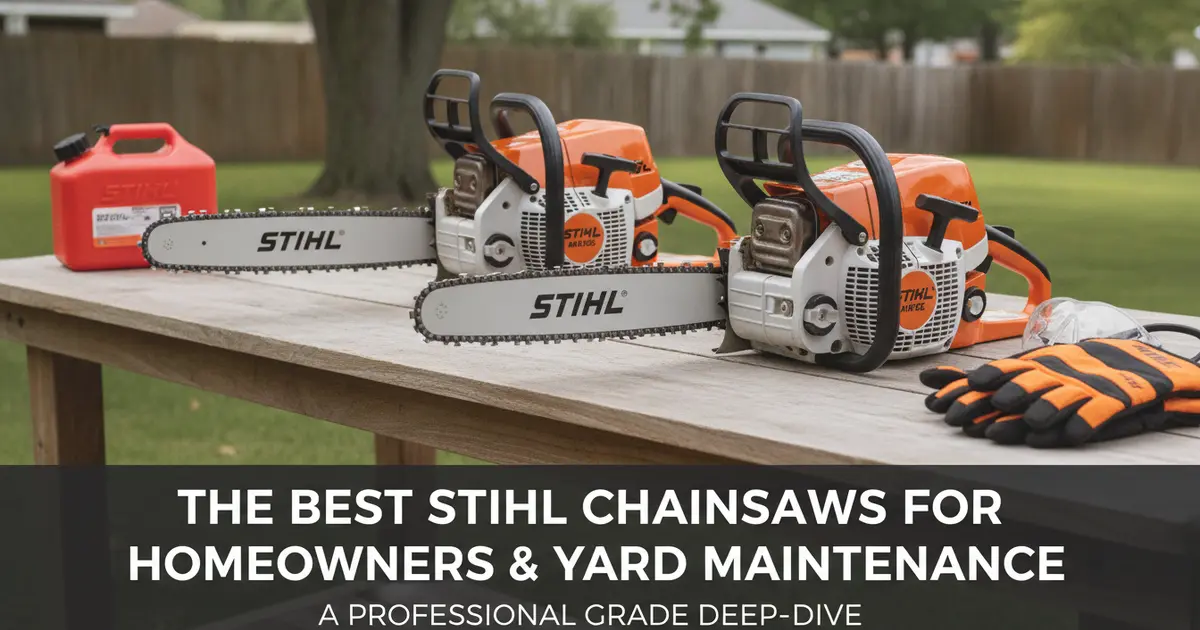
When we talk about the “Best Stihl Chainsaws for Homeowners,” we aren’t just looking at the cheapest price point at the local dealer. We’re looking for “Lugging Power”—that raw ability to keep the chain moving under load without the engine bogging down into a pathetic whine. Stihl refined the “Prosumer” balance over many model generations, taking the high-revving DNA of their professional forestry saws and packaging it into units like the Stihl MS 170 and the legendary Stihl MS 250.
In this guide, we aren’t just listing specs you can find on a brochure. We’re tearing these machines down to the crankcase to understand why one saw feels like a toy and another feels like an extension of your own arms.
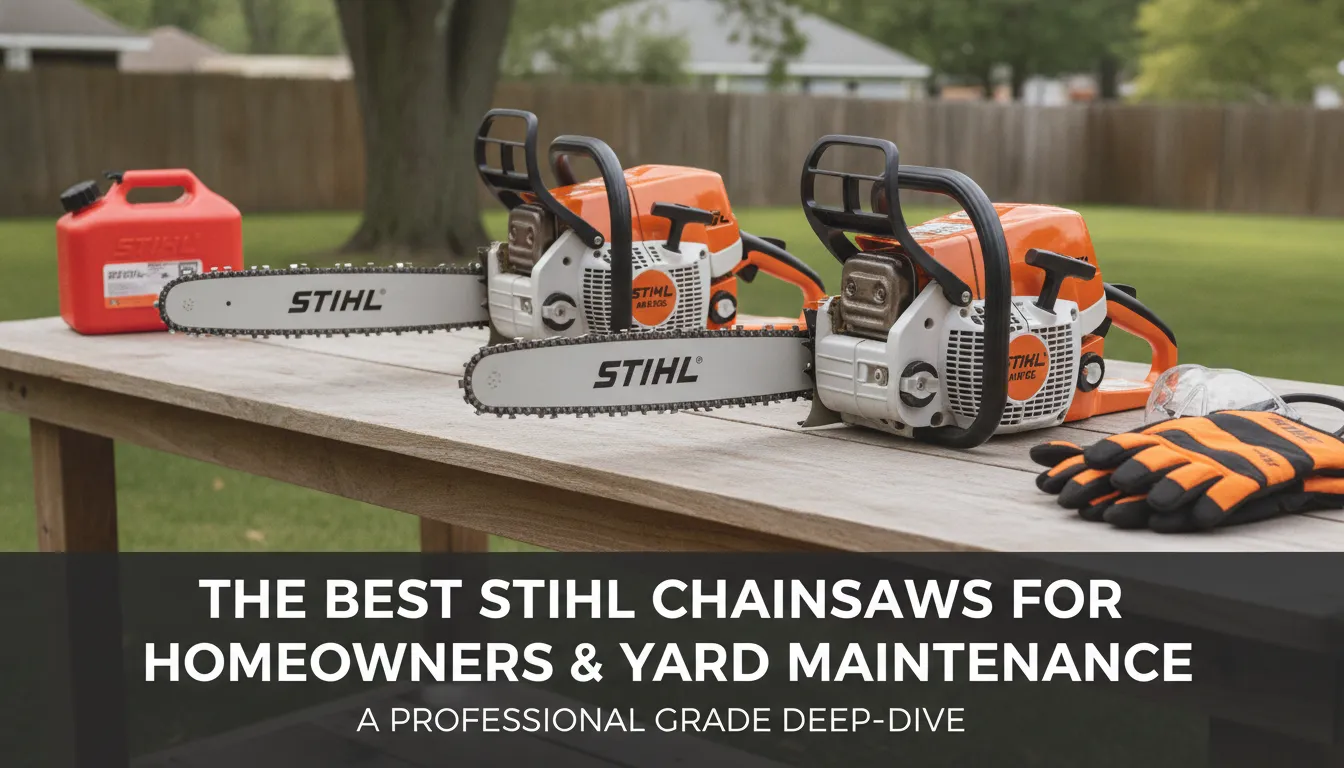
Strategic Comparison: The Homeowner Heavyweights
Before we get into the grease and metal, let’s look at how the top contenders stack up. I’ve selected these based on their power-to-weight ratio and their historical reliability in residential settings.
| Model | Displacement | Power Output | Weight (Powerhead) | Best Use Case | Check Price |
|---|---|---|---|---|---|
| Stihl MS 170 | 30.1 cc | 1.7 bhp | 8.6 lbs | Light pruning & limb work | 🛒 View on AliExpress |
| Stihl MS 180 C-BE | 31.8 cc | 2.0 bhp | 9.3 lbs | Easy-start yard cleanup | 🛒 View on AliExpress |
| Stihl MS 250 | 45.4 cc | 3.0 bhp | 10.1 lbs | Serious firewood & felling | 🛒 View on AliExpress |
| Stihl MS 251 Wood Boss | 45.6 cc | 3.0 bhp | 10.8 lbs | Modern, low-emission power | 🛒 View on AliExpress |
Technical Engineering Deep-Dive: The Heart of the Orange and White
To understand why a Stihl holds up season after season while a big-box store brand struggles after a few years of ethanol-blended fuel, you have to look at the internal architecture.
The 2-MIX Engine Technology
Most of the saws in this lineup utilize Stihl’s “2-MIX” engine technology. This isn’t just marketing jargon; it’s a stratified scavenging process. In a traditional two-stroke engine, a fresh fuel-air mixture pushes out the exhaust gases, often leading to unburnt fuel escaping through the exhaust port. Stihl’s 2-MIX system creates a layer of fuel-free air between the burned charge in the combustion chamber and the fresh charge in the crankcase.
When I’ve stripped these down on the workbench, the difference is visible in the piston crown carbon deposits. This system reduces fuel consumption by up to 20% and significantly lowers emissions without needing a heavy catalytic converter. For you, the homeowner, this means more “grunt” in the cut and less of that dizzying two-stroke smell hanging around your yard.
Filtration and Centrifugal Air Cleaning
One of my biggest gripes with homeowner-grade saws is how quickly the air filters clog. Stihl addresses this with a pre-separation air filtration system. Before air reaches the filter, it’s spun by the flywheel fan. The centrifugal force flings the heavier dust and wood chips away from the intake.
I’ve run the Stihl MS 251 through dry, punky oak—the kind of wood that creates a cloud of fine dust—and was surprised to find the filter nearly pristine after four hours of bucking. This isn’t just about maintenance; it’s about engine longevity. If dust gets past that filter, it acts like sandpaper on your cylinder walls.
Anti-Vibration Geometry
If you’ve ever used an old metal-bodied saw from the 1970s, you know the “white finger” feeling—the numbness caused by high-frequency vibrations. Stihl uses a sophisticated system of rubber buffers and, in higher-end homeowner models, steel springs to decouple the engine from the handles.
We call this the “AV System.” In the Stihl MS 180, the layout is designed specifically for those who might not have the forearm strength of a full-time logger. The vibration levels are dampened to a point where you can run three tanks of gas through the saw without feeling like you’ve been holding a jackhammer.
Real-World Performance: Limbing, Bucking, and the Bore Cut
Specs on a page are one thing; putting the bar into a 14-inch log of frozen Hickory is another.
The MS 170: The Surgical Scalpel
The MS 170 is often dismissed as a “beginner’s saw.” I disagree. It’s a precision tool. When I’m limbing a downed pine, I want a saw that I can flick with one hand (though safety protocols dictate two). The 30cc engine doesn’t have massive torque, but it has high chain speed. In softwoods and small diameter hardwoods (under 6 inches), it zips through like a hot knife. However, if you try to bury a 16-inch bar in seasoned Maple, you’ll hear the clutch slip and the engine bog. It’s a tool for yard maintenance, not forestry.
The MS 250: The High-Torque Legend
Then there’s the MS 250. This saw is a bit of an anomaly in the Stihl lineup. It’s technically a homeowner saw, but it has the power-to-weight ratio that rivals some older pro saws. In a stand of white oak, the “bark” of the engine under load is impressive. It handles an 18-inch bar with surprising dignity.
During a bore cut—where you lead with the nose of the bar into the center of the log—the MS 250 holds its RPMs remarkably well. It doesn’t have the sophisticated M-Tronic timing of the pro saws, but its simple, well-tuned carburetor provides a raw, mechanical feel that I personally love. It’s the saw I recommend to anyone who needs to cut more than two cords of firewood a year.
Ergonomics & Operator Comfort: More Than Just Plastic
Stihl’s Master Control Lever is perhaps the most intuitive design in the industry. One lever controls the choke, the start-throttle setting, the run position, and the stop function. When you’re wearing thick gloves and your hands are cold, you don’t want to be fumbling with three different switches.
The weight distribution is another area where Stihl excels. On a model like the Stihl MS 180 C-BE, the center of gravity is kept low and tight to the body. The “C-BE” designation stands for “Comfort” features, including the ErgoStart (a spring-assisted starter) and the Quick Chain Tensioner.
Field Note: I usually prefer the traditional side-access tensioner with two bar nuts because it’s more robust, but for a homeowner who doesn’t want to carry a scrench in their pocket, the tool-less B-feature (Quick Chain Tensioner) is a godsend. Just be sure to keep the area under the sprocket cover clean, or the plastic gears can get jammed with sap and sawdust.
Historical Context: The Heritage of the Homeowner Line
Stihl didn’t always make saws for homeowners. For decades, they were purely industrial tools. The shift began in the 1990s with the 0 series (017, 018, 021, 025). These were the ancestors of the current MS lineup.
The move from the 025 to the MS 250 was a refinement of the ignition system and the housing. Stihl understood that the “Homeowner” didn’t need a magnesium crankcase (which adds cost and weight but increases durability for 8-hour workdays) and instead pioneered high-strength glass-reinforced polymers. This kept the saws affordable while maintaining a level of impact resistance that can survive falling off a tailgate or being bumped in a crowded shed.
Maintenance & Serviceability: The SAWOFF Survival Guide
A Stihl is only as good as its last sharpening and the quality of its fuel. Here is my “pro-level” maintenance checklist for these specific models:
- The Ethanol Trap: Modern homeowner saws are sensitive. If you leave pump gas (E10 or E15) in the tank over the winter, the ethanol will attract moisture and gum up the tiny orifices in the carburetor. I always tell folks: either run it dry before storage or use Stihl MotoMix (pre-mixed, ethanol-free fuel). It’s expensive, but it’s cheaper than a $120 carb rebuild.
- The Air Filter: On the MS 170 and 180, the filter is a simple felt pad. Don’t blow it out with high-pressure air, or you’ll tear the fibers. Wash it in warm soapy water, let it dry, and put it back.
- Bar Dressing: After about 10 hours of cutting, you’ll notice a “burr” developing on the edges of your guide bar. Take a flat file and knock those edges down. If you don’t, the chain won’t sit flat, and your cuts will start to curve.
- The Spark Plug: Check the color. It should be a “toasty marshmallow” brown. If it’s black and oily, you’re running too much oil or your air filter is clogged. If it’s white and ashy, you’re running “lean,” which is a fast track to a seized piston.
Comprehensive Hardware Specifications
| Feature | MS 170 | MS 180 C-BE | MS 250 | MS 251 Wood Boss |
|---|---|---|---|---|
| Engine Displacement | 30.1 cc | 31.8 cc | 45.4 cc | 45.6 cc |
| Power Output | 1.3 kW (1.7 bhp) | 1.5 kW (2.0 bhp) | 2.2 kW (3.0 bhp) | 2.2 kW (3.0 bhp) |
| Weight (No Bar/Chain) | 8.6 lbs | 9.3 lbs | 10.1 lbs | 10.8 lbs |
| Fuel Capacity | 8.5 oz | 8.5 oz | 15.9 oz | 13.2 oz |
| Chain Pitch | 3/8-inch P | 3/8-inch P | .325” | .325” |
| Oil Capacity | 4.9 oz | 4.9 oz | 6.8 oz | 6.8 oz |
Pros & Cons: The Brutal Truth
Stihl MS 170
Pros:
- Incredibly Lightweight: You can use this all day without shoulder fatigue.
- Affordability: The lowest entry point into the Stihl ecosystem.
- Simple Design: Very few parts to fail.
Cons:
- Fixed Carburetor: On newer models, you can’t easily adjust the high/low screws to compensate for altitude or fuel quality.
- Plastic Clutches: Not designed for heavy-duty bucking.
Stihl MS 250
Pros:
- The SAWOFF Edge: This saw has the best power-to-weight ratio in the homeowner class. It punches way above its weight.
- Reliability: A proven design that has been in production for decades.
- Easy Access: The “flippy caps” (if equipped) and tool-less air filter cover make field checks a breeze.
Cons:
- Vibration: It uses the older rubber bushing AV system, which isn’t as smooth as the MS 251’s spring system.
- Noise: It has a higher-pitched, more aggressive exhaust note.
Final Verdict: Which One Should You Buy?
Choosing the “best” saw depends on the “acreage” of your responsibility.
If you live on a standard suburban lot and just need to clean up branches after a thunderstorm or prune a fruit tree, the Stihl MS 170 is all the saw you will ever need. Don’t be “that guy” who buys a pro-grade MS 261 to cut sticks.
However, if you have more than an acre, or if you plan on heating your home with wood, the Stihl MS 250 is the gold standard. It is rugged, powerful enough to fell medium-sized trees, and simple enough to maintain in your garage. It is, in my professional opinion, the pinnacle of homeowner engineering.
SAWOFF Rating: 4.8 / 5
🛒 Shop All Stihl Homeowner SawsFAQ: Technical Troubleshooting & Common Questions
1. Why is my Stihl saw hard to start after it’s been running?
This is often “vapor lock.” The heat from the engine causes the fuel in the lines to turn into gas. Let it cool for 10 minutes, or try starting it in the “Fast Idle” (starting throttle) position without the choke.
2. What fuel-to-oil ratio should I use?
Stihl mandates a 50:1 ratio. That’s 2.6 ounces of high-quality two-stroke oil (like Stihl HP Ultra) to 1 gallon of gasoline. Using too much oil will carbon-up your spark arrestor screen; using too little will melt your engine.
3. Can I put an 18-inch bar on an MS 170?
Technically, it might fit, but I strongly advise against it. The oil pump on the 170 isn’t designed to lubricate that much chain, and the engine lacks the torque to pull it through a deep cut. Stick to the 12-inch or 14-inch bar for best performance.
4. My chain won’t stop spinning at idle. Is it dangerous?
Yes. This usually means your idle speed is set too high or your clutch springs are broken/weak. If the chain is spinning at idle, the centrifugal clutch is engaging prematurely. Adjust the “LA” screw on the carb counter-clockwise until the chain stops.
5. What is the “Winter/Summer” shutter?
On models like the MS 250, there is a small plastic flap. In winter (below 50°F), you flip it to allow warm air from the cylinder to reach the carburetor to prevent icing. In summer, you close it to prevent the carb from overheating.
6. Why does my saw bog down when I tilt it sideways?
This is a classic sign of a pinhole leak in the fuel line or a failing “impulse line.” When the engine moves on its AV mounts, the gap opens, air leaks in, and the fuel mixture goes lean. It needs a pressure/vacuum test at a dealer.
7. How often should I replace the spark arrestor?
You don’t need to replace it; you just need to clean it. It’s the small screen inside the muffler. If it gets clogged with carbon, the saw will feel like it’s “choking.” Remove it and burn the carbon off with a torch or scrub it with a wire brush.
8. Is the MS 251 better than the MS 250?
The MS 251 is “newer,” but not necessarily “better” for everyone. The 251 has better anti-vibration and lower emissions, but it’s heavier and more complex. The 250 is the “old school” powerhouse that many pros still keep as a backup.
Frequently Asked Questions
Why is my Stihl saw hard to start after it has been running?
This is often vapor lock. The heat from the engine causes the fuel in the lines to turn into gas. Let it cool for 10 minutes, or try starting it in the Fast Idle starting throttle position without the choke.
What fuel-to-oil ratio should I use for Stihl homeowner saws?
Stihl mandates a 50:1 ratio. That is 2.6 ounces of high-quality two-stroke oil like Stihl HP Ultra to 1 gallon of gasoline. Using too much oil will carbon-up your spark arrestor screen and using too little will melt your engine.
Can I put an 18-inch bar on an MS 170?
Technically it might fit but I strongly advise against it. The oil pump on the 170 is not designed to lubricate that much chain and the engine lacks the torque to pull it through a deep cut. Stick to the 12-inch or 14-inch bar for best performance.
My chain will not stop spinning at idle. Is it dangerous?
Yes. This usually means your idle speed is set too high or your clutch springs are broken or weak. If the chain is spinning at idle the centrifugal clutch is engaging prematurely. Adjust the LA screw on the carb counter-clockwise until the chain stops.
What is the Winter/Summer shutter on Stihl saws?
On models like the MS 250 there is a small plastic flap. In winter below 50F you flip it to allow warm air from the cylinder to reach the carburetor to prevent icing. In summer you close it to prevent the carb from overheating.
Why does my saw bog down when I tilt it sideways?
This is a classic sign of a pinhole leak in the fuel line or a failing impulse line. When the engine moves on its AV mounts the gap opens, air leaks in, and the fuel mixture goes lean. It needs a pressure and vacuum test at a dealer.
How often should I replace the spark arrestor?
You do not need to replace it you just need to clean it. It is the small screen inside the muffler. If it gets clogged with carbon the saw will feel like it is choking. Remove it and burn the carbon off with a torch or scrub it with a wire brush.
Is the MS 251 better than the MS 250?
The MS 251 is newer but not necessarily better for everyone. The 251 has better anti-vibration and lower emissions but it is heavier and more complex. The 250 is the old school powerhouse that many pros still keep as a backup.