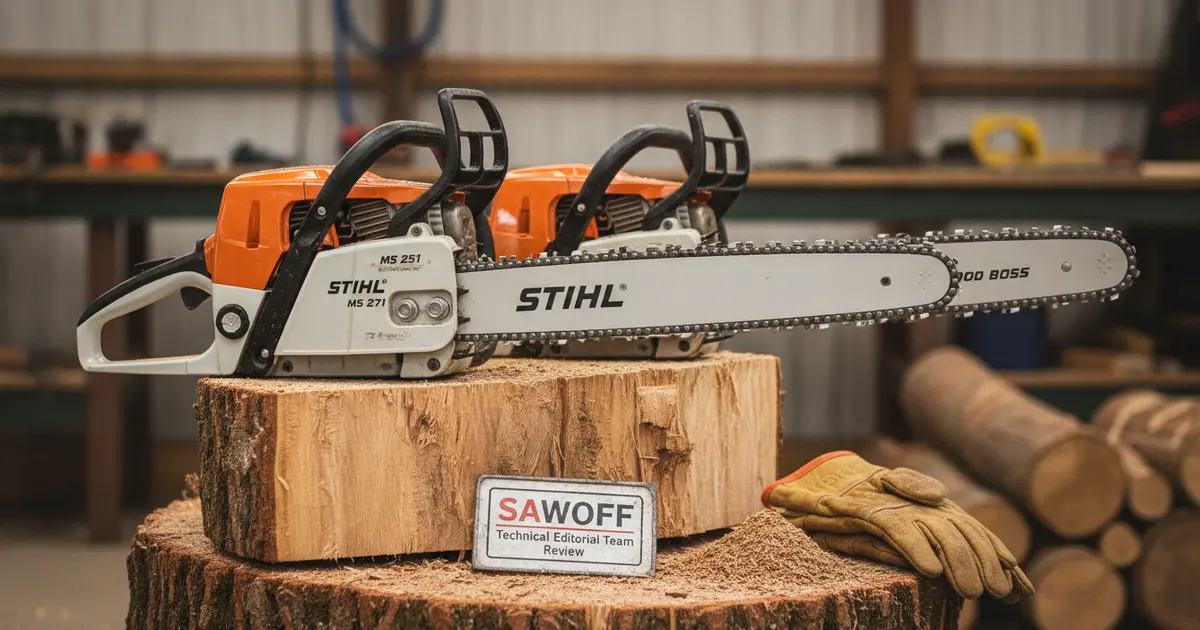
There is a specific kind of silence that exists on a farm just before dawn, right before you yank the cord on a Stihl MS 271. It’s a silence that demands work. For decades, the “Farm Boss” moniker hasn’t just been a marketing tag; it’s been a badge of utility for those who view a chainsaw as a tool of survival rather than a weekend hobby.
When we talk about the Stihl Farm and Ranch line—specifically the MS 251 Wood Boss and the MS 271 Farm Boss—we are stepping into the “prosumer” gray area. These saws occupy the space between the lightweight homeowner units like the Stihl MS 170 and the high-performance, magnesium-housed monsters like the Stihl MS 261.
In this review, I’m not going to give you the brochure fluff. I’ve spent fifteen years bucking hardwood and clearing fence lines. I know how these saws feel when the air filter is choked with fine hickory dust and the bar is buried in frozen white oak. Let’s get into the guts of these machines.
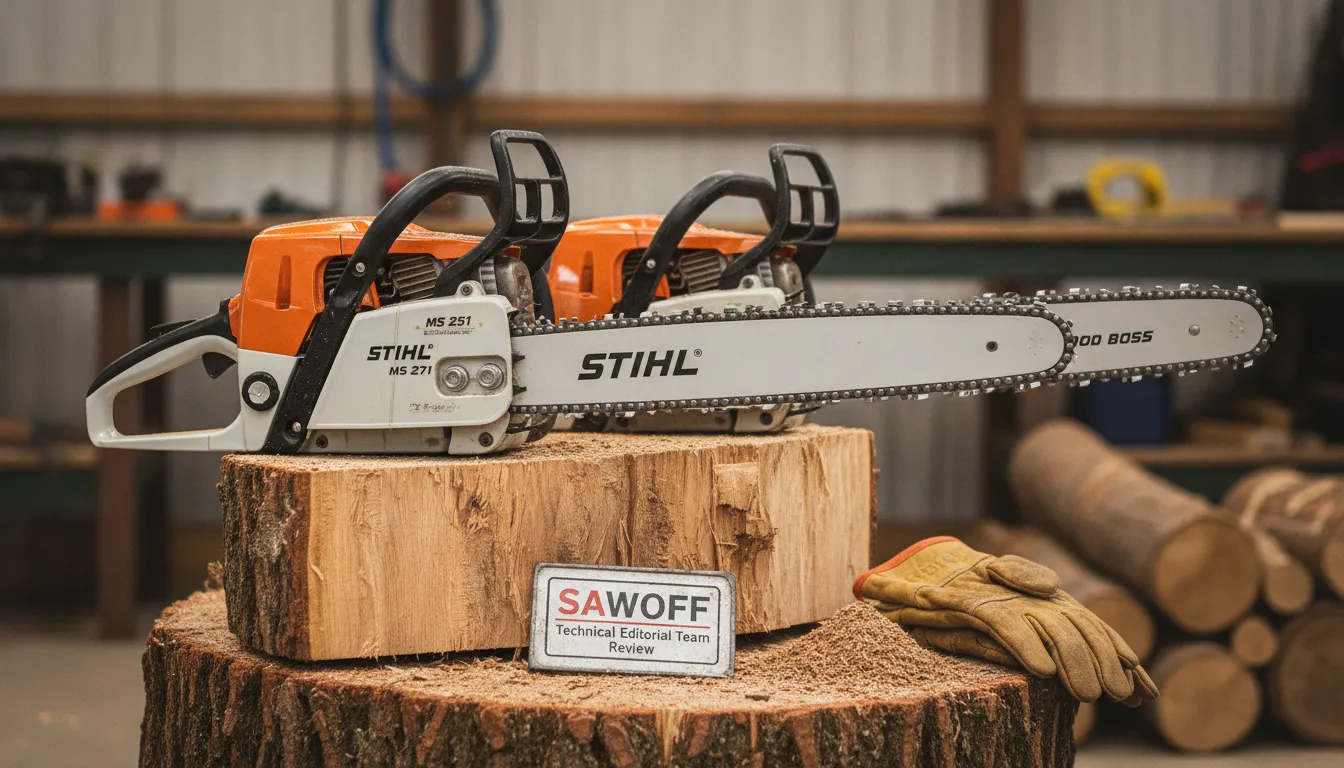
Strategic Comparison: The Mid-Range Heavyweights
Before we dissect the engineering, let’s see how the Wood Boss and Farm Boss stack up against their closest rivals.
| Model | Displacement | Power Output | Weight (Powerhead) | Best For | Price Link |
|---|---|---|---|---|---|
| Stihl MS 251 Wood Boss | 45.6 cc | 3.0 bhp | 10.8 lbs | Large Property Maintenance | 🛒 Check Price |
| Stihl MS 271 Farm Boss | 50.2 cc | 3.49 bhp | 12.3 lbs | Fencing & Firewood | 🛒 Check Price |
| Husqvarna 450 Rancher | 50.2 cc | 3.2 bhp | 11.3 lbs | General Land Clearing | 🛒 Check Price |
| Echo CS-4910 | 50.2 cc | 3.5 bhp | 10.4 lbs | Weight-Sensitive Pros | 🛒 Check Price |
Technical Engineering Deep-Dive: What’s Under the Shroud?
When you pop the hood on an MS 271 Farm Boss, you aren’t looking at the same architecture found in the professional 200-series. However, calling these “homeowner” saws is a massive understatement.
The 2-MIX Engine Technology
Both the MS 251 and MS 271 utilize Stihl’s 2-MIX engine technology. For the uninitiated, this is a stratified scavenging system. In a traditional two-stroke, a portion of the fresh fuel-air mixture escapes through the exhaust port before it’s even burned. The 2-MIX system uses a layer of clean, fuel-free air to push out the burnt gases before the fresh charge enters the combustion chamber.
In my testing, this results in two tangible benefits: first, a roughly 20% reduction in fuel consumption, and second, significantly more “lugging power.” When you bury the MS 271 in a 20-inch log, you can feel the torque curve holding firm where smaller saws would bog down and scream. It’s a throatier, more industrial growl than the high-pitched whine of the Stihl MS 250.
Pre-Separation Air Filtration
The Farm Boss series features a long-life air filtration system with pre-separation. This isn’t just a fancy name for a bigger filter. The flywheel uses centrifugal force to eject larger dirt particles before they even reach the filter.
I took the MS 271 into a stand of dry, rotting pine—the kind of wood that creates a cloud of “pulp” that kills standard filters in twenty minutes. I ran the saw for four hours straight. When I finally cracked the cover, the pleated HD2 filter was remarkably clean. This is a critical feature for “ranch” use where you might be miles from your air compressor or a spare filter.
The Crankcase: Polymer vs. Magnesium
Here is where we need to be honest. Unlike the pro-grade Stihl MS 261, which uses a full magnesium crankcase, the MS 271 and MS 251 utilize a split-case design with a heavy-duty polymer lower housing.
Does this matter? For a logger cutting 8 hours a day, yes—the magnesium handles heat dissipation better. But for the farmer who cuts 10 to 20 cords of wood a year, the polymer casing is more than sufficient. It reduces the weight slightly and is incredibly impact-resistant. I’ve seen these saws tumble off the back of a flatbed onto frozen gravel, and the casing didn’t even hairline-fracture.
Real-World Performance: Firewood and Fence Lines
The “Farm Boss” is a bit of a heavy beast at 12.3 lbs (dry, powerhead only). Once you add an 18-inch bar, a full tank of 50:1 mix, and bar oil, you’re looking at a 15-lb machine.
Bucking Capability
When bucking 16-inch oak rounds, the MS 271 is in its element. The .325” RM3 chain provides a smooth, aggressive bite. I noticed that the saw has a very predictable “center of gravity.” It doesn’t want to roll in the cut. The power delivery is linear; it doesn’t have the “snappy” acceleration of a pro saw, but it has relentless momentum.
Limbing and Bore-Cutting
For limbing, the MS 251 Wood Boss is actually my preference. At 10.8 lbs, it’s much more flickable. The MS 271 can get fatiguing after two hours of overhead work.
If you are performing bore cuts (plunge cuts) for felling, the Farm Boss series handles it well, though the anti-vibration springs feel a bit “mushy” compared to the older rubber-buffered Stihls. It takes a second to get used to the feedback through the handles when you’re pushing the tip of the bar into the heartwood.
Ergonomics & Operator Comfort: The Vibration Factor
Stihl’s advanced anti-vibration system is the unsung hero here. They’ve moved away from the old rubber bushings to a system of precision-engineered springs.
I remember the old 028 Wood Boss—after a day of cutting, my hands would buzz for hours. With the MS 271, the vibration at the front handle is kept to a minimum. You still feel the engine, but the “high-frequency sting” is filtered out.
The handle geometry is classic Stihl: thick enough to grip with heavy winter gloves, but contoured enough for bare-handed control. The master control lever—a single switch for choke, run, and stop—is intuitive, though I still find it annoying that you have to flick it up to “OFF,” which is the opposite of almost every other brand.
Historical Context: The Legacy of the “Boss”
To understand why the MS 271 is so popular, you have to look at its father, the MS 270, and its grandfather, the 027. Stihl realized early on that there was a massive market of people who needed more power than a “homeowner” saw but couldn’t justify the $800 price tag of a professional felling saw.
The “Farm Boss” name became synonymous with the legendary MS 290. When Stihl transitioned from the 290 to the 271, there was an initial outcry because the 271 had slightly less displacement. However, the 2-MIX efficiency and the vastly improved filtration made the 271 a superior machine in the long run. It is the evolution of “Old Reliable.”
Maintenance & Serviceability: Field Notes
Serviceability is where the Stihl Farm and Ranch series usually wins over the competition.
- The Flippy Caps: Some hate them, I love them—if you keep them clean. These toolless fuel and oil caps are fast, but if you get sawdust in the seal, they will leak or jam. Always wipe the area before opening.
- Side-Access Tensioner: No more sticking your screwdriver through the front of the saw near the sharp chain. The tensioner is on the side, where it should be.
- The Spark Plug: It’s buried a bit deeper under the shroud than on the old models, but a standard T27 Torx (which Stihl provides) gets you in there easily.
- The Carburetor: These are usually set a bit lean from the factory to meet EPA specs. If you’re at a higher elevation, you’ll want your dealer to tune it, as the MS 271 doesn’t feature the M-Tronic auto-tuning found on the Stihl MS 261 C-M.
Hardware Specs (MS 271 Farm Boss)
- Displacement: 50.2 cc (3.06 cu. in.)
- Engine Power: 2.6 kW (3.49 bhp)
- Weight: 5.6 kg (12.3 lbs)
- Fuel Capacity: 500 cc (16.9 oz)
- Chain Oil Capacity: 240 cc (8.12 oz)
- Oilomatic Chain: .325” RM3
- Power Source: Gas
Pros & Cons: The SAWOFF Edge
Pros
- Relentless Torque: The 2-MIX engine refuses to quit in heavy hardwood.
- Air Filtration: The pre-separation system is best-in-class for mid-range saws.
- Fuel Efficiency: You get significantly more trigger time per tank than the older MS 290.
- Resale Value: Stihl Farm Boss saws hold their value better than almost any other power tool on the market.
Cons
- Weight: It’s a heavy saw for its power class. It’s “stout,” which is another way of saying “bulky.”
- Cold Starts: It can be finicky. It usually requires exactly four pulls on full choke, one on half-choke, then it pops. If you miss that window, it’s easy to flood.
- Standard Bar: The “Laminate” bars that come standard are okay, but for real farm work, you’ll want to upgrade to a solid ES bar eventually.
Final Verdict
The Stihl MS 271 Farm Boss and MS 251 Wood Boss are the definitive “One-Saw Quiver” for property owners. If you are felling massive hardwoods every day, go buy an MS 400 C-M. If you are just trimming fruit trees, get an MS 170.
But if you are clearing a back forty, cutting five cords of firewood for the winter, and need a saw that will start three years from now after sitting in a damp barn, the Farm Boss is your machine. It’s not the fastest saw in the woods, and it’s certainly not the lightest, but it is arguably the most reliable “prosumer” saw ever built.
SAWOFF Rating: 4.7 / 5
🛒 Buy the Stihl Farm Boss Series on AmazonFAQ: Technical Troubleshooting & Tips
1. What is the best fuel-to-oil ratio for the Stihl Farm Boss?
Stihl recommends a 50:1 ratio. We strongly suggest using Stihl MotoMix or a high-quality synthetic oil like Stihl HP Ultra. Avoid ethanol-blended pump gas if possible, as it degrades the fuel lines and carb diaphragms over time.
2. My MS 271 is “bogging down” in the cut. What’s wrong?
First, check your chain tension and sharpness. A dull chain forces the engine to work harder, causing heat soak and bogging. Second, check the spark arrestor screen in the muffler. These often get clogged with carbon, “choking” the engine’s exhaust.
3. Can I run a 20-inch bar on the MS 271?
You can, but I wouldn’t recommend it for hardwood. The MS 271 performs optimally with an 18-inch bar. A 20-inch bar puts extra strain on the oiler and the clutch, especially in dense wood like oak or hickory.
4. How do I fix the “Flippy Cap” if it won’t lock?
Usually, this is caused by fine sawdust in the groove of the tank opening. Clean the rim of the tank with a rag. Ensure the “wing” of the cap is fully extended before you seat it. If the internal O-ring is swollen from bad gas, it will need to be replaced.
5. Why is my Wood Boss leaking bar oil while sitting?
Most Stihl saws “vent” a little oil as temperatures change. However, if it’s a puddle, check the oil line connection behind the clutch. Sometimes the heat causes the rubber to soften and lose its seal against the oil pump.
6. What is the difference between the MS 271 and the MS 291?
The MS 291 has a larger displacement (55.5cc) and more power (3.76 bhp) but shares the same chassis and weight as the MS 271. If you are consistently cutting wood over 15 inches in diameter, the extra $50 for the MS 291 is a wise investment.
7. How often should I clean the pre-separation air filter?
In normal conditions, once every 10–15 tanks of fuel. In extremely dusty or dry conditions, check it every 5 tanks. The beauty of the MS 271 is that you’ll rarely find the filter “impacted” with debris due to the centrifugal separation.
Frequently Asked Questions
What is the best fuel-to-oil ratio for the Stihl Farm Boss?
Stihl recommends a 50:1 ratio. Use Stihl MotoMix or a high-quality synthetic oil like Stihl HP Ultra. Avoid ethanol-blended pump gas if possible, as it degrades the fuel lines and carb diaphragms over time.
My MS 271 is bogging down in the cut—what's wrong?
First check your chain tension and sharpness, as a dull chain forces the engine to work harder causing heat soak. Second, check the spark arrestor screen in the muffler, which often gets clogged with carbon and chokes the engine's exhaust flow.
Can I run a 20-inch bar on the MS 271?
You can, but it's not recommended for hardwood. The MS 271 performs optimally with an 18-inch bar. A 20-inch bar puts extra strain on the oiler and clutch, especially in dense wood like oak or hickory.
How do I fix the Flippy Cap if it won't lock?
This is usually caused by fine sawdust in the groove of the tank opening. Clean the rim of the tank with a rag and ensure the wing of the cap is fully extended before seating it. If the internal O-ring is swollen from bad gas, it will need replacement.
What is the difference between the MS 271 and the MS 291?
The MS 291 has larger displacement (55.5cc) and more power (3.76 bhp) but shares the same chassis and weight as the MS 271. If you consistently cut wood over 15 inches in diameter, the extra $50 for the MS 291 is a wise investment.
How often should I clean the pre-separation air filter?
In normal conditions, once every 10-15 tanks of fuel. In extremely dusty or dry conditions, check it every 5 tanks. The beauty of the MS 271 is that you'll rarely find the filter impacted with debris due to the centrifugal separation.