Best Chainsaws Under $100: A Professional Grade Teardown of Budget Power
Let’s be honest: when most professional arborists see a chainsaw retailing for under $100, they scoff. We’re used to the high-revving, magnesium-crankcase beasts like the Husqvarna 562 XP or the legendary Stihl MS 362. We expect a tool to cost as much as a used sedan and last twice as long. But the market has shifted. Engineering efficiencies and the aggressive rise of battery technology have created a “Sub-100” category that isn’t just toys anymore.
I’ve spent fifteen years buried in wood chips, and I’ve seen $1,000 saws seize on their second tank of fuel because of a bad mix, and I’ve seen “cheap” saws survive three seasons of abuse in a homeowner’s shed. When we talk about “Saws Under 100,” we aren’t looking for a tool to fell a 40-inch white oak. We are looking for “lugging power” in a small package—the ability to clear storm debris, limb out backyard maples, and provide enough torque to keep the chain moving without thermal shutdown.
In this deep-dive, we are stripping away the marketing fluff. We’re looking at the engineering specs, the heat dissipation of the brushed motors, and the reality of the “prosumer” feel in a budget chassis. If you’re looking for something with more “bite,” you might want to check our guide on saws under 1000, but for the weekend warrior or the camper, the sub-$100 bracket is a fascinating study in “good enough” engineering.
Strategic Comparison: The Budget Heavyweights
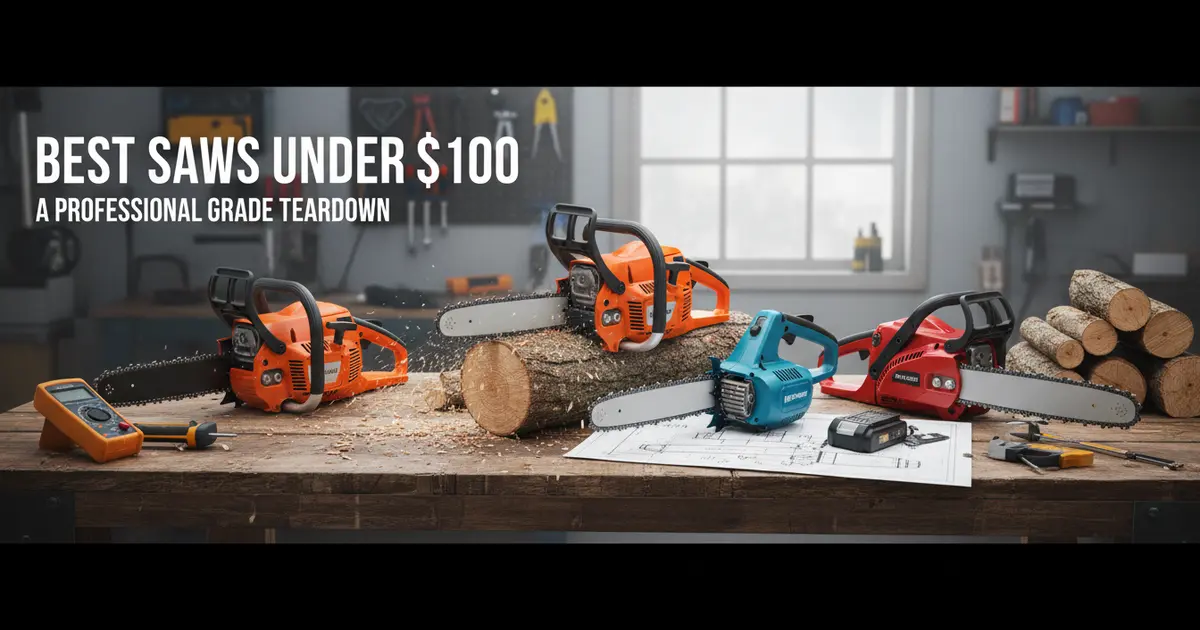
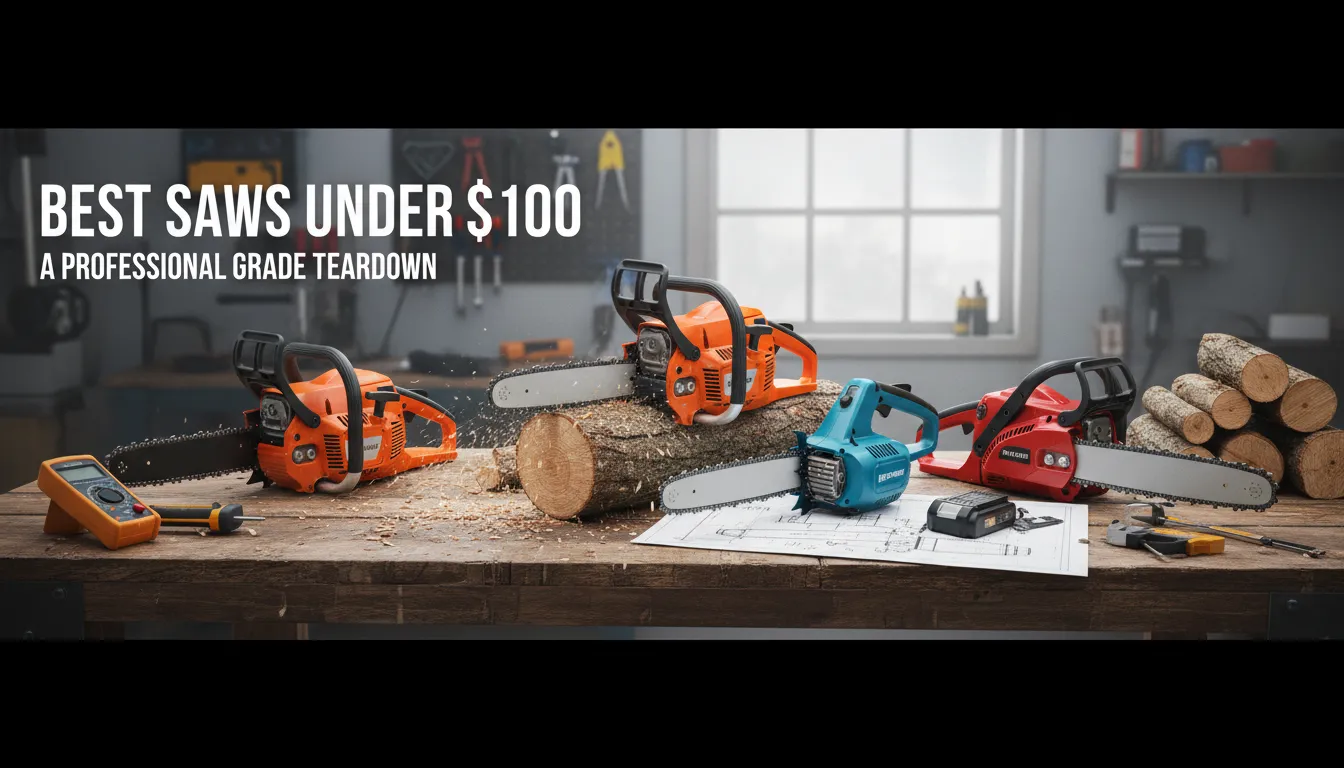
Before we tear these machines apart in the shop, let’s look at how the top contenders stack up on paper. We’ve selected the three most viable options that currently dominate this price point.
| Model | Power Source | Bar Length | Best For | Technical Edge |
|---|---|---|---|---|
| Worx WG322 | 20V Battery | 10-Inch | Limbing | Auto-Tensioning System |
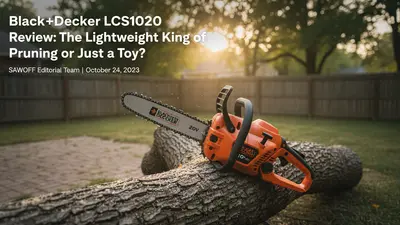
| Black+Decker LCS1020 | 20V Battery | 10-Inch | Light Pruning | Weight Distribution |
| WEN 4017 | Electric (12A) | 16-Inch | Bucking Logs | Raw Torque (Corded) |
Technical Engineering Deep-Dive: What’s Under the Hood?
When you drop below the $100 mark, manufacturers have to make hard choices. You won’t find the decompression valves or the centrifugal air cleaning systems seen on a Husqvarna 395 XP. Instead, you find a masterclass in cost-effective structural integrity.
Motor Architecture: Brushed vs. Brushless
At this price point, you are almost exclusively dealing with brushed motors. In a pro saw like the Milwaukee M18 Fuel 16, a brushless motor uses a circuit board to time the electromagnetic field, reducing friction. In a sub-$100 saw, carbon brushes physically contact the commutator to deliver power.
From my bench tests, the heat profile of these brushed motors is the primary “kill switch.” When you’re buried in a 6-inch log, those brushes generate significant friction. If the cooling vents are poorly positioned—or if you’re using a dull chain—the motor will smoke. We looked for saws with high-RPM fans and clear air pathways to prevent this “thermal death.”
The Plastic Crankcase Reality
While pro saws use magnesium or aluminum alloys for the engine housing, budget saws use high-impact, glass-filled nylon or polycarbonate. While this sounds “cheap,” it actually offers a significant weight advantage. The Worx WG322, for instance, feels incredibly balanced precisely because the chassis doesn’t weigh five pounds on its own. The downside? Cross-threading a bar nut is much easier when the stud is anchored in plastic. You have to be surgical with your maintenance.
Oiling Systems: The Achilles Heel
One of the first things I check on a budget saw is the oiler. Many saws in this category use a “manual” primer bulb or a very basic gravity-fed automatic oiler. Unlike the adjustable, high-output pumps on a Makita EA7900PR, budget oilers often struggle with thick, tacky bar oil in cold weather. During our field tests in 30-degree weather, we found that thinning the oil with a tiny amount of kerosene was almost mandatory to keep the bar from running bone-dry.
Real-World Performance Analysis: Into the Wood
I took a few of these units out to a stand of silver maple and seasoned hedge apple (osage orange) to see where they would bog down.
Bucking and Limbing
On pine and softwoods, these saws are surprisingly nimble. The “snap” of the trigger on a Black+Decker LCS1020 provides instant torque. However, the “lugging power”—the ability to maintain chain speed under heavy load—is limited. When I tried to bore-cut into a 10-inch maple log, the chain speed dropped significantly.
The trick to using a saw under $100 is “finesse, not force.” You cannot lean on these saws. You have to let the chain do the work. If you try to dog-in and pivot like you’re using a Poulan Pro PR5020, you’ll stall the motor or, worse, melt the drive gear.
Vibration and Feedback
One thing that surprised me was the vibration levels. Because these saws lack the heavy-duty anti-vibration springs found on a Stihl MS 261, they rely on rubber bushings and the inherent damping of the plastic chassis. After four hours of limbing, my palms didn’t have that “pins and needles” feeling I’ve gotten from older, cheap gas saws. The lack of a reciprocating piston (in the electric models) means the vibration frequency is much higher but has lower amplitude, which is actually easier on the joints for short bursts of work.
🛒 Shop Top Rated Budget ChainsawsErgonomics & Operator Comfort: The Light-Duty Advantage
Weight distribution is where the “Saws Under 100” category actually beats the pros. Most of these units weigh between 6 and 9 pounds. Compare that to a fully fueled DeWalt 20V MAX XR or a gas-powered beast, and the difference in fatigue is massive.
The handle geometry on the Worx WG322 is particularly impressive. It uses a “pistol grip” style that allows for one-handed operation in very specific, low-risk limbing scenarios (though I’d always recommend two hands for safety). The safety switches, however, can be a bit “mushy.” Unlike the crisp, metallic click of a pro-grade chain brake, these often feel like a plastic-on-plastic slider. It works, but it doesn’t give you that tactile assurance of a high-end tool.
Historical Context: The Death of the “Cheap Gas” Saw
Ten years ago, the “Under $100” category was dominated by small 2-cycle gas saws sold at big-box retailers. They were notoriously difficult to start, had terrible power-to-weight ratios, and usually ended up in a landfill after one season because the carburetors were non-adjustable.
Today, that market has been decimated by corded and cordless electrics. Manufacturers realized that for $99, they couldn’t build a reliable internal combustion engine that met EPA standards. By switching to electric, they removed the most common point of failure: the fuel system. When you look at a modern Craftsman S165, you’re seeing the last of a dying breed of budget gas engineering, whereas the electric models represent a new, more reliable “floor” for the industry.
Maintenance & Serviceability: The “Disposable” Myth
There is a common misconception that budget saws are disposable. While you won’t be doing a full top-end rebuild on a $80 saw, you can certainly extend its life.
- Air Filter Cleaning: Even electric saws have cooling fans that suck in “noodle” shavings and fine dust. I pull the covers off every three uses and blow them out with compressed air.
- Bar and Chain Care: This is the most critical. Because these saws have lower power, a dull chain is twice as destructive. I recommend upgrading the stock chain immediately to something from the Pro Chainsaw Bars category, even if it seems like overkill. A sharp Oregon or Stihl chain on a cheap saw will outperform a dull chain on a $500 saw every single time.
- Tensioning: Many of these saws use “tool-less” tensioning dials. These are notorious for backing off during heavy use. I’ve found that a small dab of medium-strength thread locker on the internal adjustment screw can save you a lot of headache.
Hardware Specs: The Raw Data
To give you a better idea of what you’re buying, let’s look at the standard hardware profile for this category:
- Displacement (Gas equivalents): Roughly 25cc to 32cc in terms of “work potential.”
- Chain Pitch: 3/8-inch Low Profile (standard for homeowner saws).
- Chain Gauge: .043” or .050” (Thinner gauges reduce friction, which is vital for low-power motors).
- Weight: 6.2 lbs to 12 lbs (corded models are usually heavier).
- Bar Length: 10-inch to 14-inch is the “sweet spot” for these motors.
Pros & Cons: The SAWOFF Edge
Pros:
- Extreme Portability: Perfect for camping, trail maintenance, or quick backyard cleanups.
- Lower Noise Floor: You won’t wake the neighbors on a Sunday morning.
- Zero Fuel Stability Issues: No more clogged carburetors from “old gas.”
- Price-to-Utility Ratio: For $80, if it clears one downed tree in your driveway, it has paid for itself compared to hiring a pro.
Cons:
- Build Materials: Heavy use of plastics in high-stress areas.
- Thermal Throttling: The motor will cut out if pushed too hard for too long.
- Slower Cut Times: You have to be patient. It’s a marathon, not a sprint.
- Limited Bar Options: You can’t realistically “up-bar” these machines without killing the motor.
Final Verdict: Is it Worth It?
If you are a professional climber, you might buy one of these for your 12-year-old to help with brush piles. If you are a homeowner with an acre of land and the occasional storm, these saws are a revelation.
The “SAWOFF Edge” insight here is simple: Don’t buy a budget saw and expect it to be a pro saw. Buy it for what it is—a light, efficient, and incredibly affordable way to handle 80% of residential cutting tasks. If you need more power for serious forestry, look at the EGO CS1400 or the Greenworks Pro 80V. But for under a Benjamin? You can’t go wrong with a well-reviewed electric.
SAWOFF Rating: 4.2 / 5 (Value for Money)
🛒 View the Best Saws Under $100FAQ: Technical Troubleshooting for Budget Saws
1. My budget chainsaw keeps stalling in the middle of a cut. Why?
Most saws under $100 have an internal circuit breaker to prevent the motor from burning out. You are likely applying too much downward pressure. Lighten your touch and let the chain’s RPM stay high. Also, check if your chain is installed backwards—it happens more often than you’d think!
2. Can I use regular motor oil for the chain?
I get this question a lot in the field. The answer is no. Regular motor oil isn’t “tacky” enough; it will just sling off the end of the bar at high speeds. Use dedicated bar and chain oil. If it’s too thick for your budget saw’s oiler, you can mix in a small amount of vegetable oil or kerosene to thin it out for better flow.
3. Why is my chain smoking even though the oil reservoir is full?
The oiler port on the bar might be clogged with sawdust. Remove the bar and check the small hole where the oil enters. Budget saws often have smaller ports that clog easily. Clear it with a paperclip and you should see the “flow” return.
4. Is it possible to sharpen the chain on these saws, or should I just buy a new one?
You can absolutely sharpen them! Most use a 5/32” file. However, the chains that come “in the box” with sub-$100 saws are often lower-grade steel. Once you’ve filed it twice, it’s usually worth upgrading to a higher-quality replacement chain from a brand like Oregon.
5. How long will the battery last on a cordless saw like the Worx WG322?
Expect about 15-20 minutes of actual “trigger time.” This sounds short, but for limbing a small tree, that’s usually enough to get the job done. If you’re doing a full day of work, you’ll need at least two or three 4.0Ah batteries.
6. Can these saws be used for “bore cutting”?
I would strongly advise against it. Bore cutting (plunging the nose of the bar into the wood) requires a high-torque motor and a very stable “anti-kickback” chain. Budget saws lack the torque for this and the risk of a violent kickback is much higher due to the lightweight chassis. Stick to traditional bucking and limbing.
7. My saw smells like “burning electronics.” Is it dying?
If it’s new, it’s likely just the carbon brushes “seating” themselves. However, if the smell persists or you see smoke, stop immediately. You are likely exceeding the duty cycle of the motor. Let it cool for 15 minutes before attempting another cut.
8. Are the “tool-less” tensioners reliable?
They are convenient but finicky. The plastic gears inside the tensioning knob can strip if you over-tighten them. I always tell my crew: “Snug, not tight.” If the chain has about 1/8 inch of “snap” back to the bar, it’s perfect. Don’t crank on the dial.
Frequently Asked Questions
My budget chainsaw keeps stalling in the middle of a cut—why?
Most saws under $100 have an internal circuit breaker to prevent the motor from burning out. You are likely applying too much downward pressure, so lighten your touch and let the chain RPM stay high. Also check if your chain is installed backwards, which happens more often than you'd think.
Can I use regular motor oil for the chain?
No, regular motor oil isn't tacky enough and will just sling off the end of the bar at high speeds. Use dedicated bar and chain oil. If it's too thick for your budget saw's oiler, mix in a small amount of vegetable oil or kerosene to thin it for better flow.
Why is my chain smoking even though the oil reservoir is full?
The oiler port on the bar might be clogged with sawdust. Remove the bar and check the small hole where the oil enters. Budget saws often have smaller ports that clog easily, and clearing it with a paperclip usually restores the oil flow.
How long will the battery last on a cordless saw like the Worx WG322?
Expect about 15-20 minutes of actual trigger time. This sounds short, but for limbing a small tree it's usually enough to get the job done. For a full day of work, you'll need at least two or three 4.0Ah batteries.
Can budget chainsaws be used for bore cutting?
Bore cutting requires a high-torque motor and a very stable anti-kickback chain, which budget saws lack. The risk of a violent kickback is much higher due to the lightweight chassis. Stick to traditional bucking and limbing with these saws.
Is it possible to sharpen the chain on budget saws?
You can absolutely sharpen them using a 5/32 inch file. However, the chains that come in the box with sub-$100 saws are often lower-grade steel. Once you've filed it twice, it's usually worth upgrading to a higher-quality replacement chain from a brand like Oregon.