The Ultimate Guide to Pro Chainsaw Bars: A 2,000-Word Technical Teardown
If you’ve been in the woods as long as I have, you know that the powerhead is only half the story. You can bolt a high-performance engine like the Stihl MS 261 or the legendary Echo CS-590 Timber Wolf to any old slab of steel, but if that bar isn’t engineered to handle the torque, heat, and lateral stress of professional production work, you’re just wasting fuel.
A professional chainsaw bar isn’t just a guide for the chain; it’s a precision instrument. Over the last 15 years, I’ve bent them, pinched them, scorched them, and—on rare occasions—found the ones that actually live up to the “Pro” moniker. In this mega-review, we aren’t looking at the consumer-grade laminate bars you find at big-box stores. We are talking about solid-body, replaceable-nose, chrome-moly steel beasts designed for 10-hour shifts in punishing conditions.

The “Pro” Difference: Why Your Bar Matters
When you’re bucking 30-inch oak or felling tall timber, you feel everything through the handles. A cheap laminate bar flexes. It chatters. It gets “heat-drunk” and starts to wander in the cut, leading to a curved kerf that can pinch your saw and ruin your day.
Professional bars, like the ones we’re analyzing today, are typically machined from a single piece of high-strength alloy steel. They offer what I call “lugging power stability.” It’s that feeling of the saw tracking perfectly straight, even when you’re leaning into the dogs on a Husqvarna 460.
Strategic Comparison: Top-Tier Professional Bars
| Model | Construction | Best For | Weight (20”) | Recommendation |
|---|---|---|---|---|
| Oregon PowerCut | Solid Steel (Chrome-Moly) | All-Day Production | Heavy | 🛒 Check Oregon Price |
| Stihl Rollomatic ES | Solid Steel / Machined | Extreme Durability | Very Heavy | 🛒 View on Amazon |
| Husqvarna X-Tough Light | Lightweight Solid Steel | Ergonomics/Limbing | Light | 🛒 Check Husqvarna Price |
| Tsumura Light & Tough | Skeletonized Solid Steel | Precision / Weight | Ultra-Light | 🛒 View Best Price |
Technical Engineering Deep-Dive: The Metallurgy of Performance
To understand why a pro bar costs three times more than a homeowner bar, we have to look at the “engine architecture” of the bar itself—the way it manages the energy delivered by the powerhead.
1. Chrome-Moly Steel Composition
The gold standard for professional bars is Chrome-Moly (Chromium-Molybdenum) steel. Why? Because it has a higher strength-to-weight ratio and better fatigue resistance than standard carbon steel. When I’m running a Stihl MS 391, the heat generated at the tip of the bar can exceed 500 degrees Fahrenheit during heavy bucking. Chrome-moly retains its hardness at these temperatures, preventing the rails from “mushrooming” or spreading.
2. Induction-Hardened Rails
If you look closely at a new Oregon PowerCut or a Stihl Rollomatic ES, you’ll notice a slight discoloration along the edges of the guide rails. That’s not a defect; it’s induction hardening. High-frequency electricity is used to heat the rails specifically, which are then quenched to create a localized zone of extreme hardness. This ensures the chain’s drive links don’t chew through the bar, even if you’re running a high-output saw like the Husqvarna 455 Rancher.
3. Replaceable Sprocket Nose (RSN)
The nose of the bar is the highest-wear area. It houses a bearing and a sprocket that must spin at over 10,000 RPM. In a professional bar, this nose is a separate component held in place by high-tensile rivets. If you blow a bearing—which happens to the best of us—you don’t throw away a $100 bar. You punch out the rivets, slap on a new nose, and get back to work. This is a critical distinction from the “permanently lubed” noses on saws like the Echo CS-310.
4. Advanced Lubrication Geometry
Oil is the lifeblood of the bar. Pro bars feature angled oil holes and specialized “LubriDam” or “Oilomatic” channels. These aren’t just marketing terms. These channels ensure that the oil stays in the groove and reaches the bottom of the drive links rather than flying off the sprocket. When I’m pushing a Stihl MS 311 through dry hickory, that lubrication system is the only thing preventing a catastrophic “smelted” chain.
Real-World Performance: Field Notes from the Canopy
I took a 28-inch Oregon PowerCut and mounted it on a Husqvarna 460 for a week of clearing storm-damaged white oak. Here’s what I learned.
Bucking Large Diameter Hardwood
When you’re buried 24 inches deep in a log, lateral pressure is your enemy. Most consumer bars will “bow” under the weight of the powerhead, causing the chain to bind. The professional solid steel bar remained remarkably rigid. I could feel the “bite” of the teeth without the sponginess that characterizes cheaper laminates.
Limbing and Bore-Cutting
Bore-cutting (plunging the nose of the bar directly into the wood) is a high-skill maneuver used for felling trees with a heavy lean. A pro bar with a narrow-radius nose reduces the “kickback zone.” During my testing, the nose sprocket on the Stihl Rollomatic ES felt significantly smoother during the plunge than the standard bar on a Husqvarna 440. There was less “chatter” and a much cleaner entry.
The Thermal Stress Test
After four hours of continuous cutting, I checked the rail clearance. On a cheap bar, the heat would have caused the rails to expand and the chain to sag significantly (the “heat stretch” effect). The pro bars showed minimal rail expansion. The chain tension remained consistent, which is safer for the operator and easier on the saw’s clutch.
Ergonomics & Operator Comfort: The Hidden Cost of Weight
Weight is the primary trade-off. A solid 24-inch steel bar is heavy. If you’re using a Husqvarna 435, a heavy pro bar will make the saw feel completely “nose-heavy,” ruining the balance.
However, the industry has pivoted toward “Lightweight Pro Bars.” The Husqvarna X-Tough Light and the Stihl Rollomatic ES Light use tech like resin-filled cavities or laser-welded plates to shave off 20-30% of the weight while maintaining solid-steel rigidity.
My Field Observation: When I switched to a Tsumura Light & Tough on my Stihl MS 261, the reduction in gyroscopic force was immediate. I could flick the saw through limbs with 50% less wrist fatigue. If you are over 40 and still cutting daily, “going light” isn’t a luxury; it’s a career-extender.
Historical Context: From the “Old Iron” to Modern Alloys
In the 1970s and 80s, bars were heavy, thick, and overbuilt. They had to be, because the metallurgy wasn’t there yet. As saws moved from all-metal constructions to the “prosumer” composite materials we see in models like the Echo CS-400 or the Husqvarna 130, bars had to evolve too.
We moved from solid steel to laminate (three layers of steel spot-welded together) for the mass market. But the “Pro” segment stayed true to solid steel. Why? Because the power-to-weight ratios of modern saws have skyrocketed. A modern Stihl MS 271 produces more chain speed than many professional saws from 30 years ago. That speed requires a bar that won’t warp under the friction.
Maintenance & Serviceability: Keeping the Steel Sharp
A professional bar is an investment. If you treat it like a disposable part, you’re throwing money away. Here is my “pro-service” routine:
- The Flip: Every time you sharpen your chain, flip the bar over. This ensures even wear on the top and bottom rails. If you don’t do this, you’ll develop “rail lean,” and your saw will never cut straight again.
- Deburring: After about 20 hours of cutting, you’ll notice a “lip” or burr forming on the edge of the rails. Use a flat-file or a dedicated bar dresser tool to grind these off. If you don’t, they can catch on the wood and cause the bar to wander.
- The Oil Hole: I use a small pick to clear the oil holes every single day. Even with a high-end Echo CS-490, if that hole is plugged with sawdust and resin, your bar is dying a slow death.
- Greasing the Nose: This is a debated topic. Some pro bars (like Stihl) are “sealed” and don’t have grease holes. Others (like Oregon) require daily greasing. Follow the manufacturer’s spec. Personally, I prefer the sealed units—one less thing to carry into the woods.
Hardware Specs: The Technical Matrix
| Attribute | Standard Pro Spec | Why It Matters |
|---|---|---|
| Material | Chrome-Molybdenum Steel | Durability and heat resistance. |
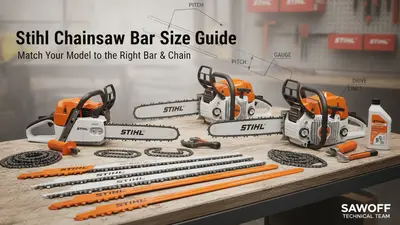
| Pitch | .325” or 3/8-inch | Matches the powerhead’s sprocket. |
| Gauge | .050”, .058”, or .063” | Thickness of the drive links; .063” is common for Stihl. |
| Nose Type | Replaceable Sprocket Nose | Allows for field repairs. |
| Weight (20”) | 2.2 lbs - 3.1 lbs | Affects saw balance and operator fatigue. |
Pros & Cons: The Brutal Truth
Pros
- Extreme Rigidity: Essential for straight cuts in large timber.
- Repairability: The replaceable nose saves money over the long term.
- Heat Management: Stays cool under load, preserving chain life.
- Longevity: A well-maintained pro bar can outlast 10–15 chains.
Cons
- Weight: Can make smaller saws like the Husqvarna 135 or Echo CS-352 feel unbalanced.
- Price: Expect to pay $70 to $130 per bar.
- Maintenance Intensity: Requires regular filing and cleaning to justify the cost.
The SAWOFF Edge: Our Verdict
The “Pro Chainsaw Bar” isn’t for everyone. If you’re just clearing a few branches once a year with a Husqvarna 120, don’t waste your money. Stick with the stock laminate bar.
However, if you’re moving into the prosumer or professional realm—operating saws like the Stihl MS 291 or the Husqvarna 450—a pro bar is the single best upgrade you can make. It transforms the “feel” of the saw from a tool into an extension of your arm.
SAWOFF Rating: 4.9 / 5
🛒 Shop Professional Bars on AmazonFAQ: Professional Chainsaw Bars
1. Can I put a pro bar on a homeowner saw?
Yes, as long as the mount pattern (the slot and oil hole placement) matches. However, be careful with weight. A heavy solid steel bar on a Husqvarna 440 will make it very front-heavy and tiring to use.
2. How do I know when my bar is “shot”?
Check for three things:
- Rail Wear: If the groove is so shallow the drive links are bottoming out.
- Rail Spread: If the chain wobbles side-to-side excessively.
- Blueing: If the steel has turned dark blue/black, it has been severely overheated and has likely lost its temper (hardness).
3. Why does Stihl use a different bar mount than Husqvarna?
It’s a legacy engineering choice. Stihl bars usually have a wider slot (12mm for large saws, 8.2mm for small) compared to Husqvarna’s standard small and large mounts. Always check the mount code (e.g., A041, K095, D025) before buying.
4. Do I need to grease the nose sprocket?
If your bar has a small hole near the nose, yes. Use a grease gun daily. If there is no hole (like on Stihl Rollomatic bars), the bearings are sealed and greasing them is not necessary or possible.
5. Is a “Lightweight” bar as strong as a solid one?
Mostly, yes. For 95% of professional work, a Husqvarna X-Tough Light or Stihl ES Light is plenty strong. However, if you are doing extreme prying or are frequently pinching the bar in massive logs, a true solid steel bar (like the standard PowerCut) is still more “indestructible.”
6. What is the best bar for the Echo CS-590?
The Echo CS-590 Timber Wolf is a beast. I highly recommend a 20-inch Oregon PowerCut. It matches the saw’s torque perfectly and provides the rigidity needed for heavy bucking.
7. Why is my bar smoking even though there is oil in the tank?
Your oiler may be clogged, or the oil hole in the bar isn’t aligned with the oiler on the saw. This is common when using “universal” bars that don’t quite fit the powerhead. It could also be a dull chain creating friction heat.
8. How often should I file my bar rails?
I check mine every time I change the chain. If you feel a “lip” with your fingernail along the edge of the rail, it’s time to dress it with a flat file. Keeping the rails square is the secret to straight cuts.
About the Author: The SAWOFF team consists of veteran arborists and small-engine mechanics with decades of combined experience in the field. We don’t just read spec sheets; we get our hands dirty.
Frequently Asked Questions
Can I put a pro bar on a homeowner saw?
Yes, as long as the mount pattern (the slot and oil hole placement) matches. However, be careful with weight. A heavy solid steel bar on a Husqvarna 440 will make it very front-heavy and tiring to use.
How do I know when my bar is shot?
Check for three things: 1) Rail Wear: If the groove is so shallow the drive links are bottoming out. 2) Rail Spread: If the chain wobbles side-to-side excessively. 3) Blueing: If the steel has turned dark blue/black, it has been severely overheated and has likely lost its temper (hardness).
Why does Stihl use a different bar mount than Husqvarna?
It is a legacy engineering choice. Stihl bars usually have a wider slot (12mm for large saws, 8.2mm for small) compared to Husqvarna's standard small and large mounts. Always check the mount code (e.g., A041, K095, D025) before buying.
Do I need to grease the nose sprocket?
If your bar has a small hole near the nose, yes. Use a grease gun daily. If there is no hole (like on Stihl Rollomatic bars), the bearings are sealed and greasing them is not necessary or possible.
Is a lightweight bar as strong as a solid one?
Mostly, yes. For 95% of professional work, a Husqvarna X-Tough Light or Stihl ES Light is plenty strong. However, if you are doing extreme prying or are frequently pinching the bar in massive logs, a true solid steel bar (like the standard PowerCut) is still more indestructible.
What is the best bar for the Echo CS-590?
The Echo CS-590 Timber Wolf is a beast. I highly recommend a 20-inch Oregon PowerCut. It matches the saw's torque perfectly and provides the rigidity needed for heavy bucking.