Stihl Home vs Pro: The Definitive Engineering & Field Performance Breakdown
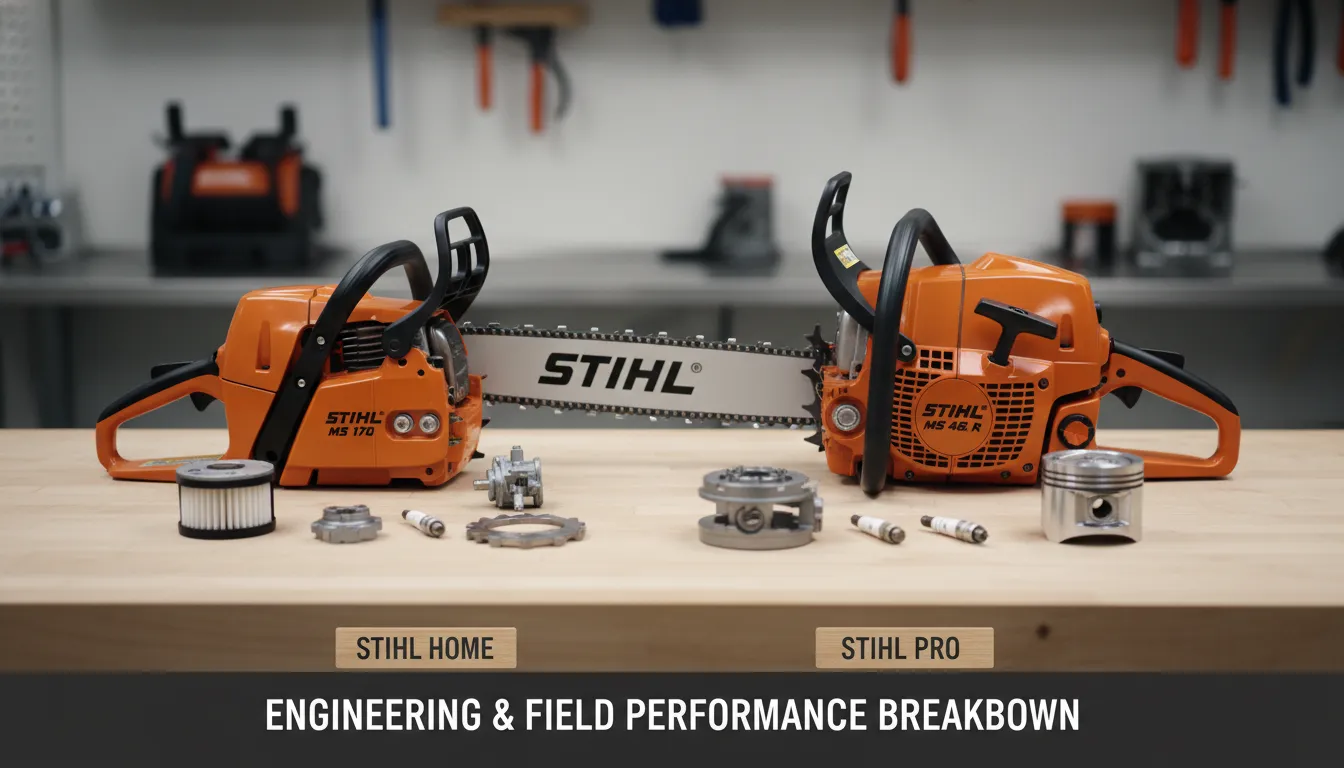
Walking into a Stihl dealership is a sensory overload for any woodcutter. You’ve got the smell of Motomix in the air, the rows of gleaming orange and white powerheads, and that nagging question at the back of your mind: “Is the professional saw really worth double the price of the homeowner model?”
I’ve spent fifteen years with a saw in my hand, from clearing hurricane debris in the Florida humidity to bucking frozen white oak in the dead of a Vermont winter. I’ve run the gamut from the featherweight Stihl MS 170 to the absolute monster Husqvarna 395 XP. If there is one thing I’ve learned, it’s that the difference between a “Homeowner” saw and a “Professional” saw isn’t just marketing fluff. It’s written in the metallurgy of the crankcase and the snap of the throttle response.
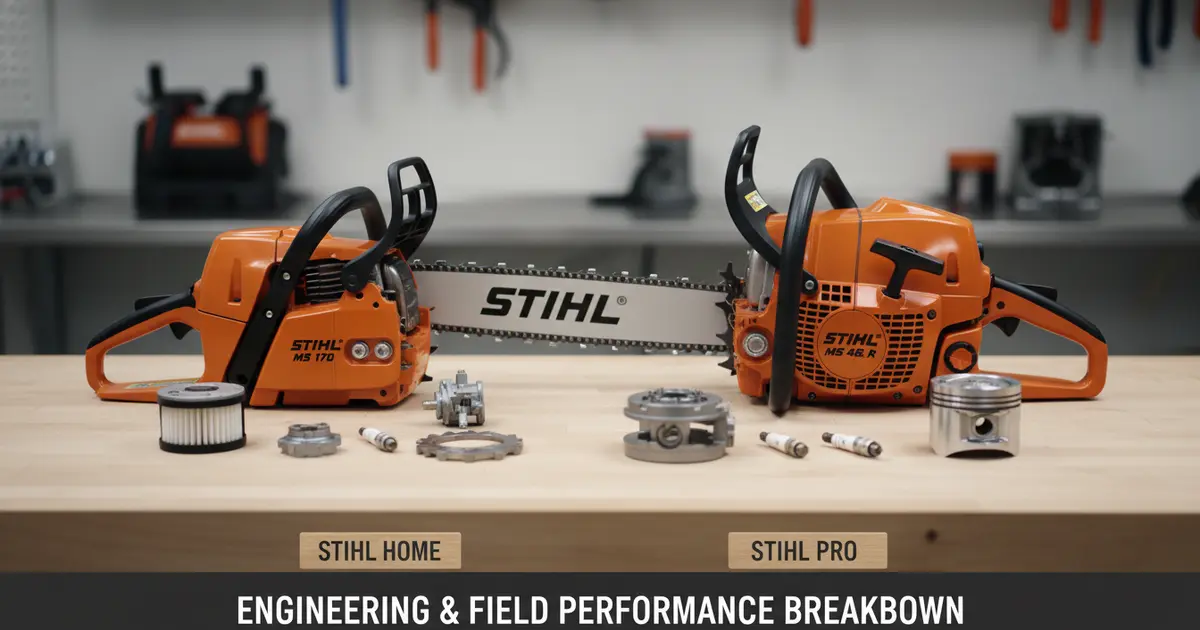
In this deep-dive, we are going beyond the spec sheet. We’re tearing into the engine architecture, the filtration systems, and the “prosumer” middle ground to find out exactly where your money goes when you upgrade from the white-handle consumer line to the orange-handle professional beasts.
The Strategic Comparison: Power, Weight, and Purpose
Before we get into the guts of the machines, let’s look at how these categories stack up on paper. I’ve picked three benchmarks that represent the “Home,” “Farm/Ranch,” and “Professional” tiers.
| Feature | Homeowner (MS 170) | Farm & Ranch (MS 271) | Professional (Stihl MS 261) |
|---|---|---|---|
| Displacement | 30.1 cc | 50.2 cc | 50.2 cc |
| Power Output | 1.7 bhp | 3.49 bhp | 4.0 bhp |
| Crankcase Material | Polyamide (Plastic) | Polyamide (Clamshell) | Magnesium Alloy |
| Weight (Powerhead) | 8.6 lbs | 12.3 lbs | 10.8 lbs |
| Air Filtration | Basic Felt | Pre-separation System | HD2 Large Surface Filter |
| Typical Use | Light Trimming | Firewood/Fencing | Daily Professional Use |
| Price Link | 🛒 Check MS 170 Price | 🛒 Check MS 271 Price | 🛒 Check MS 261 Price |
Technical Engineering Deep-Dive: What’s Under the Hood?
If you want to understand the “Pro” difference, you have to look at the crankcase. Most homeowner saws, and even many in the “Farm and Ranch” category, use what we call a “clamshell” engine design. In this setup, the bottom half of the engine—the bearings and the crank—is cradled in a plastic (polyamide) housing. It’s cheap to manufacture and lightweight, but it’s a nightmare for heat dissipation. When you’re leaning into a 20-inch log for four hours straight, that plastic housing doesn’t pull heat away from the bearings the way metal does.
The Magnesium Advantage
The professional line, starting with legends like the Stihl MS 261 and the Stihl MS 362, uses a split magnesium alloy crankcase. Magnesium is significantly stronger and more heat-conductive than plastic. This allows for tighter tolerances and higher RPMs. When I’m running a pro saw, I can feel that stability. There’s a lack of “flex” in the powerhead when you’re prying on a stuck bar that you just don’t get with the plastic homeowner frames.
Fuel Layering and the 2-MIX Engine
Stihl’s 2-MIX engine technology is standard across most of their modern line, but the tuning varies wildly. In a pro saw, the scavenging process—where a layer of air is used to push out exhaust gases before the new fuel charge enters—is tuned for maximum torque. You’ll notice that a pro saw has a “broader” power band. A homeowner saw might have plenty of zip at the top end, but the moment you put real pressure on the bar, the RPMs bog down. A pro saw like the MS 261 fights back. It has “lugging power” that keeps the chain moving even when the wood is trying to pinch it shut.
Filtration: The Silent Killer
I’ve seen more homeowner saws killed by dust than by actual wear. The MS 170 and MS 180 use a simple felt or foam square. It works, but it clogs fast. Once it clogs, the engine runs “rich,” loses power, and eventually pulls fine dust into the cylinder, scoring the walls.
The professional line uses the HD2 filtration system. This is a pleated, high-surface-area filter that captures particles down to the micron level. More importantly, it’s paired with a centrifugal air cleaning system. Before the air even hits the filter, the flywheel spins the heavy dust particles outward and ejects them. I’ve gone weeks without needing to tap out the filter on an MS 362, whereas a homeowner saw would have been gasping for air by lunchtime.
Real-World Performance Analysis: Into the Oak
Let’s talk about the actual experience of cutting. There is a specific “vibration frequency” you get with cheaper saws. They use rubber buffers for anti-vibration. After three hours of bucking logs, your palms have that pins-and-needles feeling. Stihl’s pro saws utilize steel spring anti-vibration systems. These springs decouple the engine from the handles far more effectively.
When I took an MS 251 (Home/Ranch) and an MS 261 (Pro) into a stand of downed hickory last fall, the difference was immediate. The MS 251 did the job, but it felt “buzzy.” The MS 261 felt like a precision instrument. The throttle response on the pro model is “snappy”—you blip the trigger and it hits 14,000 RPM instantly. That’s crucial for limbing, where you need quick bursts of speed to move from branch to branch safely.
Bore-Cutting and Torque
If you’re doing technical felling, you’re going to be doing bore-cuts (plunge cuts). This is where the nose of the bar is buried into the heart of the tree. This is the ultimate test of a saw’s power-to-weight ratio. A homeowner saw often lacks the oiling capacity and the raw torque to handle a bore-cut without the chain overheating. Pro saws feature adjustable high-output oilers that allow you to dial in the lubrication based on the wood species. Trying to plunge-cut through frozen oak with an MS 211 is an exercise in frustration; doing it with an MS 261 is like a hot knife through butter.
Ergonomics & Operator Comfort: The 8-Hour Shift
The weight distribution on professional saws is a result of obsessive engineering. When you pick up a Stihl MS 362, it feels balanced. The center of gravity is low, and the handle geometry is designed for both “felling” (holding the saw sideways) and “bucking” (holding it vertically).
The “Home” series handles often feel a bit cramped if you’re wearing heavy-duty arborist gloves. Furthermore, the chain tensioning systems differ. While the “Quick Chain Tensioner” (the thumbwheel on many homeowner models) is marketed as a convenience, most pros hate it. It’s prone to clogging with sap and dust. Give me the side-access captive bar nuts of a pro saw any day. There’s a reason you’ll find two bar nuts on a pro saw—it locks the pro chainsaw bar in place so it won’t move even under extreme prying force.
Historical Context & Brand Heritage
Stihl basically invented the portable chainsaw, and their naming convention tells a story. Historically, the “0” series (like the 026, 036, 044) set the standard for what a professional saw should be. When they transitioned to the “MS” (MotorSäge) nomenclature, they split the lines more distinctly.
The “white handle” saws were designed to compete with big-box brands like Craftsman or Poulan Pro. They are designed for the person who needs to clear one downed tree a year and then lets the saw sit in the shed for 11 months. The “orange handle” saws are the descendants of the saws that built the logging industry. If you want to dive deeper into how to get the most out of these machines, check out my guide on pro chainsaw tuning.
Maintenance & Serviceability: The “Shop” Factor
Here’s where the “Pro” price tag starts to pay for itself. Pro saws are built to be rebuilt.
- Cylinder Access: On a pro saw, you can usually have the top cover off and the cylinder exposed in minutes.
- Spark Plug and Carburetor: Everything is accessible.
- M-Tronic System: Modern pro Stihls feature the M-Tronic engine management system. It’s an onboard computer that automatically adjusts the fuel-air mixture. No more fiddling with high and low-speed screws every time the temperature changes 10 degrees. You just start it in the “on” position and let the saw do the thinking.
Compare that to a homeowner saw. If you burn out the top end of an MS 170, the labor cost to open up that clamshell plastic housing usually exceeds the cost of a new saw. They are, sadly, “disposable” machines in the eyes of many mechanics.
Hardware Specs: The Raw Numbers
- Engine Type: 2-Stroke with 2-MIX scavenging.
- Ignition: Electronic (M-Tronic on pro models).
- Chain Pitch: .325” or 3/8-inch (Pro) vs. 3/8-inch Picco (Homeowner).
- Bar Lengths: 12”-16” (Home), 16”-20” (Ranch), 16”-25”+ (Pro).
- Decompression Valve: Standard on larger Pro models for easier pulling.
- Fuel Tank: Translucent on pro models for easy level checking.
Pros & Cons
Homeowner Series (MS 170, 180, 211)
Pros:
- Extremely Lightweight: Easy for anyone to handle.
- Affordable: Usually under $250.
- Simple: Less complex for the occasional user.
Cons:
- Plastic Crankcase: Poor heat management.
- Non-Adjustable Oilers: Can lead to bar wear.
- Limited Life Span: Not designed for daily use.
Professional Series (MS 261, 362, 500i, 661)
Pros:
- Magnesium Construction: Built for a lifetime.
- Power-to-Weight: The highest in the industry.
- Serviceability: Every part is replaceable.
- The SAWOFF Edge: The vibration damping is so good you can cut all day without fatigue.
Cons:
- Expensive: A serious investment.
- Requires Knowledge: You need to know how to maintain a high-performance engine.
Final Verdict: Which One Do You Need?
If you are a suburban homeowner with a half-acre lot and a couple of pine trees that drop limbs during storms, the “Home” series is perfectly fine. Don’t spend $600 on a saw that will sit in a case.
However, if you heat your home with wood, if you have more than 5 acres, or if you simply value tools that don’t quit when the going gets tough, buy the Pro saw. The Stihl MS 261 is, in my opinion, the greatest all-around chainsaw ever made. It’s light enough for limbing but has the guts to buck a 16-inch log all day.
SAWOFF Rating: 4.8 / 5 (Professional Series) | 3.5 / 5 (Homeowner Series)
🛒 Shop Stihl Professional SawsFAQ: Technical Troubleshooting & Usage
1. Can I use a professional bar on a homeowner saw?
Generally, no. Homeowner saws usually use a different mount pattern (often called the A074 mount) and a smaller chain pitch (.325” Mini or 3/8-inch Picco). Professional saws use the D025 mount and heavier chains. Putting a heavy pro bar on a small saw would also ruin the balance and bog down the engine.
2. Why does my homeowner saw struggle to start when hot?
This is a classic “clamshell” issue. Heat soak in the plastic housing can cause the fuel to “vapor lock” in the lines. Professional saws handle heat better, and M-Tronic models compensate for this automatically.
3. What fuel mix should I use?
For both Home and Pro, use 50:1. I highly recommend using Stihl Motomix or a high-quality 91+ octane ethanol-free gas mixed with Stihl HP Ultra synthetic oil. Ethanol is the #1 killer of chainsaw carburetors.
4. Is the MS 271 “Pro”?
No. The MS 271 is part of the “Farm & Ranch” line. It has a plastic clamshell engine but a more robust filtration system than the MS 170. It’s a “prosumer” saw. It’s great, but it’s not a Stihl MS 261.
5. How often should I clean the HD2 filter?
If you’re cutting dry, dead wood, check it every 4-5 tanks of fuel. If you’re cutting green wood, you can go much longer. One of the perks of the pro line is the ease of access—just three quarter-turn screws and you’re in.
6. Does the pro saw require more maintenance?
Not necessarily “more,” but it requires “better” maintenance. You should be comfortable checking the spark gap and cleaning the cooling fins. If you treat a pro saw well, it will outlast three homeowner saws.
7. What is the “snap” I hear when I pull the cord on a pro saw?
That’s the high-compression “pop.” Pro saws have higher compression ratios for more power. This is why many have a decompression valve—without it, the pull cord can actually kick back and hurt your hand.
8. My saw is leaking oil while sitting. Is this normal?
To an extent, yes. Most saws will “burp” a little oil as temperatures change. However, pro saws have higher-quality oil pumps that generally seal better than the gravity-fed or simple impulse pumps on cheap models. If it’s a puddle, check your oil line seating.
If you’re still undecided, check out our list of the best saws under $1000 for more options that bridge the gap between home and pro performance.
Frequently Asked Questions
Can I use a professional bar on a homeowner saw?
Generally no. Homeowner saws use a different mount pattern (A074) and smaller chain pitch (.325 Mini or 3/8 Picco). Professional saws use the D025 mount and heavier chains. Putting a heavy pro bar on a small saw would also ruin the balance and bog down the engine.
Why does my homeowner saw struggle to start when hot?
This is a classic clamshell issue. Heat soak in the plastic housing can cause the fuel to vapor lock in the lines. Professional saws handle heat better, and M-Tronic models compensate for this automatically.
What fuel mix should I use for Stihl chainsaws?
For both Home and Pro models, use a 50:1 ratio. I highly recommend using Stihl Motomix or a high-quality 91+ octane ethanol-free gas mixed with Stihl HP Ultra synthetic oil. Ethanol is the number one killer of chainsaw carburetors.
Is the MS 271 considered a professional saw?
No. The MS 271 is part of the Farm and Ranch line. It has a plastic clamshell engine but a more robust filtration system than the MS 170. It is a prosumer saw that is great for occasional use but not equivalent to the MS 261.
How often should I clean the HD2 filter?
If you are cutting dry dead wood, check it every 4 to 5 tanks of fuel. If you are cutting green wood, you can go much longer. One of the perks of the pro line is the ease of access with just three quarter-turn screws.
Does the pro saw require more maintenance than a homeowner model?
Not necessarily more, but it requires better maintenance. You should be comfortable checking the spark gap and cleaning the cooling fins. If you treat a pro saw well, it will outlast three homeowner saws.
What is the snap I hear when I pull the cord on a pro saw?
That is the high-compression pop. Pro saws have higher compression ratios for more power. This is why many have a decompression valve because without it the pull cord can actually kick back and hurt your hand.
My saw is leaking oil while sitting. Is this normal?
To an extent yes. Most saws will burp a little oil as temperatures change. However pro saws have higher-quality oil pumps that generally seal better than the gravity-fed or simple impulse pumps on cheap models. If it is a puddle, check your oil line seating.