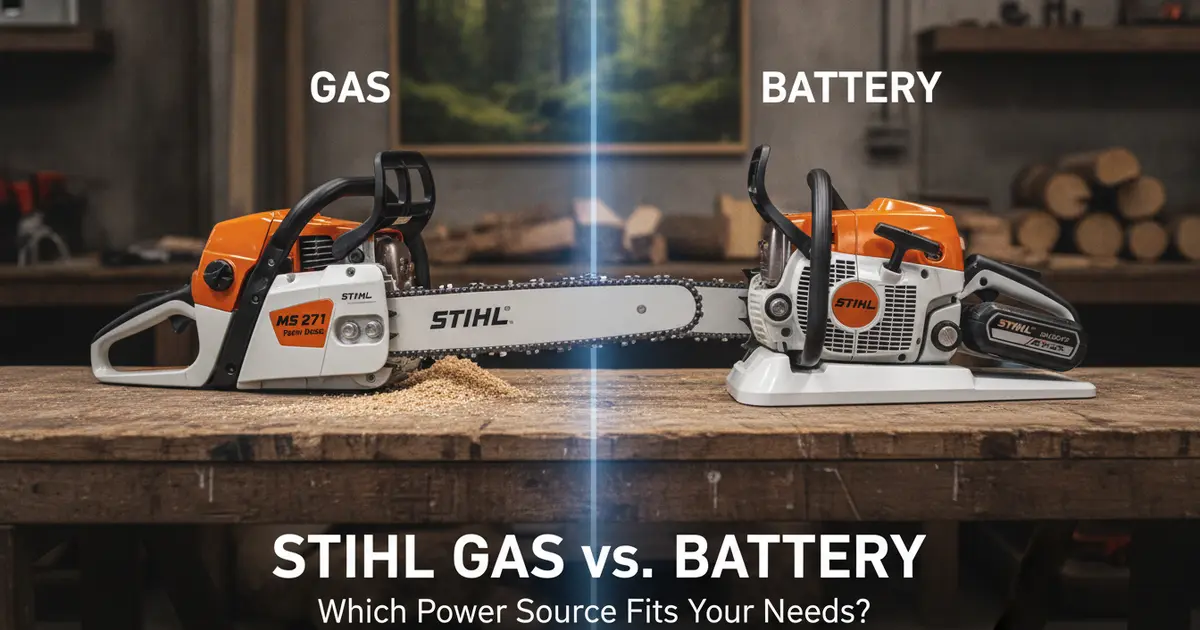
Stihl Gas vs Battery Chainsaw: Which Power Source Fits Your Needs?
There is a specific vibration that lives in your palms after an eight-hour shift with a gas-powered Stihl. It’s a high-frequency hum, the kind that makes your fingers tingle long after the Stihl MS 261 C-M has been tucked into the truck bed. For decades, that vibration was the heartbeat of the woods. But lately, the silence of the battery-powered units is starting to speak louder than the roar of the two-stroke.
I’ve spent the last 15 years bucking, limbing, and dropping everything from frozen white oak to rain-soaked cedar. I remember when the idea of a battery-powered chainsaw was a joke—a plastic toy for suburbanites who needed to trim a rogue hydrangea. But things have changed. Stihl’s AP and AR battery systems aren’t toys; they are sophisticated pieces of industrial engineering.
The question isn’t “which is better” in a vacuum. The question is “which is better for your dirt, your trees, and your back.” We are going to strip these machines down to their metaphorical studs, looking at the physics of energy density versus the raw mechanical advantage of internal combustion.
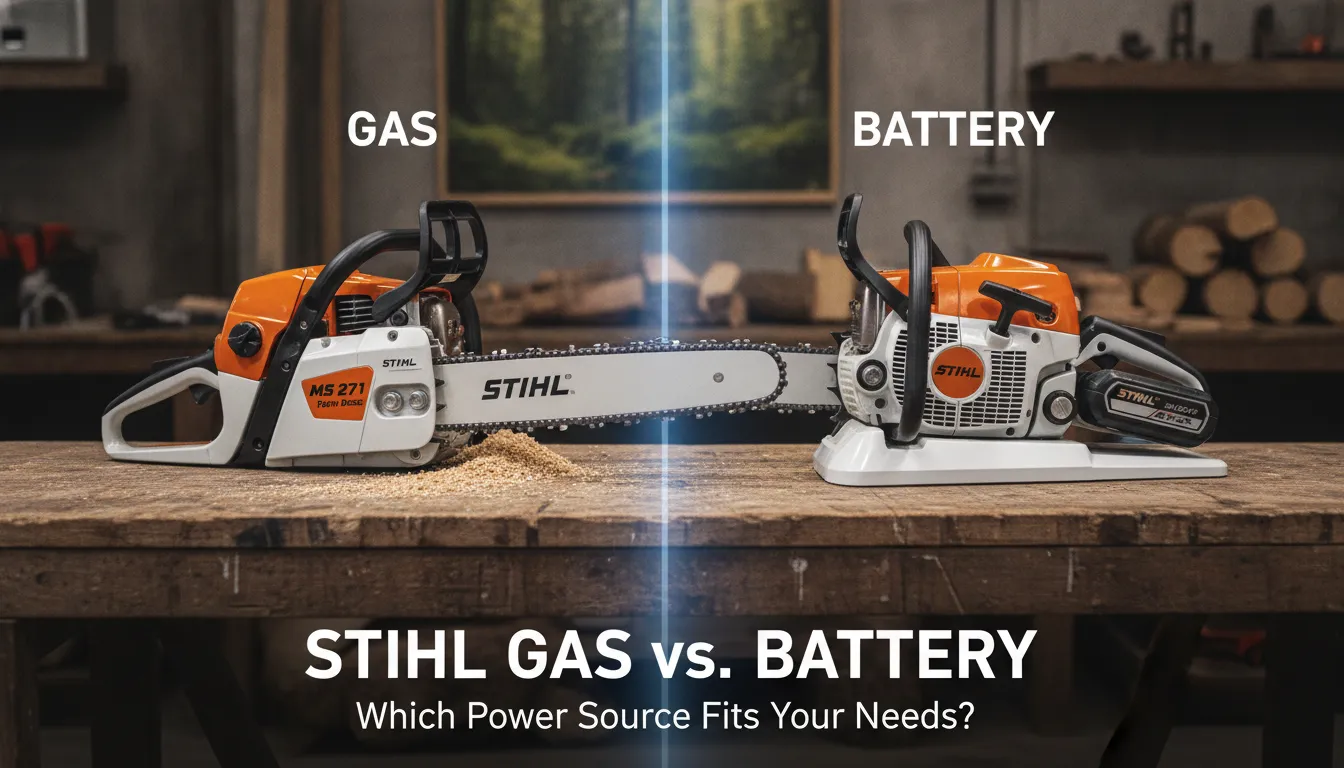
The Strategic Battlefield: At a Glance
Before we dive into the metallurgy and the chemistry, let’s look at how the heavy hitters stack up on the spec sheet.
| Feature | Stihl MS 261 C-M (Gas) | Stihl MSA 300 C-O (Battery) | Stihl MS 170 (Gas) | Stihl MSA 140 C-B (Battery) |
|---|---|---|---|---|
| Power Output | 3.0 kW (4.0 bhp) | 2.5 kW / 3.0 kW (Boost) | 1.3 kW (1.7 bhp) | ~1.1 kW |
| Weight (Dry/No Bat) | 10.8 lbs | 9.9 lbs (Motor only) | 8.6 lbs | 5.7 lbs |
| Operating Weight | ~13.5 lbs (Fuel/Oil/Bar) | ~17.2 lbs (AP 500 S/Bar) | ~11.0 lbs | ~10.4 lbs (AK 30/Bar) |
| Max Chain Speed | ~25.6 m/s | ~30.0 m/s | ~18.6 m/s | ~14.0 m/s |
| Primary Use | Pro Forestry | Pro/Municipal | Homeowner/Light Use | Homeowner/Noise Sensitive |
| Buy Now | 🛒 Check Gas Price | 🛒 Check Battery Price | 🛒 Check MS 170 Price | 🛒 Check MSA 140 Price |
Technical Engineering Deep-Dive: The Heart of the Beast
Internal Combustion: The 2-MIX Legacy
Stihl’s gas dominance isn’t just about legacy; it’s about the 2-MIX engine technology. Traditional two-stroke engines are inherently dirty because the fresh fuel-air mixture pushes out the exhaust gases, and inevitably, some raw fuel escapes through the exhaust port. Stihl’s 2-MIX system adds a layer of fuel-free air between the burned charge in the combustion chamber and the fresh charge in the crankcase.
When I pull the cord on a Stihl MS 500i, I’m engaging a machine that uses electronically controlled fuel injection—a first in the chainsaw world. But even in the standard carb models, the engineering is obsessive. The magnesium crankcases are cast to tolerances that would make a watchmaker sweat. The heat dissipation fins on the cylinder head are strategically angled to maximize airflow from the centrifugal fan, ensuring that even when you’re deep in a 24-inch bucking cut in 90-degree heat, the piston doesn’t seize.
The torque curve on a gas saw like the MS 261 is “peaky.” You have to keep it in the power band. If you bury the bar and let the RPMs drop below 8,000, you’re losing efficiency. It requires an active relationship between the operator’s trigger finger and the engine’s mechanical limits.
Battery Electrification: The EC Motor Revolution
Now, let’s look at the Stihl MSA 300. This isn’t just a motor strapped to a battery. It uses an Electronically Commutated (EC) motor. There are no carbon brushes to wear out. The power delivery is handled by a sophisticated controller that manages the three-phase current from the lithium-ion cells.
The physics of an electric motor are fundamentally different from gas. An electric motor delivers 100% of its torque at 0 RPM. This is a game-changer for limbing. In the time it takes for a gas saw to “spool up” to its power band, the battery saw has already made the cut.
However, the bottleneck isn’t the motor; it’s the energy density of the Lithium-Ion cells. Even the AP 500 S battery, which is a marvel of chemistry, can’t compete with the energy-to-weight ratio of high-octane gasoline mixed with Motomix. A gallon of gas contains roughly 33 kWh of energy. An AP 500 S battery contains 0.337 kWh. That means you would need nearly 100 batteries to match the raw energy potential of one gallon of fuel. But—and this is a huge “but”—gas engines are only about 20-25% efficient, while electric motors are over 90% efficient. The gap is closing, but for high-intensity, all-day felling, gas still holds the crown of “energy density king.”
Filtration and Cooling
In a gas saw, the Long-Life Air Filter System with routing through the centrifugal separator is critical. It flings the heavy dust particles outward so the filter stays clean longer. On a battery saw, there is no air intake for combustion, but cooling is still a massive hurdle. High-discharge rates generate heat in the battery cells. Stihl manages this with internal cooling fins and airflow channels. If you push an MSA 220 too hard in heavy timber, the thermal protection circuit will kick in, forcing a “cool down” period. You don’t have that with gas; if it’s too hot, you just give it more air.
Real-World Performance: Into the Wood
When I took the Stihl MS 462 C-M out alongside the MSA 300 to clear a stand of downed Hickory after a microburst, the differences were tactile.
Bucking (Large Diameter Logs)
In 20-inch Hickory, the gas saw is the undisputed victor. The MS 462 has a “lugging power” that feels infinite. You can lean into the dawgs, pull the bar through the wood, and the M-Tronic system adjusts the timing to keep the chain moving. There’s a “growl” that changes pitch but never loses its rhythm.
The MSA 300, while impressive, requires a lighter touch. If you try to bully it through the heartwood of a dense hardwood, the electronics will sense the amperage spike and throttle back to protect the motor. You have to let the chain speed do the work rather than the torque.
Limbing (Precision and Speed)
This is where the battery saw shines. Limbing involves a lot of “trigger time” but very little “full-load time.” With a gas saw, you’re idling between cuts, burning fuel, creating noise, and inhaling fumes. With the battery saw, it’s instant-on, instant-off. The silence between cuts allows you to hear what’s happening in the canopy—a safety feature that people often overlook.
The weight distribution on the battery units is also centered. Since there’s no heavy fuel tank in the rear and no cylinder head up front, the “pivot point” is right at the front handle. This makes it incredibly flickable for clearing branches.
🛒 Explore Stihl Battery AccessoriesErgonomics & Operator Comfort: The Price of Power
As a professional, I look at ergonomics as “fatigue management.”
The Weight Paradox
Gas saws are lighter “out of the box” for the power they provide. A 50cc gas saw is significantly lighter than a battery saw with equivalent run-time (which would require multiple batteries). However, the battery saw lacks the high-frequency vibration of a reciprocating piston.
After 4 hours of bucking with a gas saw, my hands feel “thick.” Even with Stihl’s excellent anti-vibration springs, you can’t escape the physics of a 12,000 RPM explosion happening inches from your grip. The battery saw is smooth. It hums rather than vibrates. For users with carpal tunnel or joint issues, the battery saws are a godsend.
Handle Geometry
Stihl has maintained a consistent handle geometry across both lines. Whether you’re holding a Stihl MS 180 or an MSA 200, the distance between the front and rear handles remains optimized for leverage. However, the battery saws often feel “taller” because of the battery slot, which can occasionally snag on tight brush when you’re deep in the thicket.
Historical Context: From the 1926 Electric to Today
People think battery saws are new. They aren’t. Andreas Stihl developed the first electric chainsaw in 1926. It was a two-man behemoth designed for use in log yards where electricity was plentiful but gas was scarce.
The modern shift toward battery is driven by two things: regulations and urbanization. In Europe, noise ordinances are forcing crews to go electric. In North America, we’re seeing it more in residential tree care. Stihl has positioned their battery lineup not as a replacement for gas, but as a parallel evolution. They didn’t just slap a battery on a hobbyist tool; they integrated the ruggedness of the “Farm & Ranch” series into the cordless world.
Maintenance & Serviceability: The Garage Factor
The Gas Ritual
Gas saws are mechanical puzzles. You have to manage the fuel-to-oil ratio (50:1), clean the spark arrestor, adjust the carburetor (if it’s not an M-Tronic model), and replace spark plugs. I find this rewarding. There’s a satisfaction in knowing exactly why a saw isn’t starting—usually a fouled plug or a clogged fuel filter.
The Battery Reality
Battery saws are “appliance-like.” You check the bar oil, sharpen the chain, and that’s about it. There’s no air filter to blow out (mostly), no fuel to stabilize for winter, and no pull cord to snap. But, when a battery saw fails, it’s usually an electronic module or a controller board. You aren’t fixing that in the woods with a scrench. It’s a “take it to the dealer” situation.
The SAWOFF Edge Insight: If you live 50 miles from the nearest dealer, buy gas. You can fix almost any gas issue with a basic tool kit. If you live in a suburb and hate the smell of gasoline in your garage, battery is the clear winner.
Hardware Specs: The Raw Data
Stihl Gas (Professional Series Standards)
- Cylinder: Chrome-plated or Nikasil-coated.
- Crankcase: Die-cast magnesium.
- Ignition: Electronic with variable timing.
- Chain Tensioning: Side-access (standard on pro models).
- Decompression Valve: Standard on 50cc+ models to reduce pull effort.
Stihl Battery (AP System Standards)
- Motor Type: Brushless EC motor.
- Voltage: 36V System.
- IPX4 Rating: Certified for all-weather use (you can use these in the rain).
- Cooling: Active air cooling for the power electronics.
- Control: Variable speed trigger with “Eco” mode on select models.
Pros & Cons
Gas-Powered Stihl
- Pros:
- Infinite Runtime: Just pour in more fuel and keep cutting.
- Raw Torque: Better for high-diameter, hardwood felling.
- Serviceability: Can be maintained and repaired by the owner.
- Cost: Lower initial entry price compared to saw + batteries + charger.
- Cons:
- Noise: Requires heavy ear protection and limits working hours in residential areas.
- Maintenance: Requires mixing fuel and regular engine tuning.
- Vibration: Higher fatigue over long periods.
Battery-Powered Stihl
- Pros:
- Instant Start: No pull cords, no cold-start drama.
- Quiet Operation: Can talk to your ground crew without turning off the saw.
- Zero Emissions: Better for the environment and the operator’s lungs.
- Low Maintenance: No fuel, no spark plugs, no filters.
- Cons:
- Runtime Bottleneck: When the battery dies, you’re done until it charges.
- Weight: Batteries are heavy, making the overall “wet” weight higher in some classes.
- Initial Investment: The cost of 3-4 AP 500 S batteries is more than the saw itself.
Final Verdict: Which One Fits?
After years of running both, I’ve come to a conclusion that isn’t a cop-out: The power source fits the task, not the person.
If you are a landowner with 20 acres of mixed hardwood, felling 10-15 trees a year for firewood, the Stihl MS 271 Farm Boss is your tool. It is the gold standard for reliable, high-torque work that doesn’t rely on a charging grid.
If you are a “prosumer” with a few acres, or an arborist who spends 60% of their time in a bucket truck or doing residential removals, the Stihl MSA 300 is a revelation. The lack of noise and the instant power delivery make it more efficient for 80% of common tree tasks.
SAWOFF Rating: 4.8 / 5 (Gas) | 4.6 / 5 (Battery)
The only thing keeping battery from a perfect score is the cost of entry and the thermal throttling under extreme load. But make no mistake, the gap is narrowing every single year.
🛒 Shop Stihl Gas ChainsawsFAQ: Clearing the Smoke (and the Hum)
1. Can I use a battery saw in the rain?
Yes, most of Stihl’s professional-grade battery saws (AP system) are rated IPX4, meaning they are splash-resistant and can be used in the rain. I’ve run an MSA 220 in a North Carolina downpour with zero electrical issues.
2. How many batteries do I need to equal a tank of gas?
In a high-power saw like the MSA 300, one AP 500 S battery lasts roughly 20-40 minutes depending on the load. To match a full day of “pro-level” cutting (about 4-5 tanks of gas), you would realistically need 4 to 6 large batteries.
3. Does the chain oil last longer on battery saws?
Actually, it’s about the same. Since the chain only spins when you pull the trigger, you aren’t “wasting” oil at idle. However, the flow rate is still tied to the chain speed. Always check your oil every time you swap a battery.
4. Is the chain different for battery saws?
Often, yes. Stihl uses “Picco Micro” or “Light 04” bars and thin-kerf chains (like the 1/4-inch PM3) on battery saws. This thinner chain requires less energy to pull through the wood, maximizing battery life.
5. Why is my gas saw hard to start after sitting for a month?
Ethanol. Modern pump gas contains ethanol which attracts moisture and gums up the tiny passages in a chainsaw carb. If you’re going gas, use Stihl MotoMix or an ethanol-free high-octane fuel to avoid this.
6. Can I sharpen a battery saw chain the same way?
Absolutely. The teeth are made of the same chrome-plated steel. Use the appropriate file size (usually 5/32” or 3/16” depending on the pitch).
7. Which is safer?
Battery saws have an inherent safety advantage: they are “off” when the trigger is released. There is no rotating centrifugal clutch that might stay engaged if the idle is set too high. However, the instant torque of a battery saw can cause a faster kickback if you aren’t careful. Always wear your chaps.
Frequently Asked Questions
Can I use a battery saw in the rain?
Yes, most of Stihl's professional-grade battery saws (AP system) are rated IPX4, meaning they are splash-resistant and can be used in the rain. The MSA 220 and MSA 300 have been tested in heavy downpours with zero electrical issues.
How many batteries do I need to equal a tank of gas?
In a high-power saw like the MSA 300, one AP 500 S battery lasts roughly 20-40 minutes depending on the load. To match a full day of pro-level cutting (about 4-5 tanks of gas), you would realistically need 4 to 6 large batteries.
Is the chain different for battery saws?
Often yes. Stihl uses Picco Micro or Light 04 bars and thin-kerf chains on battery saws. This thinner chain requires less energy to pull through the wood, which maximizes battery life and runtime.
Why is my gas saw hard to start after sitting for a month?
Ethanol in modern pump gas attracts moisture and gums up the tiny passages in a chainsaw carburetor. Use Stihl MotoMix or ethanol-free high-octane fuel to avoid this problem entirely.
Which is safer—gas or battery?
Battery saws have an inherent safety advantage because they are off when the trigger is released, with no rotating centrifugal clutch that might stay engaged. However, the instant torque of a battery saw can cause faster kickback if you aren't careful. Always wear chaps regardless of power source.
Does the chain oil last longer on battery saws?
It's about the same. Since the chain only spins when you pull the trigger, you aren't wasting oil at idle like with gas saws. However, the flow rate is still tied to chain speed, so check your oil every time you swap a battery.