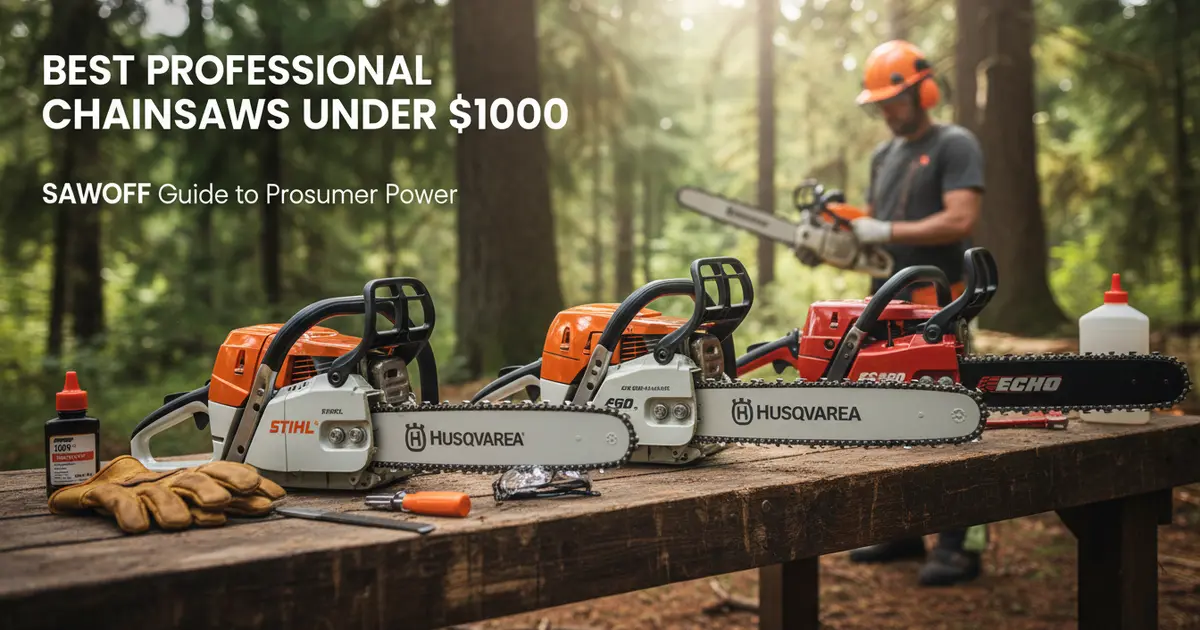
The Best Professional Chainsaws Under $1000: A Technical Deep-Dive into Prosumer Dominance
When you cross the $600 threshold and start eyeing that $1,000 ceiling, you aren’t just buying a tool; you’re investing in a legacy of engineering. For those of us who have spent fifteen years clearing fence lines, felling stubborn hardwoods, and feeling the heat of a magnesium crankcase through our gloves, the “Under $1,000” category is the sweet spot. It’s where “homeowner grade” plastic gives way to professional-grade metallurgy, and where “lugging power” becomes a tangible reality rather than a marketing buzzword.
I’ve run almost every saw on this list until the bar was too hot to touch. At SAWOFF, we don’t care about the shiny plastic covers; we care about the scavenge losses, the torque curves, and how a saw feels after six hours of bucking frozen white oak. If you’re looking for a saw that won’t bog down when the dogs bite into a 20-inch trunk, you’re in the right place.
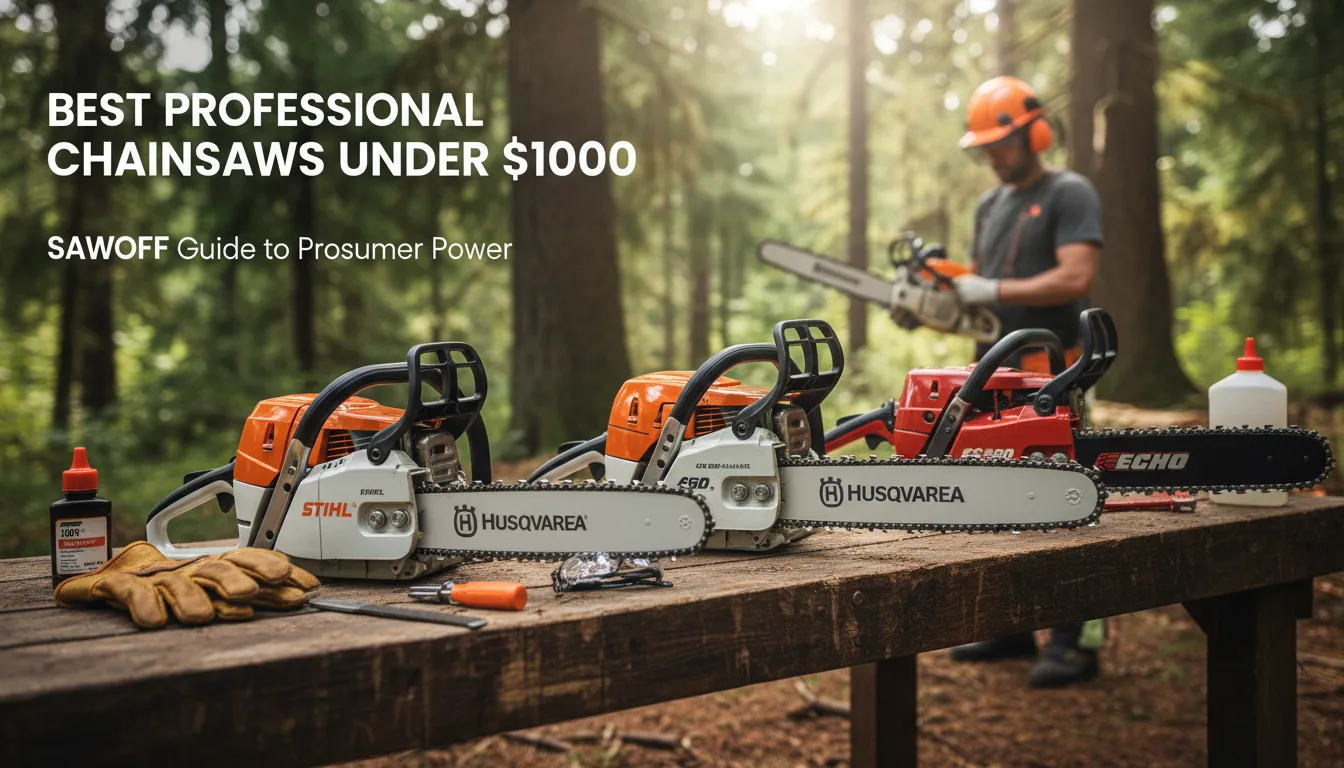
The Heavy Hitters: A Strategic Comparison
Before we tear these machines down to the studs, let’s look at how the top contenders stack up on paper. These are the “Big Three” that define the sub-$1000 landscape.
| Model | Displacement | Power Output | Dry Weight | Best Use Case | Check Price |
|---|---|---|---|---|---|
| Stihl MS 261 C-M | 50.2 cc | 4.0 bhp | 10.8 lbs | Pro Woodcutting | 🛒 View on Amazon |
| Husqvarna 460 Rancher | 60.3 cc | 3.62 bhp | 13.2 lbs | Farm & Ranch | 🛒 View on Amazon |
| Echo CS-590 Timber Wolf | 59.8 cc | 3.9 bhp | 13.2 lbs | Best Value / Torque | 🛒 View on Amazon |
| Stihl MS 391 | 64.1 cc | 4.4 bhp | 13.7 lbs | Heavy Bucking | 🛒 View on Amazon |
Technical Engineering Deep-Dive: What’s Under the Hood?
To understand why a Stihl MS 261 costs twice as much as a box-store special despite having a smaller displacement, you have to look at the internals. In the sub-$1000 range, we move away from “clamshell” engine designs and into true split-case construction.
The Magnesium Revolution
Most saws under $400 use a plastic (polyamide) chassis where the engine sits in a plastic cradle. When you’re pushing into the prosumer $600–$900 range, you’re paying for a magnesium alloy crankcase. Why does this matter? Heat dissipation and rigidity. Magnesium can withstand the incredible thermal stresses of high-RPM operation without warping. When I’m felling a 30-inch maple, I need the crankshaft bearings to stay perfectly aligned. A plastic-cased saw will flex under that kind of load; a magnesium saw stays true.
Fuel Layering and Scavenging
The engineering of a Husqvarna 460 utilizes X-Torq technology, while Stihl relies on their 2-MIX system. Both are designed to solve the inherent inefficiency of two-stroke engines: “short-circuiting,” where unburnt fuel escapes through the exhaust port.
These systems use a layer of fresh air to push out the exhaust gases before the new fuel-air mixture enters the combustion chamber. In the field, this translates to a 20% reduction in fuel consumption and significantly more torque at lower RPMs. You can hear the difference—it’s that guttural “braap” that doesn’t falter when the chain hits a knot.
Intelligent Carburetion: M-Tronic vs. AutoTune
The pinnacle of this price bracket is electronic engine management. The Stihl MS 261 C-M features the M-Tronic system. Gone are the days of fiddling with “L” and “H” screws with a tiny screwdriver in the freezing rain. A microprocessor adjusts the ignition timing and fuel metering 30 times per second.
I’ve taken an M-Tronic saw from sea level up to 5,000 feet in a single afternoon. On a traditional saw like the Echo CS-590 Timber Wolf, I would have been stopping to tune for the thinner air. The M-Tronic saw just compensated and kept screaming. It’s a game-changer for professional productivity.
Filtration and Centrifugal Air Cleaning
Husqvarna’s “Air Injection” is the gold standard here. It uses centrifugal force to eject larger dust and wood particles before they ever reach the air filter. When I’m bucking dry, “punky” oak, the dust is incredible. With a Husqvarna 455 or 460, I can often go an entire week without cleaning the filter. Stihl’s HD2 filters are also superb, made of a polyethylene material that repels water and oil, making them far superior to the old felt or foam filters found on cheaper models like the Husqvarna 120.
Real-World Performance Analysis: The “Grin Factor”
Specs are just numbers until the chain hits the wood. Let’s talk about how these machines actually behave when you’re in the thick of it.
Bucking and Limbing
If your primary job is limbing—removing branches from a downed tree—weight is your enemy. This is where the Stihl MS 261 shines. It is arguably the most balanced 50cc saw ever built. The power-to-weight ratio is surgical. You can flick it through branches with a precision that prevents fatigue.
On the other hand, if you are bucking (cutting the trunk into firewood lengths), you want the mass and “grunt” of something like the Echo CS-590. While heavier, the CS-590 has a massive amount of low-end torque. You can lean on it. You can feel the saw pull itself through the cut. In my experience, the CS-590 out-torques the Stihl MS 271 significantly, making it the “blue-collar hero” of this price range.
Bore Cutting and Felling
Bore cutting—plunging the nose of the bar directly into the tree—requires an engine that can recover quickly from a momentary RPM drop. The Husqvarna 460 Rancher is a beast at this. Its 60cc displacement provides enough inertia that the chain doesn’t stall when the tip initiates the cut. I’ve used the 460 to drop 24-inch pines with ease, though I’d recommend a 20-inch bar over the 24-inch for maximum efficiency.
Ergonomics and Operator Comfort: Fighting the “White Finger”
Vibration is the silent killer of a woodcutter’s career. Long-term exposure leads to Hand-Arm Vibration Syndrome (HAVS), or “white finger.”
The saws in the under $1000 category utilize advanced spring-based anti-vibration systems. Look at the Husqvarna 450 or its larger brother the 460; they use heavy-duty steel springs to decouple the handles from the engine. It feels “mushy” to some old-school loggers, but your joints will thank you after four hours of work.
I’ve noticed that Stihl’s AV system feels a bit more “connected.” You get more feedback from the bar, which I prefer when doing delicate felling work. However, for pure comfort during a long day of firewood production, the Husqvarna LowVib system is hard to beat.
The Grip and Geometry
The handle geometry on the Echo CS-490 and CS-590 is surprisingly ergonomic. The wrap handle is thick enough to provide a secure grip even with wet leather gloves. One minor gripe: the trigger lockout on some newer Stihl models can feel a bit “plasticky” compared to the older, more robust magnesium-housed triggers of the 90s, but that’s a small price to pay for the weight savings.
Brand Heritage: Where Does Your Saw Come From?
The Stihl Legacy
Stihl is the juggernaut. When you buy a Stihl MS 250 or an MS 311, you’re buying into a dealer network that is second to none. The MS 261, specifically, is a direct descendant of the legendary MS 026/260. It’s a saw designed for professionals who need a light “ground saw.” It’s built in Waiblingen, Germany (or Virginia Beach, USA), with a level of QC that is legendary.
The Husqvarna “Rancher” Pedigree
The “Rancher” nameplate, including the Husqvarna 450 and 455, has become the definitive farm saw. Husqvarna (the “Orange Saw”) is known for its high-revving engines. If Stihl is a diesel truck, Husqvarna is a turbocharged sports car. They like to run hot and fast.
The Echo Value Proposition
Echo often gets overlooked by “pro” snobs, but the CS-590 Timber Wolf is the most disruptive saw in the market. It offers professional features—magnesium case, decompression valve, adjustable oiler—at a price that undercuts the Europeans by $200. It’s the spiritual successor to the reliable old Homelite and McCulloch saws that built America.
Maintenance & Serviceability: Keeping the Beast Hungry
A saw is only as good as its last sharpening and its air filter’s cleanliness.
- Air Filter Access: The Stihl MS 291 and MS 391 feature a tool-less filter cover. One twist of a knob and you’re in. This is vital in the field.
- Chain Tensioning: Most saws in this range have side-access tensioning. Avoid any saw that requires you to stick a flathead screwdriver through the front of the bar cover—it’s dangerous and clumsy. The Husqvarna 435 and 440 have decent systems, but the Husqvarna 460 has a much more robust dual-nut bar mount that holds the tension far longer.
- The Spark Plug: It’s a small thing, but the spark plug placement on the Echo CS-400 and CS-590 is excellent. It’s shielded but accessible. I’ve seen some prosumer saws where you practically have to disassemble the shroud just to check the gap.
Maintenance Schedule for Prosumer Saws
- Every 5 Tanks: Blow out the air filter with compressed air.
- Every 10 Tanks: Flip the bar to ensure even wear on the rails.
- Daily: Check the grease on the needle bearing (especially on Husqvarna’s outboard clutch designs).
Hardware Specs: The Raw Data
| Feature | Stihl MS 261 C-M | Husqvarna 460 | Echo CS-590 |
|---|---|---|---|
| Engine Type | 2-MIX / M-Tronic | X-Torq | 2-Stroke Professional |
| Decompression Valve | Yes | Yes | Yes |
| Oiler Type | Adjustable | Adjustable | Adjustable |
| Max Bar Length | 20” | 24” | 24” |
| Crankcase Material | Magnesium | Magnesium | Magnesium |
| Chain Pitch | .325” or 3/8-inch | 3/8-inch | 3/8-inch |
Pros and Cons: The SAWOFF Edge
Stihl MS 261 C-M
- PROS: Incredible power-to-weight ratio; M-Tronic takes the guesswork out of tuning; extremely low vibration.
- CONS: Most expensive 50cc saw; requires a Stihl dealer for electronic diagnostics.
- THE SAWOFF EDGE: This is the saw for the person who wants the absolute best and is willing to pay for it. It feels like a surgical instrument.
Husqvarna 460 Rancher
- PROS: Proven reliability; massive 60cc torque; great Air Injection system.
- CONS: Heavy for its power output; the “outboard” clutch makes chain changes slightly more annoying.
- THE SAWOFF EDGE: The ultimate “I only want to buy one saw for the rest of my life” tool. It’s the AK-47 of chainsaws.
Echo CS-590 Timber Wolf
- PROS: Unbeatable price; pure professional construction; easy to work on.
- CONS: A bit thirstier on fuel; the aesthetics are a bit dated (if you care about that).
- THE SAWOFF EDGE: The best value in the industry. Period. You get 95% of the performance of a professional Stihl for 60% of the price.
Final Verdict: Which Saw Should You Buy?
If you are a professional arborist or someone with 10+ acres of dense hardwood, the Stihl MS 261 C-M is the winner. It is the gold standard for 50cc saws.
However, for the average “prosumer” who needs to buck 10 cords of firewood a year and fell the occasional 30-inch oak, the Echo CS-590 Timber Wolf is my top recommendation. It is a true 60cc professional-grade machine that leaves enough money in your pocket to buy a high-quality helmet, chaps, and extra chains.
If you prefer the screaming RPMs and ergonomics of the Swedes, the Husqvarna 460 Rancher is a tank that will never let you down.
SAWOFF Rating: 4.8 / 5
FAQ: Professional Technical Support
1. What fuel mixture should I use for these prosumer saws?
Always use a 50:1 ratio with a high-quality synthetic oil (like Stihl HP Ultra or Husqvarna XP). Crucially, use non-ethanol (REC-90) gasoline. Ethanol attracts moisture and will gum up the delicate fuel injectors or carburetors in these high-performance machines.
2. Why does my saw bog down when I start the cut?
Usually, this is a sign of a dull chain or a depth gauge (raker) issue. If the chain is sharp, you might be leaning too hard on a saw that doesn’t have the torque for that specific bar length. For a Husqvarna 445, stick to a 16-18” bar.
3. My Stihl M-Tronic saw won’t start. What do I do?
First, ensure you are using the “Triangle” start position. If it still won’t fire, try the “Reset” procedure: start the saw in the cold start position, let it idle for 90 seconds, then shut it off. This recalibrates the electronic carb to your current ambient conditions.
4. Is the magnesium crankcase really that much better than plastic?
Yes. For long-term durability, magnesium is essential. Plastic (clamshell) engines are designed to be replaced, not repaired. Magnesium cases allow for bearing replacement and can handle much higher heat cycles without losing structural integrity.
5. What is the best bar length for a 60cc saw?
While the Husqvarna 460 and Echo CS-590 can pull a 24-inch bar, they are much “happier” and faster with a 20-inch bar. You get better chain speed and better balance.
6. How often should I replace my spark plug?
I check mine every season. If the electrode is rounded or the color is anything other than a “toasted marshmallow” brown, swap it out. A $5 spark plug can save you a lot of frustration in the woods.
7. Should I buy the “AutoTune” or “M-Tronic” version?
If you are a professional, yes. The productivity gain from never having to tune a carb is worth the extra $100. If you are a hobbyist who enjoys mechanical tinkering, a traditional carb like the one on the Echo CS-490 might be more your speed.
8. My chain is smoking but it’s sharp. What’s wrong?
Check your oiler. The Stihl MS 311 and most others in this class have an adjustable oiler on the bottom of the saw. Turn it up. Also, ensure the oil holes in the bar itself aren’t clogged with sawdust and pitch.
🛒 Shop All Top-Rated Professional ChainsawsFrequently Asked Questions
What fuel mixture should I use for these prosumer saws?
Always use a 50:1 ratio with a high-quality synthetic oil like Stihl HP Ultra or Husqvarna XP. Crucially, use non-ethanol (REC-90) gasoline because ethanol attracts moisture and will gum up the fuel injectors or carburetors in these high-performance machines.
Why does my saw bog down when I start the cut?
This is usually a sign of a dull chain or a depth gauge (raker) issue. If the chain is sharp, you might be leaning too hard on a saw that doesn't have the torque for that specific bar length. Match your bar length to your saw's displacement for optimal performance.
Is the magnesium crankcase really that much better than plastic?
Yes, for long-term durability magnesium is essential. Plastic clamshell engines are designed to be replaced, not repaired. Magnesium cases allow for bearing replacement and can handle much higher heat cycles without losing structural integrity.
What is the best bar length for a 60cc saw?
While 60cc saws can pull a 24-inch bar, they are much happier and faster with a 20-inch bar. You get better chain speed and better balance, which translates to less fatigue during extended cutting sessions.
Should I buy the AutoTune or M-Tronic version?
For professionals, the productivity gain from never having to tune a carb is worth the extra $100. If you're a hobbyist who enjoys mechanical tinkering, a traditional carb might be more your speed. Both systems automatically adjust for altitude and fuel quality.
My chain is smoking but it's sharp—what's wrong?
Check your oiler adjustment on the bottom of the saw and turn it up. Also ensure the oil holes in the bar itself aren't clogged with sawdust and pitch. A properly oiled chain should never smoke, even when cutting hardwood.