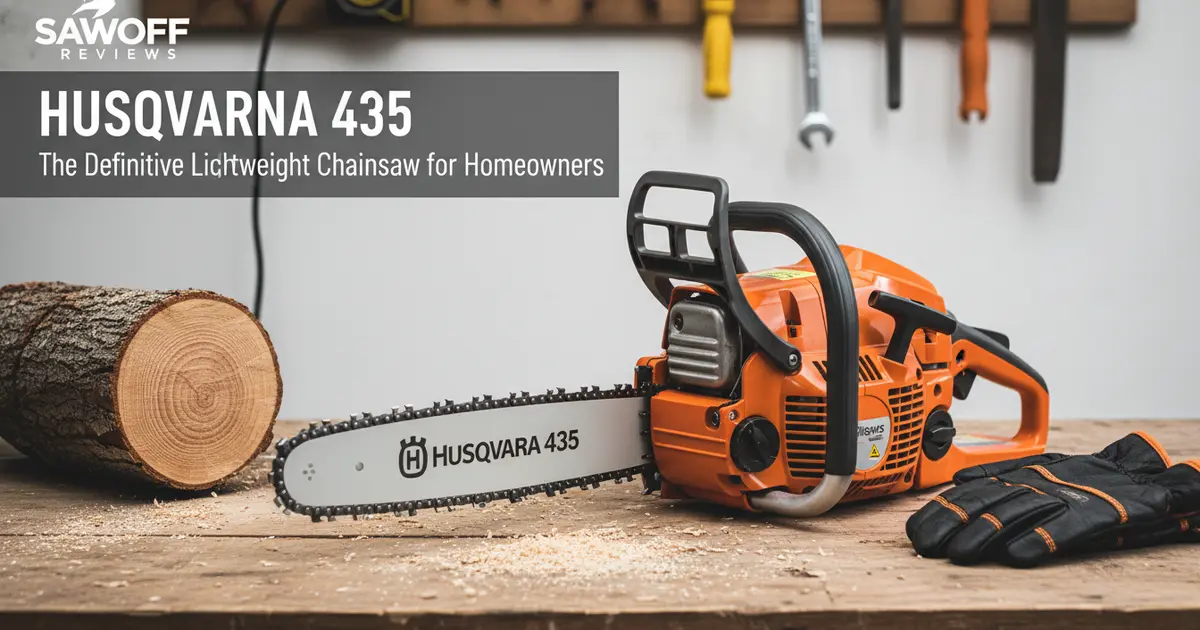
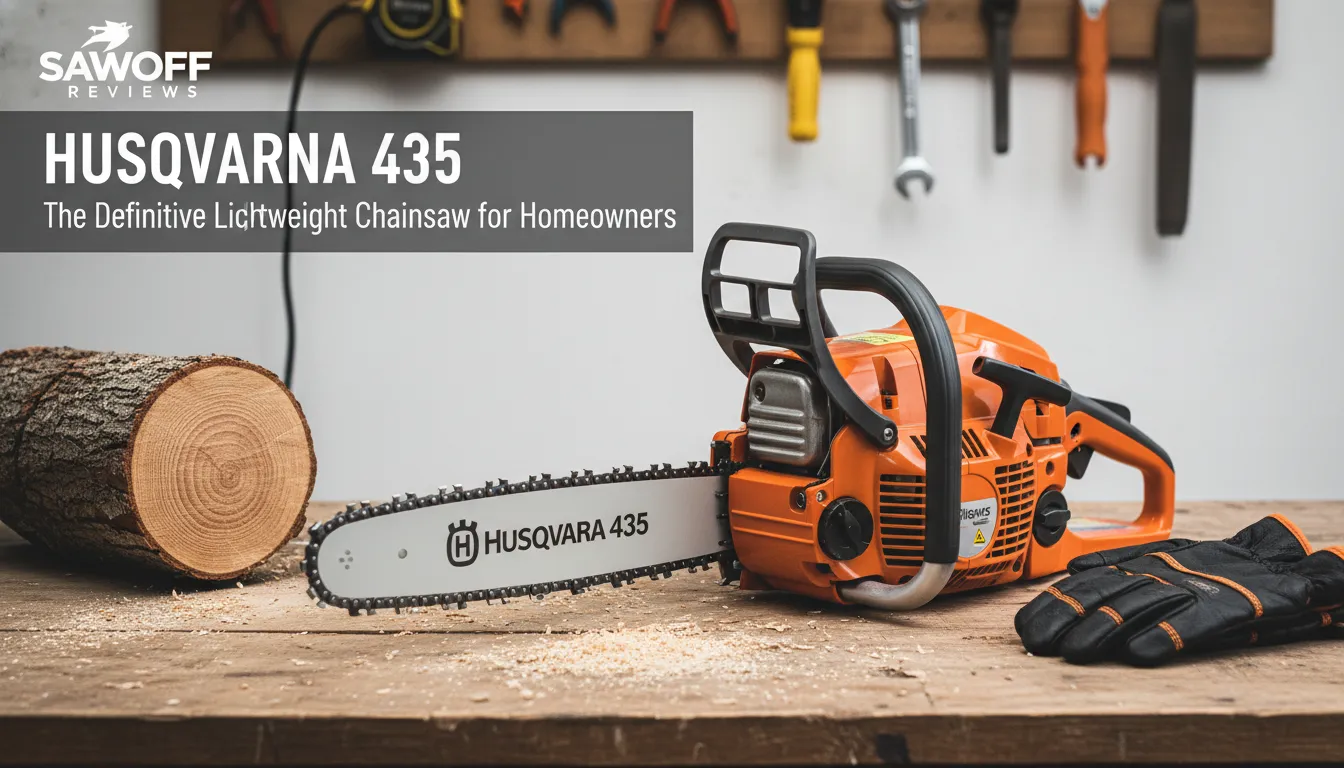
The Husqvarna 435 is the benchmark in the all-around residential chainsaw category. At 40.9cc and just 9.2 lbs, it delivers a power-to-weight ratio that makes it ideal for limbing, firewood processing, and storm cleanup. We tested it on mixed hardwoods over three weeks to evaluate its real-world capabilities.
Quick Comparison: The 40cc Class Leaders
| Model | Displacement | Weight | Power Output |
|---|---|---|---|
| Husqvarna 435 | 40.9 cc | 9.2 lbs | 2.2 hp |
| Stihl MS 211 | 35.2 cc | 9.5 lbs | 2.3 hp |
| Echo CS-400 | 40.2 cc | 10.1 lbs | 2.0 hp |
Performance Analysis: The X-Torq Advantage
The X-Torq engine delivers 2.2 hp with a 20% reduction in fuel consumption and up to 75% fewer emissions versus traditional two-strokes. Chain speed and throttle response are excellent—the 435 excels at precision limbing where frequent throttle transitions are required.
Our key advice: This saw prefers high chain speed and light pressure. Do not muscle it through cuts. Let the X-Torq engine work at its natural RPM and it will reward you with clean, fast cuts.
For more on power source considerations, read gas vs electric chainsaw.
Hardware Specs & Technical Breakdown
- Engine Displacement: 40.9 cm³
- Power Output: 1.6 kW / 2.2 hp at 9,000 RPM
- Idling Speed: 2,900 RPM
- Fuel Tank: 0.37 Liters
- Oil Tank: 0.25 Liters
- Vibration (F/R): 2.5 / 3.2 m/s²
- Chain Pitch: .325”
Ergonomics and Maintenance Features
The LowVib system uses steel springs rather than rubber bushings, effectively isolating engine vibration. Tool-less cylinder cover access via felling-lever clips allows rapid spark plug and filter inspection. The Smart Start system reduces starter cord resistance by up to 40%.
Maintenance checklist: Clean the Air Injection centrifugal system every 15 hours. Check spark plug gap (0.020”) each season. Use ethanol-free fuel to prevent carburetor diaphragm hardening.
Always confirm your bar and chain match your model.
Chainsaw Safety
Read our chainsaw safety guide before operating. The inertia-activated chain brake is your primary safety system. Test it before each use. Always maintain two hands on the saw.
Pros & Cons
Pros: Exceptional power-to-weight at 9.2 lbs; X-Torq fuel efficiency; LowVib reduces fatigue significantly; Smart Start makes starting easier; tool-less filter access.
Cons: Composite crankcase not pro-grade; chain tensioning requires scrench on standard model; fixed oil pump; not suitable for hardwoods over 14 inches diameter.
Final Verdict
The Husqvarna 435 is a surgical instrument in a world of sledgehammers. It provides refinement and technical sophistication missing in homeowner-grade saws. Ideal for property maintenance, light firewood duty, and storm cleanup—not for dropping 30-inch oaks.
SAWOFF Rating: 4.7 / 5
Get out there and cut. Safely.
Frequently Asked Questions
What fuel mix does the Husqvarna 435 require?
A 50:1 ratio of high-quality unleaded gasoline (minimum 89 octane) to 2-cycle engine oil. Using Husqvarna pre-mixed XP fuel can extend warranty and engine longevity.
Can I use an 18-inch bar on the 435?
The 435 can physically mount an 18-inch bar but is optimized for 14 or 16 inches. An 18-inch bar increases load on the 40.9cc engine, slowing chain speed and risking overheating.
How does the 435 differ from the 435e?
The 435e includes a tool-less chain tensioning system and easier starting mechanism. The core engine specs remain identical between the two variants.
Is the 435 suitable for professional use?
The 435 is classified as a homeowner saw. Its composite crankcase is not intended for 8-hour daily professional use. For pro work, look at Husqvarna 500-series XP saws.
How often should I clean the air filter?
Thanks to the Air Injection system, inspect every 10-15 tanks of fuel. In dry, dusty conditions check more frequently. Tap clean gently—never use compressed air.
What is the weight of the Husqvarna 435?
The powerhead weighs 9.2 lbs, making it one of the lightest 40cc saws on the market and excellent for overhead limbing and precision work.
Does the 435 have an adjustable oiler?
No, the oil pump is fixed flow. It delivers adequate lubrication for 14-16 inch bars but cannot be adjusted for different wood densities or bar lengths.