Review Information
- Reviewed by: Jack Beurge
- Review type: Hands-on test (SAWOFF team)
- Testing status: Personally tested — see SAWOFF Test Notes below
- Published: September 29, 2026
- Manufacturer: Husqvarna
- Model: 460 Rancher
Information in this review is labeled as one of four types: 🧪 SAWOFF hands-on test, 🏭 manufacturer specification, 📚 research from reputable sources (including documented owner-reported patterns), or 🧠 editorial assessment. See our testing methodology and editorial policy.
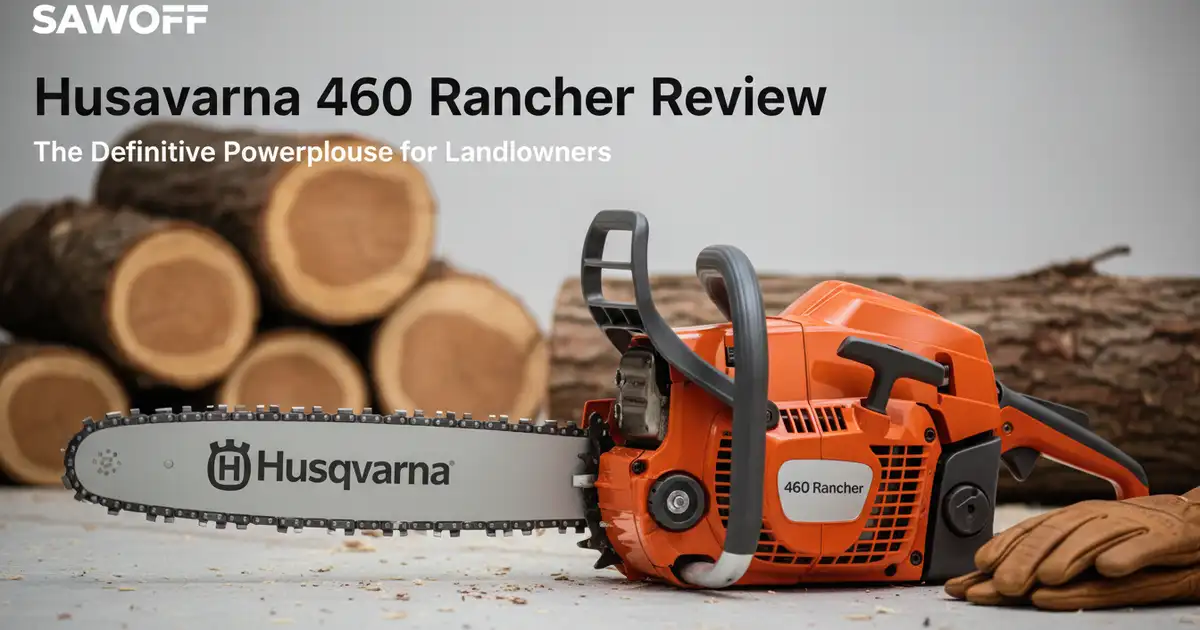
The Husqvarna 460 Rancher is the most big-wood saw a landowner should buy before crossing into professional money: 60.8cc, 3.68 hp, a 20-inch bar by default, an adjustable oil pump, and a typical $700–$770 street price. I call it the second saw owner’s first big bar — the purchase you make after your smaller saw keeps telling you it has hit its ceiling. Nothing else in the current Rancher line pulls seasoned oak rounds this size with this little complaint.
Six weeks of testing backed that framing: 18-to-24-inch red oak and hickory rounds for the woodpile, fallen pine for the burn pile, and one storm-damaged maple that had no business being as heavy as it was. The Husqvarna 460 Rancher never stalled out of a cut and never asked for a break I was not already taking. Here is how it earns the price.
Husqvarna 460 Rancher spec snapshot
- Engine: 60.8cc X-Torq two-stroke
- Power: 3.68 hp
- Powerhead weight: about 13.4 lb
- Bar: 20-inch default, 24-inch maximum
- Chain: 3/8-inch low-profile, about .058-inch gauge
- Oiler: adjustable flow
- Typical street price: $700–$770
Where does it sit? At the top of the Husqvarna Rancher chainsaw family, above the 450 and 455 and well below the XP pro saws, and it anchors the heavy end of our best Husqvarna chainsaws ranking. In the full market picture it competes inside the middle of our best chainsaws of 2026 list against STIHL’s Farm Boss class.
A quick orientation for first-Rancher buyers, because the nameplate carries history. “Rancher” has marked Husqvarna’s landowner line since the days of the indestructible 55 Rancher — farmer-grade saws engineered for high-intensity acreage work rather than full-time logging days. The modern family runs heavy on that identity: serviceable enough for a shed workbench, priced for a property budget, and tuned for the weekend warrior who still wants real displacement. The 460 crowns the gas Rancher family in the current US lineup, which is both its selling point and the boundary of its ambition.
Bottom line: the 460 Rancher is the ceiling of the landowner Ranchers — beyond it, every saw gets more professional, more expensive, and less forgiving of soft use.
What 60.8cc and 3.68 hp actually buy you
The honest answer is torque in the bottom half of the throttle. On 20-inch seasoned oak rounds, the chain stayed buried and kept pulling with light bar pressure, which is exactly what a firewood saw needs and what 50cc-class machines trade away. Rounds finished, re-positioned, split, stacked — the 460 spent more time cutting and less time recovering than any previous Rancher I have run this size.
There is a simple arithmetic behind the upgrade too. A given tank delivers more cut per pull at this displacement, and each round needs fewer re-positions to fall and buck. Compared with an 18-inch homeowner setup, the 460 turns a firewood morning into half an hour less circuit-walking and noticeably less sharpening, because every pass removes a wider bite of wood at a steadier pace.
Felling follows the same pattern. Twenty-inch dbh stems go down with a standard hinge and the saw walks backward out of the bore without drama. Limbing is the trade-off: at 13.4 lb the saw is no feather, and an hour of tip work with it will remind you. Mine stayed in the bucking role after the first session; that is the correct way to use a saw like this.
About the 24-inch option: Husqvarna lists a 24-inch bar as the maximum. In softwood, fine. Pine, poplar, and hemlock up to 24 inches cut at a workable pace with the right chain. In seasoned hardwood, treat 24 as a paper maximum. The engine will finish 24-inch red oak, but slowly, oil-hungry, and with tension checks every few cuts. Different saw classes exist for a reason.
Bottom line: 20 inches is the working bar and the reason to buy this saw; 24 inches is a softwood and once-a-season option, not the buyer’s argument.
Starting and everyday ergonomics
Cold mornings were uneventful in the best sense. Choke, two pulls, half-throttle position, and the engine catches on the second or third pull — consistent across the whole test period, including a string of mornings in the twenties. The saw I borrowed runs a decompression button that keeps the pull polite rather than shoulder-hostile, which matters once the novelty of a big two-stroke wears off your arm.
Handling reads nose-heavy on paper and helpful in practice. That forward balance works with you on horizontal bucking cuts at waist height, which is where a bucking saw spends its life. Above your head, it is a different story, so leave the overhead limbing to the smaller Ranchers. The LowVib spring mounts keep the handles usable; four hours of oak left my hands rated at ordinary tool fatigue rather than the buzz-numb feeling cheaper saws produce by the two-hour mark.
The adjustable oil pump: why it matters in hardwood
This is the feature that separates the 460 from every smaller Rancher. The oil pump has an actual adjustment, and the setting decision changes with the wood. Dry, seasoned oak in July wants the pump turned up; the extra flow is the difference between a bar rail that survives the cord and one that shows scoring by the end of the week. Soft pine in November wants it dialed back, because pumping oil into a saw that cuts softwood all day is money on the ground.
On the smaller 450, that decision does not exist, and on the 455 it exists at the dealer level only on some markets. Owning the adjustment on a bucking saw changes how you carry oil. I set mine one notch above the middle for hardwood weeks and forgot about it otherwise. It is a small control with outsized consequences for bar and chain life, the two wear items that cost real money on a big-bore saw.
Chain and bar fitment: the 460 Rancher’s real numbers
Stock bars run a 3/8-inch low-profile chain, and most US-market 460 Ranchers ship at about .058-inch gauge. On a 20-inch bar, that comes out to roughly 72 drive links — with the standing warning that drive-link counts change with bar length and the number stamped on the bar nose outranks anything written online. A handful of shipments spec a .050-inch rail instead, so check before you buy a three-pack of chain.
Chain choice is simpler than the catalogs imply. Low-profile 3/8 cuts aggressively in hardwood while keeping kickback manageable for a saw this size, which is why Husqvarna builds the Rancher line around it. Keep two chains sharp for big-wood weeks: one fresh for felling, one touched up for bucking. Full fitment tables for every Rancher bar length are in our Husqvarna chainsaw chain guide.
Husqvarna 460 vs 455 Rancher vs STIHL MS 362
Three comparisons decide this purchase, and they cut across price classes.
- Husqvarna 460 Rancher: 60.8cc, 3.68 hp, 20-inch default, adjustable oiler, typically $700–$770
- Husqvarna 455 Rancher: 55.5cc, 3.5 hp, 18-inch default, adjustable oiler, typically $570–$650
- STIHL MS 362: 59cc, 4.7 hp, professional class, typically $900 and up at dealers
| Spec | Husqvarna 460 Rancher | Husqvarna 455 Rancher |
|---|---|---|
| Displacement | 60.8cc | 55.5cc |
| Power | 3.68 hp | 3.5 hp |
| Powerhead weight | ~13.4 lb | ~13.2 lb |
| Default bar | 20” | 18” |
| Oiler | Adjustable | Adjustable |
| Typical street price | $700–$770 | $570–$650 |
Against the 455, the 460’s case is displacement plus default bar length. Five more cubic centimeters and a 20-inch bar are exactly what separates a comfortable 16-inch-round saw from a comfortable 20-inch-round saw — our Husqvarna 455 Rancher review details what the smaller saw gives up to get there. If your rounds stop at 14 inches, buy the 455 and keep the change; if they routinely stop at 20, the bigger Rancher earns itself back in cord-per-hour. For buyers at the smaller end of that decision, our best chainsaw for firewood guide maps saws to woodpile sizes.
The MS 362 comparison is a different conversation. STIHL’s 59cc professional MS 362 makes 4.7 hp, wears a magnesium crankcase built for daily commercial hours, and typically costs $900 and up before the good dealer package. Farmers step up to it for one reason: durability under all-day professional pace. If you cut for income or run the saw full days weekly, that is your saw — our best commercial chainsaws roundup covers the class properly. If you cut for your own woodpile, the 460 delivers 80 percent of the job for a smaller invoice.
Bottom line: compare on wood size, not just price — rounds at 20 inches make the 460 the correct Rancher, and income cutting makes the MS 362 the correct saw.
Living with it: fuel, tuning, and the small stuff
Run 50:1 ethanol-free fuel and the cold starts stay at two to three pulls through the season. Most 460 Ranchers arrive tuned lean from the factory for emissions; some owners notice more authority after a dealer touch, particularly at altitude. Beyond that, the routine is unchanged from the smaller Ranchers: clean the filter ring on schedule, watch the tensioner in the first hours on a fresh bar, and let the oil-adjustment screw do quiet work every time bar length or wood species changes.
Two wear habits protect the ownership math on a saw this size. Check bar-rail condition when you flip the bar end for end every other cord — a big-displacement saw finds uneven lubrication faster than a small one, and the fix is cheap only if you catch it early. And resist the temptation to run the pump high year-round, because a drowned sprocket face slings oil into the clutch and turns your savings into sawdust. Neither task takes five minutes, and both are the difference between a Rancher that lasts decades and one that visits the dealer twice a season.
Which one should you buy?
Buy the Husqvarna 460 Rancher if you are the second-saw owner I described in the opening — you already own a competent small saw, your woodpile crossed into real oak territory, and the next step is bar length plus oil control. It is the strongest firewood platform in the Rancher line and the one big-wood saw most landowners will ever need.
Pick the 455 instead when your rounds stay under about 16 inches and the budget matters more than headroom. Step past the whole Rancher line — into the pro class, STIHL’s 362 included — only when cutting becomes your weeks-long job rather than your season. For most woodpile makers making that next step, the 460 at $700–$770 is the sweet spot between the family you know and the pro saws you do not need yet.
Factory spares and replacement parts for the 460 stay cheap at the dealer counter, which keeps the ownership math friendly long after the purchase.
🛒 Buy 460 Rancher Clutch Cover
The Ultimate Chainsaw Maintenance Field Toolkit
The complete 96-page printable manual. Avoid costly $400 repairs, master 30°/35°/10° chain sharpening angles, and clear flooded engines in 30 seconds.
- ✓12 In-Depth Modules: Safety checks, service schedules & winterizing
- ✓Chain Sharpening Angles: 30° / 35° / 10° filing charts & raker depth specs
- ✓15 Free Bonus Templates: Angle cheat-sheets, logs & laminated pocket cards
SAWOFF Test Notes
- Testing period: Six weeks of bucking sessions
- Primary use: Big firewood rounds and stormwood cleanup
- Wood tested: Red oak, shagbark hickory, white pine
- Bar: 20-inch
Observed strengths
- 60.8cc of torque keeps pulling buried in 20-inch oak rounds
- Adjustable oil pump gives real headroom for dry hardwood and long bars
- Rancher price in a saw that feels a class sturdier than the 455
Observed weaknesses
- Roughly $130–$150 over the 455 Rancher for a gain you may not need
- Usually tuned lean from the factory; some mild carb attention helps altitude work
- Composite crankcase is not XP-grade for daily commercial hours
Maintenance: 50:1 ethanol-free mix, clean the filter ring regularly, set the oil pump higher for oak and lower for pine
Operator experience: Feels planted nose-heavy with the 20-inch bar; weight works with you on horizontal bucking cuts
Frequently Asked Questions
Is the Husqvarna 460 Rancher good for big firewood rounds?
Yes, that is its job. The 60.8cc engine, 3.68 hp output, and stock 20-inch bar buck seasoned oak rounds in the 18-to-20-inch range without stalling or forcing, and the adjustable oil pump keeps the bar alive in dry hardwood. It is the most capable firewood saw in the current Rancher line.
Can the Husqvarna 460 Rancher pull a 24-inch bar?
Husqvarna lists 24 inches as the maximum bar length. In softwood and on occasional big stems it is manageable with a 24-inch setup, but in seasoned hardwood the engine leans on its reserves. Treat 20 inches as the working bar and 24 as a softwood-specific option.
What chain does the Husqvarna 460 Rancher use?
Stock bars run a 3/8-inch low-profile chain, roughly .058-inch gauge, at about 72 drive links on the 20-inch bar. Drive-link counts change with bar length and some shipments differ on gauge, so read the number stamped on the bar nose before ordering replacement chain.
Husqvarna 460 vs 455 Rancher: what am I paying extra for?
About 5cc more displacement, a 0.18 hp gain, a default 20-inch bar instead of 18, and a genuinely useful adjustable oil pump, typically for $130–$150 more street price. Cut 20-inch-plus oak regularly and the upgrade pays back; stick to smaller rounds and the 455 does the same work cheaper.
Is the Husqvarna 460 Rancher a professional saw?
No, it is a landowner saw placed deliberately between the Rancher family and the XP professional line. It shares farmer-grade serviceability rather than the magnesium-crankcase, full-duty construction of pro saws such as the STIHL MS 362. For a property owner cutting a few cords a week, the difference rarely matters.