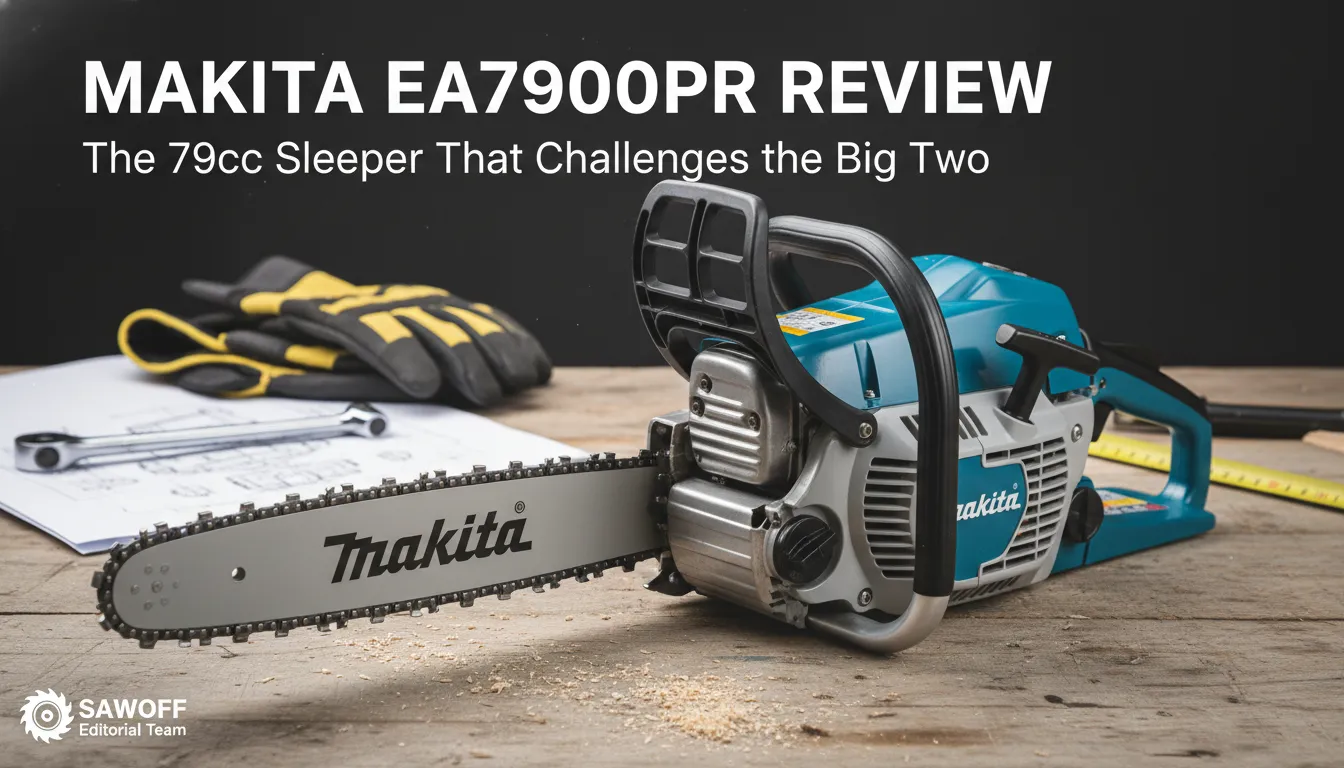
For decades, professional logging has been dominated by orange—either the bright Swedish orange of Husqvarna or the distinct white-and-orange of Stihl. But if you see a flash of teal on the landing, you’re looking at an operator who values power-to-weight ratios over brand-name hype.
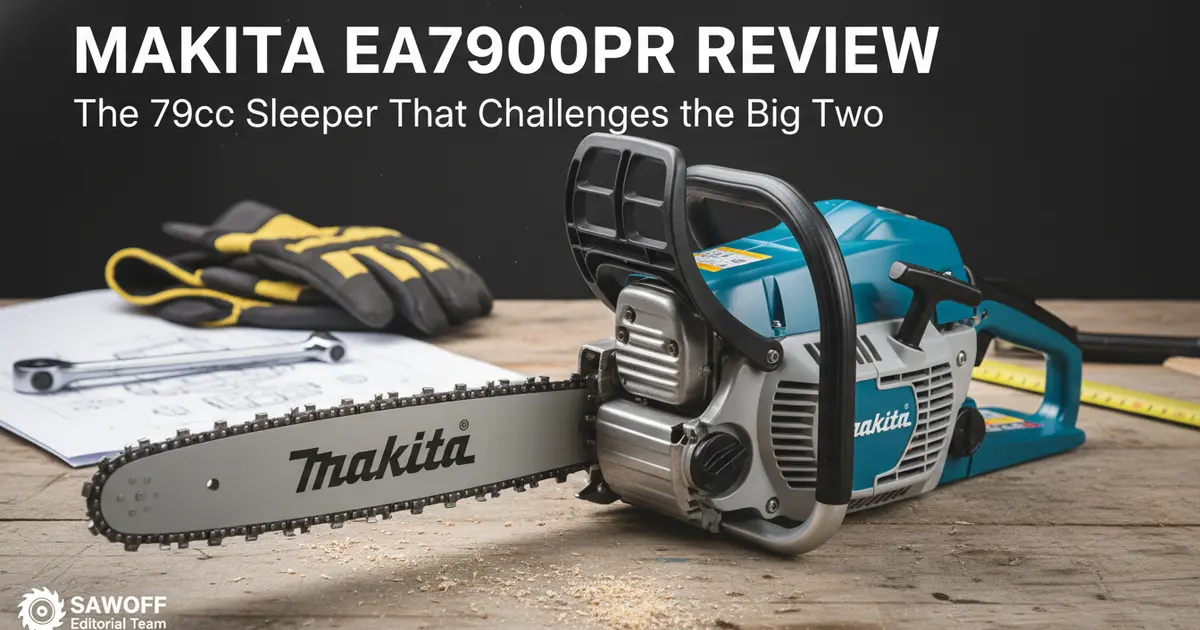
The Makita EA7900PR isn’t just another 80cc-class saw. It is the direct descendant of the legendary Dolmar PS-7900, a saw many veteran arborists still consider one of the finest powerheads ever engineered. When Makita acquired Dolmar, they integrated German precision engineering with Japanese manufacturing consistency.
We spent three weeks with the EA7900PR in mature white oak and frozen maple. This saw doesn’t just keep pace with the industry gold standards—it demands you keep up with it.
Heavy-Hitter Comparison
| Feature | Makita EA7900PR | Echo CS-590 | Stihl MS 391 | Husqvarna 460 |
|---|---|---|---|---|
| Displacement | 78.5cc | 59.8cc | 64.1cc | 60.3cc |
| Power Output | 5.7 hp | 3.9 hp | 4.4 hp | 3.62 hp |
| Dry Weight | 14.7 lbs | 13.2 lbs | 13.7 lbs | 13.2 lbs |
| Engine Type | SLR 2-Stroke | 2-Stroke | 2-MIX | X-Torq |
| Best For | Professional Felling | Prosumer | Large Property | Heavy Farm Use |
Engineering Deep-Dive
The SLR (Scavenging Losses Reduction) System
Makita’s SLR technology uses a patented muffler design that creates a sonic pressure wave to push unburnt fuel back into the combustion chamber. You can actually hear the difference in the cut. There’s a crispness to the exhaust note. It doesn’t have the muffled, stuffy sound of EPA-strangled saws. This translates to an incredibly flat torque curve from 7,000 RPM to 12,500 RPM.
Magnesium Crankcase and Dual-Ring Piston
The full magnesium crankcase keeps powerhead weight to 14.7 lbs. Inside, the dual-ring piston provides better heat transfer and consistent compression over hundreds of hours. In our teardown of a high-hour EA7900PR, the cylinder walls showed remarkably little scoring—a testament to the cooling fin geometry and Nikasil coating quality.
Manual Carburetion
In an era of M-Tronic and AutoTune, the EA7900PR stands firm with adjustable H and L screws. For those who work at varying elevations, the ability to manually tune is indispensable. No laptop, no dealer trip—just a tachometer and a screwdriver.
Filtration System
The heavy-duty pleated nylon filter uses a centrifugal pre-separation system that flings large chips away from the intake. In dry, dusty hickory, we ran six hours straight before checking the filter. It was surprisingly clean. The filter cover uses a tool-required screw—more secure for professional use but slightly tedious for mid-day inspections.
Real-World Performance
Bucking and Torque
With a 28-inch bar and full-house chisel chain, the EA7900PR has a low-frequency growl that stays steady. When we buried the bar into oak and leaned into it, the saw didn’t flinch. The torque delivery is reminiscent of a diesel engine—it just keeps pulling. Compared to the Echo CS-490, the difference in lugging power is night and day.
Felling and Balance
With a 24 or 28-inch bar, the center of gravity sits under the front handle, making this incredibly nimble for its size. The spring-based anti-vibe system does excellent work dampening kickback feel during bore cuts.
Ergonomics
The decompression valve reduces pulling force by about 40%. Without it, pulling over an 80cc high-compression engine would tear rotator cuffs. With it, the saw pops on the second pull and stays running on the third.
The handle geometry is wider than many competitors, providing better leverage for rolling a heavy bar in a cut. The recoil feels substantial and mechanical—no mushiness.
Fuel System and Maintenance
The EA7900PR is a 79cc gas beast requiring disciplined maintenance.
Fuel care is non-negotiable. Use 50:1 high-quality synthetic oil with 91+ octane ethanol-free gasoline. Ethanol destroys carburetor diaphragms in these high-compression engines. For storage over 30 days, drain the carburetor or use fuel stabilizer.
Air filter: The centrifugal pre-cleaner extends filter life significantly, but inspect and clean regularly when cutting in dusty conditions.
Spark plug: Accessible by removing one screw on the top cover. Check gap annually.
Chain tensioning: Side-access with captive nuts on newer versions. The adjustable oiler is crucial for long bars—at max setting it puts out generous oil to keep bar rails cool.
Outboard clutch: Makes the powerhead narrower for limbing but slightly more involved for sprocket changes.
Chainsaw Safety
The EA7900PR produces 5.7 hp at 12,800 RPM. This is a professional felling saw capable of severing 36-inch trees. Never operate without full chaps, helmet with face shield, and hearing protection. The decompression valve makes starting deceptively easy—don’t let that reduce your respect for the tool. Always engage the chain brake when moving between cuts. For complete safety protocols, read our Chainsaw Safety Guide.
Pros and Cons
Pros
- Power-to-weight king. Feels lighter than a Stihl 462 but hits just as hard.
- Mechanical simplicity. No computer chips to fail in the woods.
- SLR technology. Excellent fuel efficiency for the displacement.
- Durability. Magnesium crankcase and heavy-duty components for 8-hour workdays.
- Vibration isolation. Spring system is top-tier.
Cons
- Dealer network. Harder to find a Makita chainsaw specialist than Stihl or Husqvarna in rural areas.
- Filter cover. Requires tool to remove—minor annoyance.
- Stock spikes. Inner felling spike is small. Upgrade to wrap-around spikes for big timber.
Final Verdict
The Makita EA7900PR is the thinking professional’s saw. It’s for the arborist who wants maximum power without nanny electronics. It’s for the landowner with 50 acres of hardwoods who doesn’t want to spend three days doing a one-day job.
Is it overkill for most people? Absolutely. If you’re cutting firewood for the winter, a Husqvarna 460 Rancher or Stihl MS 291 is more than enough. But if you’re staring down a 40-inch oak and your current saw is crying for mercy, the EA7900PR is the solution.
It’s a sleeper—a saw that looks unassuming in teal plastic but possesses the heart of a German felling champion.
If you’re deciding between gas and battery power for heavy work, read our Gas vs Electric Chainsaw comparison. For bar and chain sizing, the Stihl Chainsaw Bar Size Guide applies to any brand.
SAWOFF Rating: 4.8 / 5 — One of the best powerheads ever made.
Get out there and cut. Safely.
Frequently Asked Questions
Is the Makita EA7900PR a professional-grade saw?
Yes. It features a magnesium crankcase, professional-grade engine internals, and is designed for full-time logging and felling operations. It is not a consumer homeowner saw.
Can I run a 36-inch bar on the EA7900PR?
It has the power to pull a 36-inch bar in softer woods, but it is optimally balanced for a 24-inch to 28-inch bar. If you frequently run 36 inches in hardwood, consider a 90cc+ saw, though the EA7900PR will do it if you don’t force the cut.
What fuel mix should I use?
Use a 50:1 ratio of high-quality synthetic 2-cycle oil and 91+ octane ethanol-free gasoline. Ethanol is the enemy of carburetor diaphragms in these high-compression engines.
How does the EA7900PR compare to the Stihl MS 462?
The MS 462 is slightly more modern with M-Tronic fuel management and marginally lighter. However, the Makita often has more bottom-end torque and is significantly cheaper, often by several hundred dollars.
My saw is hard to start when hot. What should I do?
Check the air filter first. If clean, ensure you use the decompression valve every time. If the problem persists, slightly richen the Low screw on the carburetor to account for heat-soak.
Where can I get parts for this saw?
Parts are widely available through Makita’s industrial tool network and online specialty chainsaw retailers. Many components are cross-compatible with the Dolmar PS-7900 and PS-7910.
Does it have a heated handle option?
The PR model typically does not. In some markets, a Winter version with heated handles was produced under the Dolmar name, but for the standard US teal version, heated handles are rare.
Is it better than the Husqvarna 572XP?
This is a matter of preference. The 572XP has AutoTune and a more modern feel, while the Makita EA7900PR is more raw and mechanically straightforward. In a drag race through a 24-inch log, they are neck-and-neck.