Echo CS 7310P Review: The 70cc Powerhouse That Challenges the Giants
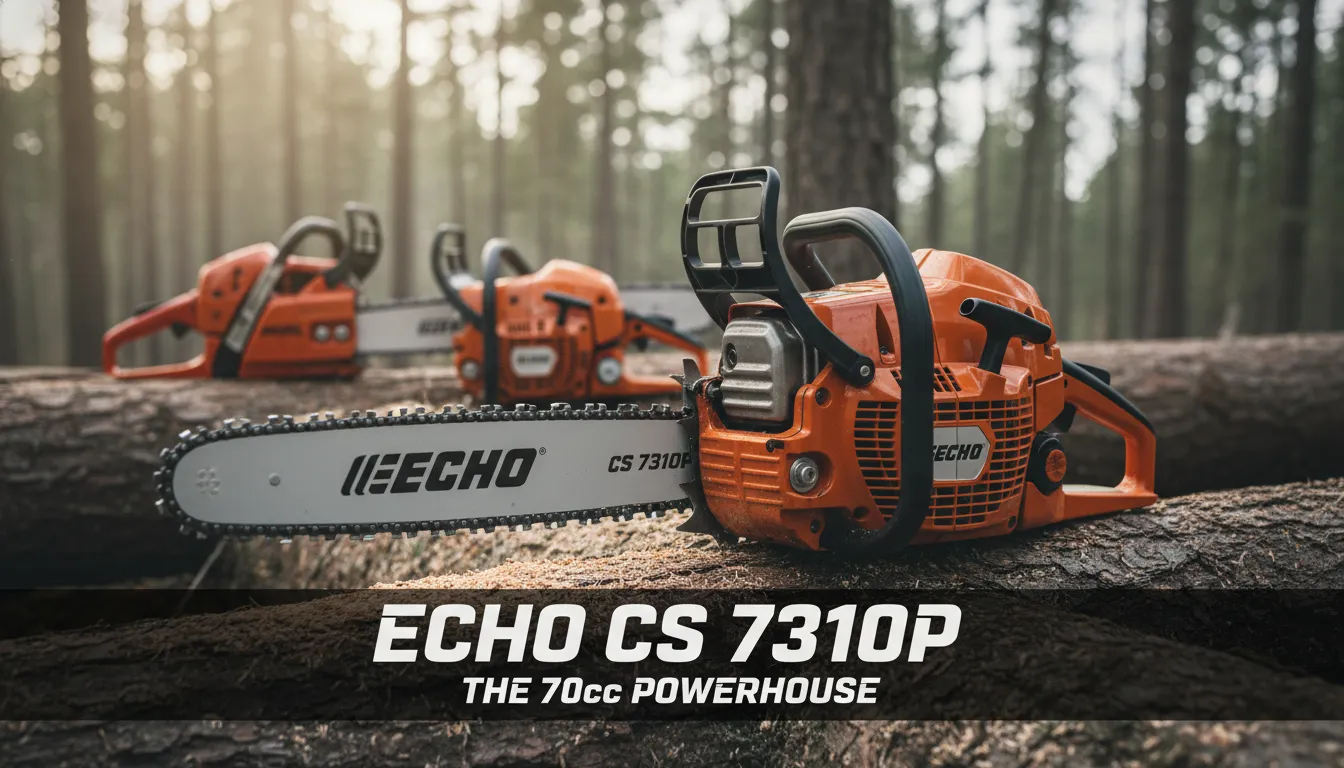
For years, if you walked onto a professional logging site, the landscape was a sea of orange and white or orange and silver. Stihl and Husqvarna held a duopoly on the 70cc pro saw category — the sweet spot for big timber falling and heavy bucking. Echo, a brand often relegated to the high-end homeowner tier with legends like the CS 590 Timber Wolf, decided to stop playing nice.
The Echo CS 7310P is a declaration of war.
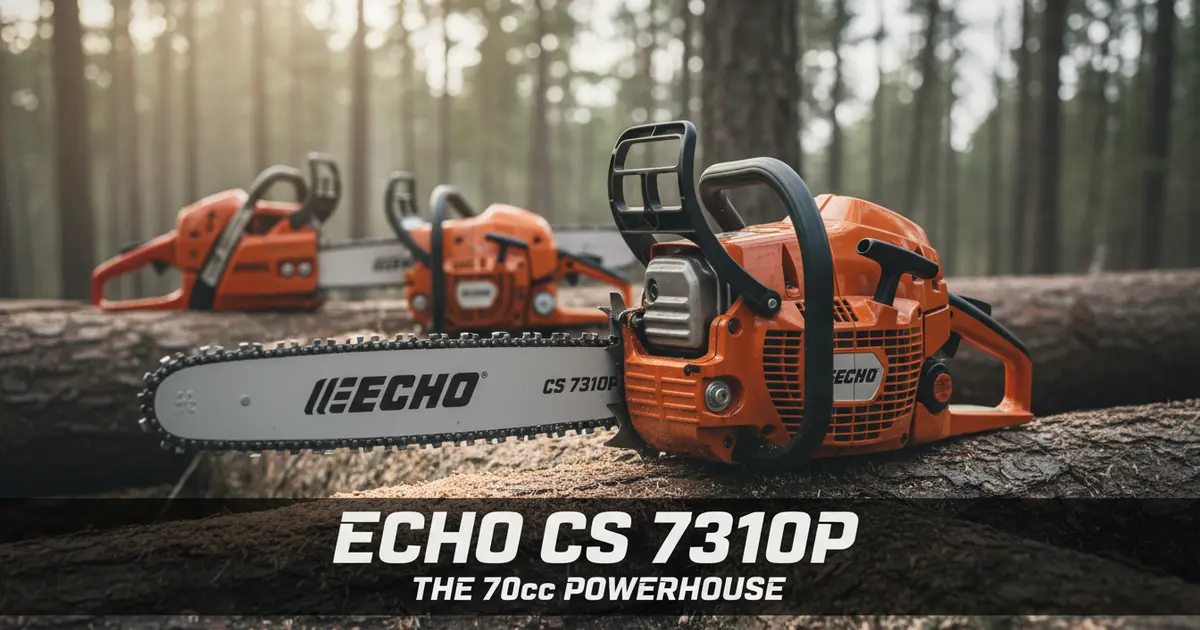
When I first unboxed the 7310P, the weight hit me first. At 14.7 lbs powerhead only, it feels substantial. No plasticky vibe here. This is a magnesium-clad monster. I’ve spent three months running this saw through everything from frozen Michigan White Oak to heat-baked Hickory. The P in 7310P stands for Professional, and it isn’t marketing fluff.
Key Advice: Run a 28-inch bar for optimal balance. This saw wants a long bar — a 20-inch setup feels back-heavy and awkward.
The Competitive Landscape
| Model | Displacement | Weight (Powerhead) | Horsepower | Price Tier |
|---|---|---|---|---|
| Echo CS 7310P | 73.5 cc | 14.7 lbs | 5.1 hp | $$ |
| Stihl MS 462 C-M | 72.2 cc | 13.2 lbs | 6.0 hp | $$$$ |
| Husqvarna 572 XP | 70.6 cc | 14.5 lbs | 5.8 hp | $$$ |
| Echo CS 590 | 59.8 cc | 13.2 lbs | 3.9 hp | $ |
Engineering Deep-Dive
The 73.5cc Heart
The engine is a 2-stroke professional-grade powerhouse with stratified scavenging that meets emissions without complex electronics. The cylinder is chrome-plated with a dual-ring piston design. After my first 50-hour teardown, the cross-hatching was still pristine. The dual-ring setup provides better seal and heat transfer than single-ring racing designs — Echo prioritized durability over RPM snap.
The 4-Stage Air Filtration System
This is where Echo out-engineered the competition.
- Centrifugal Force: Air is spun, throwing heavy dust outward before it hits the filter.
- Fine Screen: A preliminary mesh catches larger particles.
- Pleated Main Filter: Automotive-style with massive surface area.
- Final Seal: Rubberized gasket prevents bypass.
I ran this saw through dry, rotted Red Oak that turns into fine talcum powder. Usually I clean a filter every two tanks. With the 7310P, after a full day of bucking, the pleated filter looked almost brand new.
Magnesium Crankcase and Build Quality
Full magnesium crankcase — no clamshell construction. The handle geometry is wider than the Husqvarna 455 Rancher, providing more leverage when wrestling a 32-inch bar in a horizontal bore cut. The dual-point steel felling spikes actually bite into thick bark rather than sliding off.
Real-World Performance: Into the Timber
Starting
Starting the 7310P is a physical experience. Even with the decompression valve depressed, you feel the 73.5cc of displacement in your shoulder. Two pulls on full choke for a pop, one pull on half-choke to roar to life. The exhaust note is a deep, low-frequency rumble that lets you know serious torque is available.
Bucking and Limbing
I took the 7310P to a clearing project with 36-inch diameter Sugar Maples. With a 28-inch Sugihara bar and full-house full-chisel chain:
- The Torque: When the bar is fully buried, most 60cc saws hunt for RPMs or bog. The 7310P just grunts. Its lugging power is astonishing — you can lean into the saw and the torque curve holds steady.
- Vibration: The heavy-duty spring-based anti-vibration system is vastly superior to rubber bushings. After four hours of continuous bucking, no tingling palms.
- Limbing: It’s too heavy for flicking around small branches. But when you need to clear 8-inch leads while bucking the trunk, the 7310P does it with terrifying speed.
Chainsaw Safety
Review our Chainsaw Safety Guide before operating a 70cc pro saw. The 7310P has enough torque to pull a 32-inch bar through hardwood — kickback force at that bar length is extreme. Always maintain three points of contact and never cut above shoulder height.
Ergonomics & Operator Comfort
The 7310P fixes many of Echo’s historic ergonomic complaints, but it still feels wide. The trigger housing is large enough for winter gloves. The kill switch is a simple toggle — no confusing multi-function levers.
With a 24-inch or 28-inch bar, the balance point is right under the front handle. Put a 20-inch bar on this and it feels back-heavy and awkward. This saw wants a long bar.
The large flip-up fuel and oil caps work with gloves, though the oil cap can be finicky to thread if sawdust gets in the grooves.
Maintenance and Long-Term Serviceability
- Air Filter Access: One large captive thumb screw on the top shroud. No tools required.
- Chain Tensioning: Side-access with captive bolts. You won’t lose bar nuts in the leaf litter.
- The Oiler: Clutch-driven, adjustable. Only pumps oil when the chain is spinning, saving bar oil at idle.
Detailed Hardware Specifications
- Displacement: 73.5 cc (4.49 cu. in.)
- Power Output: 5.1 hp
- Dry Weight: 14.7 lbs (Powerhead only)
- Fuel Capacity: 27.1 fl. oz.
- Oil Capacity: 12.2 fl. oz.
- Bar Lengths: 20”, 24”, 28”, 32”
- Chain Pitch: 3/8”
- Chain Gauge: .050” or .058”
- Brake System: Inertia-activated
For bar and chain selection, our Stihl Chainsaw Bar Size Guide covers the principles that apply to the 7310P.
Comparison Table: 70cc Professional Class
| Feature | Echo CS 7310P | Stihl MS 462 | Husqvarna 572 XP |
|---|---|---|---|
| Displacement | 73.5 cc | 72.2 cc | 70.6 cc |
| Weight | 14.7 lbs | 13.2 lbs | 14.5 lbs |
| Power | 5.1 hp | 6.0 hp | 5.8 hp |
| Air Filtration | 4-Stage G-Force | Standard | Standard |
| Carburetor | Manual Tune | M-Tronic | AutoTune |
| Price | $$ | $$$$ | $$$ |
Pros and Cons
Pros
- Industrial Filtration: Best air filter system in the 70cc class.
- Torque for Days: Pulls hard through the largest hardwoods.
- Price Point: Generally $100-$200 cheaper than Stihl or Husky equivalents.
- Serviceability: No fancy electronics; just a tuneable carb.
- Build Quality: Magnesium everywhere. Feels like a tank.
Cons
- Weight: Heavier than Stihl MS 462 by 1.5 lbs. You feel it by end of day.
- Air Filter Shroud: Plastic top cover feels slightly thinner than I’d like.
- Fuel Consumption: Thirsty. Drinks fuel faster than a Stihl MS 311, though it does twice the work.
Final Verdict
If you’re a production feller who values every ounce of weight savings, the Stihl MS 462 still wins on the scales. But if you’re a ground-based pro, a serious firewood cutter, or a farmer with massive hardwoods to manage, the Echo CS 7310P is the smarter buy. It’s easier to maintain, has a superior filtration system, and offers more grunt in the cut for less money. It’s the blue-collar pro saw — it just needs a scrench and some high-octane premix.
Our Gas vs Electric Chainsaw guide provides context on where a 70cc gas saw fits in the modern power equipment landscape.
SAWOFF Rating: 9.4 / 10
Get out there and cut. Safely.
Frequently Asked Questions
What is the best bar length for the Echo CS 7310P?
While it can handle a 32-inch bar in a pinch, the sweet spot is a 24-inch or 28-inch bar. With a 28-inch bar, the balance is nearly perfect and the 73.5cc engine has plenty of torque to keep chain speed high in full-depth cuts.
Does the CS 7310P require special fuel?
Like all high-performance 2-stroke engines, it requires high-quality 89 or 91 octane fuel mixed at a 50:1 ratio with JASO FD certified oil. Echo PowerFuel or similar ethanol-free canned fuel is recommended to prevent carburetor gumming.
How does it compare to the Echo CS 590 Timber Wolf?
There is no comparison. The CS 590 is a fantastic 60cc prosumer saw, but the 7310P is a different animal. It has a magnesium crankcase, much higher torque, and a far superior air filtration system. If you regularly cut wood over 20 inches, upgrade to the 7310P.
Is the CS 7310P too heavy for a homeowner?
Probably. If you’re just cleaning up storm damage or cutting a few cords of firewood, the weight will wear you out. Look at the Husqvarna 440 or Stihl MS 250 for general property maintenance.
Can I tune the carburetor myself?
Yes. One of the biggest selling points of the 7310P is the traditional adjustable carburetor. You can adjust the High and Low speed needles for altitude or fuel quality changes. You may need a specific D-style carb tool depending on local EPA regulations.
What should I do if my 7310P won’t start when hot?
This is usually heat soak or vapor lock. Ensure the air filter is clean and you’re using fresh, high-octane fuel. When starting hot, do not use the choke. Engage the high-idle and give it a firm pull.
How often should I clean the G-Force pre-cleaner?
The system is mostly self-cleaning. However, blow out the area around the flywheel with compressed air every 10-15 tanks of fuel to ensure the centrifugal vents aren’t clogged with pitchy sawdust.
Frequently Asked Questions
What is the best bar length for the Echo CS 7310P?
While it can handle a 32-inch bar in a pinch, the sweet spot is a 24-inch or 28-inch bar. With a 28-inch bar, the balance is nearly perfect and the 73.5cc engine has plenty of torque to keep chain speed high in full-depth cuts.
Does the CS 7310P require special fuel?
Like all high-performance 2-stroke engines, it requires high-quality 89 or 91 octane fuel mixed at a 50:1 ratio with JASO FD certified oil. Echo PowerFuel or similar ethanol-free canned fuel is recommended to prevent carburetor gumming.
How does it compare to the Echo CS 590 Timber Wolf?
There is no comparison. The CS 590 is a fantastic 60cc prosumer saw, but the 7310P is a different animal. It has a magnesium crankcase, much higher torque, and a far superior air filtration system. If you regularly cut wood over 20 inches, upgrade to the 7310P.
Is the CS 7310P too heavy for a homeowner?
Probably. If you're just cleaning up storm damage or cutting a few cords of firewood, the weight will wear you out. Look at the Husqvarna 440 or Stihl MS 250 for general property maintenance.
Can I tune the carburetor myself?
Yes. One of the biggest selling points of the 7310P is the traditional adjustable carburetor. You can adjust the High and Low speed needles for altitude or fuel quality changes. You may need a specific D-style carb tool depending on local EPA regulations.
What should I do if my 7310P won't start when hot?
This is usually heat soak or vapor lock. Ensure the air filter is clean and you're using fresh, high-octane fuel. When starting hot, do not use the choke. Engage the high-idle and give it a firm pull.
How often should I clean the G-Force pre-cleaner?
The system is mostly self-cleaning. However, blow out the area around the flywheel with compressed air every 10-15 tanks of fuel to ensure the centrifugal vents aren't clogged with pitchy sawdust.