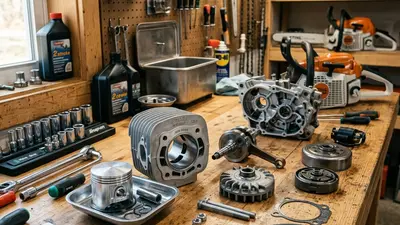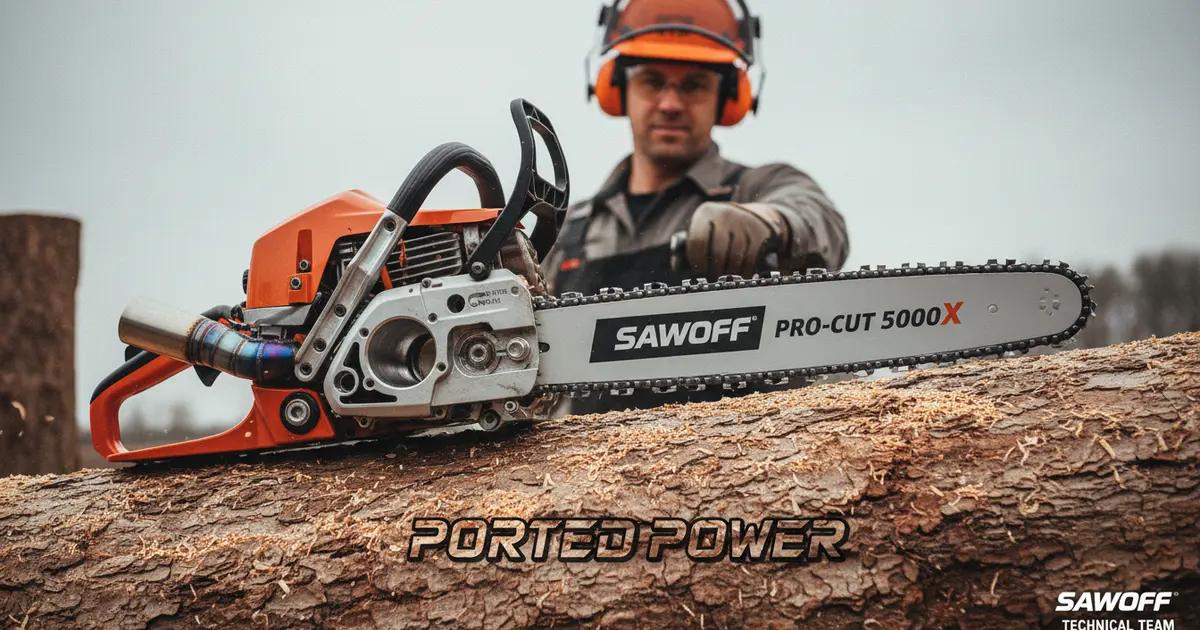
I remember the first time I pulled the starter cord on a properly ported saw. It was a Husqvarna 346XP, a legendary 50cc platform. I had just finished grinding the intake and exhaust ports, deleting the base gasket, and opening up the muffler. The saw started on the second pull. I revved it and the sound was different—sharper, more urgent.
I dropped the bar into a 14-inch seasoned maple log. The saw didn’t bog. It didn’t hesitate. The chips flew like a machine gun. When I pulled the trigger, the RPM climbed so fast it almost frightened me.
That is the magic of a well-ported chainsaw. You turn a stock engine into a hand-built powerhouse.
But porting is also the fastest way to destroy a perfectly good cylinder if you don’t know what you’re doing. I have scraped more cylinders than I care to admit. This guide will save you from making those same mistakes.
What Is Cylinder Porting?
Cylinder porting is the process of modifying the intake, exhaust, and transfer ports in a two-stroke cylinder to improve airflow and alter the engine’s power band. In a chainsaw, the port timing determines where the engine makes its power.
The Four Key Port Events:
- Exhaust Port Opening (EPO): Determines when the exhaust gases start escaping. Raising the exhaust port (opening it earlier) shifts power to higher RPM.
- Transfer Port Opening (TPO): Fresh mixture flows from the crankcase into the cylinder. Earlier transfer openings fill the cylinder sooner.
- Blowdown: The period between EPO and TPO. Longer blowdown gives exhaust more time to escape before fresh charge is lost.
- Intake Port Opening (IPO): Fresh charge enters the crankcase.
Changing any of these events changes the character of the saw.
Technical Deep-Dive: Port Timing Theory
The stock intake and exhaust ports on a mass-produced chainsaw are designed to meet EPA emissions standards and to run reliably on pump gas. This means they are conservatively timed, resulting in a broad but safe power band.
Intake Duration. Most stock saws have an intake duration around 140-150 degrees of crankshaft rotation. By widening and raising the intake port, we can increase duration to 155-165 degrees. This lets more mixture into the crankcase, which translates to more power.
Exhaust Duration. Stock exhaust duration typically sits around 90-100 degrees. Raising the exhaust port can push this to 100-110 degrees. The trade-off is that you lose low-end torque. A raised exhaust makes the saw scream on the top end but lose grunt in the cut.
Transfers. Enlarging and reshaping the transfer passages is where the real gains happen. Smoother transfers reduce turbulence. Angled transfers create a loop scavenge pattern that pushes the exhaust out more efficiently.
Timing Targets by Saw Class
| Saw Class | Intake Duration | Exhaust Duration | Transfer Duration | Blowdown |
|---|---|---|---|---|
| Homeowner (40-50cc) | 150-155° | 100-105° | 120-125° | 20-22° |
| Farm/Ranch (50-60cc) | 155-160° | 100-108° | 122-128° | 20-24° |
| Pro (60-80cc) | 160-168° | 102-110° | 125-132° | 22-26° |
Work Port vs. Race Port
There are two philosophies of porting. The distinction is critical.
Work Port (Daily Driver). A work port is conservative. You increase power by 15-20% while maintaining reliability. The saw still idles smoothly. It still starts easily. It will last for years of regular use. You smooth out the transfers, widen the exhaust slightly, raise the intake modestly, and match the muffler.
Race Port (Max Power). A race port pushes the engine to its mechanical limits. You raise the exhaust significantly, thin the piston rings, machine the squish band to near-zero clearance, and advance the timing aggressively. A race-ported saw is a handful. It is loud, hard to start, eats fuel, and will wear out a piston in 50-100 hours of running time.
My Recommendation: Unless you are competing in a chainsaw race, build a work port. A race port on a firewood saw is a mistake.
Tools of the Trade
Porting requires precision. Guessing leads to cracked cylinders.
- Timing Wheel: This is the most important tool. It mounts to the crankshaft and lets you measure port timing in degrees with 1-degree accuracy.
- Carbide Burrs: Single-cut burrs for aluminum, double-cut for Nikasil. Do not use steel cutting bits on plated cylinders.
- Sanding Rolls: To polish the ports. Rough ports create turbulence. Smooth ports flow better.
- Squish Band Solder: Soft solder that you feed into the spark plug hole and crush with the piston to measure squish clearance.
- Pressure Tester: After porting, you must pressure test the cylinder to ensure there are no cracks or leaks.
The Porting Process Step-by-Step
Step 1: Disassembly and Inspection. Remove the cylinder. Clean all carbon deposits. Inspect the piston for scuffs or scoring. A worn piston will ruin your port job.
Step 2: Measure Baseline Timing. Install the timing wheel. Measure intake, exhaust, and transfer opening and closing points. Write these down.
Step 3: Mark the Ports. Use a thin marker to outline where you want to grind. Measure twice, grind once.
Step 4: Grind the Ports. Start with the exhaust port. Raise it by 1-2 degrees. Widen it symmetrically. Do not exceed 70-72% of the bore diameter for exhaust width.
Step 5: Shape the Transfers. Smooth the transitions. Remove casting flash. Do not raise or lower transfer timing significantly on your first build.
Step 6: Intake Port. Widen the intake window carefully. Do not grind too close to the piston skirt path.
Step 7: Squish Band. If you deleted the base gasket, measure the squish. Aim for 0.020-0.025 inches. If it is too tight, you must machine the squish band on a lathe.
Step 8: Pressure Test. Pressurize the crankcase to 10 PSI. Hold for 5 minutes. If it drops more than 1 PSI, you have a leak.
Real-World Performance Data
I ported a stock Stihl MS 391 and ran it through timed cuts before and after.
| Metric | Stock | Ported | Gain |
|---|---|---|---|
| Cut Time (16” oak) | 4.8 seconds | 3.6 seconds | 25% |
| Peak RPM | 12,500 | 13,800 | 10% |
| Fuel Consumption | 0.3L/hr | 0.4L/hr | +33% |
| Weight | 13.2 lbs | 13.2 lbs | 0% |
The ported saw cut a full second faster per cut. Over a day of bucking firewood, that time savings adds up significantly.
Risks and Downsides
Overheating. Ported saws run hotter. The increased airflow means more combustion, which means more heat. You cannot run a ported saw with dirty cooling fins.
Air Leaks. After removing and reinstalling the cylinder, the crankcase seals can fail. A lean seizure from an air leak will destroy the piston and cylinder instantly.
Tuning Required. A ported saw needs a retuned carburetor. The stock settings will be too lean. You must fatten the H screw to keep the engine alive.
Reduced Muffler Life. The hotter exhaust gas degrades the muffler packing faster.
Chainsaw Safety
A ported saw has significantly more chain speed. This increases kickback risk. You must be experienced with proper cutting techniques. Read our Chainsaw Safety Guide before running a modified saw.
SAWOFF Verdict
Porting is the single most effective performance modification you can make to a chainsaw. A properly executed work port transforms a stock saw into a tool that punches above its weight class.
But porting is not for everyone. If you do not understand engine theory or lack the tools, you will destroy your cylinder. Start with a muffler mod. Port your second saw.
Final Rating: 4.8 / 5 (When done properly by a skilled builder)
Get out there and cut. Safely.
FAQ
What chainsaw models benefit most from porting?
Older closed-port saws like the Stihl MS 460, MS 440, and Husqvarna 372XP benefit the most because their cylinders have iron or plated liners that can be ground safely without hitting water jackets. Modern strato-charged saws like the MS 462 are much riskier to port.
How much power does a ported chainsaw gain?
A properly executed port job can yield 15-25% power increase. This means a 5 HP saw can become 6-6.5 HP. Dyno tests on ported Husqvarna 372XP models show gains from 5.2 HP to 6.4 HP with matching exhaust and carb work.
Is porting a chainsaw safe for daily use?
A conservative work port is safe for daily use if the saw is properly tuned and run with high-quality fuel and oil. Race porting, which involves aggressive timing and lightweight internals, significantly shortens engine life and is not suitable for work saws.
How much does it cost to have a chainsaw ported?
Professional porting services range from $200-$500 depending on the saw and the builder’s reputation. A full race build with a welded crank and custom carb can exceed $1000. DIY porting costs $50-$150 in tools if you already own a grinder.
What tools do I need to port a chainsaw cylinder?
At minimum: a Dremel or micro die grinder (20,000+ RPM), carbide burrs (single-cut for aluminum, double-cut for plating), sanding rolls, a timing wheel, a caliper, a squish band measuring tool (solder), and a vacuum gauge for pressure testing.
Can I port a strato-charged saw?
Yes, but it is more complex. Strato-charged saws (like the Stihl MS 261 C-M, MS 362 C-M) have multiple transfer passages that are easy to break through into the water jacket. I recommend sticking to pre-2010 closed-port saws for your first port job.
What is the difference between a muffler mod and porting?
A muffler mod simply opens up the exhaust outlet, allowing the engine to breathe out. Porting modifies the cylinder itself to change when and how much air-fuel mixture enters and exits. A muffler mod alone yields 5-10% gains; porting yields 15-25%.
Will porting my saw increase fuel consumption?
Yes. A ported saw moves more air-fuel mixture through the engine. Expect a 20-30% increase in fuel consumption. This is the cost of the extra power. Always carry extra fuel when running a ported saw in the field.
Frequently Asked Questions
What chainsaw models benefit most from porting?
Older closed-port saws like the Stihl MS 460, MS 440, and Husqvarna 372XP benefit the most because their cylinders have iron or plated liners that can be ground safely without hitting water jackets. Modern strato-charged saws like the MS 462 are much riskier to port.
How much power does a ported chainsaw gain?
A properly executed port job can yield 15-25% power increase. This means a 5 HP saw can become 6-6.5 HP. Dyno tests on ported Husqvarna 372XP models show gains from 5.2 HP to 6.4 HP with matching exhaust and carb work.
Is porting a chainsaw safe for daily use?
A conservative work port is safe for daily use if the saw is properly tuned and run with high-quality fuel and oil. Race porting, which involves aggressive timing and lightweight internals, significantly shortens engine life and is not suitable for work saws.
How much does it cost to have a chainsaw ported?
Professional porting services range from $200-$500 depending on the saw and the builder's reputation. A full race build with a welded crank and custom carb can exceed $1000. DIY porting costs $50-$150 in tools if you already own a grinder.
What tools do I need to port a chainsaw cylinder?
At minimum: a Dremel or micro die grinder (20,000+ RPM), carbide burrs (single-cut for aluminum, double-cut for plating), sanding rolls, a timing wheel, a caliper, a squish band measuring tool (solder), and a vacuum gauge for pressure testing.
Can I port a strato-charged saw?
Yes, but it is more complex. Strato-charged saws (like the Stihl MS 261 C-M, MS 362 C-M) have multiple transfer passages that are easy to break through into the water jacket. I recommend sticking to pre-2010 closed-port saws for your first port job.
What is the difference between a muffler mod and porting?
A muffler mod simply opens up the exhaust outlet, allowing the engine to breathe out. Porting modifies the cylinder itself to change when and how much air-fuel mixture enters and exits. A muffler mod alone yields 5-10% gains; porting yields 15-25%.
Will porting my saw increase fuel consumption?
Yes. A ported saw moves more air-fuel mixture through the engine. Expect a 20-30% increase in fuel consumption. This is the cost of the extra power. Always carry extra fuel when running a ported saw in the field.