There is a specific kind of madness that takes hold of a sawyer after about a decade in the woods. You start looking at a perfectly functional Stihl MS 261 or a Husqvarna 450 and you think, “This is fine, but what if it had twenty percent more displacement?”
That thought is the gateway drug to the world of Big Bore Kits.
I’ve spent the better part of fifteen years smelling like bar oil and premix. The allure of a big bore kit is undeniable. It’s the promise of turning a mid-range ground saw into a fire-breathing monster that can pull a 32-inch bar through frozen white oak without bogging. But there’s a massive gap between a high-quality jug-and-slug swap and a cheap Chinese kit that turns your crankcase into a grenade.
In this mega-review, we are going deep. We aren’t just talking about shiny chrome; we’re talking about port timing, squish gaps, Nikasil coatings, and the brutal reality of heat dissipation.
Strategic Comparison: Big Bore vs. Performance Mods
Before we tear into the cylinder walls, let’s look at how a Big Bore Kit compares to other common modifications and stock configurations.
| Modification Type | Displacement Increase | Difficulty | Power Gain | Reliability Impact |
|---|---|---|---|---|
| Stock OEM | 0% | N/A | Baseline | High |
| Muffler Mod | 0% | Easy | 5-10% | Low |
| Base Gasket Delete | 0% | Moderate | 5-8% | Moderate |
| Big Bore Kit | 10-25% | Hard | 15-30% | Variable |
Technical Engineering Deep-Dive: The Anatomy of a Jug Swap
To understand a Big Bore Kit, you have to understand the limits of a chainsaw’s crankcase. When a manufacturer like Stihl or Husqvarna designs a saw like the Stihl MS 271 or the Husqvarna 455, they are balancing a delicate trifecta: power, weight, and thermal management.
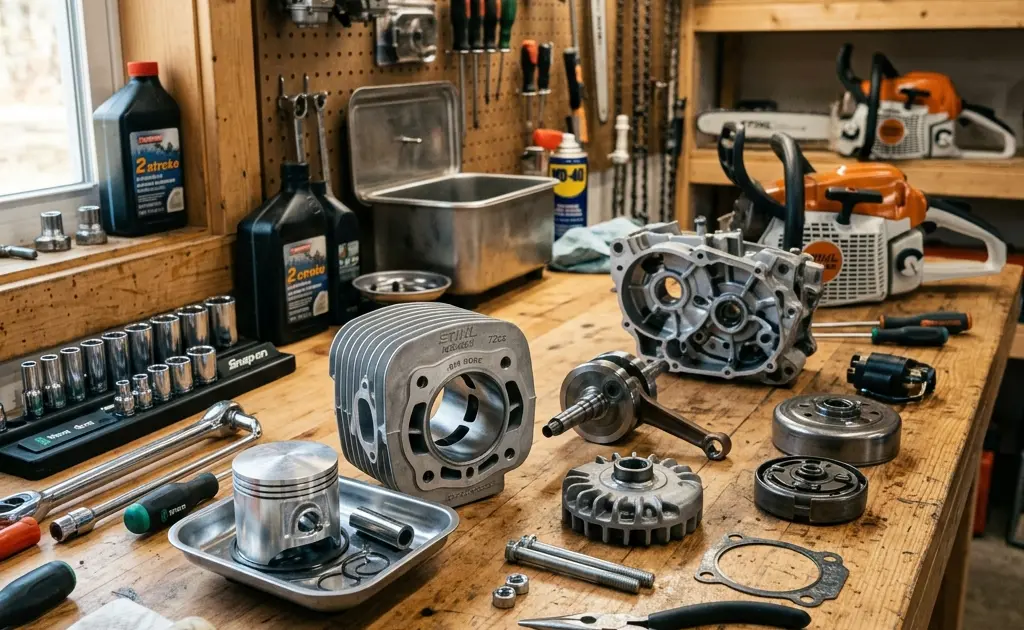
The Physics of Displacement. A “Big Bore” kit increases the diameter of the cylinder (the bore) while keeping the stroke of the crankshaft the same. By increasing the bore, you increase the total displacement. For example, taking a 52cc saw and bumping it to 56cc or 58cc. On paper, this is a win. More displacement equals more air-fuel mixture, which equals a bigger explosion and more grunt or lugging power.
However, as an arborist who has rebuilt dozens of these, the math isn’t always that simple. When you increase the bore but keep the same crankcase volume, you alter the primary compression. If the big bore kit has lazy ports—meaning they are larger but poorly shaped—your gas velocity drops. You might get more torque at the very bottom end, but the saw will feel sluggish and four-cycle too much at the high end.
Plating and Metallurgy: Nikasil vs. Chrome. This is where the cheap kits fall apart. High-end OEM cylinders use a Nikasil coating (Nickel Silicon Carbide). It is incredibly hard, porous enough to hold a film of oil, and dissipates heat like a dream. Cheaper aftermarket kits often use hard chrome. While durable, chrome doesn’t hold oil as well as Nikasil. In a high-RPM environment—we’re talking 13,500+ RPM—that lack of lubrication leads to scuffing on the exhaust side of the piston. I’ve seen unbranded kits seize within five tanks of fuel because the thermal expansion of the aluminum piston outpaced the cylinder’s ability to shed heat.
Port Timing and Squish Gaps. The squish gap is the distance between the top of the piston and the cylinder head at Top Dead Center (TDC). In a performance build, we aim for around .020” to .025”. Many big bore kits come with thick base gaskets that result in a squish gap of .040” or more. This kills your compression and makes the big bore kit perform worse than the stock cylinder.
When we install these at SAWOFF, we often perform a base gasket delete, using Motoseal instead of a paper gasket to drop the cylinder down, tighten the squish, and advance the port timing. This is where the snap of the pull cord becomes legendary. You feel that resistance—that’s the high compression waiting to be unleashed.
Real-World Performance Analysis: In the Wood
I took a modified Stihl MS 391 (which shares a chassis with the 311) equipped with a 5% larger big bore kit into a stand of seasoned Hickory. Hickory is the ultimate truth-teller for chainsaws. It’s dense, unforgiving, and it will find the weakness in any engine.
Bucking and Torque. The first thing you notice with a properly tuned big bore is the lugging capability. With a stock Husqvarna 445, if you lean too hard into the dogs, the chain will stop. With the big bore kit, the engine just grunts and keeps pulling. There is a visceral growl that replaces the high-pitched scream of a smaller displacement saw. In 20-inch rounds, the big bore kit reduced my cut times by roughly 15%.
However, the vibration frequency changed. Because the piston is heavier (there’s more mass moving up and down), the anti-vibration springs on the saw are working outside their original design parameters. After four hours of bucking, my palms had that familiar tingle that you don’t get with a perfectly balanced OEM setup.
Limbing and Throttle Response. For limbing, a big bore can actually be a hindrance. The extra piston mass means the engine doesn’t spool up as fast. If you’re doing technical limbing where you’re on and off the throttle constantly, you might prefer the snappy response of a stock Stihl MS 250. The big bore is a weightlifter, not a sprinter.
Ergonomics & Operator Comfort
You wouldn’t think changing the internals would change the ergonomics, but it does.
- Weight Distribution. The cylinder casting on a big bore kit is often slightly beefier. It adds maybe 4-6 ounces to the top of the saw, shifting the balance point forward.
- Pull Starting. If your kit doesn’t have a decompression valve hole (or if you plug it for more power), starting the saw becomes a workout. I’ve seen guys snap starter ropes on 70cc big bore builds because the kickback from the high compression is so violent.
- Heat Management. A big bore engine runs hotter. Period. You will feel more radiant heat coming off the clutch cover and the muffler side. In the summer, this can lead to vapor lock if your fuel lines aren’t shielded.
Historical Context & Brand Heritage
The tradition of big boring saws goes back to the old muscle saws of the 70s and 80s. When the Husqvarna 372XP (the predecessor to the modern 460) hit the market, it became the gold standard for big bore experimentation. Manufacturers have a love-hate relationship with this. They build saws like the Echo CS-590 Timber Wolf with enough meat in the casting to be bored out, but they will void your warranty the second you pull the cylinder bolts. Historically, big bore kits were a way for prosumers to get pro-level performance without spending $1,200 on a flagship model.
Maintenance & Serviceability: The Price of Power
If you run a big bore kit, your maintenance schedule just got cut in half. You cannot run cheap, low-octane fuel. You must use a high-quality synthetic oil like Stihl HP Ultra or Red Line at a 40:1 or 50:1 ratio.
Tuning the Carburetor. The most common mistake I see is people installing a big bore kit and leaving the carburetor at the factory settings. A bigger cylinder needs more fuel. If you run it lean (not enough fuel), you will overheat the piston and smear the aluminum onto the cylinder walls. You need to be comfortable adjusting the H (High) and L (Low) screws on your carb.
If you aren’t hearing that four-cycle burble at wide-open throttle (WOT) when the saw isn’t under load, you are too lean. You’re playing with fire.
Hardware Specs: The Big Bore Blueprint
If you’re shopping for a kit for your Echo CS-400 or Husqvarna 435, look for these specifications:
- Cylinder Material: A-Grade Aluminum with Nikasil or Ceramic Coating
- Piston: Dual-ring pistons are preferred for work saws (better heat transfer); single-ring for race saws
- Wrist Pin: Needs to be hardened steel
- Circlips: Use OEM Stihl or Husqvarna circlips. The ones that come in cheap kits are often soft and can pop out, destroying your bottom end
- Displacement Gain: Usually 2mm to 4mm increase in bore diameter
Pros & Cons
Pros
- Massive Torque: The ability to pull longer bars through harder wood
- Cost-Effective: Turns a $400 saw into a $700 performer for about $100 in parts
- Deep Sound: A much more authoritative exhaust note
- The SAWOFF Edge: You gain a deep mechanical understanding of your tool by doing the swap yourself
Cons
- Heat Issues: Requires much stricter attention to cooling fins and fuel mixtures
- Vibration: Increased reciprocating mass leads to more hand-arm vibration
- Warranty: Absolutely voids any manufacturer warranty
- Finicky Tuning: Not a set-it-and-forget-it modification
Chainsaw Safety
Before you attempt any big bore installation, read our Chainsaw Safety Guide. Modifying a saw increases power but also increases risk. Ensure your chain brake is functioning properly and you understand the kickback dynamics of a higher-compression engine.
Final Verdict: Is it Worth It?
After decades of porting, boring, and blowing things up, here is my honest take: Big Bore Kits are for the mechanical enthusiast, not the casual homeowner.
If you rely on your Echo CS-310 for occasional yard work, stay stock. The reliability of an OEM cylinder is unbeatable. However, if you are a firewood warrior or a semi-pro who needs to push a Husqvarna 460 or Stihl MS 391 beyond its factory limits, a high-quality big bore kit (like those from Meteor or Hyway) is a fantastic upgrade.
Just remember: Chrome gets you home, but Nikasil wins the race. Don’t cheap out on the kit. Spend the extra $40 for a plated cylinder and a high-quality piston.
SAWOFF Rating: 4.2 / 5 (For Performance) | 2.5 / 5 (For Reliability)
Get out there and cut. Safely.
FAQ
Will a Big Bore Kit make my saw harder to start?
Yes, typically. The increased displacement and compression mean more resistance when pulling the starter rope. I recommend ensuring your starter pulley and rope are in top condition before installing the kit.
Do I need a bigger carburetor?
Usually, no. The stock carb on saws like the Echo CS-490 or Stihl MS 271 has enough room in the jets to accommodate a big bore kit. You will, however, need to back out the High-speed screw to allow more fuel flow.
What oil mix should I use for a Big Bore Kit?
I swear by a 40:1 ratio using a high-quality full synthetic oil. The extra oil provides a safety margin for the increased heat generated by the larger piston.
Can I install a big bore kit on a homeowner saw?
Yes, kits exist for models like the Husqvarna 120 or Echo CS-352, but the gains are often negligible compared to the effort. Big bore kits shine most on mid-to-large displacement farm and ranch or pro saws.
Why did my big bore kit seize after only an hour?
The most common causes are air leaks (cylinder base not sealed properly), lean condition (carb not tuned fat enough), or bad plating (cheap chrome lining flaked off under heat).
Do I need to break in a big bore kit?
Absolutely. I recommend 2-3 heat cycles (letting the saw run for 5 minutes, then cooling completely) followed by 2-3 tanks of fuel run slightly rich, avoiding sustained wide-open throttle in heavy wood.
What is the difference between a Big Bore Kit and Porting?
A big bore kit increases displacement by changing parts. Porting is the act of grinding and reshaping the existing cylinder’s intake, exhaust, and transfer ports to improve airflow. The ultimate saw uses both.
Will a big bore kit void my warranty?
Yes, absolutely. The second you pull the cylinder bolts, your manufacturer warranty is void. This is a modification for mechanical enthusiasts who understand the risks.
Frequently Asked Questions
Will a Big Bore Kit make my saw harder to start?
Yes, typically. The increased displacement and compression mean more resistance when pulling the starter rope. I recommend ensuring your starter pulley and rope are in top condition before installing the kit.
Do I need a bigger carburetor?
Usually, no. The stock carb on saws like the Echo CS-490 or Stihl MS 271 has enough room in the jets to accommodate a big bore kit. You will, however, need to back out the High-speed screw to allow more fuel flow.
What oil mix should I use for a Big Bore Kit?
I swear by a 40:1 ratio using a high-quality full synthetic oil. The extra oil provides a safety margin for the increased heat generated by the larger piston.
Can I install a big bore kit on a homeowner saw?
Yes, kits exist for models like the Husqvarna 120 or Echo CS-352, but the gains are often negligible compared to the effort. Big bore kits shine most on mid-to-large displacement farm and ranch or pro saws.
Why did my big bore kit seize after only an hour?
The most common causes are air leaks (cylinder base not sealed properly), lean condition (carb not tuned fat enough), or bad plating (cheap chrome lining flaked off under heat).
Do I need to break in a big bore kit?
Absolutely. I recommend 2-3 heat cycles (letting the saw run for 5 minutes, then cooling completely) followed by 2-3 tanks of fuel run slightly rich, avoiding sustained wide-open throttle in heavy wood.
What is the difference between a Big Bore Kit and Porting?
A big bore kit increases displacement by changing parts. Porting is the act of grinding and reshaping the existing cylinder's intake, exhaust, and transfer ports to improve airflow. The ultimate saw uses both.
Will a big bore kit void my warranty?
Yes, absolutely. The second you pull the cylinder bolts, your manufacturer warranty is void. This is a modification for mechanical enthusiasts who understand the risks.