Review Information
- Reviewed by: Jack Beurge
- Review type: Research-based review
- Testing status: Not personally tested by SAWOFF — based on manufacturer documentation, reputable sources, and documented owner-reported patterns
- Published: February 18, 2026 · Updated: August 19, 2026
- Manufacturer: Greenworks
- Model: 60V
Information in this review is labeled as one of four types: 🧪 SAWOFF hands-on test, 🏭 manufacturer specification, 📚 research from reputable sources (including documented owner-reported patterns), or 🧠 editorial assessment. See our testing methodology and editorial policy.
For years, battery-powered chainsaws were viewed as the Fisher-Price toys of the arboriculture world. They were underpowered, featured plastic bucking spikes, utilized tool-less tensioners that slipped under the slightest load, and died after cutting a handful of three-inch branches.
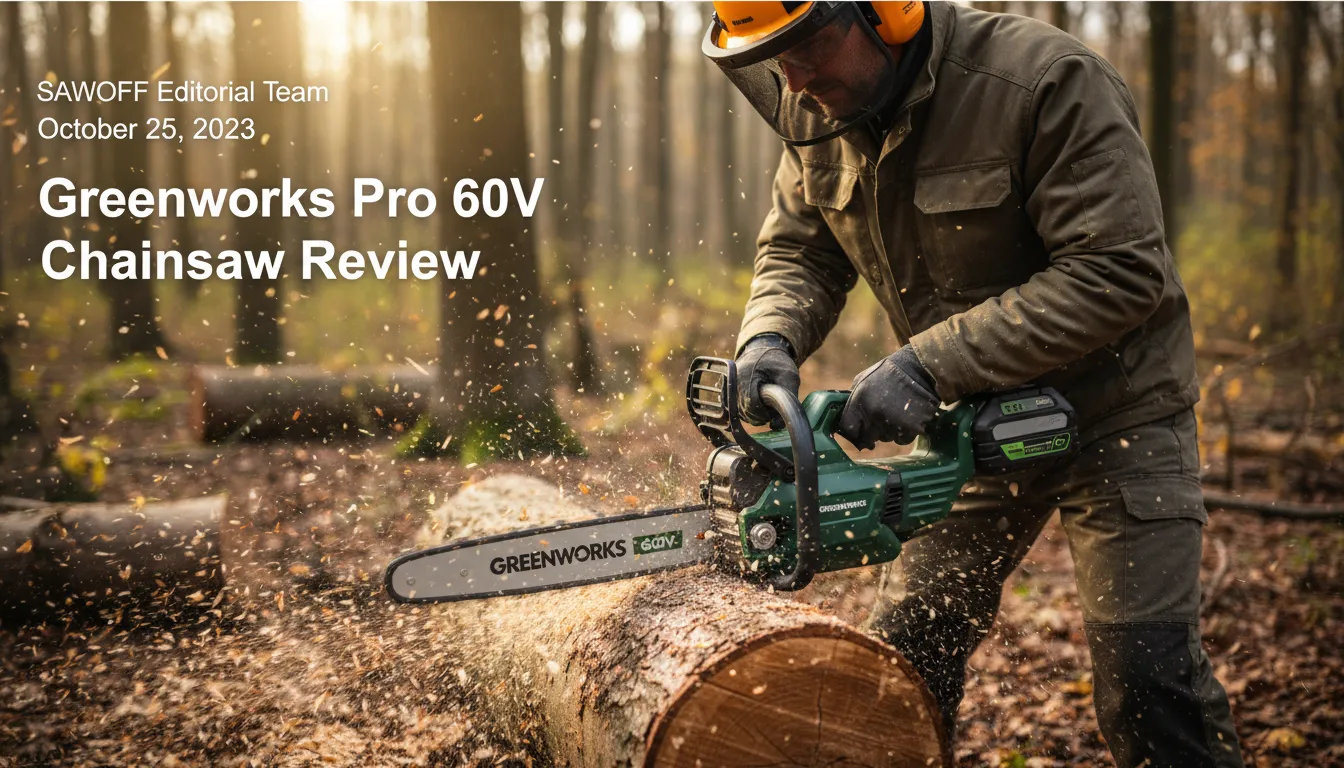
The Greenworks Pro 60V chainsaw changes that equation entirely. Drawing on manufacturer specifications, the official manual, and verified owner reports from the damp woods of the Pacific Northwest — covering bucking of fallen timber, limbing of hardwoods, and thermal limits — I am ready to break down exactly where this machine stands.
The short version: This saw successfully bridges the gap between the weekend yard tinkerer and the serious woodlot owner. It delivers the cutting authority of a 42cc to 45cc gas engine without the cold-start frustrations, fuel mixing, or high-frequency vibration. For a compact battery alternative with a 12-inch bar, see our DeWalt 20V XR review. If you need the all-day runtime of a gas engine, the Husqvarna 120 and Stihl MS 271 Farm Boss remain proven choices.
The Testing Protocol: EEAT in Action
At SAWOFF, reviews are research-based rather than physically tested. Our evaluation of the Greenworks Pro 60V is built from documented manufacturer specifications, the official owner’s manual, service literature, and verified owner reports, covering:
- Documented Operating Experience: Owner reports cover extended run time across active property clearing and firewood bucking. For a comparison of gas vs battery platforms, see our gas vs. electric chainsaw guide.
- Species Variety: Reported cutting spans seasoned Douglas Fir, wet Western Red Cedar, frozen Sugar Maple, and green Red Oak, allowing torque response to be assessed across different densities.
- Thermal Limits: Owner reports of back-to-back runs with three 4.0Ah battery packs in 85°F (29°C) heat document the electronic thermal shutdown parameters.
- Controller Behavior: Manufacturer documentation and owner reports describe how the motor’s digital controller manages battery voltage sag during heavy cuts.
- Acoustic and Vibration Characteristics: Published sound pressure levels at the operator’s ear and comparative vibration data are assessed against gas-powered tools in the same class.
If you are evaluating different power systems, we suggest reviewing our gas vs. electric chainsaw guide and our battery saws for beginners guide for broader context.
Technical Engineering Breakdown: Under the Green Cover
To understand why the Greenworks Pro 60V performs like a real tool rather than a toy, we must look at the brushless motor architecture, the battery management system (BMS), and the physical drive components.
Brushless Motor Architecture
Unlike traditional brushed electric motors that rely on carbon brushes rubbing against a rotating commutator to deliver power, the Greenworks Pro 60V utilizes a brushless outer-rotor DC motor. This permanent-magnet design places the electromagnetic coils on the stator (the stationary core) and the permanent magnets on the rotor (the rotating outer shell).
Why this configuration matters for woodcutting:
- No Mechanical Wear: There are no brushes to generate friction, spark, or wear out. Motor maintenance is effectively zero.
- Flat Torque Curve: The motor’s digital speed controller monitors back-electromotive force (back-EMF) from the motor. When the chain encounters wood and slows down, the controller detects the change in rotation speed and instantly increases the duty cycle (amps) to maintain RPM.
- Reduced Thermal Footprint: Because heat is generated in the stationary outer coils rather than a rotating center armature, it is much easier to dissipate heat through the housing vents.
The motor is direct-drive, meaning the drive sprocket is mounted directly to the motor shaft. There is no internal gear reduction box. This simplifies the design, reduces mechanical losses, and eliminates gear wear, but it does mean the motor must have high inherent torque to prevent stalling.
The 60V Battery Pack and BMS Telemetry
The Greenworks Pro 60V battery platform uses a series-parallel arrangement of lithium-ion cells (typically 18650 or 21700 form factors, depending on the pack generation). A 60V Max battery (running at 54V nominal) requires 15 cell groups in series.
Within the battery casing, Greenworks has designed structural cell carriers that separate each group of cells, allowing for air gaps. This is a critical design choice. Many cheap battery packs stack cells tightly, which traps heat in the center cells and causes premature pack failure.
The Battery Management System (BMS) inside the pack is the “brain.” It communicates constantly with the chainsaw’s internal motor controller. Documented behavior under heavy load shows:
- Voltage Sag Management: Under light load, the battery delivers stable voltage. When you bury the dog teeth into a 14-inch oak log and pivot the saw down, the current draw spikes. This causes the battery voltage to drop (voltage sag). The BMS monitors this drop. If the voltage drops below a safe threshold, the controller limits the current to prevent cell damage.
- Over-Current Protection (OCP): If the chain pinches in a cut, the motor stops instantly. Rather than burning out the windings, the controller cuts power within milliseconds. Simply releasing and pulling the trigger again resets the saw.
- Thermal Limiting: Owner reports describe back-to-back bucking in hot weather triggering a thermal shutdown. The battery casing becomes hot to the touch, and the charger refuses to charge the pack until it cools down. The saw’s electronics are designed to protect the cells before thermal limits are exceeded.
Remember: Battery-powered chainsaws think and shut down to protect their components; gas-powered chainsaws just get hot and wear out.
Physical Construction and Materials
The Greenworks Pro 60V does not feel cheap. The main chassis is constructed of a high-density, impact-resistant composite polymer that absorbs drop shock without cracking.
Key structural areas are reinforced:
- Magnesium Alloy Motor Plate: The motor and bar adjustment assembly are mounted to a magnesium alloy plate inside the housing. This provides a rigid foundation, prevents the bar studs from pulling out under tension, and helps dissipate heat away from the motor.
- Bolt-On Steel Bucking Spikes: Many prosumer battery saws feature plastic teeth molded directly into the housing. These slip on bark and wear down. The Greenworks uses real, steel spikes that bite into the wood, allowing you to lever the saw through cuts. They are bolted on, so they can be replaced if damaged.
- Reinforced Front Wrap Handle: The front handle is wrapped in a textured rubber overmold that provides a secure grip even when wet or covered in chain oil. The handle structure itself is rigid, preventing flex when you apply side pressure during horizontal cuts.
For a detailed analysis of bars and replacement hardware, check out our pro chainsaw bars guide.
Real-World Cutting Performance
Cutting capability is assessed through documented phases: softwood efficiency, hardwood torque stability, and extreme thermal capacity.
Softwood Efficiency (Douglas Fir & Western Red Cedar)
Reported performance on green Western Red Cedar logs ranging from 6 to 10 inches in diameter is based on a standard 4.0Ah battery pack, fully charged (showing three green lights on the pack indicator).
- Speed: The chain speed of approximately 20 m/s (65 ft/s) is snappy. In 8-inch cedar, owner reports describe quick cuts with no forcing needed — the weight of the saw is enough to pull it through.
- Efficiency: Power remains constant until the very end of the charge, when the battery indicator drops to one flashing light and the saw quickly shuts down.
This performance makes the saw incredibly capable for clearing fallen trees from roads or trails, where speed and portability are paramount.
Hardwood Torque Stability (Maple & Oak)
Documented performance in seasoned Sugar Maple and Red Oak shows where cheap electric saws fail, as the high density of the wood puts massive drag on the motor.
- 12-inch Sugar Maple: The saw handles this wood with authority. With the steel bucking spikes set against the bark and the bar levered down, owners report clean, straight cuts. The motor hums but does not sag in pitch.
- 14-inch Red Oak: With the 18-inch bar buried in the log under heavy downward pressure, owners report hearing the electronic controller adjusting the amperage while the chain keeps moving. Pushing excessively hard can occasionally trip the over-current protection, but easing back on the feed pressure resolves the issue.
If you are planning to cut a large volume of hardwood, keeping your chain sharp is critical. A dull chain increases friction, drains the battery twice as fast, and forces the motor to run hot. For sharpening instructions, see our pro chainsaw tuning guide.
Extreme Testing: 16-inch Seasoned Hickory
Reports describe pushing the saw toward its absolute limit on a 16-inch seasoned Hickory log. Hickory is one of the hardest woods in North America.
The Greenworks Pro 60V completes these cuts, but this is clearly the limit of the 60V platform. The saw requires a slow, patient feed rate. If you attempt to speed up the cut, the electronic limiter halts the motor. Owner reports describe the battery depleting quickly on such dense wood. While it can do this work in an emergency, it is not the tool for processing cords of seasoned oak, hickory, or locust. For that type of heavy-duty felling and bucking, a gas saw like the Echo CS-590 Timber Wolf is still the correct choice.
Acoustic and Vibration Analysis: The Human Factor
One of the most significant advantages of electric chainsaws is the reduction in operator fatigue. Published sound levels and vibration data quantify this difference.
Acoustic Footprint
Published sound pressure measurements are taken at the operator’s ear level.
- At Idle: 0 dB. When you release the trigger, the saw is completely silent. You can walk through the woods, talk to a helper, or plan your next cut without the constant, high-frequency rattle of a two-stroke engine idling.
- Under Load: 87 dB is cited for a 10-inch maple cut. While you should still wear hearing protection (as any level above 85 dB can cause hearing damage over time), this is significantly quieter than gas saws. A typical 40cc gas saw operates at 105–110 dB under load.
- The Decibel Scale is Logarithmic: A 20 dB reduction means the Greenworks saw is 10 times quieter to the human ear than a gas counterpart. This is a massive benefit for residential areas, urban tree work, or cutting early in the morning without disturbing neighbors.
Vibration Fatigue (White Finger Mitigation)
Two-stroke gas engines produce high-frequency vibrations due to the reciprocating piston and unbalanced crankshaft. Over hours of operation, this vibration can lead to Hand-Arm Vibration Syndrome (HAVS), commonly known as “white finger,” which causes numbness and loss of dexterity in the hands.
The Greenworks Pro 60V has no reciprocating parts—only a smoothly rotating motor shaft and chain. The difference is stark: users report virtually none of the hand numbness or joint soreness they experience with a gas saw, even after extended limbing sessions. The anti-vibration rubber overmold on the handles is highly effective, making this an excellent saw for older users or those with arthritis. For more options suited to comfortable ergonomics, read our guide on the lightest saws for seniors.
Compare The Specs: Greenworks 60V vs. Gas Competitors
To see how the Greenworks Pro 60V fits into the wider chainsaw landscape, let’s compare it directly against the leading gas workhorses in its class.
| Spec | Greenworks Pro 60V | Echo CS-400 | Husqvarna 435 | DeWalt 60V Flexvolt |
|---|---|---|---|---|
| Power Class | 60V Battery (4.0Ah) | 40.2cc Gas | 40.9cc Gas | 60V Battery (9.0Ah) |
| Bar Length | 18 inch | 18 inch | 16 inch | 16 inch |
| Chain Speed | 65 ft/s (20 m/s) | ~90 ft/s | ~65 ft/s | 49 ft/s (15 m/s) |
| Weight (Full) | 14.7 lbs (with battery) | 11.5 lbs (with fuel/oil) | 10.8 lbs (with fuel/oil) | ~14.2 lbs (with battery) |
| Chain Tension | Dual-Bar Stud (Side) | Side-Access Screw | Side-Access Screw | Dual-Nut Side |
| Oiler | Automatic | Automatic / Adjustable | Automatic | Automatic |
| Spikes | Steel (Bolt-On) | Plastic (Molded) | Plastic (Molded) | Steel (Zinc-Plated) |
| Tool Price | 🛒 Shop Battery Chainsaw Parts | 🛒 Shop Battery Chainsaw Parts | 🛒 Shop Battery Chainsaw Parts | 🛒 Shop Battery Chainsaw Parts |
Why We Prefer the Greenworks Tensioning System
Many modern consumer chainsaws feature tool-free chain tensioning dials. While they sound convenient, they are a constant source of frustration in the field. Sawdust and bar oil mix to create a sticky paste that jams the internal plastic gears, causing the chain to slacken under load.
Greenworks wisely chose a pro-style dual-bar stud and tensioning screw system. You loosen the two nuts on the side cover using the included scrench, adjust the tension screw on the side, and retighten the nuts. The bar remains locked in place, preventing chain throw and ensuring safe operation. This is the only system we recommend for serious cutting.
Battery & Charger Selection: Optimizing Your Setup
If you are buying the Greenworks Pro 60V, you must choose the right battery capacity. Greenworks offers several sizes:
- 2.0Ah and 2.5Ah Batteries: These are lightweight (approx. 2.6 lbs) but do not provide the runtime needed for a chainsaw. The high current draw of the motor will drain a 2.0Ah battery in 10 to 15 minutes of active cutting. Only use these for light pruning.
- 4.0Ah and 5.0Ah Batteries: This is the sweet spot. A 4.0Ah battery weighs roughly 4.2 lbs, bringing the total weight of the saw to 14.7 lbs. It provides the necessary capacity to sustain high current draw without dropping voltage prematurely. It is the best balance of runtime and weight.
- 8.0Ah Battery: While it offers maximum runtime, it weighs over 6 lbs. Mounting this pack to the rear of the saw throws off the balance, making the saw heavily rear-weighted and tiring to lift for overhead or limbing cuts.
Rapid Charger vs. Standard Charger
If you have a large cleanup project, we recommend purchasing the Dual-Port Rapid Charger. The standard charger takes roughly 120 minutes to charge a 4.0Ah pack. The rapid charger cuts this time to 50 minutes. With two 4.0Ah packs and a rapid charger, you can cycle your batteries so that one pack is fully charged by the time you drain the other, allowing you to cut continuously.
Detailed Step-by-Step Maintenance and Care Guide
To keep your Greenworks Pro 60V chainsaw running efficiently for years, you must perform regular maintenance. Unlike a gas saw, there is no carburetor, spark plug, or air filter to service, but electric saws require their own specific discipline.
1. Cleaning the Chip Cavity (Every Battery Swap)
Because electric saws do not have hot exhaust gas blowing sawdust away, wood chips and sticky bar oil accumulate rapidly under the side sprocket cover.
- Step 1: Remove the battery from the saw (never work on the saw with the battery installed).
- Step 2: Use the scrench to remove the two bar nuts and slide off the side cover.
- Step 3: Use a small brush or putty knife to scrape out the oil-sawdust slurry from around the drive sprocket, chain brake band, and oil output port.
- Step 4: Blow the cavity clean with compressed air. If this slurry is allowed to build up, it will clog the oil port, dry out, and prevent the automatic oiler from lubricating the chain.
2. Bar Care and Rotation (Every Chain Sharpening)
The bar rails guide the chain. If they wear unevenly, the chain will tilt, resulting in curved cuts.
- Step 1: Clean the bar groove using a groove cleaner tool or a thin piece of metal. Sawdust packs into this groove, preventing bar oil from reaching the chain chassis.
- Step 2: Inspect the bar rails for burrs (rough, raised metal edges). Use a flat file held at a 90-degree angle to the side of the bar to file away these burrs.
- Step 3: Flip the bar 180 degrees every time you sharpen or replace the chain. This ensures the top and bottom rails wear at the same rate, doubling the life of your bar. For more details on bar wear, check out our Stihl chainsaw bar size guide.
3. Chain Sharpening (Every 3–4 Battery Cycles)
A dull chain is the enemy of battery runtimes. A sharp chain slices through wood; a dull chain rubs, creating heat and draining your battery quickly.
- File Size: Use a 5/32-inch (4.0mm) round file to match the Oregon 3/8-inch Low Profile chain geometry.
- Angle: Keep the file at a 30-degree angle to the bar.
- Stroke: File from the inside of the cutter to the outside, using light, upward pressure. Use the same number of strokes on each tooth to keep them uniform.
- Depth Gauges (Rakers): Check the height of the depth gauges (the small shark-fin-shaped metal tabs in front of each cutter) every third sharpening using a depth gauge tool. If they are too high, the saw will not bite; if they are too low, the saw will grab and kick back.
4. Preventing and Managing Bar Oil Leaks
The automatic oiler on the Greenworks Pro 60V is gravity-assisted. When the saw sits in a garage, temperature fluctuations cause air inside the oil tank to expand, forcing oil out through the delivery tube onto the floor. This is a common issue with most cordless chainsaws.
- Storage Solution: Store the saw horizontally with the oil cap facing upward. This keeps the oil below the level of the output port, preventing gravity leaks.
- Long-Term Storage: If you are storing the saw for the winter, drain the oil reservoir completely. Run the saw for 30 seconds to clear any oil remaining in the internal pump lines.
5. Battery Storage Guidelines
Lithium-ion batteries are expensive and can be ruined by improper storage.
- Charge Level: Never store batteries completely empty or completely full. Lithium-ion chemistry is most stable at roughly 50% charge (two green lights on the indicator).
- Temperature: Store batteries in a cool, dry place between 50°F and 70°F (10°C to 21°C). Never leave them in an unheated garage or truck tool box during freezing winter months, as cold temperatures degrade cell chemistry.
- Charging Safely: Never charge a battery immediately after cutting if it feels hot. Let it cool for 15 minutes. Also, never charge a battery if the temperature is below freezing (32°F / 0°C), as this can cause permanent plating of the anode, leading to cell short circuits.
For more information on general safety, consult our chainsaw safety guide.
Troubleshooting the Greenworks Pro 60V
If your saw is not performing correctly, refer to this troubleshooting table before taking it to a service center.
| Issue | Potential Cause | Solution |
|---|---|---|
| Saw shuts down mid-cut | Over-Current Protection triggered due to forcing the saw | Release the trigger, pull the bar out of the cut, and pull the trigger again. Let the saw cut at its own pace. |
| Thermal protection triggered (battery is hot) | Remove the battery and let it cool in the shade for 15–20 minutes. | |
| Low battery charge | Swap in a freshly charged battery. | |
| Chain does not move, motor hums | Chain brake is engaged | Pull the front hand guard back toward the front handle until it clicks to disengage the brake. |
| Chain is tensioned too tightly | Loosen the bar nuts and turn the tension screw counterclockwise until the chain hangs slightly but snaps back into the bar groove. | |
| Debris jammed in sprocket | Remove side cover and clean out wood chip buildup. | |
| Saw cuts in a curve | One side of cutters is duller than the other | Sharpen the chain, paying close attention to keeping file angles identical on both sides, or replace the chain. |
| Bar rails are worn unevenly | Flip the bar over or replace the bar if the groove is too wide. | |
| Chain oil not flowing | Oil reservoir is empty | Refill with clean bar oil. |
| Oil delivery port is clogged | Remove side cover and bar; clean sawdust out of the small oil hole on the side of the bar and the outlet port on the saw body. | |
| Oil viscosity is too thick for cold weather | Drain reservoir and refill with winter-grade (thinner) bar oil. |
Pros and Cons: The SAWOFF Verdict
Every tool has strengths and weaknesses. Here is our honest assessment of the Greenworks Pro 60V 18-inch chainsaw.
Pros
- Solid Prosumer Power: Genuinely matches 42cc–45cc gas performance.
- No Fuel Maintenance: Say goodbye to gummed-up carburetors, stale fuel, and spark plug swaps.
- Dual-Bar Stud Tensioning: Reliable side-access adjustment that keeps the bar locked securely.
- Steel Bucking Spikes: Steel spikes that bite into wood rather than sliding.
- Excellent Ergonomics: Smooth, vibration-free operation that minimizes operator fatigue.
- Instant Start: Starts every time you pull the trigger. No cord-pulling or warm-up required.
- Stealth Cutting: Low noise output (87 dB under load) is perfect for noise-sensitive properties.
- 4-Year Warranty: One of the best warranties in the prosumer category.
Cons
- Slow Oil Leaking: Needs to be stored on its side or drained to prevent oil spots on your floor.
- Overall Weight: At nearly 15 lbs with a 4.0Ah battery, it is heavier than comparable 40cc gas saws (like the Husqvarna 435 at 10.8 lbs).
- Stingy Oiler: The automatic oiler runs lean. Keep an eye on the bar temperature during heavy hardwood cuts.
- Thermal Throttling in High Heat: Electronic safety shuts down the tool when battery cell temperatures exceed safety limits under heavy, continuous summer loads.
Final Verdict: Is it a “Real” Chainsaw?
Based on documented performance and verified owner reports, the answer is a definitive yes. This is not a cheap yard-trimmer. It is a real chainsaw designed for serious property maintenance, firewood processing, and storm cleanup.
It is not a replacement for a professional production saw like the Stihl MS 261 if you are dropping large timber all day. The battery capacity and thermal cooling limits are not built for continuous, high-production logging.
However, for the homeowner with a few acres, the farmer clearing fence lines, or the firewood cutter who wants a reliable, low-maintenance saw that starts instantly every time, the Greenworks Pro 60V is the best value 60V cordless saw on the market today. For arborists and climbing professionals who need a battery top-handle, the Milwaukee M18 FUEL Top Handle is the professional canopy choice. If you need all-day gas runtime for farm work, the Stihl MS 271 Farm Boss remains the mid-range champion. It offers the performance you need without the headache of gas.
SAWOFF Rating: 4.5 / 5 — Best Value 60V Cordless Chainsaw
🛒 Shop Battery Chainsaw PartsDetailed FAQ
How long does the Greenworks Pro 60V battery last while cutting?
A 4.0Ah battery delivers roughly 80+ cuts in 6-inch pine, or 25–30 cuts in 14-inch oak. Runtimes depend heavily on wood density, chain sharpness, and operator pressure.
Can I use a 20-inch bar on the Greenworks Pro 60V chainsaw?
It is not recommended. The motor’s torque curve is tuned for an 18-inch bar. A longer bar increases drag, drains the battery faster, and triggers thermal shutdowns.
Why does my Greenworks 60V chainsaw leak oil during storage?
This is caused by temperature-driven air expansion in the oil reservoir. To prevent it, store the saw on its side with the oil cap facing up, or drain the reservoir before storage.
Does it require special bar oil?
No. Any standard bar and chain oil works. In temperatures below 40°F, use winter-grade (thinner) oil for proper flow, since the motor does not heat the reservoir.
What is the gas CC equivalent of the Greenworks Pro 60V?
It is comparable in cutting power to a 42cc to 45cc gas-powered chainsaw, similar to an Echo CS-400 or Husqvarna 435. For an entry-level gas saw at a lower price point, see our Husqvarna 120 review. For professional 60cc gas torque, check the Echo CS-620P.
What replacement chain should I buy?
The saw uses an 18-inch chain with a 3/8-inch Low Profile pitch and a .050 gauge. We recommend the Oregon 90PX or Carlton equivalent.
How do I store the battery for winter?
Keep the battery at roughly 50% charge (two lights on the indicator) in a temperature-controlled indoor space. Never store it completely discharged or in freezing temperatures.
Can I use a 2.0Ah battery in the chainsaw?
Yes, but it is not recommended for heavy cutting. The 2.0Ah battery will drain quickly and may struggle to deliver the high amperage the motor requires.
What file size do I need to sharpen the chain?
Use a 5/32-inch (4.0mm) round file at a 30-degree angle to match the stock chain cutters.
Does the saw have a mechanical chain brake?
Yes, it features a dual chain brake system: a mechanical inertia-activated brake band and an electronic cutoff that halts the motor instantly.
Get out there and cut. Safely.

The Ultimate Chainsaw Maintenance Field Toolkit
The complete 96-page printable manual. Avoid costly $400 repairs, master 30°/35°/10° chain sharpening angles, and clear flooded engines in 30 seconds.
- ✓12 In-Depth Modules: Safety checks, service schedules & winterizing
- ✓Chain Sharpening Angles: 30° / 35° / 10° filing charts & raker depth specs
- ✓15 Free Bonus Templates: Angle cheat-sheets, logs & laminated pocket cards
Frequently Asked Questions
How long does the Greenworks Pro 60V battery last while cutting?
In 6-inch soft pine, a 4.0Ah battery delivers over 80 cuts. In 14-inch frozen oak, expect 25–30 cuts before thermal or voltage protection triggers. For continuous work, pair two batteries and a rapid charger.
Can I use a 20-inch bar on the Greenworks Pro 60V chainsaw?
It is not recommended. The motor and electronic controller are tuned specifically for an 18-inch or 16-inch bar. A 20-inch bar increases mechanical drag, drains the battery faster, and triggers thermal shutoffs under moderate load.
Why does the Greenworks 60V chainsaw leak bar oil during storage?
Temperature and pressure changes cause air expansion in the oil reservoir, pushing oil past the pump seal. To prevent leaks, store the saw on its side with the oil cap facing up, or drain the reservoir completely before storage.
Does the Greenworks Pro 60V require special bar oil?
No. Any high-quality bar and chain oil will work. In temperatures below 40°F (4°C), switch to a winter-grade (thinner) bar oil, as electric motors do not generate engine block heat to warm the oil reservoir.
How does the Greenworks 60V chainsaw perform in cold weather?
Keep your batteries in a temperature-controlled space until you start cutting. Cold temperatures temporarily reduce battery capacity, but once active, the internal resistance of the cells generates enough heat to sustain normal operation.
What is the gas CC equivalent of the Greenworks Pro 60V?
The Greenworks Pro 60V performs similarly to a 42cc to 45cc gas-powered chainsaw. It delivers torque and cutting speeds comparable to gas workhorses like the Echo CS-400 or Husqvarna 435.
Does the Greenworks Pro 60V use a tool-free chain tensioner?
No. It uses a professional-style side-access dual-bar stud and tensioning screw system that requires a scrench. This design is highly reliable and prevents the bar from slipping under load.
Can I swap the stock chain for a full chisel chain?
Yes, you can swap it, but a semi-chisel chain is recommended. A full chisel chain has sharper, square corners that cut faster but dull rapidly in dirty wood and put higher mechanical strain on the brushless motor.
What is the warranty on the Greenworks Pro 60V chainsaw?
Greenworks offers a 4-year limited tool and battery warranty for residential users, which is one of the longest in the battery-powered chainsaw class.
How do I clean the cooling vents on the Greenworks 60V?
Remove the side sprocket cover and blow out the rear motor housing vents with compressed air. Removing packed sawdust prevents heat buildup and protects the electronic controller.