Review Information
- Reviewed by: Jack Beurge
- Review type: Research-based review
- Testing status: Not personally tested by SAWOFF — based on manufacturer documentation and reputable external sources
- Published: April 27, 2026
Information in this review is labeled as one of four types: 🧪 SAWOFF hands-on test, 🏭 manufacturer specification, 📚 research from reputable sources, or 🧠 editorial assessment. See our testing methodology and editorial policy.
Introduction
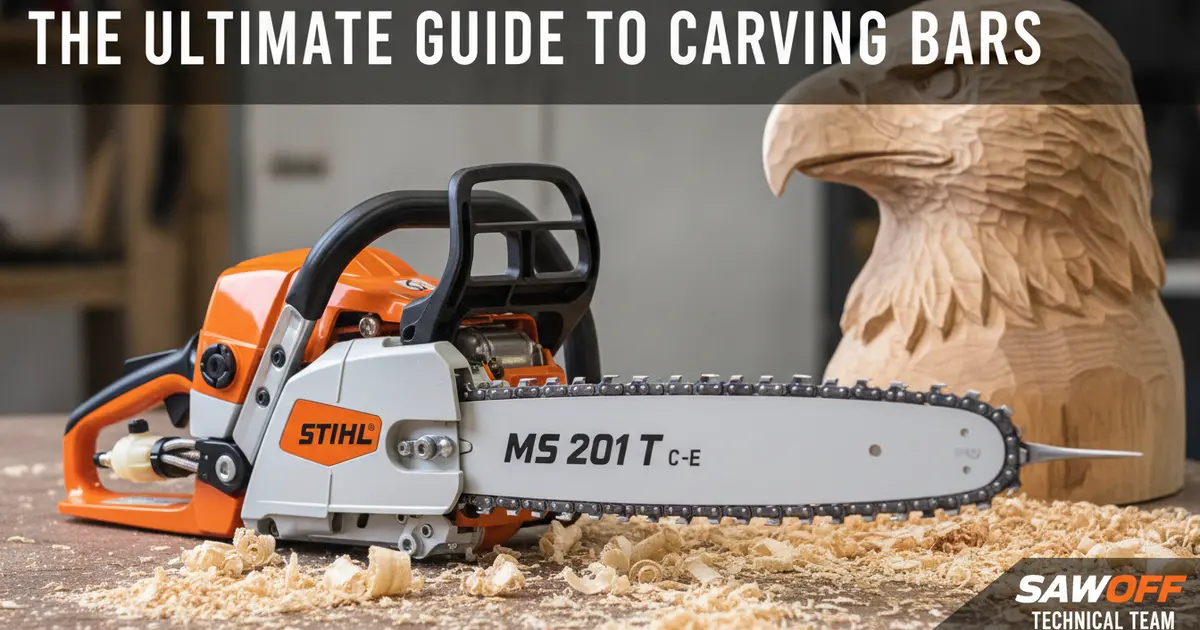
There is a specific, visceral satisfaction that comes from burying a dime-tip carving bar into a block of seasoned western red cedar. It isn’t the raw, destructive power of a Stihl MS 311 ripping through a 20-inch oak log. Instead, it’s about surgery. When you mount a high-end carving bar—think Sugihara or Cannon—onto a professional top-handle powerhead, you aren’t just holding a tool; you’re holding a high-RPM scalpel.
For years, I’ve watched guys try to carve fine details with standard laminated bars and 3/8-inch low-profile chains. It’s a mess. The kickback zone is too large, the radius is too wide, and the finish is ragged. But when you transition to a dedicated carving setup on a saw like the Echo CS-2511T or the Stihl MS 151 TC-E, the game changes. You gain the ability to “draw” in wood.
In this exhaustive breakdown, we’re going to tear down the engineering requirements, the ergonomic shifts, and the hard-won field knowledge required to master the “top-handle carver” setup. This is the setup that separates the weekend whittlers from the professional sculptors and high-end arborists who need to make surgical pruning cuts in tight crotches.
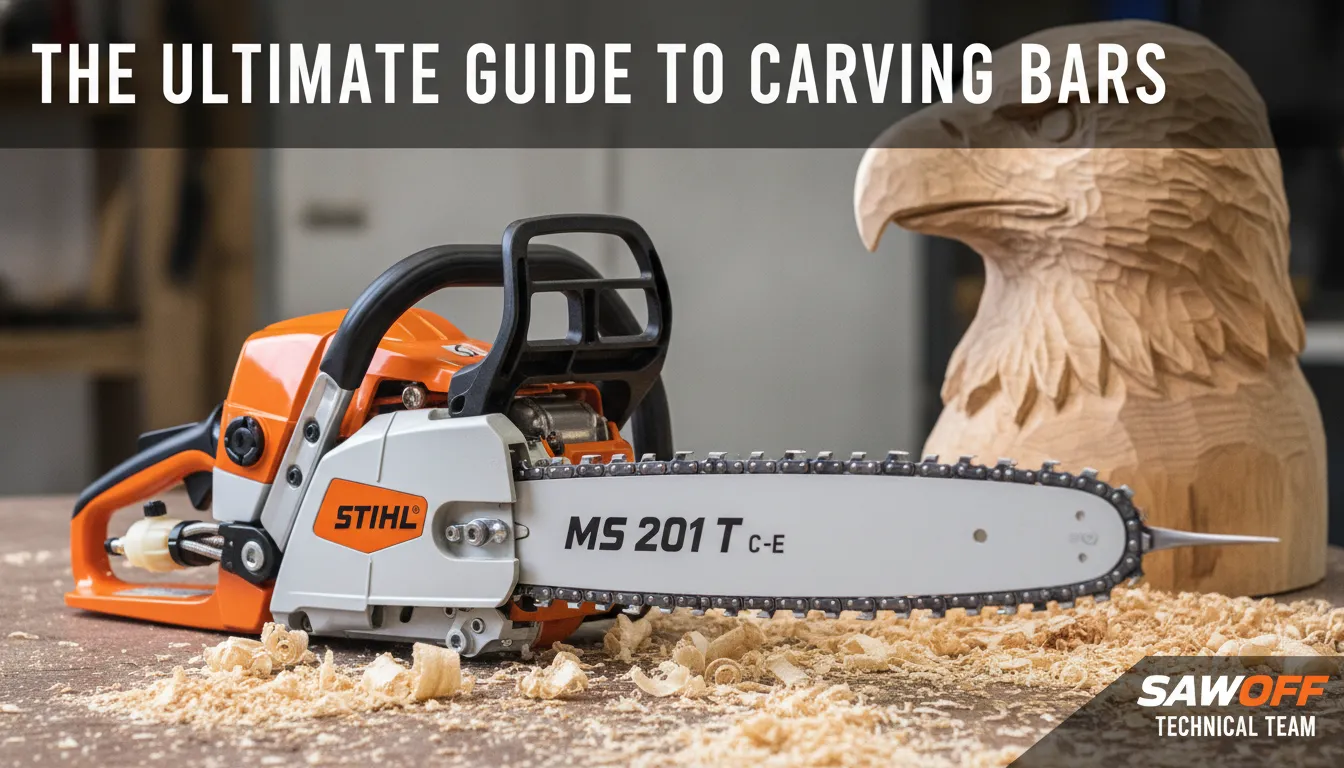
Strategic Comparison: The Best Powerheads for Carving Conversions
Before we get into the nuts and bolts, let’s look at the primary contenders. Not every top-handle is suited for a carving bar. You need a specific balance of high-RPM “zip” and a narrow chassis.
| Model | Displacement | Weight (Powerhead) | Best For | Check Price |
|---|---|---|---|---|
| Echo CS-2511T | 25.0 cc | 5.2 lbs | Ultra-Detail / Finishing | 🛒 View on AliExpress |
| Stihl MS 151 TC-E | 23.6 cc | 5.7 lbs | Precision Pruning & Carving | 🛒 View on AliExpress |
| Husqvarna T540XP MKIII | 39.1 cc | 8.4 lbs | Heavy Blockout / Large Scale | 🛒 View on AliExpress |
| Echo CS-355T | 35.8 cc | 8.0 lbs | Versatile Prosumer Work | 🛒 View on AliExpress |
While these are the “elites,” many beginners often start by trying to adapt more entry-level units like the Husqvarna 120, though the weight of a rear-handle saw makes detail work significantly more taxing on the forearms.
Technical Engineering Deep-Dive: The “Small-Scale” Revolution
To understand why a top-handle saw is the superior choice for a carving bar, we have to look at the engine architecture and the centrifugal forces at play.
Engine Architecture and High-End RPMs
When you’re carving, you aren’t always at wide-open throttle (WOT). You’re feathering the trigger. A professional top-handle saw is engineered with a lightweight piston and a precision-balanced crankshaft that allows for nearly instantaneous throttle response. In the world of Stihl, this is achieved through their 2-MIX engine technology, which uses a stratified charge to ensure that the fuel-air mixture is pushed into the combustion chamber while a layer of clean air sits between the fresh charge and the exhaust.
For a carver, this means the saw doesn’t “load up” (run rich and sluggish) when you’re doing delicate work at 1/4 throttle. If you’ve ever used a budget-tier saw like the Husqvarna 435 for detail work, you know the frustration of the engine bogging down just as you’re trying to whisper the tip of the bar across a sensitive area.
The Magnesium Crankcase Advantage
Most pro-grade top handles, especially the Husqvarna T540XP and the Echo CS-2511T, utilize a magnesium crankcase rather than a plastic (clamshell) design. This isn’t just about weight; it’s about heat dissipation and structural rigidity. When you mount a solid steel carving bar (which lacks a sprocket nose), the bar generates significantly more heat at the mount. A magnesium crankcase can wick that heat away from the main bearings far more effectively than a plastic housing. If you’re carving for six hours straight in the Georgia summer heat, that magnesium housing is the only thing keeping your crank seals from melting.
The 1/4-inch Pitch Conversion: The “Secret Sauce”
You cannot simply buy a carving bar and bolt it onto a standard saw. Standard top-handles usually come with a 3/8-inch low-profile (LP) or .325” pitch sprocket. Carving bars require 1/4-inch pitch chain.
Why? Because the radius of a “dime tip” carving bar is so small that a 3/8-inch chain link literally cannot wrap around it without binding or snapping. Converting to 1/4-inch requires three things:
- A 1/4-inch Drive Sprocket: Usually a 8-tooth or 9-tooth rim or spur sprocket.
- A 1/4-inch Pitch Bar: Solid steel, no sprocket in the tip.
- 1/4-inch Chain: Specifically .043 or .050 gauge.
The 1/4-inch chain has more drive links per foot, which translates to a much smoother “feel” in the cut. It doesn’t chatter. It doesn’t jump. It flows like a hot knife through butter.
Real-World Performance: The “Dime-Tip” Experience
I remember the first time I swapped the standard 12-inch bar on my Echo 2511T for an 8-inch Sugihara dime-tip. I was working on a white oak stump, attempting to pull out the feathers of an eagle sculpture. With a standard bar, every time I tried to use the tip, the saw would kick back or “skate.”
With the carving bar, that “kickback zone”—usually the upper quadrant of the bar tip—is virtually non-existent. You can bury the tip of the saw straight into the wood (a bore cut) with zero drama.
Bucking vs. Sculpting
While a Stihl MS 250 is great for bucking firewood, its weight distribution is all wrong for the vertical and diagonal movements required in carving. A top-handle saw’s center of gravity is tucked directly under your palm. This allows you to use your wrist to guide the cut.
When working in frozen hardwoods, the performance changes. I’ve noticed that in frozen white oak, the lack of a sprocket nose in the carving bar becomes a liability if your oiling system isn’t dialed in. Because there are no bearings at the tip to reduce friction, the chain is literally sliding over a solid piece of heat-treated steel. You will see the bar oil literally smoking if you don’t adjust your oiler to the “max” setting.
The “Snap” of the Pull Cord
There’s a specific engineering feat in these small saws called a decompression valve (though often unnecessary on 25cc saws) or a “Spring-Assisted” starting system (like Echo’s i-30). When you’re standing on a ladder or hunched over a carving, you don’t want to be fighting a high-compression pull. The 2511T starts with a literal “two-finger” flick. That ease of use allows you to shut the saw off frequently to check your proportions without the dread of a “hot-start” struggle.
Ergonomics & Operator Comfort: The Top-Handle Trade-off
We need to address the elephant in the room: Safety. Top-handle saws are designed for professional arborists working in trees. Using them on the ground for carving is common, but it requires a different set of safety protocols.
Weight Distribution and the “Claw” Grip
The weight of a Stihl MS 151 TC-E is so negligible that you might be tempted to use it one-handed. Don’t. Even with a carving bar, the chain speed on these saws is terrifyingly high. However, the handle geometry allows for a “pinch grip” where your left hand controls the pivot point on the front wrap handle, and your right hand “steers” the rear handle.
The vibration frequency in these small saws is usually dampened by a spring-based anti-vibration system. In cheaper models, they use rubber bushings. Rubber is “okay,” but after 4 hours of bucking and detail work, rubber bushings will leave your palms buzzing like you’ve been holding a hive of bees. The spring systems in the XP (Husqvarna) and Pro (Echo/Stihl) models are vastly superior for long-duration carving sessions.
The Inertia-Activated Chain Brake
When using a carving bar, you’re often working in “closed” spaces—inside a hollow log or behind a branch. A standard hand-guard chain brake might not always be triggered by your hand in a kickback event. High-end top-handles feature inertia-activated brakes that trip based on the physical “flip” of the saw, providing an essential layer of protection when your hands are in non-traditional carving positions.
Historical Context: From the “Plastic Age” to the “Precision Age”
If you look back 20 years, people were carving with massive rear-handle saws, often removing the bar guards and doing dangerous modifications just to get a smaller tip. The “Top Handle Revolution” started when carvers realized that climbing saws—engineered for the lightest possible weight—were the perfect platform for their craft.
The Echo CS-2511T was a watershed moment. Before its release, the Stihl MS 170 was the “entry-level” carver’s choice, but it was a rear-handle and felt “clunky.” When the 2511T arrived at just over 5 pounds, it allowed carvers to work for 10 hours without the debilitating back pain associated with heavier saws. It shifted the industry from “power-at-all-costs” to “power-to-weight-ratio-is-everything.”
Maintenance & Serviceability: Keeping the Scalpel Sharp
Carving is harder on a saw than almost any other type of work. Why? Dust. When you’re doing detail work, you aren’t making big chips; you’re making fine, flour-like sawdust. This dust is the enemy of your engine.
- Air Filter Cleaning: You need to clean your filter every single tank of fuel. These saws utilize centrifugal air cleaning (which flings larger particles away before they hit the filter), but the fine carving dust will still bypass it.
- Bar Dressing: Since carving bars have no sprocket, the rails at the tip take extreme pressure. You must use a flat-file to remove the “burrs” that develop on the side of the bar rails every few hours. If you don’t, your chain will start to lean to one side, ruining your precision.
- Spark Plug Access: On the Stihl MS 151, the spark plug is tucked behind a tool-less shroud. It’s elegant. On some older Husqvarna models, you’ll be fighting with a T25 Torx just to check the gap.
- Oil Mixture: I always run a slightly “richer” oil mix for carving—maybe 45:1 instead of 50:1—using a high-quality synthetic oil. The sustained high-RPM/low-load nature of carving creates a lot of internal heat that benefits from the extra lubrication.
Hardware Specs: Professional Comparison
| Feature | Echo CS-2511T | Stihl MS 151 TC-E | Husqvarna T540XP MKIII |
|---|---|---|---|
| Displacement | 25.0 cc | 23.6 cc | 39.1 cc |
| Power Output | 1.1 kW | 1.1 kW | 1.9 kW |
| Fuel Capacity | 6.4 fl. oz | 6.8 fl. oz | 10.5 fl. oz |
| Chain Pitch | 3/8-inch (Stock) / 1/4-inch (Carving) | 1/4-inch PM3 (Stock) | .325” (Stock) |
| Carrying Weight | 5.2 lbs | 5.7 lbs | 8.4 lbs |
| Oil System | Adjustable/Clutch-Driven | Adjustable | High-Flow Adjustable |
Pros & Cons: The SAWOFF Edge
Pros
- Weight: Unbeatable maneuverability. You can carve overhead or at awkward angles without fatigue.
- Visibility: The narrow “wasp-waist” design of top-handle saws allows you to see exactly where the bar tip is entering the wood.
- Precision: When paired with 1/4-inch chain, the cut is so smooth it requires minimal sanding.
- Throttle Response: High-strung engines provide the “snap” needed for quick, shallow detail strokes.
Cons
- Heat: Solid carving bars get hot. You must be religious about your oiler settings.
- Cost: Professional top-handles are significantly more expensive than their rear-handle counterparts.
- Learning Curve: The balance of a top-handle saw is “twitchy” for those used to heavy bucking saws.
- Dust Sensitivity: Requires more frequent air filter maintenance than standard cutting.
Final Verdict: Is it Worth the Conversion?
If you are serious about wood sculpture or precision arborist work, the answer is a resounding yes. Converting a high-quality top-handle saw to a carving setup is like upgrading from a butter knife to a surgeon’s blade.
For most users, the Echo CS-2511T remains the “Gold Standard” for this conversion due to its impossible lightness. However, if you want something that feels a bit more robust and has the Stihl dealer network behind it, the MS 151 TC-E is a masterclass in German engineering.
Avoid the temptation to put a carving bar on a cheap, heavy rear-handle saw unless you’re just testing the waters. The ergonomics will fight you, and the “vibration frequency” will destroy your hands within an hour. Invest in a magnesium-crankcase top-handle, spend the money on a 1/4-inch sprocket conversion, and never look back.
SAWOFF Rating: 4.8 / 5 (Specifically for the CS-2511T and MS 151 carving setups).
FAQ: Using Carving Bars on Top Handle Saws
1. Do I need a different sprocket to use a carving bar?
Yes. Almost certainly. Most top-handle saws come with 3/8-inch or .325” sprockets. Carving bars require 1/4-inch pitch chain. You must swap the drive sprocket (rim or spur) to match the 1/4-inch pitch of the chain and bar.
2. Why does my carving bar smoke even when the oiler is full?
Carving bars are “hard-nose” or “stellite-tipped,” meaning they have no sprocket nose bearings. This creates massive friction at the tip. You must adjust your oiler to the maximum setting and ensure you are using a high-tack bar oil.
3. Can I use a top-handle saw for “blocking out” a large carving?
You can, but it’s not ideal. For the initial “blocking” (removing large chunks of wood), a saw like the Echo CS-490 or even a Husqvarna 435 is better. Use the top-handle for the final 30% of the work where detail matters.
4. What is the difference between a “Dime Tip” and a “Quarter Tip”?
This refers to the radius of the bar’s tip. A “Dime Tip” is the smallest, roughly the size of a U.S. dime, allowing for extreme detail. A “Quarter Tip” is slightly larger and more durable, better for general pruning and larger detail work.
5. How tight should the chain be on a carving bar?
Unlike a standard bar, a carving chain should be run slightly “loose.” Since there is no sprocket nose to take up the slack as the metal expands from heat, a tight chain will burn the bar and stall the engine. A “slight sag” is the pro standard.
6. Is it safe to use a top-handle saw on the ground?
Technically, manufacturers and OSHA state that top-handle saws are for “in-tree” use by trained professionals. However, carvers use them on the ground because of their agility. You must maintain a two-handed grip and be hyper-aware of the kickback zone, even with a carving bar.
7. What fuel should I use for a carving saw?
I highly recommend using pre-mixed alkylate fuel (like MotoMix or TruFuel). Carving involves a lot of idling and partial-throttle work, which can cause carbon buildup with ethanol-based pump gas. Alkylate fuels burn cleaner and have a much longer shelf life.
8. Why is my 1/4-inch chain dulling so fast?
If you’re carving near the ground, you might be pulling dirt or grit into the cut. Additionally, carving bars generate more heat; if the chain gets too hot, the temper of the steel softens, and it loses its edge. Keep it oiled and keep it out of the dirt!
Frequently Asked Questions
Do I need a different sprocket to use a carving bar?
Yes almost certainly. Most top-handle saws come with 3/8-inch or .325 inch sprockets. Carving bars require 1/4-inch pitch chain. You must swap the drive sprocket which can be rim or spur to match the 1/4-inch pitch of the chain and bar.
Why does my carving bar smoke even when the oiler is full?
Carving bars are hard-nose or stellite-tipped meaning they have no sprocket nose bearings. This creates massive friction at the tip. You must adjust your oiler to the maximum setting and ensure you are using a high-tack bar oil to prevent overheating.
Can I use a top-handle saw for blocking out a large carving?
You can but it is not ideal. For the initial blocking which involves removing large chunks of wood a saw like the Echo CS-490 or even a Husqvarna 435 is better. Use the top-handle for the final 30 percent of the work where detail matters most.
What is the difference between a Dime Tip and a Quarter Tip carving bar?
This refers to the radius of the bar tip. A Dime Tip is the smallest roughly the size of a U.S. dime allowing for extreme detail work. A Quarter Tip is slightly larger and more durable making it better for general pruning and larger detail carving.
How tight should the chain be on a carving bar?
Unlike a standard bar a carving chain should be run slightly loose. Since there is no sprocket nose to take up the slack as the metal expands from heat a tight chain will burn the bar and stall the engine. A slight sag is the professional standard.
Is it safe to use a top-handle saw on the ground for carving?
Technically manufacturers and OSHA state that top-handle saws are for in-tree use by trained professionals. However carvers use them on the ground because of their agility. You must maintain a two-handed grip and be hyper-aware of the kickback zone even with a carving bar.
What fuel should I use for a carving saw?
I highly recommend using pre-mixed alkylate fuel like MotoMix or TruFuel. Carving involves a lot of idling and partial-throttle work which can cause carbon buildup with ethanol-based pump gas. Alkylate fuels burn cleaner and have a much longer shelf life.
Why is my 1/4-inch chain dulling so fast on my carving saw?
If you are carving near the ground you might be pulling dirt or grit into the cut. Additionally carving bars generate more heat and if the chain gets too hot the temper of the steel softens and it loses its edge. Keep it oiled and keep it out of the dirt.