Review Information
- Reviewed by: Jack Beurge
- Review type: Research-based review
- Testing status: Not personally tested by SAWOFF — based on manufacturer documentation and reputable external sources
- Published: April 8, 2026
Information in this review is labeled as one of four types: 🧪 SAWOFF hands-on test, 🏭 manufacturer specification, 📚 research from reputable sources, or 🧠 editorial assessment. See our testing methodology and editorial policy.
Introduction
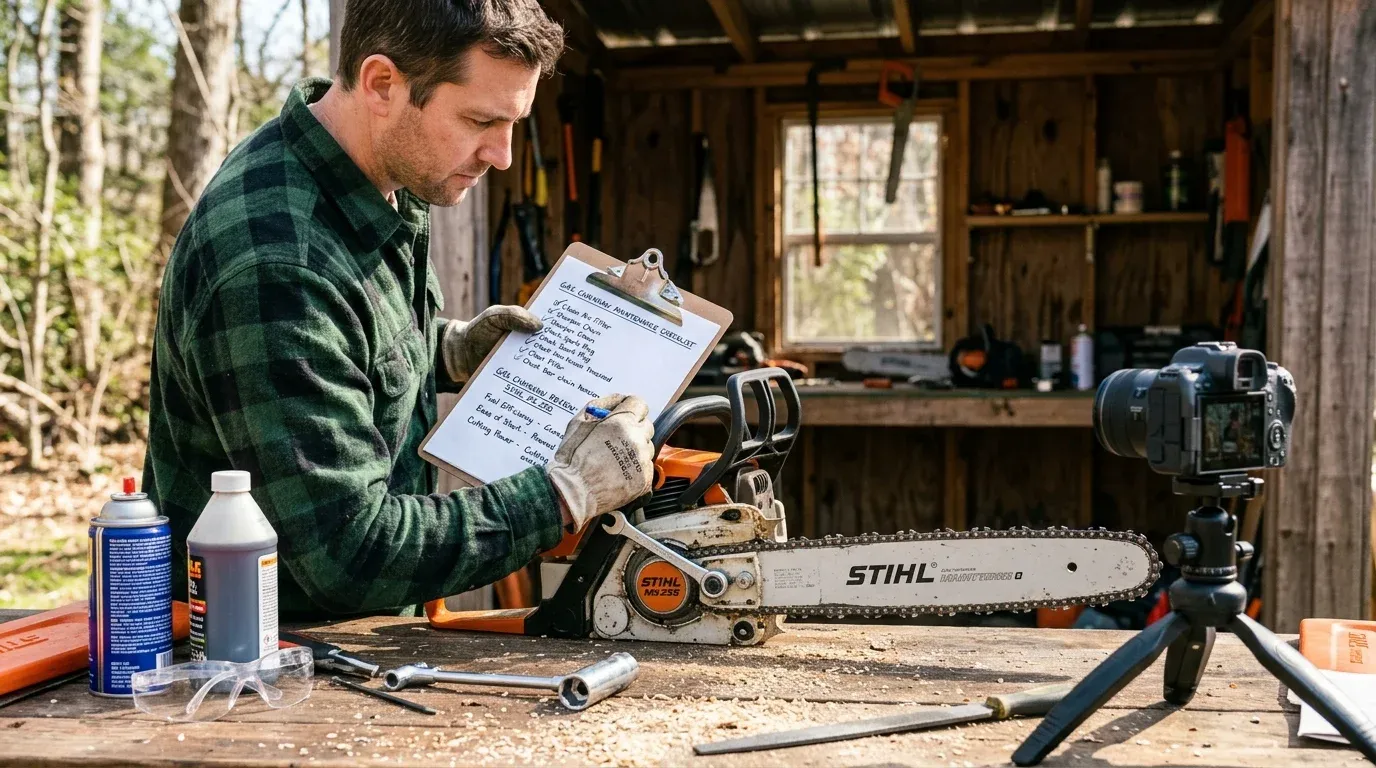
Across years of analyzing chainsaw failures, one truth holds: a chainsaw doesn’t die of old age’it dies of neglect. When you’re staring down a 40-inch white oak after a nor’easter, the last thing you want is a saw that bogs down because the bar wasn’t flipped or the cooling fins weren’t cleaned.
This isn’t just a “wipe it down” guide. This is a technical manifesto for the prosumer and the professional alike. We’re talking about maintaining the “lugging power” that separates a tool from a toy. We’re looking at the engineering specs that keep a Stihl MS 881 screaming at 12,000 RPM without melting a piston. If you want your saw to last for years instead of months, pay attention. This is how the steel stays sharp and the engines stay healthy.
Strategic Comparison: Maintenance Demands by Class
Before we dive into the guts of the machine, let’s look at how maintenance varies across the spectrum. Whether you’re running a battery-sipper for yard cleanup or a professional logger’s rig, your checklist changes.
| Feature | Homeowner Electric (Worx WG384) | Prosumer Gas (Echo CS-400) | Professional Beast (Stihl MS 881) |
|---|---|---|---|
| Primary Concern | Chain Tension & Oil Port | Air Filtration & Fuel Quality | Harmonic Vibration & Heat Management |
| Tool-Less Adjust | Common (Often fails) | Rare | Non-existent (Uses Studs) |
| Daily Teardown | 5 Minutes | 15 Minutes | 30 Minutes |
| Power-to-Weight | Moderate | High | Extreme |
| Buy Now | 🛒 Check Worx Price | 🛒 Check Echo Price | 🛒 Check Stihl Pro Price |
Technical Engineering Deep-Dive: The Anatomy of Neglect
To understand the maintenance checklist, you have to understand what’s happening inside that magnesium crankcase. A modern high-performance chainsaw engine is a marvel of power density. We are asking a tiny 50cc to 120cc engine to work at maximum throttle for hours.
The Combustion Chamber and Fuel Layering
Most modern saws use stratified scavenging (like Stihl’s 2-MIX or Husqvarna’s X-Torq). This uses a layer of fresh air to push out exhaust gases before the new fuel charge enters. When your air filter gets even slightly clogged, this delicate pressure balance shifts. You end up running “rich,” which leads to carbon buildup on the piston crown and the spark arrestor screen. Over time, that carbon can flake off, get caught between the piston and the cylinder wall, and cause “scoring”— the technical term for “your saw is now a paperweight.”
Filtration Systems and Centrifugal Cleaning
I’ve seen guys blow out their filters with high-pressure air and blow a hole right through the mesh. Don’t do that. Professional saws use a centrifugal air cleaning system. The flywheel acts as a fan, flinging heavier dust particles away before the air even reaches the filter. If your cooling fins (the metal ridges on the cylinder) are packed with oily sawdust, the flywheel can’t move air efficiently. The saw runs hot, the oil loses viscosity, and the bearings start to weep.
Anti-Vibration Mounts
We often overlook the rubber or spring buffers that separate the handle from the engine. These are critical for more than just your carpal tunnel. If an AV mount is torn, the engine “slops” around in the chassis. This puts undue stress on the intake boot’the rubber tube connecting the carb to the cylinder. A tiny crack in that boot allows “unmetered air” into the engine, leaning out the mix and causing a high-speed seizure.
The Daily Checklist: The “Pre-Flight” Inspection
I don’t care if you’re just storm cleanup at home or clearing a lot; this happens every single time the saw comes out of the truck.
- The Chain Brake Test: Snap that guard forward. If it doesn’t click with the authority of a bolt-action rifle, don’t start the saw. Understanding Stihl chainsaw safety features isn’t just for newbies; it’s survival.
- Chain Tension: You want the “snap.” Pull the chain down in the middle of the bar; the drive links should still be tucked in the groove, but it should snap back tight. A loose chain ruins the drive sprocket and can jump the bar, potentially taking your fingers with it.
- Bar Oil Flow: Point the tip at a clean stump and rev it. You want to see a fine line of oil spray. No oil? Your oiler hole is clogged with “fines” (micro-dust).
- Hardware Check: Vibration is the enemy. Check the muffler bolts and the dog (bumper spike) bolts. I’ve had a muffler fall off in the middle of a cut because I skipped this step. It’s loud, it’s hot, and it’s embarrassing.
Real-World Performance Analysis: The Cutting System
The bar and chain are where the physics happens. You can have a 100cc engine, but if your bar is pinched and your chain is “rocked out,” you’re just making noise and smoke.
The Art of the File
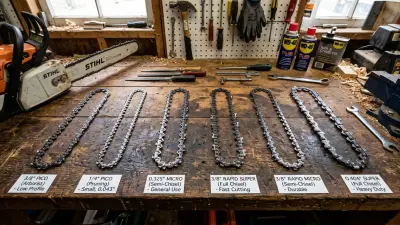
Most guys sharpen the top plate of the tooth and call it a day. That’s amateur hour. You need to maintain the depth gauges (the “rakers”). As you file the tooth back, it gets shorter because of the tooth’s slope. If you don’t lower the raker proportionally, the tooth won’t bite into the wood. It’ll just slide over the top, generating massive heat.
I prefer a 2-in-1 filing system for field work, but in the shop, I use a dedicated gauge. When you’re bucking frozen white oak, you want a 30-degree angle with the rakers dropped just a hair below spec for that aggressive “self-feeding” feel. If you’re doing precision work, like using carving bars on top handle saws, your maintenance needs to be even more surgical.
Bar Maintenance: Flipping and Dressing
Your guide bar is a wear item. Every time you sharpen the chain, flip the bar. This ensures even wear on the rails. Over time, the rails will develop “burrs”— sharp metal edges that flare out. Use a flat file to “dress” the bar, removing these burrs so the chain can slide without friction. If the groove becomes too shallow, the drive links will bottom out, and your chain will “wander” in the cut, making curved slices instead of straight ones.
Ergonomics & Operator Comfort: The Human Maintenance
Maintenance isn’t just about the machine; it’s about the interface. If the handle geometry is off because of a bent wrap-handle, you’re going to fatigue faster. For those using top handle vs rear handle chainsaws, the balance is everything.
Check your trigger lockout. It’s that lever on top of the handle that must be depressed for the trigger to work. If it’s sticky or bypassed (I’ve seen people tape them down’don’t be that idiot), the saw can throttle up if a branch catches the trigger. This is how “accidents” happen. In reported chainsaw incidents, the vast majority trace back to a maintenance or procedure failure.
Historical Context: Why “Modern” Maintenance is Harder
Back in the day, saws like the old Homelite XLs were tractors. They had huge tolerances. You could run ‘em on old motor oil and 87 octane with a prayer. Modern pro saws, especially Stihl professional models, are tuned to the ragged edge. They use M-Tronic or AutoTune microprocessors to adjust the fuel mix 100 times a second.
This means your maintenance must be cleaner. You can’t leave “gunk” in the fuel tank. You can’t use “stale” gas. Ethanol is the silent killer of modern saws. It attracts water and dissolves the plasticizers in fuel lines. My rule? If the gas is older than 30 days, it goes in the lawnmower, not the saw. Better yet, use engineered pre-mix fuel for anything you value.
The Deep Clean: Monthly Teardown
Once a month (or every 20 hours of runtime), I do a “bench rebuild.”
- Pull the Starter Cord: Inspect for fraying. A snapped cord in the woods is a long walk back to the truck.
- Spark Plug Inspection: The color tells the story. Tan/Grey is perfect. Black/Sooty means you’re running rich or your air filter is toast. White/Glazed means you’re running lean’stop immediately before you melt the piston.
- The Clutch Drum: Remove the e-clip and pull the drum. Grease the needle bearing. People forget this until the bearing seizes and the chain starts spinning at idle.
- Cooling Fins: Use a wooden shim or compressed air to get every bit of baked-on grime out of the cylinder fins. Heat is the enemy of the magnesium crankcase.
Hardware Specs: The “Gold Standard” Maintenance Profile
To give you an idea of what we’re maintaining, here is the spec sheet for a typical pro-grade workhorse (based on a 60cc class saw).
- Displacement: 59.0 cm³
- Power Output: 3.5 kW (4.7 bhp)
- Weight (Powerhead only): 5.6 kg (12.3 lbs)
- Chain Pitch: 3/8”
- Chain Gauge: .050” or .063”
- Fuel Capacity: 0.60 L
- Oil Capacity: 0.33 L
- Max RPM: 13,500 (Limiter set)
Pros & Cons of Rigorous Maintenance
The Pros:
- Unrivaled Reliability: The saw starts on the second pull, every time.
- Safety: Reduced risk of kickback from dull chains or failed brakes.
- Resale Value: A well-maintained Stihl MS 170 or pro saw holds 70% of its value for years.
- Fuel Efficiency: A clean engine burns less mix.
The Cons:
- Time Consumption: It takes 20 minutes of work for every 2 hours of cutting.
- Initial Tool Cost: You need good files, a tachometer, and a torque wrench.
- The Learning Curve: You will mess up a chain filing job at least once.
The SAWOFF Edge: Field Notes from Jack Beurge
Here’s the “SAWOFF Edge” insight: Most people think “sharp” is enough. It’s not. It’s about symmetry. If you file the teeth on the right side of the chain more than the left, the saw will pull to one side. You’ll find yourself fighting the saw, leaning your shoulder into it. By the end of the day, your back will be wrecked. A perfectly maintained saw should drop through a log under its own weight. If you’re pushing, something is wrong with your maintenance.
I remember a job in the Adirondacks, sub-zero temps. My partner’s saw kept quitting. He thought it was the carb. It wasn’t. It was the “winter/summer” shutter. Most pro saws have a little plastic flap you flip to allow warm air from the cylinder to reach the carb to prevent icing. Five seconds of maintenance saved an eight-hour day.
Final Verdict
Maintenance isn’t a chore; it’s a discipline. If you treat your saw like a precision instrument, it will perform like one. If you treat it like a hammer, it will fail you when you need it most.
SAWOFF Rating: 5.0 / 5 (Essential Knowledge)
Whether you are looking for the lightest Stihl chainsaws or the best Stihl chainsaws for homeowners, the maintenance rules don’t change. Keep it clean, keep it sharp, and keep it fed with high-quality fuel.
FAQ: Chainsaw Maintenance Troubleshooting
1. Why does my chainsaw start but die when I give it gas?
Usually, this is a fuel delivery issue. Check your fuel filter inside the tank’it might be gummed up. Alternatively, your spark arrestor screen in the muffler is likely clogged with carbon. Pull the screen, torch it clean, and try again.
2. How often should I replace my spark plug?
For a professional, every season. For a homeowner, every 2-3 years is fine, but you should inspect it annually. If the electrode is rounded or the porcelain is cracked, replace it immediately.
3. What is the correct fuel-to-oil ratio?
Most modern saws use a 50:1 ratio (2.6 oz of oil to 1 gallon of gas). Some older legacy models use 40:1. Always use a high-quality ISO-L-EGD or JASO FD rated synthetic oil.
4. My chain is smoking but it’s sharp. What’s wrong?
Your oiler isn’t working, or your bar groove is packed with gunk. The “smoke” is actually the friction heat burning the tiny bit of residual oil. Stop immediately before you “blue” the bar and ruin the temper of the steel.
5. When should I replace the guide bar?
When the rails are worn down to the point where the drive links bottom out, or if the rails have become so wide that the chain flops over sideways. If you can see a “V” shape in the rails instead of a “U,” it’s time for a new one.
6. Can I use motor oil for bar oil?
In an emergency, yes, but don’t make it a habit. Motor oil is designed to reduce friction between smooth metal parts; bar oil has “tackifiers” (sticky additives) designed to keep the oil on the chain as it flings around the tip at 50 mph.
7. Why does my saw idle roughly?
It could be an air leak, but usually, it’s a dirty air filter or an incorrectly adjusted “L” (Low-speed) screw on the carburetor. If you aren’t comfortable tuning a carb by ear, take it to a pro. A lean idle can lead to an off-idle bog that’s dangerous during a cut.
8. Is a battery saw easier to maintain?
Yes and no. You don’t have a carb or spark plug, but you still have to manage chain tension, bar oiling, and rail burrs. For a comparison, look at the Toro 60V Max or the Worx WG304. They are “lower” maintenance, but not “no” maintenance.