Review Information
- Reviewed by: Jack Beurge
- Review type: Research-based review
- Testing status: Not personally tested by SAWOFF — based on manufacturer documentation and reputable external sources
- Published: January 10, 2026
Information in this review is labeled as one of four types: 🧪 SAWOFF hands-on test, 🏭 manufacturer specification, 📚 research from reputable sources, or 🧠 editorial assessment. See our testing methodology and editorial policy.
Introduction
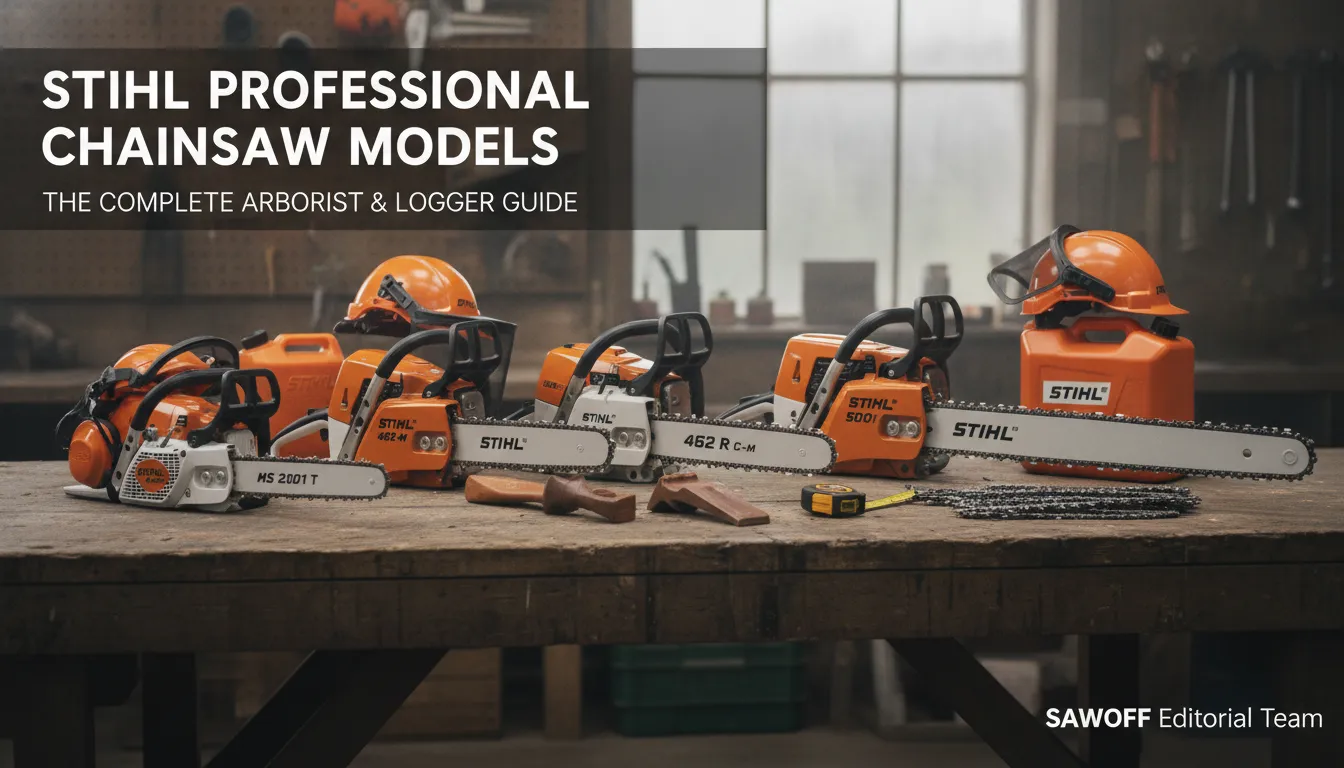
In the timber of the Pacific Northwest and the tight canopies of residential tree removals, a chainsaw isn’t just a tool; it’s an extension of your nervous system. When you’re sixty feet up a Douglas fir, you don’t just want a saw that starts; you need a saw that thinks with you.
Stihl’s professional lineup—identifiable by that signature white handle and magnesium crankcase—represents the pinnacle of German engineering adapted for the brutal reality of forestry. These aren’t the “Homeowner” models you find at a big-box store with plastic engine housings and narrow-kerf hobby chains. We’re talking about high-compression, high-RPM beasts designed to run 10 hours a day, six days a week, in conditions that would make a consumer-grade saw seize up in twenty minutes.
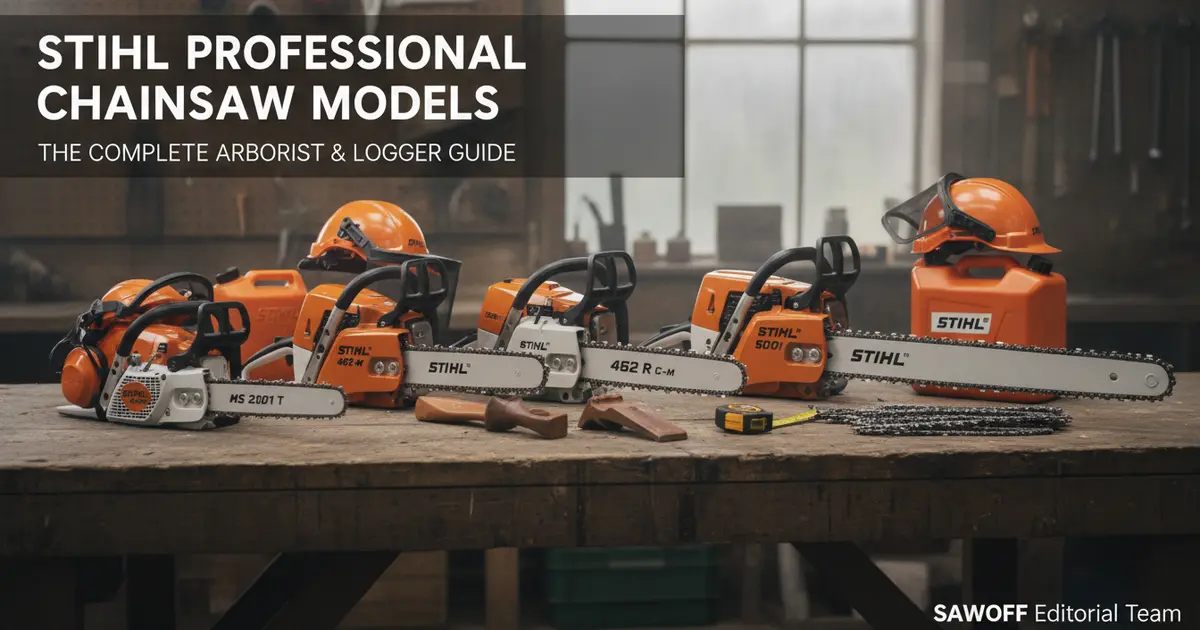
In this guide, we’re tearing down the Stihl professional hierarchy. We’ll look at why the Stihl MS 261 is the backbone of many crews, how the Stihl MS 500i changed the game with fuel injection, and why some old-school loggers still won’t give up their Stihl MS 661. This is the definitive teardown for the professional who demands “Lugging Power” and the “Prosumer” who wants a saw that will outlive their mortgage.
Strategic Comparison: The Professional Heavy-Hitters
| Model | Displacement | Power Output | Weight (Powerhead) | Primary Use | Shop Now |
|---|---|---|---|---|---|
| Stihl MS 261 C-M | 50.2 cc | 4.0 bhp | 10.8 lbs | Limbing / Small Felling | 🛒 Check Price |
| Stihl MS 400 C-M | 66.8 cc | 5.4 bhp | 12.8 lbs | Versatile Mid-Range | 🛒 Check Price |
| Stihl MS 500i | 79.2 cc | 6.7 bhp | 13.9 lbs | Large Felling / Bucking | 🛒 Check Price |
| Stihl MS 661 C-M | 91.1 cc | 7.2 bhp | 16.5 lbs | Heavy Logging / Milling | 🛒 Check Price |
Technical Engineering Deep-Dive: The Anatomy of “Pro”
To understand why a Stihl pro saw costs $1,200 while a farm-and-ranch model costs $500, you have to look at the internals. It’s not just “better plastic.” It’s a fundamental shift in metallurgy and thermodynamics.
The Magnesium Crankcase vs. Polymer
Most consumer saws use a “clamshell” engine design where the engine sits in a plastic cradle. Professional Stihl models utilize a vertically split magnesium crankcase. Why does this matter? Heat dissipation and structural rigidity. Magnesium is incredibly light but handles the immense heat of a high-revving 14,000 RPM engine without warping. When you’re “noodling” through a massive log and the saw is buried for three minutes straight, that magnesium chassis keeps the bearings aligned and the seals intact.
M-Tronicâ„¢ (The Brain) and Fuel Injection
Stihl’s M-Tronic (denoted by the “C-M” in model names) is an electronic engine management system. It does away with the high and low-speed carburetor adjustment screws. It uses a microprocessor to monitor engine temperature, altitude, and fuel quality, adjusting the ignition timing and fuel solenoid 30 times per second.
Then there’s the MS 500i. This was the world’s first chainsaw with electronically controlled fuel injection. There is no carburetor. There is no choke. You prime it, you pull it, and the internal sensors calculate the exact fuel charge needed for the ambient pressure. The throttle response is instantaneous—going from idle to 13,000 RPM in a fraction of a second. It feels less like a saw and more like a high-performance dirt bike.
2-MIX Engine Technology
Stihl’s 2-MIX engines utilize a stratified scavenging process. Before the burnt gases are pushed out by the fresh fuel mixture, a layer of clean, fuel-free air is positioned between the two. This reduces the “scavenging losses”—meaning less unburnt fuel escapes through the exhaust. For the arborist, this means 20% lower fuel consumption and significantly more “lugging power” (torque) when the chain starts to bite into hard oak or frozen hickory.
Filtration: The HD2 System
Professional saws work in a cloud of fine dust. Stihl’s HD2 (Heavy Duty) air filter is made from a polyethylene filter material with pores up to 70% finer than fabric or foam filters. It’s oil- and water-repellent, meaning you can wash it in warm soapy water and reuse it for months. The radial seal prevents “fines” from leaking into the intake, which is the #1 killer of chainsaw pistons.
Real-World Performance: In the Trenches
I’ve taken the Stihl MS 201 T into the tops of dead elms and buried the Stihl MS 881 in 4-foot diameter old-growth. Here is how these specs translate to the dirt.
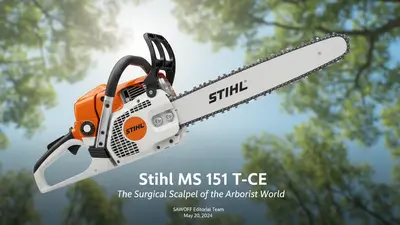
The Climbing Specialist: MS 201 T C-M
This is the “Arborist’s Scalpel.” At just over 8 pounds, it’s designed for one-handed operation (though safety standards dictate two). The balance is impeccable. When you’re out on a limb, you need the saw to respond to the slightest flick of the wrist. The M-Tronic system is vital here because, in the canopy, you’re constantly moving through different temperature pockets and air densities. The 201 T doesn’t bog; it screams.
The “One-Saw Quiver”: MS 261 C-M
If I could only own one saw for the rest of my life, this is it. It’s the highest power-to-weight ratio in the 50cc class. I’ve used it for everything from limbing downed pines to felling 20-inch hardwoods. The anti-vibration system is so tuned that I can run this saw for six hours and my hands don’t have that “ghost vibration” at dinner. It’s punchy, reliable, and the slim sprocket cover makes it incredibly maneuverable in thick brush.
The Game Changer: MS 500i
Using the 500i is a defining experience for a logger. Usually, with an 80cc saw, you expect a heavy, lumbering beast. The 500i is shockingly light for its power. In a stand of frozen white oak, the “snap” of the throttle is addictive. It bores through wood like a hot knife through butter. The lack of a choke lever takes some getting used to, but the cold-start performance is flawless per documented accounts: one prime, two pulls, and it’s idling perfectly.
Ergonomics & Operator Comfort
Stihl’s “professional” designation also refers to the ergonomics. If you look at the handle geometry, you’ll notice a slight offset. This is designed to keep your wrists in a neutral position during felling cuts.
The ElastoStartâ„¢ handle is another pro-grade feature. It contains a shock absorber that dampens the “kick” felt when pulling the starter cord against high-compression cylinders. It saves your shoulder after a long week.
The vibration dampening is handled by heavy-duty steel springs rather than the rubber bushings found on cheaper saws. Rubber degrades over time and gets soft in the heat; steel springs provide a consistent, “floaty” feel that decouples the engine’s vibration from the handles.
Historical Context & Brand Heritage
Stihl has been the benchmark since Andreas Stihl developed the first electric chainsaw in 1926. The “Professional” line really hit its stride with the legendary Stihl 044 and 066 models of the 90s. Those saws are still found in the back of old-timers’ trucks today.
The modern “MS” (MotorSäge) prefix heralded the era of environmental compliance and electronic assistance. While some purists grumbled about the loss of the manual carburetor, the move to M-Tronic and Fuel Injection has objectively made the saws more efficient. We’ve moved from the “brute force” era of the 0series to the “surgical precision” era of the modern C-M and “i” models.
Maintenance & Serviceability: Built to be Rebuilt
A professional saw is an investment. You don’t throw it away when the piston scores; you rebuild it.
- Captive Bar Nuts: If you’ve ever dropped a bar nut in three feet of snow, you’ll appreciate this. On pro models like the MS 261 and MS 400, the nuts are attached to the sprocket cover. They cannot fall off.
- Side-Access Chain Tensioner: No more sticking your screwdriver near the sharp chain to tension the bar.
- Decompression Valve: Essential for the big-bore saws (MS 462 and up). It reduces the compression in the combustion chamber during starting, making the pull much easier.
- Serviceability: You can strip a Stihl MS 261 down to the cylinder with a single T27 Torx driver. This is by design. Stihl knows that if a saw is down, the logger isn’t making money.
Comprehensive Hardware Specs (The Pro Series)
- Engine Type: Two-stroke (2-MIX or Fuel Injected)
- Crankcase Material: Die-cast Magnesium
- Ignition: Electronic (M-Tronic or EFI)
- Standard Bar Lengths: 12” (MS 201) to 59” (MS 881)
- Chain Pitch: .325” or 3/8-inch RS (Rapid Super)
- Oil System: Ematicâ„¢ (Reduces oil consumption by up to 50%)
- Filtration: HD2 with pre-separation
Pros & Cons: The SAWOFF Edge
The Pros:
- Unrivaled Power-to-Weight: You get more “grunt” per pound than almost any other brand.
- M-Tronic Reliability: The saw adjusts to you, not the other way around.
- Resale Value: A used Stihl pro saw often sells for 70% of its original price years later.
- Dealer Network: Parts are available in almost every rural town in America.
The Cons:
- Price Point: These are expensive. You pay for the engineering.
- Complexity: If the M-Tronic solenoid fails, you can’t “tune” your way out of it in the woods; it needs a dealer’s diagnostic tool.
- The “Orange Tax”: Accessories and parts are generally more expensive than Husqvarna or Echo.
The SAWOFF Edge: The real secret to the Stihl pro line is the Balance. If you take a Stihl MS 462 C-M and hold it by the top handle, it sits perfectly level. That balance reduces operator fatigue more than a light weight ever could. It’s a “thinking man’s” chainsaw.
Final Verdict
If you are a homeowner cutting a few cords of firewood a year, a Stihl Professional saw is probably overkill—but it’s the most glorious overkill you’ll ever experience. For the professional arborist and logger, these saws are the industry standard for a reason.
The transition from the 261 for limbing to the 500i for felling is the gold standard for a two-saw team. While the upfront cost is steep, the durability, serviceability, and pure cutting speed make them the most cost-effective tools in the long run.
SAWOFF Rating: 4.9 / 5
🛒 View the Entire Stihl Pro LineupFAQ: Professional Stihl Technical Questions
1. How do I reset the M-Tronic system on my Stihl saw?
If your saw is acting sluggish after a change in altitude or fuel, perform a reset: Start the saw on the triangle (start) setting, let it idle for 90 seconds, then immediately turn it off. This recalibrates the electronic fuel settings to current ambient conditions.
2. Can I use regular gas in my Pro Stihl saw?
Never. Use 89 octane or higher, and always mix with a high-quality synthetic oil like Stihl HP Ultra. Professional saws have high compression ratios; low-octane fuel can cause “pinging” or detonation, which will destroy the piston in short order.
3. Why does my MS 500i sound different than a carbureted saw?
The fuel injection system creates a very crisp, distinct “pop” at idle because the fuel is being metered precisely into the crankcase. Under load, it sounds more consistent because the computer is adjusting the mixture 30 times per second to prevent bogging.
4. What is the “Winter/Summer” shutter?
On the side of the engine housing, there’s a small slide. In the winter (below 50°F), you flip it to allow warm air from the cylinder to circulate around the intake to prevent carburetor icing. In the summer, keep it closed to prevent the engine from overheating.
5. How often should I clean the HD2 filter?
In dry, dusty conditions, check it daily. However, the pre-separation system on pro saws is so good you often only need to wash the filter once every couple of weeks. If you see a drop in top-end RPM, it’s time to wash it with warm soapy water.
6. Is the MS 400 C-M better than the MS 362?
Yes. The MS 400 features a magnesium piston (the first in the world), which is lighter than the aluminum piston in the 362. This allows for higher RPMs and faster acceleration with almost no weight penalty.
7. What chain should I run on a Pro Stihl?
For professional use, use the “Yellow Label” Stihl Rapid Super (RS). It’s a full-chisel chain designed for speed. Only use “Green Label” (low-kickback) if you are a beginner or working in high-risk kickback scenarios.
8. Does the MS 881 still have a place in modern logging?
The Stihl MS 881 is a niche tool. It’s too heavy for daily felling but indispensable for oversized timber (4ft+ diameter) and chainsaw milling. It’s the “nuclear option” of the chainsaw world.
Frequently Asked Questions
How do I reset the M-Tronic system on my Stihl saw?
If your saw is acting sluggish after a change in altitude or fuel, perform a reset. Start the saw on the triangle start setting, let it idle for 90 seconds, then immediately turn it off. This recalibrates the electronic fuel settings to current ambient conditions.
Can I use regular gas in my Pro Stihl saw?
Never. Use 89 octane or higher, and always mix with a high-quality synthetic oil like Stihl HP Ultra. Professional saws have high compression ratios and low-octane fuel can cause pinging or detonation which will destroy the piston in short order.
Why does my MS 500i sound different than a carbureted saw?
The fuel injection system creates a very crisp distinct pop at idle because the fuel is being metered precisely into the crankcase. Under load it sounds more consistent because the computer is adjusting the mixture 30 times per second to prevent bogging.
What is the Winter/Summer shutter on Stihl pro saws?
On the side of the engine housing there is a small slide. In the winter below 50F you flip it to allow warm air from the cylinder to circulate around the intake to prevent carburetor icing. In the summer keep it closed to prevent the engine from overheating.
How often should I clean the HD2 filter on a pro saw?
In dry dusty conditions check it daily. However the pre-separation system on pro saws is so good you often only need to wash the filter once every couple of weeks. If you see a drop in top-end RPM it is time to wash it with warm soapy water.
Is the MS 400 C-M better than the MS 362?
Yes. The MS 400 features a magnesium piston which was the first in the world. It is lighter than the aluminum piston in the 362 which allows for higher RPMs and faster acceleration with almost no weight penalty.
What chain should I run on a Pro Stihl saw?
For professional use use the Yellow Label Stihl Rapid Super (RS). It is a full-chisel chain designed for speed. Only use Green Label low-kickback if you are a beginner or working in high-risk kickback scenarios.
Does the MS 881 still have a place in modern logging?
The MS 881 is a niche tool. It is too heavy for daily felling but indispensable for oversized timber over 4 feet in diameter and chainsaw milling. It is the nuclear option of the chainsaw world.