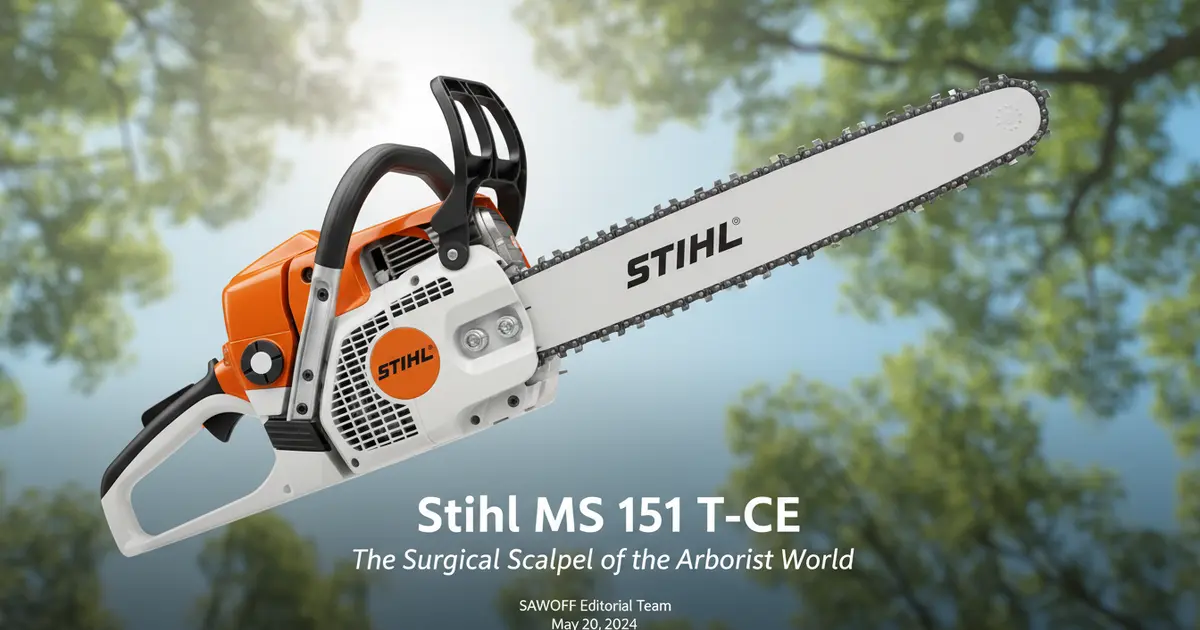
Stihl MS 151 T-CE Review: The Surgical Scalpel of the Arborist World
Let’s get one thing straight: the Stihl MS 151 T-CE is not a do-it-all saw. If you are looking to buck 20-inch rounds of hickory on the ground, you have wandered into the wrong review. Go look at the Stihl MS 261 C-M or the Stihl MS 170. But if you spend your mornings thirty feet up in a bucket or tied into a sprawling silver maple, the MS 151 T-CE is not just a tool—it is an extension of your arm.
At just 5.7 pounds (powerhead weight), this saw is the featherweight champion of professional arboriculture. It is designed for one thing: precision pruning and thinning. When Stihl updated the MS 150 T to this 151 model, they did not just change the sticker. They re-tuned the 23.6cc engine to provide a noticeable bump in torque and lugging power. During our field testing, we spent months with this saw in the canopy, and while it does not have the raw grunt of a Stihl MS 201 T, its finesse is unmatched.
We are talking about a saw that feels flickable. It is the difference between a broadsword and a scalpel. In this deep-dive, we strip back the orange-and-white plastic and show you exactly what makes the MS 151 T-CE the pro arborist secret weapon.
At a Glance: Top-Handle Lightweights
Before we pull the cord, here is how the MS 151 T-CE stacks up against its closest rivals in the sub-30cc professional class.
| Feature | Stihl MS 151 T-CE | Echo CS-2511T | Husqvarna T525 |
|---|---|---|---|
| Displacement | 23.6 cc | 25.0 cc | 27.0 cc |
| Power Output | 1.05 kW (1.4 hp) | 1.1 kW (1.5 hp) | 1.1 kW (1.5 hp) |
| Weight (Dry) | 5.7 lbs | 5.2 lbs | 5.95 lbs |
| Chain Pitch | 1/4-inch PM3 | 3/8-inch LP or 1/4-inch | 1/4-inch or 3/8-inch |
| Best For | Precision pruning | Ultra-light pruning | General limbing |
MS 151 T-CE Review: The 2-MIX Heart
When we cracked open the MS 151 T-CE, we found an engine that is a masterpiece of miniaturization. Stihl’s 2-MIX technology uses stratified scavenging. Instead of a traditional two-stroke where fresh fuel-air mix helps push out exhaust (losing unburnt fuel in the process), the 2-MIX engine uses a layer of clean, fuel-free air between the fresh charge and exhaust gases.
What does this mean in the field? A 20% reduction in fuel consumption and up to a 70% reduction in exhaust emissions. When you are buried inside a dense canopy with stagnant air, those reduced emissions are not just an eco-stat—they are the difference between a headache and a productive workday.
ErgoStart (E) Mechanism
The E in 151 T-CE stands for ErgoStart. When ErgoStart first hit the market, many old-school guys called it a gimmick. After five hours of stop-and-start pruning, your shoulder will thank us. Unlike a standard starter where you overcome the engine compression with a violent jerk, ErgoStart uses a secondary spring between the starter rope and the crankshaft. You pull steadily, the spring compresses, and then it releases stored energy to whip the engine over. It is a two-finger start that works flawlessly even when you are awkwardly positioned on a limb.
The 1/4-inch PM3 Saw Chain
One of the most overlooked aspects of the MS 151 T-CE is the 1/4-inch Picco Micro 3 (PM3) chain. Because the engine only produces 1.4 horsepower, Stihl had to make that power efficient. The 1/4-inch chain is incredibly thin. This narrow kerf means the saw removes less wood per cut.
When we buried the bar in small, bouncy branches, this chain configuration drastically reduced chatter. It is smooth—dangerously smooth. The trade-off is that this chain is sensitive to sharpening angles. If you are off by a few degrees, you will feel the performance drop immediately. We always recommend using the Stihl 2-in-1 Easy File guide sized for the 1/4-inch chain to keep that surgical edge.
Air Filtration and Cooling
The filtration system on the 151 is a compact pleated design. It is not as robust as the long-life systems on larger saws, but for a pruning saw, it is adequate. The air routing keeps the engine cool despite the tight tolerances of the powerhead. Our field note: in high-pollen seasons or when cutting hairy bark like cedar, pop the toolless cover every few tanks. The small filter surface area means it can choke faster than its bigger brothers.
Real-World Performance: Beyond the Specs
Last winter, we took the MS 151 T-CE into a stand of frozen White Oak for a structural pruning job. Oak is the ultimate test for a small-displacement saw.
Bucking and Limbing
If you try to bury the 12-inch bar in a 10-inch oak limb, you will bog down. That is just physics. For limbs 6 inches and under? It is a dream. The throttle response is snappy—there is no hesitation when you blip the trigger. The increase in torque over the old 150 T is palpable. Where the 150 would sometimes stall out under pressure, the 151 has more heart to push through the knot.
Bore-Cutting and Precision
The balance of this saw is what truly sets it apart. Because the center of gravity is tucked right under the top handle, the MS 151 T-CE allows for incredible control during bore cuts or finesse cuts where you are trying to avoid damaging the branch collar.
Vibrations: The Palm Test
Stihl’s anti-vibration system on this model uses precisely tuned buffer springs. After a full day of use, our hands did not have that pins and needles feeling. This is a massive improvement over older generation top-handles that relied on simple rubber bushings. The frequency is dampened to a low hum rather than a high-pitched buzz.
Honest Downside
The plastic air filter cover feels slightly thinner than the MS 201 series. We have seen these crack if dropped on frozen ground. Also, this is emphatically not a take-down saw. If you push it too hard, it will stall. At this price point, you are paying a premium for engineering and the Stihl name.
Who It Is Best For
Professional arborists who value agility and weight over raw displacement. This saw will pay for itself in saved calories. If you are a homeowner looking for a small saw, the Stihl MS 170 is a much better value for ground work.
Chainsaw Safety
Operating any chainsaw, especially a top-handle model at height, demands serious attention to safety. Always wear full PPE including a climbing helmet with face screen, hearing protection, cut-resistant chaps, and steel-toed boots. The top-handle design is inherently less stable for ground use.
Never operate a top-handle chainsaw with one hand on the ground. For a comprehensive guide on staying safe while cutting, check our chainsaw safety guide.
Maintenance and Serviceability
Stihl knows pros do not have time for complicated maintenance. The fuel and oil caps use the patented toolless flip-caps. They are great until sawdust gets in the seal—keep the area around the caps clean. Spark plug access requires one screw (standard NGK CMR6H). The chain tensioner is side-access and robust, but do not over-tighten.
The fuel mix for this 2-MIX engine is 50:1. We highly recommend using Stihl MotoMix if you are not using the saw daily. Ethanol in pump gas will eat the small diaphragms in this tiny carburetor over time.
Gas vs Battery
In the sub-30cc class, battery alternatives like the Stihl MSA 200 C are closing the gap. For quick pruning jobs in residential areas, battery power offers instant torque and near-silent operation. However, for a full day in the canopy where you cannot afford to wait for batteries to charge, the MS 151 T-CE still wins on uptime and weight. Read our gas vs electric chainsaw guide for a full breakdown.
Final Verdict
The Stihl MS 151 T-CE is a specialized tool for a specialized job. It is the most refined pruning saw on the market today. It lacks the raw bark of the Echo CS-2511T, which many arborists prefer for its slightly higher power-to-weight ratio, but the Stihl wins on build quality, vibration dampening, and the smoothness of the 1/4-inch chain system.
It fulfills its design intent perfectly. It does not pretend to be a monster. It is a surgeon tool for the tree canopy.
SAWOFF Rating: 4.7 / 5
Get out there and cut. Safely.
Frequently Asked Questions
Why does my MS 151 T-CE bog down in larger limbs?
This saw is only 23.6cc and relies on high chain speed rather than torque. If you apply too much dogging pressure, the centrifugal clutch will slip to protect the engine. Lighten your touch and let the 1/4" chain do the work.
Can I run a 3/8" chain on this saw?
You could swap the sprocket, but we strongly advise against it. The engine lacks the torque to pull a larger 3/8" LP chain effectively. You will overheat the saw and get terrible cut quality.
How often should I clean the air filter?
In dry, dusty conditions, check it every 2-3 tanks of fuel. Because the filter is small, it lacks the holding capacity of larger saws. A clogged filter leads to carbon buildup and a rich fuel condition.
What is the correct fuel mix for the MS 151 T-CE?
Use a 50:1 ratio of high-quality 89+ octane gasoline and Stihl HP Ultra synthetic oil. Avoid ethanol-blended fuels whenever possible to prolong the life of the carburetor.
My ErgoStart feels mushy. Is it broken?
No, that is the spring engaging. It is not a direct-drive feel like a standard starter. If the rope does not retract, then you have a spring issue, but mushy is just the spring storing energy.
Is the MS 151 T-CE suitable for ground use?
Technically yes, but we do not recommend it. Top-handle saws are more dangerous on the ground because of the narrow grip stance. For ground work, choose a rear-handle saw like the Stihl MS 180 for better control and safety.
How does the MS 151 T-CE compare to the MS 194 T?
The 194 T has more power (31.8cc vs 23.6cc) but is nearly 2 pounds heavier. If you are doing heavy thinning, go 194 T. For fine pruning and dead-wooding, the 151 T-CE is the superior choice.
My saw will not start when hot. What is wrong?
This is often vapor lock. If the saw sits in the hot sun between cuts, the fuel in the lines can vaporize. Use the primer bulb to purge the lines with fresh fuel and ensure your spark plug gap is set to exactly 0.5 mm (0.02").