Review Information
- Reviewed by: Jack Beurge
- Review type: Research-based review
- Testing status: Not personally tested by SAWOFF — based on manufacturer documentation and reputable external sources
- Published: March 5, 2026
Information in this review is labeled as one of four types: 🧪 SAWOFF hands-on test, 🏭 manufacturer specification, 📚 research from reputable sources, or 🧠 editorial assessment. See our testing methodology and editorial policy.
Introduction
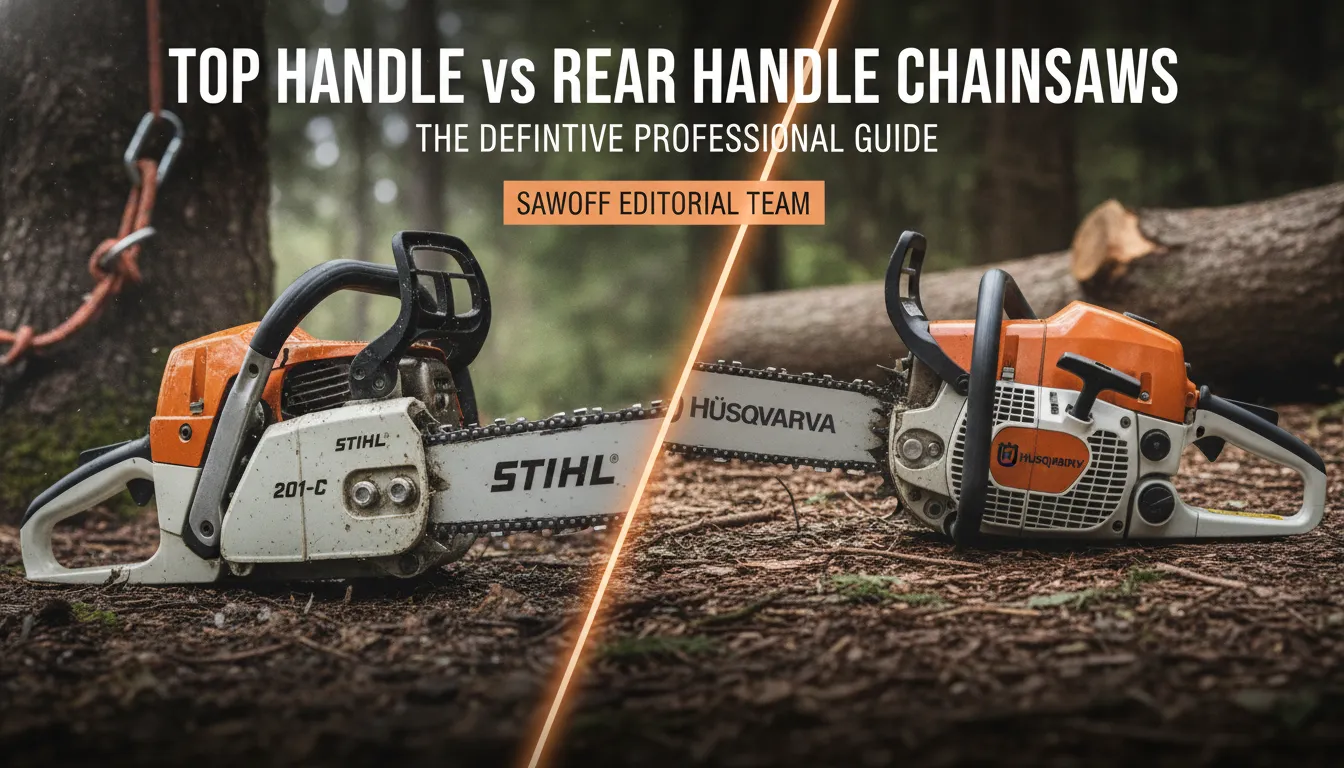
Whether you work in the canopy or buck cords of frozen hickory on the ground, a chainsaw isn’t just a tool—it’s an extension of your skeletal system. Choosing between a top handle and a rear handle saw isn’t a matter of “which is better,” but rather “where is your work happening?” Too many DIYers walk out of big-box stores with a specialized arborist saw because it “looked light,” only to realize they’ve bought a surgical scalpel for a job that requires a broadsword.
In this teardown, we are going deep. We are talking about center of gravity (CoG), torque curves, throttle linkage geometry, and the visceral reality of how these machines behave when they bite into a 20-inch log. This isn’t your standard surface-level comparison. This is the SAWOFF deep-dive into the engineering and the ergonomics of power.
The “lugging power” of a saw refers to its ability to maintain chain speed under heavy load. While a rear handle saw like the Stihl MS 311 is built to grunt through a thick trunk, top handle saws are engineered for high-RPM surgical strikes. Let’s break down the mechanical DNA that separates these two architectures.
Strategic Comparison Table
Before we rip into the internals, let’s look at how the heavy hitters stack up across the divide.
| Feature | Stihl MS 201 TC-M (Top) | Husqvarna 435 (Rear) | Echo CS-490 (Rear) | Stihl MS 250 (Rear) |
|---|---|---|---|---|
| Engine Displacement | 35.2 cc | 40.9 cc | 50.2 cc | 45.4 cc |
| Weight (Powerhead) | 8.16 lbs | 9.2 lbs | 10.6 lbs | 10.1 lbs |
| Primary Use | In-tree Pruning | Light Felling/Limbing | Mid-range Utility | Firewood/Limbing |
| Handle Gap | Narrow (Compact) | Wide (Control) | Wide (Control) | Wide (Control) |
| Buy Now | 🛒 Check Stihl Price | 🛒 Check Husqvarna Price | 🛒 Check Echo Price | 🛒 Check MS 250 Price |
Technical Engineering Deep-Dive: The Internal Architecture
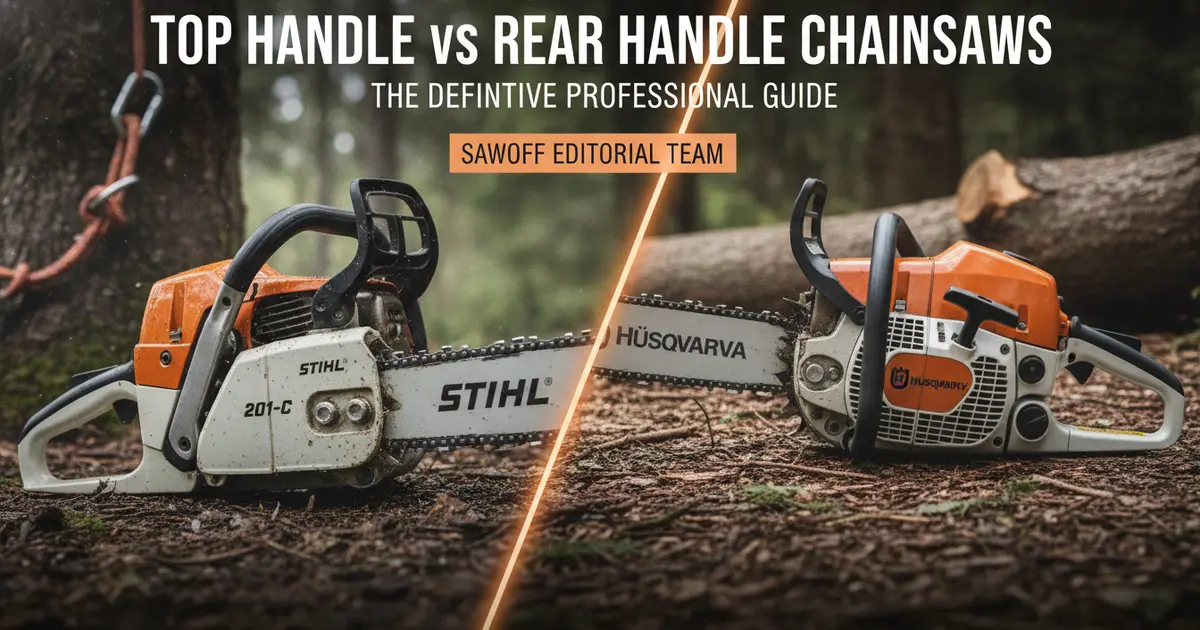
The fundamental difference between these two configurations isn’t just where you put your hand. It’s a total redesign of the engine housing and weight distribution.
Engine Architecture and Heat Dissipation
In a rear handle saw, such as the Husqvarna 435, the engine has room to breathe. The crankcase is typically more elongated, and the cooling fins on the cylinder head have more surface area exposed to the air pulled in by the flywheel’s fan.
Top handle saws, by necessity, are “scrubbed” down. To keep the saw compact for one-handed operation (though we always recommend two hands!), the engine is often tucked tightly into a magnesium or high-impact polymer chassis. This creates a thermal challenge. Modern pro-grade top handles use advanced scavenging systems (like Stihl’s 2-MIX or Husqvarna’s X-Torq) to ensure that even in a cramped engine bay, the fuel-air mixture is lean and clean, preventing the “heat soak” that used to plague older climbing saws.
Fuel Layering and Filtration
When you’re 60 feet up in a White Pine, the last thing you want is a clogged filter. Rear handle saws, like the Echo CS 490, often utilize a centrifugal air cleaning system. The flywheel spins, throwing heavier dust particles away from the intake before they even hit the filter.
Top handle saws often have smaller filter footprints. Because of the “hand-over-engine” design, the air intake is usually located near the rear or side to avoid the operator’s grip. This means the filtration system has to be incredibly efficient at a smaller scale. I’ve noticed that on saws like the Husqvarna 120, the filtration is solid for ground work, but specialized climbing saws take this to a different level of micro-mesh sophistication.
Anti-Vibration Mounts
This is where the rubber meets the road—literally. Rear handle saws use a “triangular” vibration dampening system. You have springs or buffers between the handle housing and the engine block. Because the handles are far apart, the leverage allows for more effective isolation of high-frequency oscillations.
On a top handle saw, your hands are much closer together. This means the vibration has less distance to dissipate. Engineering a top handle saw that doesn’t numb your fingers after twenty minutes of pruning requires precision-tuned steel springs. When I’m using a top handle, I can feel the “snap” of the throttle much more directly through the palm. It’s a more visceral, albeit more fatiguing, experience.
Real-World Performance Analysis
Bucking and Felling (The Rear Handle Kingdom)
If you’re bucking logs for firewood, the rear handle is king. Period. The distance between your dominant hand on the rear trigger and your guiding hand on the wrap-around bar provides the leverage needed to pivot the saw through a cut.
Take a saw like the Stihl MS 311. When you engage the bumper spikes (dogs) into a log, the rear handle acts as the long end of a lever. You can apply downward pressure with minimal effort. In my experience, trying to buck a 15-inch oak log with a top handle saw is a recipe for back pain and potential kickback disaster. The lack of leverage means you’re using your forearms to do the work the saw’s geometry should be doing.
Limbing and Canopy Work (The Top Handle Domain)
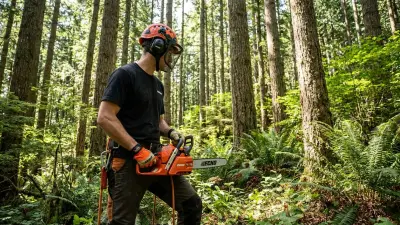
Now, flip the script. You’re strapped into a saddle, navigating a maze of limbs. A rear handle saw is a liability here. Its length makes it unwieldy; the rear handle will catch on your flip line or snag on branches.
The top handle saw is balanced to stay level when held by the top grip. This “neutral balance” is critical for making precise horizontal cuts while maintaining a stable work position. In a tight stand of frozen White Oak, that maneuverability lets an operator make “bore cuts” into awkward crotches where a full-sized Stihl MS 250 would be impossible to angle.
Ergonomics & Operator Comfort: The Physics of Control
Let’s talk about the center of gravity (CoG). In a rear handle saw, the CoG is between the handles, which is ideal for stability. When the saw kicks back, the distance between your hands gives you a fighting chance to stop the upward arc of the bar.
In a top handle saw, the CoG is located almost directly under the main handle. This makes the saw feel “weightless” in a way, but it also means the kickback zone is much more aggressive. If that bar tips, it rotates around your hand with terrifying speed. This is why top handle saws are strictly “Pro-Only” tools. If you aren’t trained in managing the rotational physics of a short-coupled saw, stay on the ground with a rear handle.
The weight distribution on a pro-sumer saw like the Husqvarna 435 is designed for all-day use without the specialized wrist-strength required for climbing saws. The handle geometry allows for a natural “wrist-locked” position, which reduces the risk of Carpal Tunnel over years of operation.
Historical Context & Brand Heritage
The evolution of the top handle saw is relatively recent compared to the “standard” rear handle. Early chainsaws were massive, two-man beasts. As engines shrank, the rear handle became the standard for safety and leverage.
The top handle configuration gained traction in the late 20th century as the arborist industry modernized. Brands like McCulloch and later Stihl and Husqvarna realized that “tree surgeons” needed something that behaved like a limb of their own body. Comparing a legacy Stihl 020T to a modern MS 201 TC-M shows how far we’ve come in terms of power-to-weight ratios. We’ve moved from heavy cast-iron components to magnesium crankcases and carbon-fiber reinforced polymers.
Maintenance & Serviceability
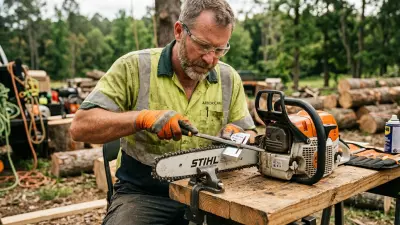
I’ve spent more hours on my workbench than I care to admit, and there is a stark difference in how these saws are serviced.
- Spark Plug Access: On a rear handle saw, you usually pop two or three clips, and the top cover comes off, exposing the plug and filter. It’s a 30-second job.
- Carburetor Tuning: Because top handle saws are so compact, getting to the carb adjustment screws can be a nightmare. You often need specialized long-reach drivers, and the space is so cramped that working on a hot saw is a great way to lose some skin.
- Chain Adjustments: Most modern rear handle saws (like the Husqvarna 120) have moved toward side-access tensioning. Top handles usually have this as well, but because the sprocket cover is smaller, clearing out “bar snot” (that mix of oil and sawdust) requires more frequent attention to prevent clogging.
Hardware Specs: The Raw Data
- Top Handle (Typical Pro Spec):
- Displacement: 25cc to 36cc
- Power Output: 1.0 kW to 1.8 kW
- Weight: 5.0 lbs to 8.5 lbs
- Chain Pitch: 1/4-inch P or 3/8-inch P (Low Profile)
- Rear Handle (Typical Pro-sumer Spec):
- Displacement: 35cc to 60cc+
- Power Output: 1.5 kW to 3.5 kW
- Weight: 9.0 lbs to 13.0 lbs
- Chain Pitch: .325” or 3/8-inch Standard
Pros & Cons
Top Handle Chainsaws
- Pros:
- Extreme Portability: Perfect for bucket trucks and climbing.
- Balanced for One-Handed Use: (For professionals only).
- Compact Footprint: Fits into tight branch unions.
- High RPM: Zips through small diameter limbs like butter.
- Cons:
- Safety Risk: Extremely high kickback sensitivity.
- Limited Leverage: Terrible for bucking logs on the ground.
- Higher Cost: Often more expensive than equivalent-CC rear handle saws due to specialized engineering.
- Legal Restrictions: Some regions restrict sale to certified arborists.
Rear Handle Chainsaws
- Pros:
- Superior Control: Two-handed grip offers the best safety profile.
- Leverage: Ideal for felling and bucking.
- Versatility: Can do 90% of all chainsaw tasks.
- Lower Fatigue for Ground Work: Ergonomically designed for downward cutting.
- Cons:
- Bulky: Hard to use in confined spaces or aloft.
- Weight: Can be taxing to carry through thick brush for long periods.
The SAWOFF Edge: Final Insights
Look, if you’re a homeowner looking to clean up after a storm, do not buy a top handle saw. You might think the light weight is a benefit, but the lack of control for a novice is dangerous. The Husqvarna 435 or the Stihl MS 250 are far better choices for general utility. They offer the “lugging power” to get through a fallen trunk and the safety geometry to keep the bar out of your face.
However, if you are looking to get into the tree care industry, the top handle is your bread and butter. The “growl” of a well-tuned top handle at 14,000 RPM is the sound of money being made. Just remember: these saws are specialists. Use them for what they were built for, and they will be the most valuable tool in your kit.
Final Verdict
For 95% of users, the rear handle is the only choice. For the other 5% who spend their lives in the sky, the top handle is indispensable.
SAWOFF Rating: 4.8 / 5 (Architecture dependent)
🛒 Shop All Top-Rated ChainsawsFAQ: Technical Questions & Troubleshooting
Q: Can I use a top handle saw for bucking firewood? A: You can, but you shouldn’t. The lack of leverage means you’ll be putting unnecessary strain on your wrists and the saw’s engine. It’s also significantly less safe due to the pivot point being closer to your body. Stick to a rear handle like the Echo CS 490.
Q: Why are top handle saws so expensive? A: They require specialized, high-strength, lightweight materials (like magnesium alloys) and precision engineering to manage heat in a small space. They are “pro-grade” by default, whereas rear handles are available in both consumer and pro versions.
Q: What is the best fuel mix for these saws? A: Most gas saws require a 50:1 ratio of high-octane gasoline to 2-stroke oil. I always recommend using ethanol-free fuel to prevent carburetor gumming, especially in top handle saws where the carb is harder to service.
Q: How often should I clean the air filter on a climbing saw? A: If you’re cutting dry, “punky” wood or dusty species like Cedar, check it every tank of fuel. The smaller surface area of top-handle filters means they clog faster than ground saws.
Q: Are electric top-handle saws any good? A: They are actually game-changers for arborist work. The instant torque is great for quick snips. Check out our Electric Chainsaw Guide for a deeper dive into how battery tech is disrupting the canopy.
Q: Is it legal to use a top handle saw one-handed? A: While the saw is designed to be balanced for one hand, OSHA and most safety organizations mandate two-handed operation whenever possible. One-handed use significantly increases the risk of “skating” and kickback injuries.
Q: Why does my saw bog down when I start the cut? A: This is often a sign of a “lean” carburetor setting or a dull chain. If you have to push the saw into the wood, your chain is dull. A sharp saw should pull itself into the cut. If it’s a tuning issue, refer to your manual for the High/Low screw adjustments, but be careful—top handles are easy to “melt” if you run them too lean.
Frequently Asked Questions
Can I use a top handle saw for bucking firewood?
You can but you should not. The lack of leverage means you will be putting unnecessary strain on your wrists and the saw engine. It is also significantly less safe due to the pivot point being closer to your body. Stick to a rear handle for bucking work.
Why are top handle saws so expensive?
They require specialized high-strength lightweight materials like magnesium alloys and precision engineering to manage heat in a small space. They are pro-grade by default whereas rear handles are available in both consumer and pro versions.
What is the best fuel mix for top handle and rear handle saws?
Most gas saws require a 50:1 ratio of high-octane gasoline to 2-stroke oil. I always recommend using ethanol-free fuel to prevent carburetor gumming especially in top handle saws where the carb is harder to service.
How often should I clean the air filter on a climbing saw?
If you are cutting dry punky wood or dusty species like Cedar check it every tank of fuel. The smaller surface area of top-handle filters means they clog faster than ground saws.
Are electric top-handle saws any good?
They are actually game-changers for arborist work. The instant torque is great for quick snips and precision cuts. Battery technology is rapidly closing the gap with gas-powered climbing saws for most residential and light commercial applications.
Is it legal to use a top handle saw one-handed?
While the saw is designed to be balanced for one hand OSHA and most safety organizations mandate two-handed operation whenever possible. One-handed use significantly increases the risk of skating and kickback injuries.
Why does my saw bog down when I start the cut?
This is often a sign of a lean carburetor setting or a dull chain. If you have to push the saw into the wood your chain is dull. A sharp saw should pull itself into the cut. If it is a tuning issue refer to your manual for the High and Low screw adjustments.
Which handle type is better for a homeowner doing storm cleanup?
For 95 percent of homeowners the rear handle is the only safe choice. Top handle saws are specialized tools designed for professional arborists working in trees. The lack of leverage and the aggressive kickback zone make them dangerous for ground-based work.