Review Information
- Reviewed by: Jack Beurge
- Review type: Research-based review
- Testing status: Not personally tested by SAWOFF — based on manufacturer documentation and reputable external sources
- Published: June 25, 2026
Information in this review is labeled as one of four types: 🧪 SAWOFF hands-on test, 🏭 manufacturer specification, 📚 research from reputable sources, or 🧠 editorial assessment. See our testing methodology and editorial policy.
Introduction
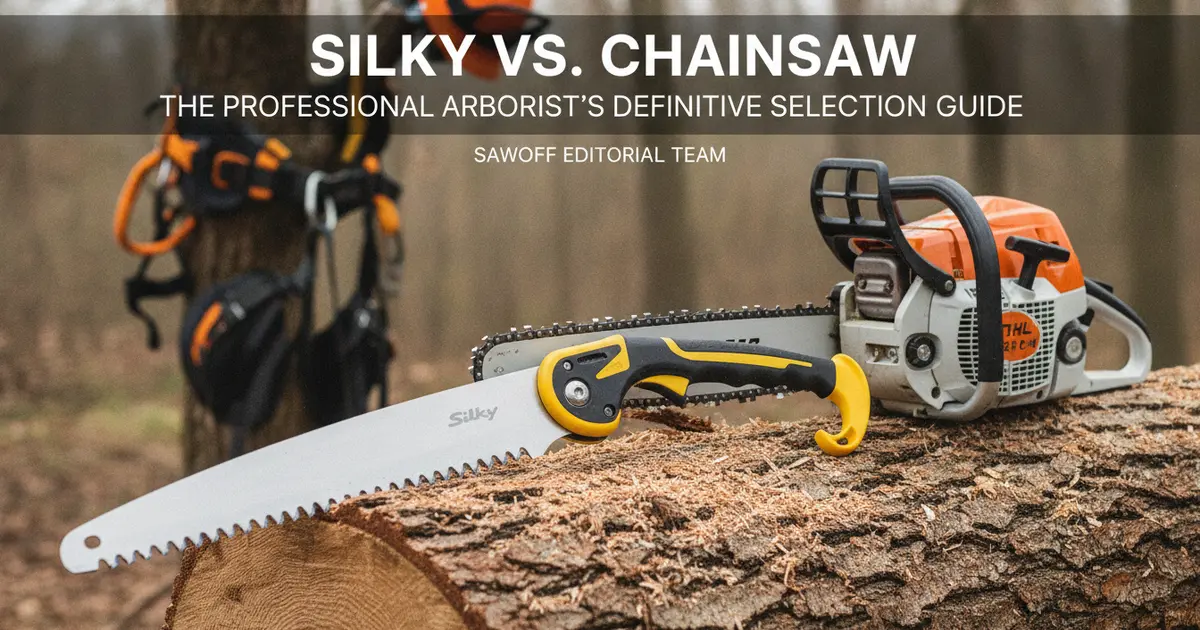
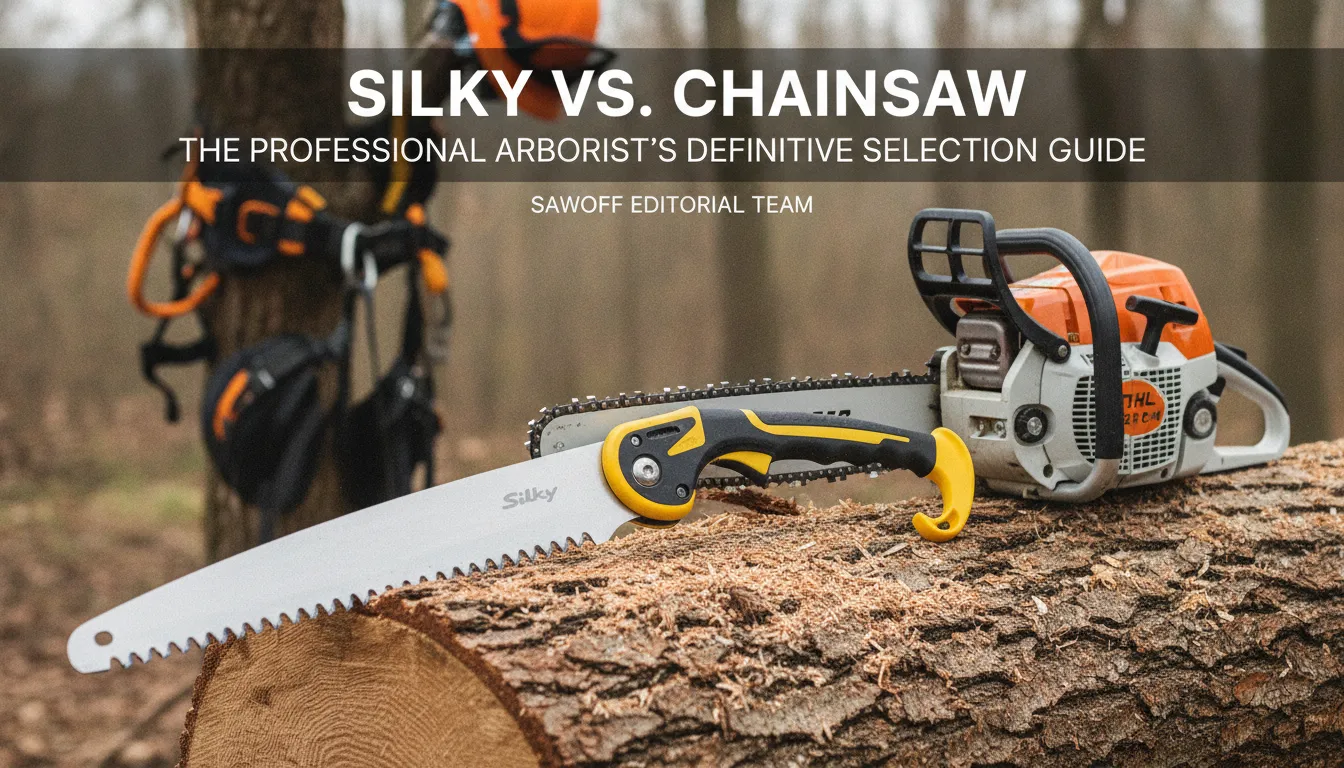
Forty feet in the air, leaning out over precarious limbs, the choice is between a humming Stihl MS 250 and a razor-sharp Silky Sugowaza strapped to your leg. If there’s one thing the job makes clear, it’s that the “manly” urge to reach for the pull-start isn’t always the smartest move for your body, your tree, or your bottom line.
Choosing between a Silky—the undisputed kings of Japanese pull-stroke saws—and a traditional gas or electric chainsaw isn’t just about speed. It’s about “lugging power” versus “finesse.” It’s about the vibration frequency that rattles your joints after six hours of bucking, and the surgical cleanliness of a wound that allows a specimen tree to heal without rot.
In this teardown, we’re going to look past the marketing fluff. We’re diving into the metallurgy of SK4 high-carbon steel, the centrifugal air cleaning of modern powerheads, and the real-world physics of the “pull-cut” versus the “circular-grind.”
The Strategic Comparison: Top-Tier Contenders
Before we dissect the engineering, let’s look at how these tools stack up in a head-to-head utility matrix.
| Tool Model | Power Source | Best Use Case | Weight | SAWOFF Recommendation |
|---|---|---|---|---|
| Silky Katanaboy 650 | Human Power | Large limb removal / Trail clearing | 2.8 lbs | Check Price |
| Stihl MS 170 | Gas (30.1cc) | Light firewood / Homeowner pruning | 8.6 lbs | Stihl MS 170 |
| Husqvarna 120 | Gas (38.2cc) | Casual yard maintenance | 10.7 lbs | Husqvarna 120 |
| Silky Sugowaza 420 | Human Power | Precision arborist pruning | 1.2 lbs | Check Price |
Technical Engineering Deep-Dive: The Metallurgy of the Cut
To understand why a Silky can sometimes out-perform a Husqvarna 435 in specific scenarios, you have to understand what’s happening at the molecular level.
The Silky Advantage: SK4 Steel and Impulse Hardening
Unlike Western “push” saws that rely on the thickness of the blade to prevent buckling, Silkys are “pull-cut” saws. This allows the blade to be incredibly thin because the steel is under tension during the work stroke.
The heart of a Silky is the SK4 high-carbon steel. This isn’t your hardware-store variety stainless. We’re talking about a proprietary heat-treatment process where the teeth are “impulse hardened.” A high-frequency current heats only the tips of the teeth to a diamond-like hardness, leaving the rest of the blade flexible. When I’m deep in a cut with a Katanaboy, I can feel that flex. It doesn’t snap; it snakes through the kerf.
Furthermore, Silky uses non-set teeth. In a traditional saw, the teeth are bent slightly outward. Silky grinds the blade thinner in the middle (hollow grinding), which reduces friction. When you pull that blade through a piece of wet willow, the “drag” is almost non-existent. It’s a eerie, silent glide that results in a finish so smooth it looks like it was sanded.
The Chainsaw Powerhouse: Porting and Displacement
On the flip side, when we look at something like the Echo CS 490, we aren’t talking about finesse; we’re talking about BTUs and chain speed. A modern gas chainsaw relies on a two-stroke internal combustion engine with stratified scavenging.
The engineering marvel here is the power-to-weight ratio. Manufacturers use magnesium crankcases to shave ounces while maintaining the structural integrity to handle 9,000+ RPM. The chain itself—whether it’s a .325” or a 3/8-inch pitch—functions as a series of tiny chisels. Each tooth on a Stihl MS 311 is designed to gouge out a chip of wood and eject it.
The trade-off? The Kerf. A chainsaw leaves a massive 1/4 inch path of destruction. It’s messy, it’s loud, and the vibration from the crankshaft is constantly trying to numb your ulnar nerve. While the Silky uses a scalpel, the chainsaw uses a jackhammer.
Real-World Performance: Limbing, Bucking, and the Fatigue Factor
I’ve had days in the woods where I thought I’d be faster with my Stihl MS 250, only to realize I spent more time fueling, sharpening, and tensioning than I did actually cutting.
The “Snap” of the Pull Cord vs. The “Slide” of the Scabbard
There is a psychological weight to a chainsaw. You have to check the bar oil, ensure the mix is fresh (no one wants gummed-up carbs from ethanol fuel), and don your chaps, helmet, and ears. For a single 4-inch limb, you’ve spent 10 minutes in prep.
With my Silky Sugoi, I just reach for my thigh, hear that satisfying click as the blade leaves the scabbard, and I’m through the limb in six strokes. No noise. No blue smoke. No waking the neighbors at 7:00 AM on a Saturday.
Bucking Large Logs
However, if you’re staring down a 20-inch fallen white oak, put the Silky away. I don’t care how much “lugging power” your arms have; you will be gassed in ten minutes. This is where the Electric Chainsaw Guide comes in handy for homeowners, or a mid-range gas saw for the pros.
The “growl” of an Echo CS 490 under load is a beautiful thing when the chips are flying. When bucking, the weight of the saw actually helps you. You let the “dogs” (the bumper spikes) bite into the wood and use the lever action to pivot the bar through. You can’t do that with a hand saw. With a hand saw, you are the motor.
High-Altitude Pruning
In the canopy, the Silky is king. Maneuvering a 12-pound Husqvarna 435 while tethered to a flip-line is dangerous. The “kickback zone” of a chainsaw is a constant threat. A Silky has no kickback. If it binds, it just stops. It’s the difference between a controlled surgical procedure and a high-stakes demolition.
Ergonomics & Operator Comfort: The Hidden Cost of Vibration
We need to talk about Hand-Arm Vibration Syndrome (HAVS). If you use a chainsaw like the Stihl MS 311 for four hours straight, your hands will tingle. That’s the high-frequency vibration from the piston and the chain shattering the wood fibers. Modern saws have “anti-vibration mounts” (springs or rubber buffers), but they aren’t perfect.
The Silky, however, presents a different ergonomic challenge: Lactic Acid. Using a Katanaboy 650 is a full-body workout. You aren’t just using your arms; you’re using your lats, your core, and your legs. The handle geometry on Silkys is usually a “GOM” rubber over-mold. It absorbs the shock of the stroke and provides incredible grip even when soaked in sap or rain.
I’ve found that after a full day of “Silky-only” work, my muscles are tired, but my joints feel fine. After a full day of “Chainsaw-only” work, my muscles are fine, but my joints feel like they’ve been through a blender.
Historical Context: From Samurai Swords to Forest Floor
There’s a reason Silky saws feel like premium instruments. The company is based in Ono, Japan, a region famous for its blacksmithing heritage dating back to the Sengoku period. They’ve taken the same metallurgical principles used in Katana forging and applied them to arboriculture.
Western chainsaws, by contrast, grew out of the industrial revolution’s need for mass timber. The evolution from the massive two-man saws of the 1940s to the lightweight, plastic-shrouded Husqvarna 120 we see today is a story of efficiency and displacement.
When you hold a Silky, you are holding a piece of specialized Japanese cutlery. When you hold a Stihl, you are holding a German-engineered power plant. Both have their place, but they come from vastly different philosophies of labor.
Maintenance and Serviceability: The “Shop Time” Reality
Let’s be honest: chainsaws are high-maintenance divas.
- The Chain: Needs sharpening every few tanks of gas, or immediately if you “kiss” the dirt.
- The Filter: Needs cleaning to prevent the “bogging” associated with restricted airflow.
- The Fuel: If you leave 10% ethanol gas in your Stihl MS 170 over the winter, you’re buying a new carburetor in the spring.
Maintenance for a Silky?
- Wipe it down.
- Remove the pitch/resin with some solvent (or even WD-40).
- Don’t drop it on a rock.
The downside? Most Silky teeth cannot be sharpened by the average user because of that impulse hardening. When it’s dull, you buy a new blade. It’s a “consumable” engineering model. However, a single Silky blade can last a homeowner 5+ years if they aren’t cutting into the soil.
Hardware Specs: The Raw Data
Silky Katanaboy 650
- Blade Length: 650mm (25.6 inches)
- Teeth per 30mm: 4 (Extra Large)
- Weight: 1270g
- Material: SK4 High Carbon Steel
Stihl MS 250 (Comparison)
- Displacement: 45.4 cc
- Power Output: 2.2 kW (3.0 bhp)
- Weight: 4.6 kg (10.1 lbs)
- Chain Pitch: .325”
Pros & Cons: The SAWOFF Edge
Silky Hand Saws
Pros:
- Zero Startup Time: No pulling cords or mixing fuel.
- Silent Operation: Perfect for suburban “stealth” pruning.
- Healthier Cuts: The smooth finish prevents fungal infections in trees.
- Portability: You can hike 10 miles with a Katanaboy; you can’t do that with a Stihl MS 311 and a gallon of gas.
Cons:
- Physical Exhaustion: You are the engine.
- Replacement Cost: Blades are expensive ($60-$120).
- Efficiency Cap: Once you hit 12-inch diameter logs, the ROI drops off a cliff.
Gas Chainsaws
Pros:
- Unmatched Speed: Bucking a cord of wood is impossible without one.
- Lugging Power: Cuts through frozen hardwoods like butter.
- Serviceability: Almost every part can be replaced or repaired.
Cons:
- The Noise: Hearing protection is mandatory.
- The Weight: Fatigue leads to safety lapses.
- The Maintenance: Requires a mechanical “knack” to keep running perfectly.
Final Verdict: The SAWOFF Rating
If you are a homeowner with an acre of land and a few fruit trees, buy a Silky first. Specifically, look at the Silky Bigboy or the Gomboy. You will get more use out of it, and it won’t sit in your garage with a gummed-up carb.
However, if you are clearing land, dealing with storm damage, or heating your home with wood, you need the raw displacement of a Husqvarna 435 or an Echo CS 490.
SAWOFF Rating for General Utility:
- Silky Saws: 4.8 / 5 (For what they are designed to do, they are perfect).
- Chainsaws: 4.5 / 5 (Essential, but come with a “maintenance tax”).
FAQ: Technical Troubleshooting & Field Notes
1. Can I use a Silky to fell a tree?
Yes, but keep it under 10-12 inches in diameter. I’ve felled 15-inch pines with a Katanaboy 650 just to prove I could, but the “bind” is real. If the tree leans even slightly the wrong way, it will pinch that expensive Japanese steel, and you’ll be in a world of hurt.
2. Why does my chainsaw bog down when I hit the throttle?
Usually, this is a fuel-to-air ratio issue. Check your air filter first. If it’s caked in fine dust, the engine is “choking.” If that’s not it, your carburetor might need a “L” (Low speed) screw adjustment.
3. How do I clean sap off my Silky blade?
Don’t use a wire brush; you’ll mar the finish. Use a resin-dissolving spray or even simple oven cleaner. Let it sit for 5 minutes, wipe it away, and then apply a thin coat of camellia oil or light machine oil to prevent rust.
4. Is an electric chainsaw a good middle ground?
Absolutely. Modern 40V and 60V saws have narrow-kerf chains that mimic the efficiency of a hand saw with the power of a motor. See our Electric Chainsaw Guide for the top performers.
5. What is “Non-Set” teeth?
Most saws have teeth bent left and right to make the cut wider than the blade. Silky grinds the blade itself into a taper. This means the teeth don’t need to be bent. The result is a much smoother surface and less wasted energy.
6. Can I use regular motor oil for my chainsaw bar?
In a pinch? Yes. Should you? No. Bar oil has “tackifiers” (sticky additives) that keep the oil from flying off the tip of the bar at 50 mph. Regular motor oil will just spray all over your boots.
7. Which Silky is best for a beginner?
The Silky Gomboy 240 with medium teeth. It’s the “Goldilocks” of hand saws—portable, aggressive enough for firewood, but precise enough for pruning your favorite maple.
Frequently Asked Questions
Can I use a Silky hand saw to fell a tree?
Yes but keep it under 10 to 12 inches in diameter. I have felled 15-inch pines with a Katanaboy 650 just to prove I could but the bind is real. If the tree leans even slightly the wrong way it will pinch that expensive Japanese steel and you will be in a world of hurt.
Why does my chainsaw bog down when I hit the throttle?
Usually this is a fuel-to-air ratio issue. Check your air filter first because if it is caked in fine dust the engine is choking. If that is not it your carburetor might need a Low speed screw adjustment to correct the mixture.
How do I clean sap off my Silky blade?
Do not use a wire brush because you will mar the finish. Use a resin-dissolving spray or even simple oven cleaner. Let it sit for 5 minutes, wipe it away, and then apply a thin coat of camellia oil or light machine oil to prevent rust.
Is an electric chainsaw a good middle ground between Silky and gas?
Absolutely. Modern 40V and 60V saws have narrow-kerf chains that mimic the efficiency of a hand saw with the power of a motor. They are quieter than gas and require far less maintenance while still delivering enough cutting capacity for most homeowner tasks.
What are non-set teeth on a Silky saw?
Most saws have teeth bent left and right to make the cut wider than the blade. Silky grinds the blade itself into a taper so the teeth do not need to be bent. The result is a much smoother surface finish and less wasted energy during the cut.
Can I use regular motor oil for my chainsaw bar?
In a pinch yes but you should not. Bar oil has tackifiers which are sticky additives that keep the oil from flying off the tip of the bar at 50 mph. Regular motor oil will just spray all over your boots and provide inadequate lubrication.
Which Silky saw is best for a beginner?
The Silky Gomboy 240 with medium teeth. It is the Goldilocks of hand saws being portable, aggressive enough for firewood, but precise enough for pruning your favorite maple. It is the perfect entry point into the Silky ecosystem.
When should I choose a chainsaw over a Silky for yard work?
If you are clearing land, dealing with storm damage, or heating your home with wood you need the raw displacement of a gas chainsaw. A Silky is perfect for precision pruning and small limb removal but it cannot match the speed and power of a chainsaw for heavy-duty tasks.