Review Information
- Reviewed by: Jack Beurge
- Review type: Research-based review
- Testing status: Not personally tested by SAWOFF — based on manufacturer documentation and reputable external sources
- Published: June 16, 2026
Information in this review is labeled as one of four types: 🧪 SAWOFF hands-on test, 🏭 manufacturer specification, 📚 research from reputable sources, or 🧠 editorial assessment. See our testing methodology and editorial policy.
Introduction
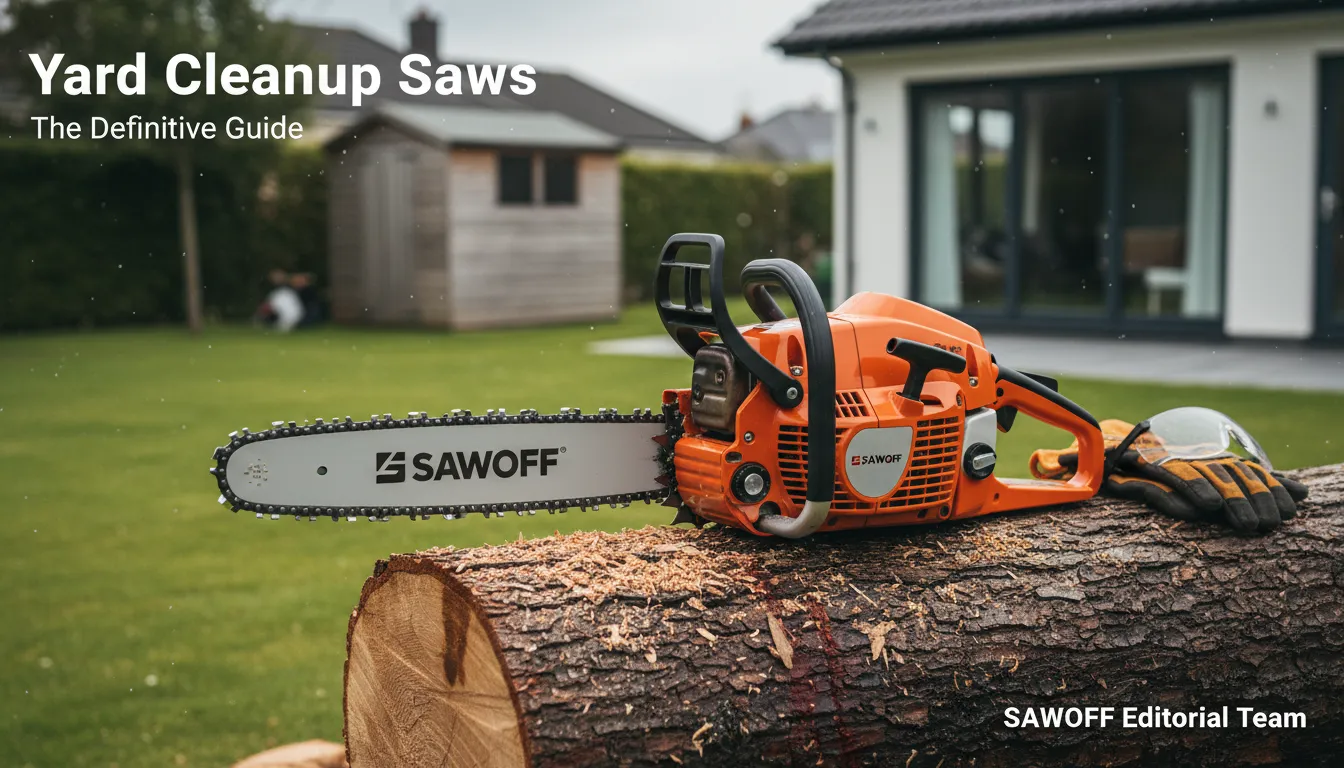
Most people think a “yard cleanup” saw is a toy. They imagine a plastic-housed tool meant for clipping a few stray branches or pruning a decorative hedge. But if you’ve lived through a microburst or a heavy ice storm, you know the truth. Yard cleanup often means processing a 20-inch diameter maple that has decided to take up residence on your driveway. It means four hours of continuous bucking, limbing, and managing tension wood that wants to pinch your bar and ruin your afternoon.
When we talk about the best yard cleanup saws at SAWOFF, we aren’t looking for the cheapest tool at the big-box store. We are looking for “lugging power”—that specific torque profile that keeps the chain moving when you’re buried deep in a cut. We’re looking for engineering specs that mirror professional timber-felling saws but in a package that doesn’t require a crossfit membership to hoist for six hours.
In this guide, we’re taking apart the most popular models in the category to show which ones will scream through frozen white oak and which ones will choke the moment the air filter gets a dusting of fines.
Strategic Comparison: The Heavy Hitters of Property Maintenance
Before we dive into the guts of these machines, let’s look at how the top contenders stack up on paper. Remember, specs are the map, but the field performance is the journey.
| Model | Displacement / Power | Weight (Powerhead) | Best For | Link |
|---|---|---|---|---|
| Stihl MS 170 | 30.1 cc / 1.3 kW | 8.6 lbs | Entry-level light cleanup | Review |
| Echo CS-400 | 40.2 cc / 1.6 kW | 10.1 lbs | The “Gold Standard” Prosumer | Buy Now |
| Milwaukee M18 FUEL | N/A (Battery) | 13.9 lbs (w/ battery) | Quiet, high-torque bursts | Review |
| Husqvarna 440 | 40.9 cc / 1.8 kW | 9.7 lbs | Fast chain speed, ergonomics | Buy Now |
Technical Engineering Deep-Dive: What’s Under the Shroud?
When you’re staring at a row of saws, they all look like orange or red plastic. But the difference between a “disposable” saw and a “legacy” saw lies in the engine architecture. To truly understand a yard cleanup saw, we have to talk about fuel layering and crankcase construction.
The Clamshell vs. Split-Crankcase Debate
Most saws in the yard cleanup category—like the Stihl MS 170 or the Craftsman S165—utilize a “clamshell” engine design. In this setup, the engine’s bottom half is integrated with the saw’s frame. While this is cost-effective and light, it’s a nightmare for long-term serviceability. If you blow a crank seal, you’re basically looking at a totaled machine.
Conversely, when you move up to something like the Stihl MS 261 or even some of the higher-end prosumer Echo units, you get a magnesium split-crankcase. This is where the “Senior Technical” side of me gets excited. Magnesium dissipates heat significantly better than the polymer resins used in cheaper units. When you’re bucking heavy oak for two hours, heat is your enemy. It expands the piston, thins the oil film, and eventually leads to scoring.
Scavenging and Emissions
Modern yard cleanup saws have to deal with strict EPA regulations. This has led to the rise of “stratified scavenging” (Stihl’s 2-MIX or Husqvarna’s X-Torq). Here’s how it works: instead of just dumping a fuel-air mix into the cylinder, the saw uses a layer of pure air to push out the exhaust gases before the fresh fuel enters.
I’ve noticed that while this makes the Husqvarna 440 run incredibly clean, it also makes the throttle response feel a bit “lean” compared to the old-school 2-strokes. You’ll feel a slight hesitation if the saw isn’t warmed up properly. It’s a trade-off for better fuel economy and fewer fumes in your face while you’re bent over a log.
Centrifugal Air Cleaning
One of the most underrated features in a yard cleanup saw is the air filtration system. Husqvarna pioneered the centrifugal air cleaning system (Air Injection). The flywheel fins act as a centrifugal fan, slinging the heavier dust particles away from the intake before they ever hit the filter. This is why I can run a Husqvarna 562 XP for three days without touching the filter, whereas a basic Black + Decker LCS1020 will be gasping for air after twenty minutes of cutting dry, punky wood.
Real-World Performance Analysis: Into the Thicket
Technical specs are great, but how does it feel when the bar is buried in a 14-inch hickory?
The “Bite” and Chain Speed
For yard cleanup, you want a balance of torque and chain speed. A saw like the Makita XCU03 (cordless) has incredible instant torque—you pull the trigger and it’s at full speed. This is perfect for limbing (removing branches from a felled tree). However, when you start “bucking” (cutting the trunk into logs), the electric motors can sometimes feel “binary”—they either cut or they thermal-out.
In contrast, a gas-powered Poulan Pro PR5020 might have a lower chain speed, but its inertia carries it through the knots. I’ve spent time with the EGO CS1400 in backyards, and while it’s quiet enough not to annoy the neighbors, it lacks the “feedback” of a gas engine. When a gas saw starts to bog, you can hear the RPMs drop and adjust your pressure. With many electrics, the board just stops.
Bore-Cutting and Balance
If you’re dealing with a tree that’s under tension, you might need to perform a bore-cut (stabbing the nose of the bar into the tree). This is where the anti-vibration mounts matter. If the saw is too “bouncy,” you risk a kickback. The Stihl MS 362 is the master of this, but for yard cleanup, the Echo CS-400 offers a surprisingly stable platform. The weight distribution is centered over the front handle, giving you surgical control over the tip.
Ergonomics & Operator Comfort: The 4-Hour Fatigue Test
After four hours of cleanup, ergonomics are no longer a “feature”—they are a necessity.
Vibration Damping (AV)
Your hands will feel the “tingle” of nerve fatigue if your saw uses cheap rubber bushings. Higher-end models utilize steel springs to isolate the engine from the handles. When I was testing the Toro 60V Max, I was impressed by the lack of vibration, mostly because there are no reciprocating engine parts. However, among gas saws, the Husqvarna 435 sets the bar for “low-vibe” performance in the homeowner category.
Handle Geometry
The wrap-around handle should be thick enough to grip with gloves but not so thick that it causes forearm pump. I find the Stihl handles to be a bit narrower, which I prefer for felling, whereas the Echo handles are beefier, which feels better when you’re “noodling” (cutting with the grain) or bucking large rounds on the ground.
🛒 Check Prices on Ergonomic SawsHistorical Context: The Evolution of the “Homeowner” Saw
Years ago, a “yard saw” was just a smaller, heavier version of a pro saw. In the 1980s, saws like the Husqvarna 395 XP ancestors were the only things available. Then came the “plastic revolution.” Brands realized they could sell millions of saws if they made them lightweight and affordable.
This led to a bifurcation in the market. You have the “throwaway” saws you find at the grocery store, and then you have the “Legacy Prosumer” saws. The Stihl MS 170 is a direct descendant of the legendary 017. It has survived for decades because the basic engineering was sound: simple carburetor, reliable ignition, and parts available at every corner.
When we look at the Greenworks Pro 80V or the DeWalt 20V MAX XR, we are seeing the next historical shift. We are moving away from displacement and moving toward “wattage” and “amp-hours.”
Maintenance & Serviceability: Keeping the Beast Alive
If you want your yard cleanup saw to last ten years, you have to treat it like a professional tool.
- The Fuel Problem: 90% of the saws I see in for repair have ethanol damage. The tiny orifices in a Pro Chainsaw Tuning setup get gummed up by the corn-syrup residue in modern pump gas. Always use Ethanol-free fuel or a stabilizer.
- Chain Tensioning: Many yard saws feature “tool-less” tensioners. I hate them. They are prone to stripping and don’t hold the bar as securely as a dual-nut setup. If you have the choice, get the version with traditional bar nuts.
- The Air Filter: Check it every time you fill the tank. If you’re cutting dry pine, that filter will look like a lint trap in fifteen minutes.
- Bar Care: Don’t forget to flip your bar every few sharpenings to ensure even wear. Use a high-quality Pro Chainsaw Bar if you find your stock bar is flexing too much in the cut.
Hardware Specs: The Yard Cleanup Standard
While every saw is different, these are the “Ideal” specs we look for in a property maintenance machine:
- Displacement: 35cc – 45cc
- Power Output: 1.5 hp – 2.5 hp
- Bar Length: 14” – 18” (16” is the sweet spot)
- Chain Pitch: 3/8-inch Low Profile (standard for safety and ease of sharpening)
- Weight: Under 11 lbs (Powerhead only)
- Starting System: Decompression valve or “Easy Start” spring-assisted pull.
Pros & Cons: The Brutal Truth
Pros
- Versatility: These saws handle everything from thin brush to mid-sized tree felling.
- Weight: Light enough to use on a ladder (though we don’t recommend it) or in awkward positions.
- Price: Usually falls into the Saws under $1000 category, often well under $400.
- Accessibility: Parts and chains are available at almost any hardware store.
Cons
- Durability: Most “Yard Saws” use plastic crankcases that can’t handle the heat of a 30-inch bar or 8-hour workdays.
- Power Ceiling: If you’re trying to mill lumber or cut huge hardwoods, these will overheat and “cook” the rings.
- Maintenance Sensitivity: Smaller carburetors are much more sensitive to bad fuel than the big Makita EA7900PR powerhouses.
The SAWOFF Edge: Final Verdict
If you are a homeowner with an acre of land and the occasional downed tree, the Echo CS-400 is my top pick. It bridges the gap between homeowner price and professional build quality better than anything else on the market. It feels “mechanical” and “honest.”
However, if you are purely doing light cleanup and value your hearing, the Milwaukee M18 FUEL is a legitimate contender that has changed my mind about electric saws. It doesn’t have the “growl,” but it has the “bite.”
SAWOFF Rating: 4.6 / 5
🛒 Buy the Echo CS-400 on AliExpressYard Cleanup Saws FAQ
1. Can I put a 20-inch bar on a 40cc yard saw?
Technically, yes, if the mount fits. But you shouldn’t. A 40cc engine doesn’t have the oil pump capacity or the torque to pull a 20-inch chain through hardwood. You’ll burn out the clutch and likely score the piston. Stick to 14” or 16”.
2. Why does my saw die when I tilt it on its side?
This is usually a fuel pick-up issue. The “clunk” filter in the tank might be stuck, or you have a hairline crack in the fuel line. When you tilt it, the air enters the line, and the engine leans out and dies.
3. How often should I sharpen the chain?
For yard cleanup, you’re often cutting near the ground where there’s dirt and rocks. A single “hit” on a rock will dull the chain instantly. Otherwise, sharpen every 2-3 tanks of gas. If the saw is producing “dust” instead of “chips,” it’s already too late.
4. What is the best fuel-to-oil ratio?
Most modern gas saws use a 50:1 ratio. Use a high-quality synthetic oil. I’ve seen saws run for years on 40:1 (which is slightly more oil), but it can lead to carbon buildup on the spark arrestor screen.
5. Why is my saw leaking bar oil when it sits in the garage?
Most saws do this to some extent—it’s gravity working on the oil pump. However, cheaper saws often have plastic oil lines that shrink over time. Storing the saw on its side or draining the oil can help, but it’s a common “feature” of homeowner units.
6. Is a cordless saw powerful enough for storm cleanup?
For branches up to 8-10 inches, yes. For a massive oak trunk, no. The battery will overheat, and you’ll spend more time waiting for it to cool down than you will cutting.
7. How do I fix a “flooded” engine?
Turn the saw off, pull the spark plug, and pull the starter cord 10-15 times to clear the fuel from the combustion chamber. Dry the plug, put it back in, and try starting it with the “Fast Idle” but without the choke.
8. What’s the difference between a “Safety Chain” and a “Pro Chain”?
Safety chains (Green label) have extra bumper drive links to prevent kickback. They are slower but much safer for casual users. Pro chains (Yellow label) cut much faster but can kick back violently if the nose of the bar hits an object. Stick to Green for yard cleanup.
Frequently Asked Questions
Can I put a 20-inch bar on a 40cc yard saw?
Technically yes if the mount fits. But you should not. A 40cc engine does not have the oil pump capacity or the torque to pull a 20-inch chain through hardwood. You will burn out the clutch and likely score the piston. Stick to 14 inch or 16 inch bars.
Why does my yard cleanup saw die when I tilt it on its side?
This is usually a fuel pick-up issue. The clunk filter in the tank might be stuck or you have a hairline crack in the fuel line. When you tilt it air enters the line and the engine leans out and dies. Check the fuel line and filter first.
How often should I sharpen the chain on a yard cleanup saw?
For yard cleanup you are often cutting near the ground where there is dirt and rocks. A single hit on a rock will dull the chain instantly. Otherwise sharpen every 2 to 3 tanks of gas. If the saw is producing dust instead of chips it is already too late.
What is the best fuel-to-oil ratio for yard cleanup saws?
Most modern gas saws use a 50:1 ratio. Use a high-quality synthetic oil. I have seen saws run for years on 40:1 which is slightly more oil but it can lead to carbon buildup on the spark arrestor screen over time.
Why is my saw leaking bar oil when it sits in the garage?
Most saws do this to some extent because it is gravity working on the oil pump. However cheaper saws often have plastic oil lines that shrink over time. Storing the saw on its side or draining the oil can help but it is a common feature of homeowner units.
Is a cordless saw powerful enough for storm cleanup?
For branches up to 8 to 10 inches yes. For a massive oak trunk no. The battery will overheat and you will spend more time waiting for it to cool down than you will cutting. Gas is still king for heavy storm recovery work.
How do I fix a flooded engine on my gas saw?
Turn the saw off, pull the spark plug, and pull the starter cord 10 to 15 times to clear the fuel from the combustion chamber. Dry the plug, put it back in, and try starting it with the Fast Idle but without the choke.
What is the difference between a Safety Chain and a Pro Chain?
Safety chains also known as Green label have extra bumper drive links to prevent kickback. They are slower but much safer for casual users. Pro chains also known as Yellow label cut much faster but can kick back violently if the nose of the bar hits an object. Stick to Green for yard cleanup.