Review Information
- Reviewed by: Jack Beurge
- Review type: Research-based review
- Testing status: Not personally tested by SAWOFF — based on manufacturer documentation and reputable external sources
- Published: June 24, 2026
Information in this review is labeled as one of four types: 🧪 SAWOFF hands-on test, 🏭 manufacturer specification, 📚 research from reputable sources, or 🧠 editorial assessment. See our testing methodology and editorial policy.
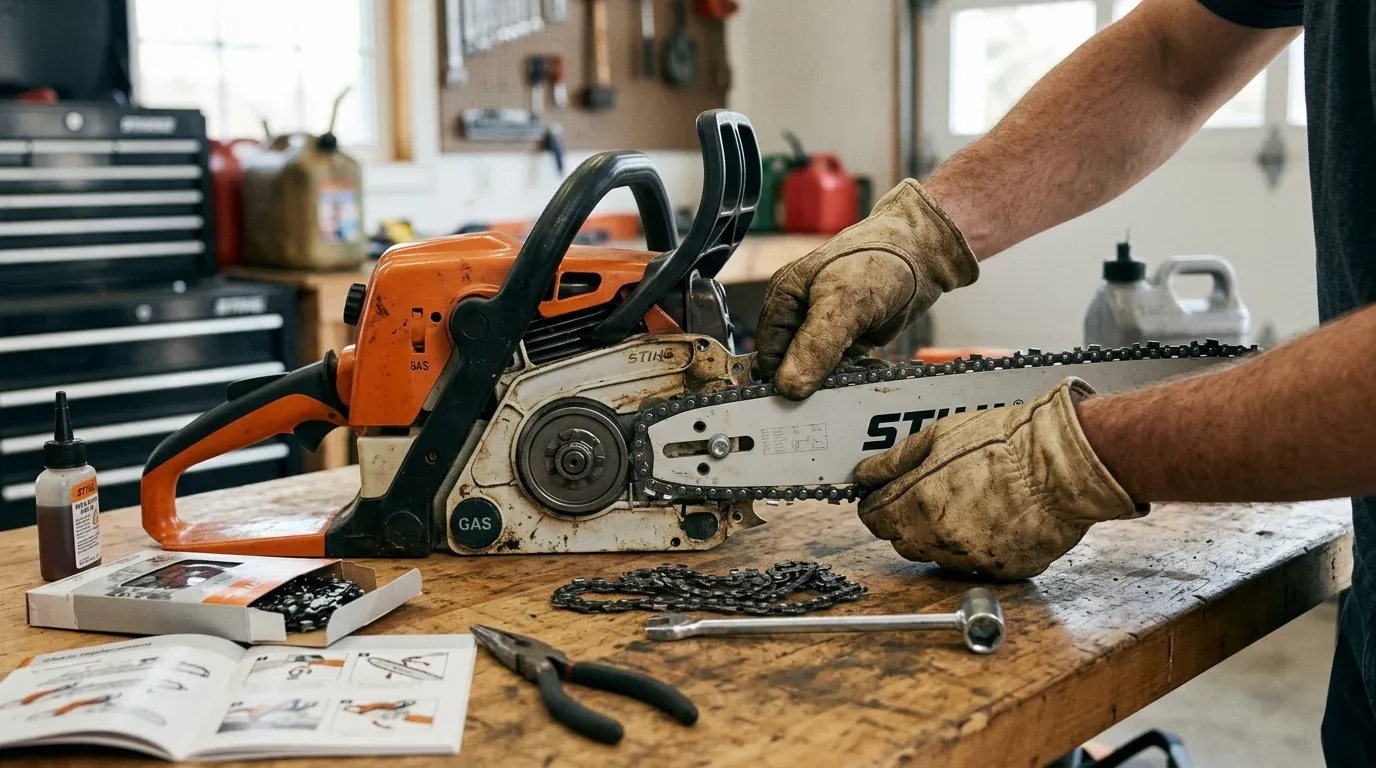
You know that feeling when your saw stops pulling itself into the wood? You’re leaning on the handles, the engine is screaming at 13,000 RPM, and all you’re getting is a fine, powdery dust that smells like scorched bar oil. That’s the sound of a professional failing.
After 15 years in the canopy and on the bucking grounds, I’ve learned that a chainsaw is only as good as the four millimeters of chrome-plated steel that actually touches the wood. Chainsaw chain replacement isn’t just about “getting a new one.” It’s about understanding the engineering specs, the metallurgy, and the geometry of the cut. Whether you’re running a massive Stihl MS 881 or a nimble Toro 60V Max, the chain is the soul of the machine.
In this guide, I’m stripping away the marketing fluff. We’re going deep into why your chain fails, how to spec a replacement that actually improves your saw’s performance, and the technical nuances that separate a “homeowner” chain from a professional-grade ripper.
The Strategic Comparison: Top-Tier Replacement Chains
Before we tear into the technical architecture, let’s look at how the heavy hitters stack up. I’ve run all of these in frozen oak, sappy pine, and everything in between.
| Chain Model | Best For | Cutter Type | Engineering Highlight | Link |
|---|---|---|---|---|
| Oregon EXL PowerCut | High-Output Gas Saws | Full Chisel | Multi-axis grind for out-of-box speed | 🛒 Check Oregon Price |
| Stihl 36RS (Rapid Super) | Professional Production | Full Chisel | High-grade Swiss steel, low stretch | 🛒 Check Stihl Price |
| Husqvarna X-Cut | All-Around Durability | Semi-Chisel | Pre-stretched at the factory | 🛒 Check Husqvarna Price |
| Oregon ControlCut | Occasional Users | Micro-Chisel | Reduced kickback, smoother feel | 🛒 Check Oregon Price |
The Technical Engineering Deep-Dive: More Than Just Metal
When people talk about chainsaw chain replacement, they usually stop at “does it fit the bar?” That’s like asking if a tire fits a rim without checking if it’s rated for 150 mph or a mud bog.
Pitch, Gauge, and Drive Links: The Holy Trinity
You cannot eyeball this. You need to understand the architectural footprint of your saw’s drive system.
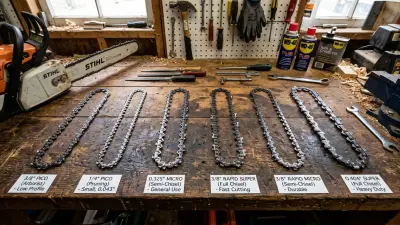
- Pitch: This is the average distance between rivets. It must match your drive sprocket and your bar’s nose sprocket exactly. Most pro saws run 3/8” or .325”. If you’re using a Worx WG384 or a smaller Worx WG322, you’re likely looking at a 3/8” Low Profile (Picco).
- Gauge: This is the thickness of the drive link where it fits into the bar groove. .050” and .063” are the industry standards for Stihl and Husqvarna respectively, but we’re seeing more .043” narrow kerf chains on battery-powered units. Use the wrong gauge, and you’ll either strip the bar or the chain won’t fit.
- Drive Link Count: Forget the “bar length.” A “20-inch bar” can take 70, 72, or 81 drive links depending on the manufacturer. Always count the individual drive links (the “shark fins” on the bottom) before buying.
Metallurgy and Chrome Coating
The “teeth” aren’t just solid steel. They are high-carbon steel chassis with a layer of industrial chrome on the outer edge. This chrome is what holds the edge. When I’m doing storm cleanup, I need a chain that can handle the microscopic grit embedded in bark by high winds.
Pro-grade chains like the Stihl RS series use a proprietary oil-tempered steel. It’s harder to file but holds an edge 20% longer than the cheap box-store replacements. If you’re transitioning from a Silky vs. a chainsaw, the jump in maintenance intensity is massive.
Real-World Performance Analysis: Bucking and Limbing
I spent the last week in a stand of seasoned Hickory’some of the hardest wood in North America. I swapped between a standard semi-chisel and a high-performance full chisel replacement.
Full Chisel: The Speed Demon
The full chisel chain has a square corner. In clean wood, it’s a revelation. It doesn’t just cut; it eviscerates. The chips are huge, like breakfast cereal. However, the second that square corner touches dirt or a rock, the edge is gone. For professional arborist work, I always go full chisel.
Semi-Chisel: The Workhorse
The semi-chisel has a rounded corner. It’s slower’maybe 10-15% slower in a timed cut’but it’s resilient. When I’m working on yard cleanup, I reach for a semi-chisel. It stays sharp through dirty bark and accidental ground contact much longer than a chisel chain.
Bore Cutting and Kickback
Replacement chains also come in “safety” (green label) and “pro” (yellow label) varieties. Safety chains have extra bumper drive links to prevent the saw from kicking back during a plunge cut. If you’re an experienced logger doing bore cuts for felling, those bumpers just get in the way. If you’re a homeowner using a Stihl MS 170, stick with the safety chain. Your collarbones will thank you.
Ergonomics & Operator Comfort: The Vibration Factor
Believe it or not, your choice in chain replacement dictates how your hands feel at 5:00 PM. Old-school chains transferred every ounce of impact directly into the guide bar and through the chassis.
Modern “low-vibration” chains use a slightly offset chassis or a “ramped” depth gauge (raker). This allows the cutter to rock slightly as it enters the wood, absorbing the shock. When I’m running a powerful saw like the Worx WG304, the difference in palm fatigue after four hours is measurable. A high-quality replacement chain should make the saw feel “creamy” in the cut, not like you’re holding a jackhammer.
Historical Context: From Chipper to X-Cut
Chainsaw chains haven’t changed their basic “chisel” shape since Joe Cox watched a timber beetle larva eat through wood in 1947. He noticed the larva didn’t use a scratching motion; it used a side-to-side slicing motion. That “Chipper” chain changed everything.
Today, we are in the era of “factory-sharpened” perfection. Brands like Husqvarna have invested millions into the X-Cut, which is pre-stretched at the factory. In the old days, you’d put on a new chain, make three cuts, and have to shut the saw down to tighten it. With modern replacements, the “break-in” period is almost non-existent.
Maintenance & Serviceability: The Life of the Chain
Replacing the chain is only half the battle. You have to maintain the replacement.
The Raker Myth
Most guys sharpen the teeth but never touch the depth gauges (rakers). If your teeth are short but your rakers are high, the saw won’t bite. Use a raker gauge tool every 3rd sharpening.
Bar Care
Whenever you replace a chain, flip your bar. This ensures even wear on the rails. If your bar has a “burr” (a sharp edge on the rail), take a flat file and remove it. A fresh chain on a thrashed bar is a waste of $30.
Tensioning: The “Snap” Test
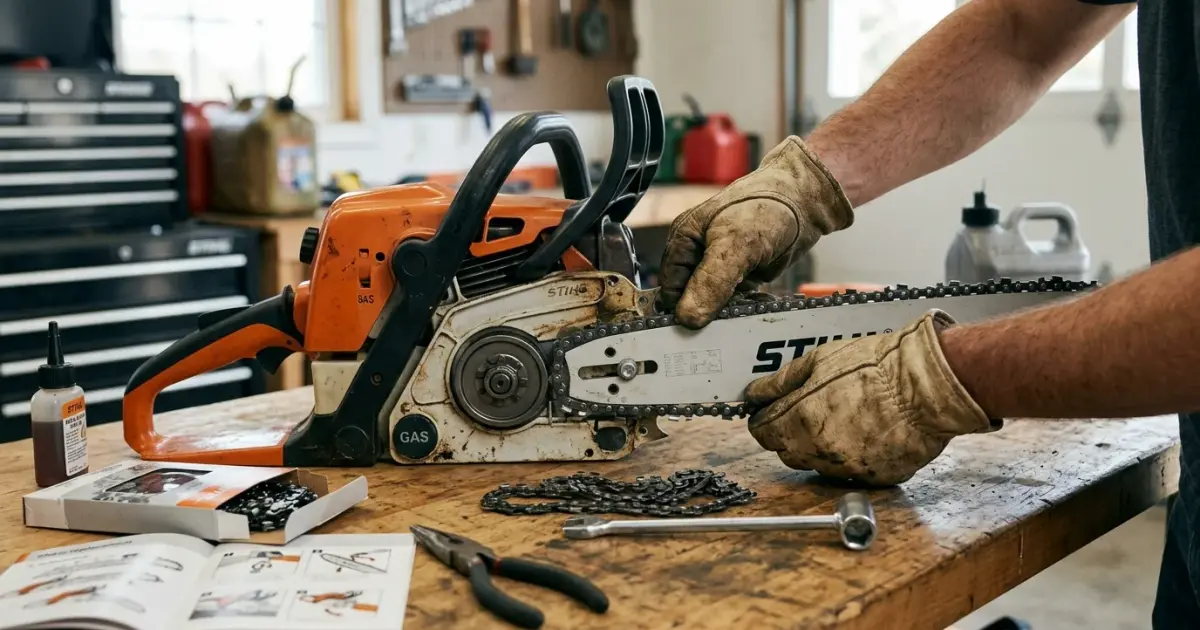
I see guys crank their chains so tight they won’t even spin. That’s a fast track to a ruined sprocket. You want it tight enough that the drive links don’t hang out of the bottom of the bar, but loose enough that you can pull it around the bar easily with a gloved hand. It should “snap” back into the groove when pulled.
Hardware Specs for Replacement
If you’re looking for the technical baseline, here is what a pro-grade 20-inch replacement chain usually looks like:
- Type: Full Chisel / Square Corner
- Pitch: 3/8”
- Gauge: .050” (1.3mm)
- Drive Links: 72
- File Size: 7/32” (5.5mm)
- Grind Angle: 25-30 Degrees
- Recommended Saw Displacement: 50cc - 90cc
Pros & Cons of Pro-Grade Replacement Chains
Pros:
- Extreme Speed: Cut times can be halved compared to dull or low-tier chains.
- Improved Fuel Efficiency: A sharp chain means the engine isn’t working as hard.
- Cleaner Cuts: Essential for those using carving bars on top handle saws.
- Longevity: High-carbon steel survives more sharpenings before the tooth is gone.
Cons:
- Higher Cost: Expect to pay $25-$40 for a quality loop.
- Aggressiveness: Professional (yellow label) chains have a much higher kickback risk.
- Fragility: One hit on a nail or rock can ruin a $35 chain instantly.
The SAWOFF Edge: Professional Field Notes
Here is the secret most people miss: The Bar Oil Matters. If you’re running a high-speed replacement chain, you need a high-tack bar oil. If the oil is too thin, it flings off the tip before it can lubricate the bottom rail. I’ve seen guys blame a “bad chain” for stretching when the reality was they were using cheap, watery oil that let the metal-on-metal friction cook the rivets.
Also, pay attention to the “sequence.” If you’re running a long bar (28” or more) on a mid-range saw, look for a Full Skip chain. It has fewer teeth, which means the engine can maintain high RPMs because it’s not trying to pull 40 teeth through the wood at once. It’s a game-changer for those of us who like big bars on small-ish saws.
Final Verdict
Replacing your chainsaw chain is the single most effective way to upgrade your saw’s performance. You don’t need a new carburetor or a muffler mod; you just need high-quality steel and the right geometry.
For the average homeowner with a Stihl homeowner saw, an Oregon ControlCut is the sweet spot of safety and speed. For those of us who make a living in the dirt, the Stihl RS or Oregon EXL is the only way to fly.
SAWOFF Rating: 4.9 / 5 (Because nothing is perfect, but a fresh X-Cut comes close.)
🛒 Buy My Favorite Replacement ChainFAQ: Chainsaw Chain Replacement Technicals
1. How do I know if I need a new chain or just a sharpening?
If your teeth have reached the “wear mark” (the little line etched on the back of the tooth) or if you’ve hit a rock so hard the teeth are “hooked” or missing chunks of chrome, it’s time for a replacement. If the teeth are still long, just sharpen it.
2. Can I put a .063” gauge chain on a .050” bar?
Absolutely not. It won’t even fit in the groove. Conversely, if you put a .050” chain in a .063” bar, it will lean to the side and cut crooked, eventually ruining the bar and the chain.
3. What is the best chain for cutting frozen wood?
Semi-chisel. The rounded corner handles the extreme hardness of frozen oak much better than a full chisel, which will dull almost instantly in sub-zero temps.
4. My new chain keeps getting loose. Why?
All chains “stretch” slightly during the first few minutes of use as the rivets seat themselves. This is normal. However, if it keeps happening, check your oiler. A dry chain gets hot, expands, and sags.
5. Why does my saw cut in a circle after I replaced the chain?
Usually, this means your bar rails are uneven or you have a “burr” on one side of the bar. It could also mean you accidentally bought a chain that doesn’t match your bar’s wear pattern. Check the Stihl safety features guide for more on bar/chain alignment.
6. Can I use a different brand of chain on my Stihl saw?
Yes, as long as the Pitch, Gauge, and Drive Link count match. You don’t have to use Stihl chains on Stihl saws, though many professionals prefer them for their high-quality steel.
7. What’s the difference between “Yellow Label” and “Green Label” chains?
This is the ANSI safety rating. Green is low-kickback (ideal for homeowners/beginners). Yellow is a professional-grade chain with no kickback protections. If you’re using the lightest Stihl chainsaws, stick with Green unless you’re an experienced carver.
8. What oil mixture should I use for a saw that’s working hard?
While the chain doesn’t care about the engine’s oil mix, the saw does. Stick to a 50:1 ratio with high-quality synthetic oil to ensure that while the chain is ripping, the engine isn’t seizing.