Review Information
- Reviewed by: Jack Beurge
- Review type: Research-based review
- Testing status: Not personally tested by SAWOFF — based on manufacturer documentation and reputable external sources
- Published: July 28, 2026
Information in this review is labeled as one of four types: 🧪 SAWOFF hands-on test, 🏭 manufacturer specification, 📚 research from reputable sources, or 🧠 editorial assessment. See our testing methodology and editorial policy.
Introduction
The difference between a dull semi-chisel chain and a perfectly filed square-ground chisel chain is unmistakable in the field: the dull chain transmits a high-frequency vibration through the palms after hours of bucking, while the sharp chisel gives off a distinct “sing” as it cuts. If there is one thing that holds across every analysis, it’s this: your chainsaw is only as good as the steel teeth spinning around the bar.
People spend weeks obsessing over whether to buy a Stihl MS 881 or a Husqvarna 592XP, but they’ll throw the first “replacement chain” they find at the big-box store onto their bar without looking at the drive link geometry. That is a massive mistake. The chain is the interface between the engine’s raw horsepower and the cellulose fibers of the wood. It is where the physics of the “power-to-weight ratio” actually meets the reality of production.
In this guide, we aren’t just looking at “sharp things.” We are doing a deep-dive into the engineering specs of pitch, gauge, cutter profiles, and sequence. This is the definitive SAWOFF teardown of chainsaw chain types.
The Core Trinity: Pitch, Gauge, and Drive Links
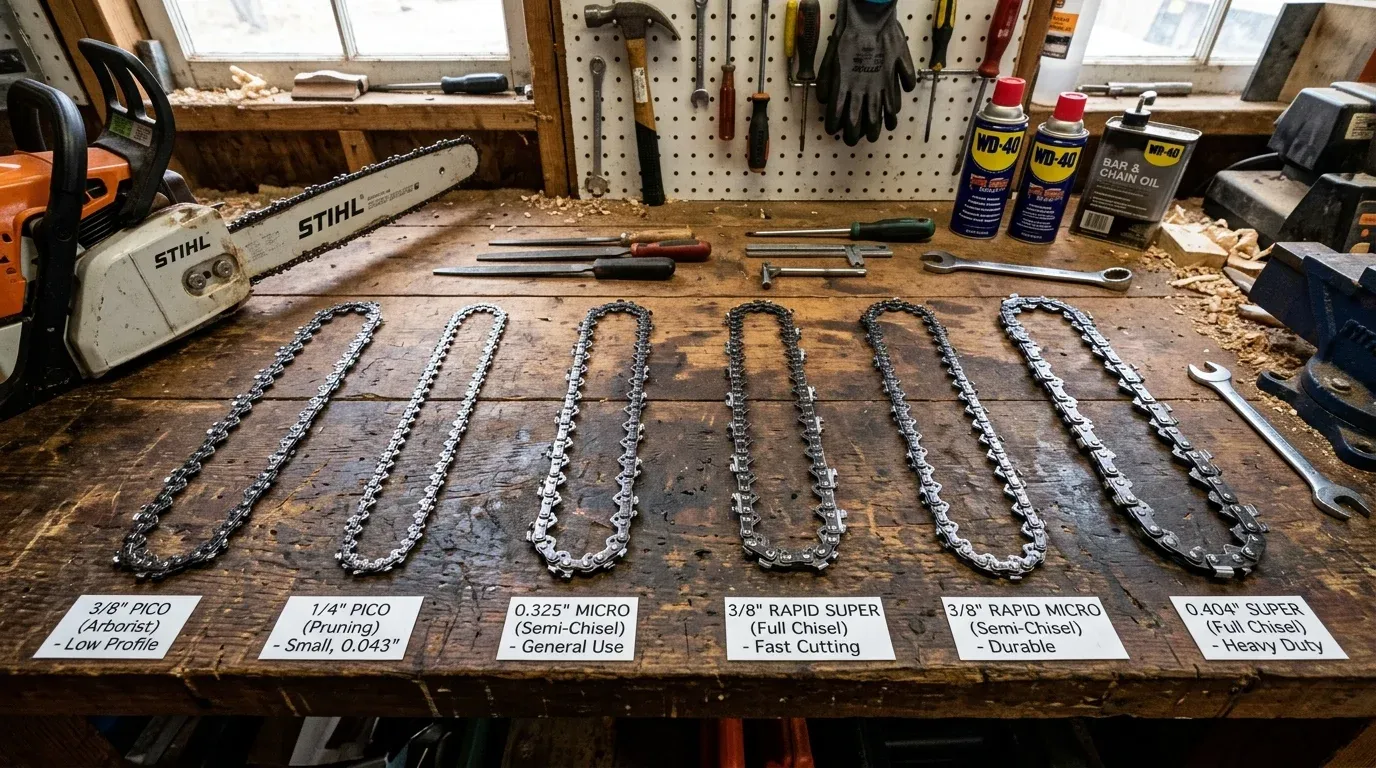
Before we even talk about the “teeth,” we have to talk about the chassis. If the chain doesn’t fit your bar and drive sprocket, you’re dead in the water. I’ve seen guys try to force a .058” gauge chain into a .050” bar groove’it’s a recipe for a ruined bar and a thrown chain that could take a chunk out of your shin.
1. Pitch
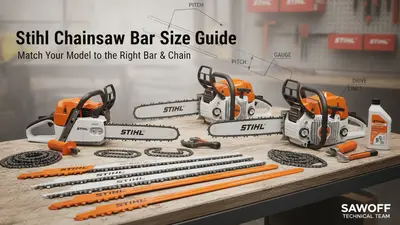
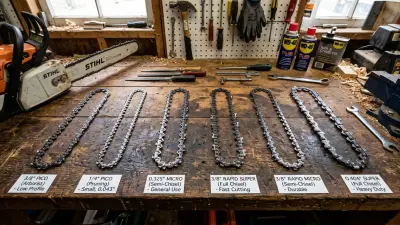
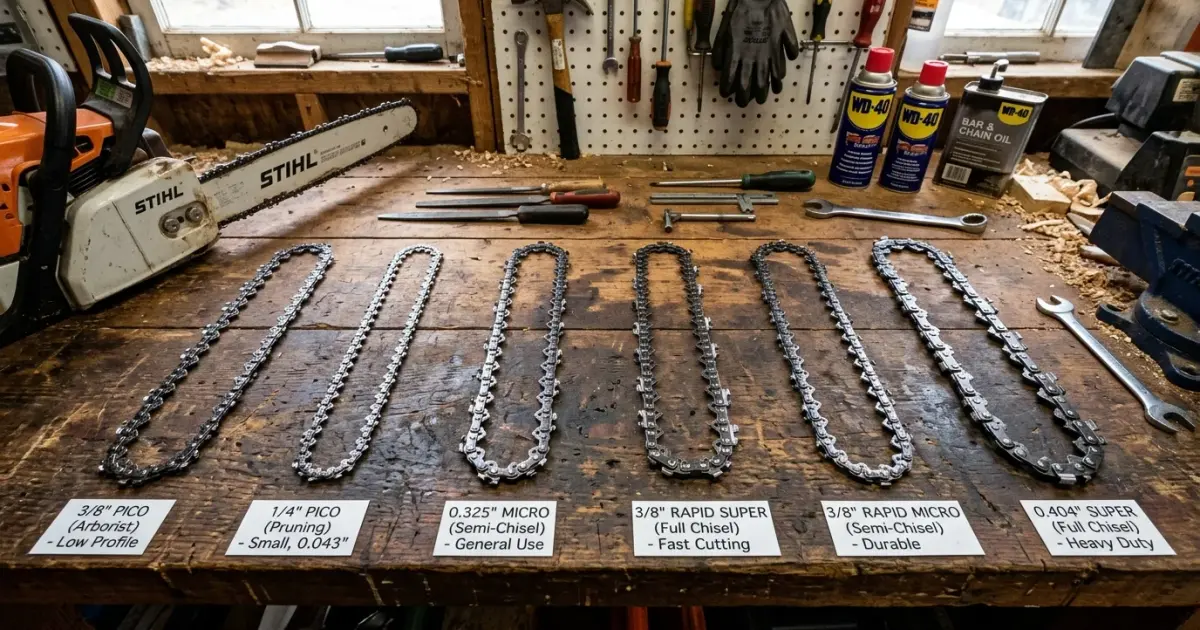
Pitch is the average distance between rivets. You calculate it by measuring the distance between three consecutive rivets and dividing by two. In the field, you’ll mostly see:
- 1/4”: Found on small carving saws and pole pruners like the Worx WG322. It’s smooth but slow.
- 3/8” Low Profile (Picco): The standard for homeowner saws and many top-handle saws.
- .325”: The “prosumer” sweet spot. It offers more speed than Picco but less vibration than full 3/8”.
- 3/8”: The industry standard for professional woodcutting.
- .404”: The heavy hitters. Used on massive felling saws like the Stihl MS 881.
2. Gauge
This is the thickness of the drive link (the part that fits into the bar). The most common are .043”, .050”, .058”, and .063”. If you’re running a Stihl, you’re likely on .050” or .063”. Husqvarna guys often lean toward .058”.
3. Drive Link Count
Never buy a chain based on the “bar length” alone. A 20-inch bar from one manufacturer might require 72 drive links, while another requires 70. Always count your links.
Strategic Comparison: Professional Chain Configurations
| Chain Type | Best For | Speed | Durability | Recommended Saw |
|---|---|---|---|---|
| Full Chisel | Clean softwood, high production | 10/10 | 5/10 | Stihl MS 881 |
| Semi-Chisel | Dirty wood, frozen logs, hardwood | 7/10 | 9/10 | Worx WG304 |
| Low Profile | Pruning, light yard work | 5/10 | 6/10 | Worx WG384 |
| Carving Chain | Detail work, sculpture | 4/10 | 8/10 | Carving Bars Guide |
Technical Engineering Deep-Dive: Cutter Geometry
The “cutter” is the actual tooth. This is where the metallurgy and geometry get intense. When I’m out on a storm cleanup job, the type of cutter I choose determines whether I’m home by dinner or still filing teeth by flashlight.
Full Chisel: The Speed Demon
Full chisel cutters have square corners. This minimizes the “kerf” friction and allows the tooth to sever wood fibers like a series of tiny, razor-sharp chisels.
- The Pros: It is terrifyingly fast. In clean pine or fir, a well-tuned full chisel chain feels like it’s pulling the saw into the wood.
- The Cons: It hates dirt. One hit against a rock or even “skidding” a log through mud will dull a full chisel chain instantly. It also has a higher tendency for kickback because the aggressive corner can grab the wood too hard in the upper quadrant of the bar nose.
Semi-Chisel: The Workhorse
The corners of semi-chisel cutters are rounded. While this seems “less sharp,” it’s actually a brilliant piece of engineering. The rounded radius stays sharp longer when cutting through dirty bark or frozen wood.
- Field Note: When I’m doing yard cleanup, I almost always reach for a semi-chisel. You lose maybe 10-15% in raw cutting speed, but you save 50% on sharpening time.
Chipper Chain: The Legend
You don’t see true chipper chains much anymore, but they have a completely radiused working corner, looking like a question mark. They were the original “modern” chain design by Joseph Cox. Today, they are mostly used for incredibly dirty conditions or specialized demolition.
Square Ground vs. Round Ground
Professional loggers in the Pacific Northwest often use “square ground” chains. This requires a special grinder or a very steady hand with a hexagonal file. The “gullet” and “top plate” are ground to a razor edge that makes a standard round-ground chain look like a butter knife. Unless you are a professional production felling contractor, stick to round-ground.
Sequence: Full House, Skip, and Semi-Skip
The “sequence” refers to how many drive links sit between the cutters.
- Full House (Standard): This is what you find on almost all saws under 60cc. There is one cutter for every two drive links. It provides the smoothest cut and is ideal for the best Stihl chainsaws for homeowners.
- Skip Tooth: There are two drive links between each cutter. Why would you want fewer teeth? Physics. On a long bar (32 inches+), having too many teeth in the cut creates too much friction for the engine to overcome. Skip tooth allows the engine to keep its RPMs in the “power band” and gives more room for chips to be cleared from the kerf.
- Semi-Skip: A middle ground, usually with alternating one and two drive link spacers.
Real-World Performance: The “Arborist’s Feel”
When you’re twenty feet up a tree with a lightweight Stihl, the chain’s “bite” is everything. I look for an “inertia-activated chain brake” compatibility and a “low-vibration” chassis.
If I’m bucking hardwood for firewood, I want a chain that throws “chips,” not “dust.” If you see sawdust coming out of your kerf, your chain is dull or the “rakers” (depth gauges) are too high. The raker is the little hump in front of the tooth. It determines how deep the tooth bites. If you file them too low, the saw will “chatter” and grab, potentially stalling the engine or snapping a wrist. If they are too high, you’ll be pushing on the saw until your shoulders burn, and you’ll still only be making smoke.
🛒 Find Your Chain Size on AliExpressHistorical Context: From the “Scratcher” to the Modern Saw
Before the late 1940s, we used “scratcher” chains. They worked like a hand saw’literally scratching away the wood. They were nightmare to sharpen and incredibly inefficient. Joseph Cox, the founder of Oregon Tool, watched a timber-beetle larva chew through wood. He noticed the larva didn’t scratch; it used side-to-side “C” shaped cutters.
He replicated that “C” shape in steel, and the modern “chipper” chain was born. Everything we use today, from the Toro 60V Max to the Stihl professional models, owes its DNA to that timber-beetle larva.
Maintenance & Serviceability: The Golden Rules
- Tension is King: A loose chain “peens” the drive links and wears out the sprocket. A tight chain creates heat that destroys the bar rails. You should be able to pull the chain up and see the bottom of the drive links just touching the bar rail, and it should “snap” back into place.
- The “One-File” Rule: Every time I fill the gas tank, I give the chain two light strokes with a round file. It keeps the edge “surgical” and prevents the need for a heavy grinding session later.
- Bar Care: Every time you swap a chain, flip your bar. This ensures even wear on the rails. Also, use a bar dresser tool to remove the “burrs” that develop on the edges.
- Oil Flow: Ensure your “Ematic” or standard oiling system is pumping. Without lubrication, even a $100 carbide chain will be ruined in minutes. Check out the Stihl safety and maintenance guide for more on this.
Hardware Specs: The Pro’s Cheat Sheet
- Cutter Material: High-carbon steel (standard) or Chrome-plated (hardened).
- Safety Links: “Bumper” drive links help reduce kickback by preventing the raker from snagging.
- Vibration Dampening: Look for “low-vibe” markings on the tie straps.
- LubriLink/LubriJet: Features in Oregon chains that help keep oil in the rivets.
Pros & Cons of Different Chain Types
Full Chisel
- Pros: Maximum speed; cleanest cut; professional’s choice for felling.
- Cons: Dulls instantly in dirt; higher kickback risk; harder to hand-file.
Semi-Chisel
- Pros: Durable; stays sharp in “dirty” wood; smoother feel.
- Cons: Slower than full chisel; generates more heat in long cuts.
Carbide Tipped
- Pros: Can cut through nails, shingles, and frozen dirt; stays sharp 25x longer.
- Cons: Extremely expensive; requires a diamond wheel to sharpen; brittle if it hits a large rock.
The SAWOFF Edge: My Verdict
If you are a homeowner, stop buying the cheapest chain at the hardware store. Upgrade to a high-quality Semi-Chisel chain with a 3/8” Low Profile pitch if you’re using something like the Worx WG304. It’s the safest and most reliable configuration for most people.
For the pros, I’m a Full Chisel, Square Ground advocate for clean timber, but I always keep a loop of Semi-Skip Semi-Chisel in the truck for those nasty, mud-caked storm removals.
SAWOFF Rating: 4.8 / 5 (Because no chain is perfect for every log, but a sharp one comes close).
FAQ: Mastering the Chain
1. Can I use a different brand of chain on my Stihl saw?
Yes, as long as the pitch, gauge, and drive link count match your bar. You don’t have to use Stihl-branded chains, though their Swiss-made steel is some of the best in the world.
2. Why does my chain get loose after only five minutes of cutting?
This is “chain stretch,” but it’s actually rivet wear. In new chains, the rivets are “seating” into the holes. In old chains, it’s a sign of poor lubrication causing the metal to wear away.
3. What is the best chain for cutting firewood?
For most people, a Semi-Chisel chain is best. Firewood logs often have dirt or sand in the bark from being dragged, and a semi-chisel will hold its edge much longer than a full chisel.
4. How do I know when my chain is beyond sharpening?
Look at the “witness mark” on the top of the tooth. It’s a small line etched into the metal. Once you’ve filed back to that line, the tooth is too small to be safe or effective. Replace it.
5. When should I use a “Ripping Chain”?
Only use a ripping chain if you are using a chainsaw mill to make lumber. They are ground at a 10-degree angle (vs the standard 25-35 degrees) to cut with the grain of the wood rather than across it.
6. Do I need a special chain for the Silky vs. Chainsaw debate?
If you’re doing light pruning where a Silky would work, use a 1/4” pitch or 3/8” LP chain. These provide the “surgical” precision needed for the tree’s health.
🛒 View All Chainsaw Accessories