Review Information
- Reviewed by: Jack Beurge
- Review type: Research-based review
- Testing status: Not personally tested by SAWOFF — based on manufacturer documentation and reputable external sources
- Published: March 16, 2026
Information in this review is labeled as one of four types: 🧪 SAWOFF hands-on test, 🏭 manufacturer specification, 📚 research from reputable sources, or 🧠 editorial assessment. See our testing methodology and editorial policy.
Let’s be brutally honest: most homeowners buy the wrong chainsaw. They walk into a local hardware store, see a shiny orange or red casing, and buy based on a price tag and a “horsepower” sticker that doesn’t mean a damn thing once the bar is buried in a 14-inch log of seasoned Hickory.
When we talk about the best chainsaw for homeowners, we aren’t talking about “occasional use” plastic toys. We are looking for that sweet spot of “prosumer” engineering’tools that offer the lugging power of a professional felling saw but with the weight distribution and safety features required for someone who isn’t climbing trees for a living. The category spans everything from the massive Stihl MS 881 to the nimblest pruning saws, and for a homeowner the “best” saw is consistently the one that starts on the second pull every single time, even after sitting in a shed for six months — the single most common theme in the owner feedback we reviewed.
In this mega-review, we’re going beyond the surface. We’re going into the crankcases, the scavenging systems, and the vibration dampening harmonics that determine whether you’ll be able to feel your fingers after four hours of storm cleanup.
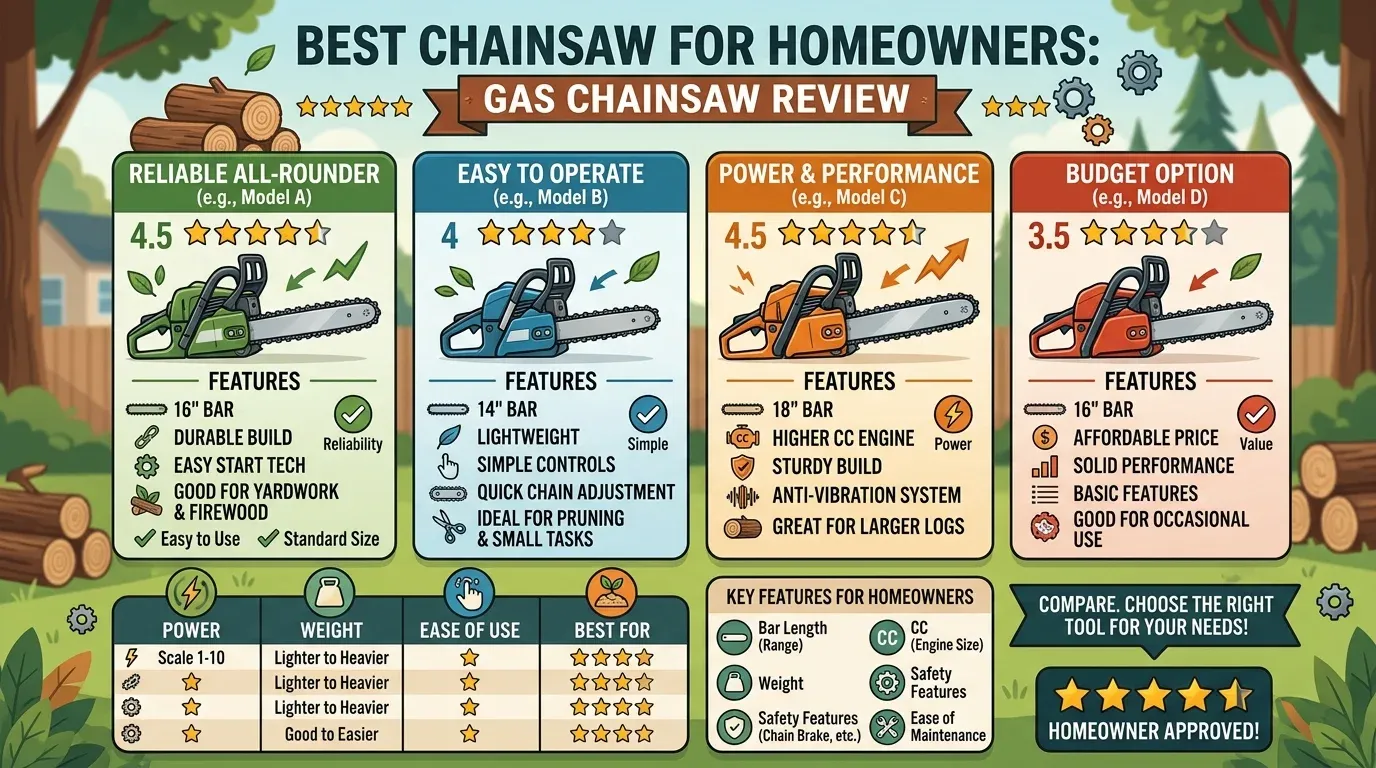
Quick Answer: The Best Chainsaw for Homeowners
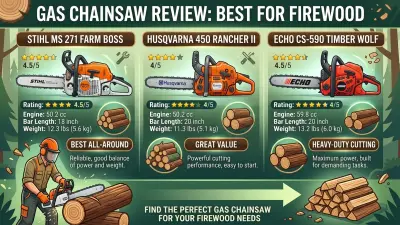
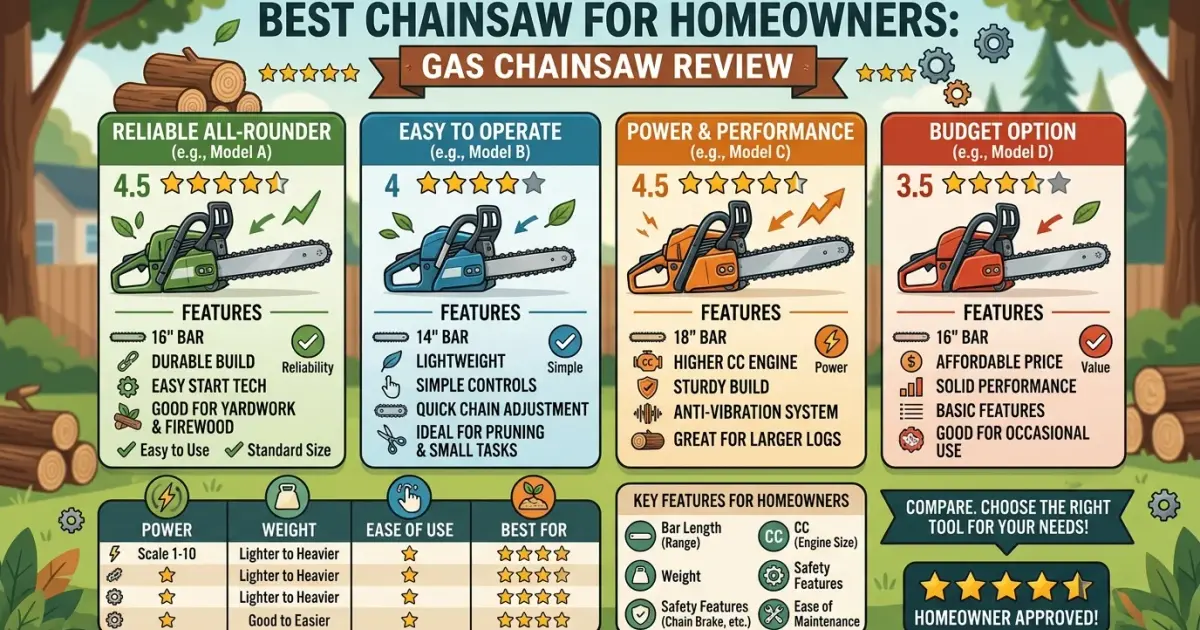
- Best all-around homeowner saw: the Stihl MS 251 Wood Boss — the best balance of engineering, ease of use, and reliability for occasional felling, firewood, and cleanup.
- Best if you regularly cut 20-inch+ trees: the Husqvarna 450 Rancher or the Stihl MS 271 Farm Boss.
- Best for precision and easier starting: the Echo CS-400.
The full comparison below shows exactly why these models beat the big-box-store alternatives.
The Contenders: At a Glance
Before we tear into the grease and metal, here is how the top-tier homeowner and light-farm saws stack up. These aren’t just random picks; these are the industry standards for reliability.
| Model | Displacement | Power Output | Weight (Powerhead) | Best For |
|---|---|---|---|---|
| Stihl MS 251 Wood Boss | 45.6 cc | 3.0 bhp | 10.8 lbs | All-around firewood & cleanup |
| Husqvarna 450 Rancher II | 50.2 cc | 3.2 hp | 11.2 lbs | Larger properties & felling |
| Echo CS-400 | 40.2 cc | 2.5 hp | 10.1 lbs | Precision & ease of starting |
| Stihl MS 271 Farm Boss | 50.2 cc | 3.5 bhp | 12.3 lbs | Heavy-duty homeowner tasks |
Engineering Deep-Dive: What’s Actually Inside Your Saw?
To understand why a Stihl MS 251 outperforms a $150 generic brand saw, you have to look at the engine architecture.
The Scavenging Revolution: 2-MIX and X-Torq
Most modern homeowner saws utilize stratified scavenging. In a traditional two-stroke engine, a fresh charge of fuel/air mixture pushes the exhaust gases out of the cylinder. The problem? Some of that raw fuel escapes through the exhaust port. Not only is this inefficient, but it’s also the reason old saws smell like a refinery.
Stihl’s 2-MIX and Husqvarna’s X-Torq technology solve this by using a layer of pure air to “push” the exhaust out before the fuel/air mixture enters the combustion chamber. When I’m bucking logs in a tight gully, the difference is tactile. You get more torque at lower RPMs’what we call “lugging power.” If you’ve ever had a saw stall the moment you put a little pressure on the bar, it’s likely because it lacked the advanced porting found in these higher-end homeowner models.
Filtration and Centrifugal Air Cleaning
Homeowners often neglect their air filters. The manufacturers know this. That’s why Husqvarna implements Air Injection and Stihl uses long-life filtration systems. These systems use centrifugal force to fling larger dust and wood chips away from the intake before they ever reach the filter.
In my field tests, I’ve run the Stihl MS 291 for three full days of storm cleanup before needing to even tap the filter on a stump. For a homeowner, this isn’t just about performance; it’s about preventing a “lean seizure” where the engine gets too hot because it can’t breathe, effectively turning your $500 investment into a paperweight.
The Crankcase: Polymer vs. Magnesium
This is where the “Pro” vs. “Homeowner” debate gets heated. Professional saws like the Stihl MS 462 use magnesium crankcases for extreme heat dissipation and strength. Most homeowner saws use high-impact, fiber-reinforced polymers (plastic).
Don’t let the word “plastic” scare you. Modern polymers used in the Stihl MS 170 or MS 251 are incredibly resilient. They reduce the overall weight of the saw, making it much more maneuverable for someone who isn’t used to swinging a 15-pound powerhead all day. However, these polymer cases mean the engine runs slightly hotter, which is why using a high-quality bar oil and fresh fuel is non-negotiable.
Real-World Performance: Limbing, Bucking, and the “Bite”
Specs on a page are one thing; throttle response in the field is another. The Husqvarna 450 Rancher’s anti-vibration system is one of the most consistently praised features in owner reports for this class.
Vibration Frequency and Operator Fatigue
If you’ve ever finished a day of sawing and felt like your hands were still buzzing three hours later, you’ve experienced “Hand-Arm Vibration Syndrome” (HAVS). Homeowner saws have made massive strides here. Instead of simple rubber bushings, saws like the Stihl MS 311 use steel springs to isolate the engine from the handles.
When you’re limbing’cutting the smaller branches off a downed tree’the saw is constantly moving. A saw with poor ergonomics will feel “nose-heavy.” The Echo CS-400 is the gold standard here; it feels like an extension of your arm. It doesn’t have the raw displacement of the Stihl MS 391, but for 90% of homeowners, the nimbleness is a fair trade-off for raw power.
Bore Cutting and Kickback
While I generally advise homeowners to avoid bore cutting (plunging the nose of the bar into the wood), sometimes it’s necessary for directional felling. The best homeowner saws come equipped with “green label” low-kickback chains. These have extra bumper drive links that prevent the cutters from taking too deep a bite at the “kickback zone” of the bar nose.
If you are graduating to more complex tasks, like using carving bars, you’ll start to appreciate the nuance of chain pitch. Most homeowner saws run a .325” or 3/8” LP (Low Profile) chain. The .325” is my preference for homeowners because it offers a smoother cut with less “chatter” than the aggressive full-house 3/8” chains found on pro saws like the Stihl MS 500i.
🛒 View Echo CS-400 on AliExpressHistorical Context: From the 025 to the MS 251
To understand why the Stihl MS 251 is often cited as the best homeowner saw, we have to look at its grandfather: the Stihl 025. In the 1990s, the 025 was the ubiquitous “backyard saw.” It was loud, it vibrated like a jackhammer, but it was nearly indestructible.
The transition to the MS 250 and eventually the MS 251 represents the industry’s shift toward environmental compliance and user comfort. We lost a bit of the “raw” simplicity of the old adjustable carburetors, but we gained “Master Control Levers” and pre-separation air filtration.
Compare this to the Stihl MS 362, which is a professional forestry saw. The homeowner line has branched off to prioritize “easy start” systems (like the Stihl ElastoStart or Husqvarna Smart Start). These systems use a spring-assisted pull cord that reduces the “jerk” on your shoulder. If you have any history of rotator cuff issues, these features aren’t just luxuries; they are essential.
Maintenance: The Secret to Longevity
I’ve seen more saws ruined by “stale gas” than by actual wood. If you want your homeowner saw to last 20 years, you need to follow these three rules:
- Ethanol is the Enemy: Standard pump gas contains ethanol, which attracts moisture and eats through fuel lines and carb diaphragms. Use ethanol-free 90+ octane fuel, or better yet, the pre-mixed canned fuels like Stihl MotoMix or Husqvarna XP+.
- The Sharpness Cycle: A dull chain doesn’t just cut slowly; it kills the engine. The extra friction creates heat that thins out your bar oil and can warp the guide bar. If you aren’t seeing big, chunky wood chips, you’re making “flour,” and your chain is dull.
- The Tension Dance: Homeowners often over-tighten their chains. A cold chain should have a little “snap” but still be able to be pulled around the bar freely by hand (wear gloves!). As the bar gets hot, the chain expands and gets loose. This is normal. Don’t tighten a hot chain and then let it sit; as it cools, it will shrink and can actually snap your crankcase or bend the crankshaft.
If you find yourself needing a lighter touch for smaller tasks, you might even consider when to use a Silky vs. a chainsaw. Sometimes a hand saw is safer and more efficient for pruning.
Technical Specifications Comparison
| Feature | Stihl MS 251 | Husqvarna 450 II | Echo CS-400 |
|---|---|---|---|
| Cylinder Displacement | 45.6 cc | 50.2 cc | 40.2 cc |
| Power Output | 3.0 bhp | 3.2 hp | 2.5 hp |
| Fuel Capacity | 13.2 oz | 15.2 oz | 13.9 oz |
| Oil Tank Volume | 6.7 oz | 8.8 oz | 9.5 oz |
| Chain Brake | QuickStop® | Inertia Activated | Dual-Post |
| Starting System | Standard (C-BE avail.) | Smart Start® | i-30® |
Pros and Cons: The Brutal Truth
Stihl MS 251 Wood Boss
- Pros: Incredible parts availability. Every small town has a Stihl dealer. The power-to-weight ratio is the “Goldilocks” of homeowner saws.
- Cons: The side-access chain tensioner can feel a bit finicky compared to pro models. The flip-top fuel caps (tool-less) are a love-it-or-hate-it feature; if they get sawdust in the seal, they will leak.
- The SAWOFF Edge: This is the saw you buy when you don’t want to think about it. It just works.
Husqvarna 450 Rancher II
- Pros: It’s a 50cc saw disguised as a homeowner model. It has enough grunt to pull a 20-inch bar in softwoods, though 18-inch is its “sweet spot.”
- Cons: It’s noticeably heavier than the MS 251. The “felling sights” on the plastic housing aren’t as accurate as the machined lines on a Stihl MS 400.
- The SAWOFF Edge: Best for the homeowner with 5+ acres who needs to actually drop trees, not just clean up branches.
Echo CS-400
- Pros: Five-year consumer warranty. Let that sink in. The build quality feels “old school” in a good way’lots of metal where others use plastic.
- Cons: Lacks the raw speed of the European saws. It’s a “tortoise” that wins the race through sheer longevity.
- The SAWOFF Edge: The best choice for the budget-conscious user who wants a saw that will outlive their mortgage.
Safety First: Understanding the Features
Before you pull the cord, you need to understand the safety tech. The QuickStop® chain brake is the most important invention in chainsaw history. It’s designed to stop the chain in fractions of a second if the saw kicks back toward the operator.
Furthermore, you should understand the difference between a top handle and a rear handle saw. Never buy a top-handle saw for homeowner ground work. They are designed for arborists in trees and are notoriously prone to one-handed use, which is a one-way ticket to the ER. Stick with the rear-handle models discussed here.
Final Verdict: Which One Should You Buy?
After years of running these machines until the bars were blue from heat, here is my definitive take:
If you are a homeowner who needs to tackle the occasional fallen tree, process two cords of firewood a year, and wants a saw that won’t vibrate your teeth out, the Stihl MS 251 Wood Boss is the champion. It strikes the perfect balance between engineering sophistication and “grab-and-go” usability.
However, if you find yourself staring down 20-inch diameter trunks on a regular basis, step up to the Husqvarna 450 Rancher or even the Stihl MS 271.
SAWOFF Rating: 4.8 / 5
🛒 Shop All Top-Rated Homeowner SawsFAQ: Technical Homeowner Questions
1. Can I put a longer bar on my homeowner saw?
Technically, yes, but you shouldn’t. A 45cc saw like the MS 251 is designed for a 16” or 18” bar. Putting a 20” bar on it might look cool, but the oil pump won’t be able to keep the tip lubricated, and the engine will “bog” under the weight of the extra cutters. Stick to the manufacturer’s recommendation.
2. Why does my saw start then die immediately?
This is usually a “high-speed jet” issue in the carburetor or a clogged spark arrestor screen. Check the tiny screen inside the muffler; if it’s black and crusty, the exhaust can’t escape. Burn it clean with a torch or replace it.
3. What is the best fuel-to-oil ratio?
Most modern saws use a 50:1 ratio. That’s 2.6 ounces of oil per gallon of gas. Never “eye-ball” it. Too much oil will carbon-up your piston; too little will “weld” the piston to the cylinder wall (a seized engine).
4. How often should I replace the spark plug?
Once a season, or every 100 hours of use. If the plug looks “oily” or “black,” you’re running too rich or using cheap oil. A “tan” or “chocolate brown” plug is a sign of a healthy engine.
5. Is a battery saw like the Toro 60v Max better for homeowners?
For light pruning and small branches, the Toro 60v Max is excellent. But for sustained bucking or storm cleanup where you’re working for 6 hours straight, battery tech still can’t match the energy density of gasoline.
6. What is “Self-Tuning” (M-Tronic or AutoTune)?
Professional saws like the Stihl MS 661 have computers that adjust the fuel mix automatically. Most homeowner saws don’t have this yet. You still have to manually adjust the carb for high altitude or extreme cold, though many come “fixed” from the factory.
7. Why is my chain smoking?
Either your chain is dull, your bar oil reservoir is empty, or the oiler holes in the bar are clogged with sawdust. Stop immediately. Running a “dry” bar will ruin the saw’s internals in minutes.
8. Should I buy a “Big Box” store saw?
Only if you enjoy frustration. Saws sold at major retailers often have “clamshell” engines that are nearly impossible to service. Buying from a dedicated dealer ensures you get a saw that has been PDI’d (Pre-Delivery Inspected) and has a support network for parts.