Review Information
- Reviewed by: Jack Beurge
- Review type: Research-based review
- Testing status: Not personally tested by SAWOFF — based on manufacturer documentation, reputable sources, and documented owner-reported patterns
- Published: October 4, 2026 · Updated: October 15, 2026
Information in this review is labeled as one of four types: 🧪 SAWOFF hands-on test, 🏭 manufacturer specification, 📚 research from reputable sources (including documented owner-reported patterns), or 🧠 editorial assessment. See our testing methodology and editorial policy.
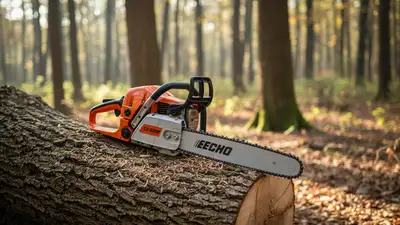
The best echo chainsaw for most buyers in 2026 is the CS-590 Timber Wolf for firewood and farm work, with the CS-400 as the homeowner pick, the CS-2511T for arborists, and the CS-7310P as ECHO’s big-iron pro saw. ECHO’s pitch is simple: pro-grade magnesium guts and a 5-year consumer warranty, $100–$300 under STIHL.
After years of running ECHO beside STIHL and Husqvarna on the same wood, the honest summary is this: ECHO sells you a tank that starts on the third pull and keeps running — not the lightest, not the quickest to throttle, but the most likely to still be cutting next decade.
Our best chainsaws of 2026 covers the whole market; this page stays on the orange-and-grey lane. If you want the head-to-head with the German brand, jump to our STIHL vs Husqvarna comparison or the brand hub in our best STIHL chainsaws guide.
Bottom line: ECHO’s lineup is the value tier of serious gas saws — one class less expensive than STIHL for the same architecture, at the cost of a pound here and a tenth of a horsepower there.
The full ECHO chainsaw lineup at a glance
Master table first, ranked by engine class. Weights are powerhead-only; prices are typical street ranges, since ECHO sells through dealers and hardware chains alike:
| Rank | Model | cc | Class | Typical bar | Typical street price |
|---|---|---|---|---|---|
| 1 | CS-310 | 30.1 cc | Light limbing | 14”–16” | ~$230–$270 |
| 2 | CS-352 | 35.8 cc | Homeowner upgrade | 16”–18” | ~$300–$340 |
| 3 | CS-400 | 40.4 cc | Best homeowner | 16”–18” | ~$300–$350 |
| 4 | CS-490 | 50.2 cc | Light farm work | 18”–20” | ~$400–$450 |
| 5 | CS-590 Timber Wolf | 59.8 cc | Best firewood / farm | 18”–24” | ~$450–$500 |
| 6 | CS-620P | 59.8 cc | Pro all-rounder | 18”–24” | ~$500–$560 |
| 7 | CS-7310P | 73.5 cc | Pro felling | 20”–28” | ~$700–$800 |
| 8 | CS-2511T | 25.0 cc | Arborist top-handle | 12”–16” | ~$650–$700 |
Keep reading for the ranked verdict on each model, then the price bands.
Bottom line: pick the cc class you need first, then use this table to sanity-check you aren’t paying the 620P price for 590 work.
ECHO CS-310: the light-duty specialist
Verdict: best for pruning, thinning, and storm twigs — a good value first saw.
- 30.1 cc, about 8.8 lb powerhead
- 14”–16” bar, .325” pitch typical
- As low as ~$230 street, sometimes less on sale
- 5-year consumer warranty
The CS-310 is the smallest gas saw ECHO sells. It limbs, prunes, and cleans up storm debris at a weight almost anyone can hold at arm’s length for an hour. Cold starts land on the second or third pull. What it will not do is bucking: an 18-inch oak round is the top of its envelope. Our ECHO CS-310 review covers it fully.
ECHO CS-352: the quiet achiever
Verdict: the CS-400’s smaller sibling — buy it when weight matters more than muscle.
- 35.8 cc, about 9.8 lb
- 16”–18” bar, 3/8” low-profile chain
- ~$300–$340 typical street
The CS-352 fills an odd gap that works: more cutting authority than the CS-310, less weight than the CS-490, a hair under the CS-400’s price. For a smaller-framed homeowner it is arguably the sweet spot of the family, as our ECHO CS-352 review explains.
ECHO CS-400: the best homeowner gas saw, full stop
Verdict: our default recommendation for a first gas chainsaw.
- 40.4 cc, about 10.1 lb dry
- 16”–18” bar, 3/8” low-profile, automatic oiler
- ~$300–$350 typical street
- Magnesium-influenced build for its price bracket
The CS-400 wins the homeowner class on the logic that wins it sales charts: honest 40cc power, a build that tolerates storage neglect and stale fuel better than most, and a price below STIHL’s MS 211-class saws. It is also the saw I hand a first-time firewood cutter, since 16 or 18 inches of bar on 40cc teaches bar control without a heavyweight penalty. Full verdict in our ECHO CS-400 review.
Bottom line: if you want one name to leave the store with, the CS-400 is the safest first gas saw on the market.
ECHO CS-490: the do-something-more saw
Verdict: the step up when 40cc is not enough but pro pricing feels silly.
- 50.2 cc, about 10.6 lb
- 18”–20” bar
- ~$400–$450 typical street
- Magnesium crankcase, G-Force pre-cleaner filtration
The 490 packs a genuine 50.2cc into a 10.6-pound body — a better power-to-weight number than the price suggests. It bucks 20-inch pine rounds without complaint and limbs with a lightness the 590 can’t match. Choose it over the CS-400 for oak country, and over the CS-590 when carrying matters more than cutting. Detail in our ECHO CS-490 review.
ECHO CS-590 Timber Wolf: the value king of the lineup
Verdict: the best dollar-for-dollar firewood and farm saw we’ve tested in this whole price band.
- 59.8 cc, about 13.2 lb
- 18”–24” bar, 3/8” chain, adjustable clutch-driven oiler
- ~$450–$500 typical street
- 21.8 fl oz fuel tank, generous bar-oil capacity
This is the saw that made ECHO’s reputation in North America, and it still earns the label. The 590 carries a 24-inch bar through seasoned oak with the dogs set, has the oil-tank appetite to run a full day without fuel-cooling breaks, and keeps its simplicity at a ~$470 street price. On power-per-dollar, the 590 is the class champion here. Our ECHO CS-590 Timber Wolf review has the long-form numbers.
Bottom line: as a firewood machine, the CS-590 might be the single best value in gas chainsaws — full stop.
ECHO CS-620P: the pro’s 60cc, minus the pro markup
Verdict: the 590’s professional sibling, worth the upgrade if you cut weekly.
- 59.8 cc, about 12.1 lb
- 18”–24” bar, .375” chain pitch; better anti-vibration mounts
- ~$500–$560 typical street
- Magnesium crankcase, professional HD air-filtration family
I lean with the purists who argue the CS-620P is the saw the CS-590 wants to be when it grows up. The “P” is ECHO’s pro-family tag: better anti-vibration mounts, tighter tolerances, the magnesium crankcase, and filtration built for all-day use. It is ECHO’s answer to the STIHL MS 261 in spirit, even if it cedes a bit of top-end chain speed. Read our ECHO CS-620P review for the vibration numbers.
ECHO CS-7310P: the big-iron flagship
Verdict: ECHO’s answer to a 70cc falling saw — legit, if heavier than the class leaders.
- 73.5 cc, about 14.8 lb
- 20”–28” bar typical, stretchable in lighter wood
- ~$700–$800 typical street
- Full pro build: magnesium, high-output oiler, pro filtration
The CS-7310P is ECHO’s biggest rear-handle pro saw, aimed squarely at the falling and lot-clearing crowd. Its 73.5cc pulls 28 inches of bar through hardwood without losing revs, and it balances better than the raw weight suggests. The trade versus the STIHL MS 462 is roughly a pound of extra weight and blunter throttle response, exchanged for a couple hundred dollars and the famously simple, fix-it-anywhere engine. Long-form in our ECHO CS-7310P review.
ECHO CS-2511T: the arborist’s climbing saw
Verdict: the lightest serious top-handle in the market — the climber’s love letter.
- 25.0 cc, about 5.7 lb
- 12”–16” bar, top-handle configuration
- ~$650–$700 typical street
The CS-2511T is a top-handle built for in-tree work, and at 5.7 pounds it weighs about what a helmet and muffs do. What surprises climbers is that it still has real cutting authority — it limbing and dead-woods all day in a harness without the forearm burn. STIHL’s MS 201 T-class carries more cc, but most climbers tally the weight savings first. Full detail in our ECHO CS-2511T review.
Bottom line: for climbing, the 2511T is ECHO’s most respected modern design — weight you forget on the rope.
Price bands: what your budget actually buys
The same lineup in four price bands, with my pick and the trade-off in each:
| Budget band | Pick | What you get | What you give up |
|---|---|---|---|
| ~$230–$280 | CS-310 | Lightest, cheapest full gas kit | Any real bucking authority |
| ~$300–$350 | CS-400 | Best homeowner value, forgiving engine | 50cc-class power |
| ~$400–$500 | CS-590 | Genuinely professional architecture | Light weight and premier vibration damping |
| ~$550–$800 | CS-620P / CS-7310P | Pro-grade build for the money | The last hundred dollars vs STIHL finishing |
The table reads blunt on purpose: every rung of ECHO’s ladder has a clear “why you move up” and “why you stop here.” If that filter helps, our best gas chainsaws for the money applies it to the broader market.
ECHO vs STIHL: the dollar-for-dollar matchup
This decides most purchases in this aisle, so let me answer it in money terms.
Architecture: from the CS-400 up, ECHO builds with magnesium crankcases, chrome-plated cylinders and side-access tensioners — the same recipe as STIHL’s pro saws. In some matchups (the CS-590 at $470 versus the $570 MS 271) ECHO gives more machine for the money.
Warranty: ECHO’s 5-year consumer coverage is the longest in the industry, and it gets honored. STIHL’s 2-year homeowner warranty doubles to 4 years with an oil or MotoMix purchase. ECHO wins.
Weight and feel: STIHL’s high-end saws are lighter, better balanced and sharper in anti-vibration tuning. Run a saw daily and those grams are the premium; a weekend cutter will feel none of it.
Dealer network: STIHL’s servicing-dealer network is deeper, while ECHO sits in both dealer and big-box worlds — easier price drops, more of a service lottery. STIHL wins that round.
The verdict: dollar-for-dollar, ECHO wins for landowners, firewood cutters, and anyone who wants pro architecture on a farm budget. STIHL wins for full-time operators, resale value, and service depth. It’s a division of labor, not a winner — my garage has one of each.
Where to buy an ECHO chainsaw
ECHO’s retail model is wider than STIHL’s. Authorized ECHO dealers — often the same shops that carry STIHL — assemble and PDI the saw and can tell you which bar lengths are stocked locally. Big-box hardware chains carry ECHO too at promotional prices, but test-pull the saw in the store since shelf assembly quality varies.
Two practical notes: ask for the core saw plus a spare chain and a bottle of ECHO’s own 2-cycle oil, and register within 30 days — the 5-year consumer warranty needs that registration, and it genuinely gets honored.
Bottom line: buy from whichever dealer will let you listen to the saw run before you pay, then register immediately — that thirty-day window is what actually secures the 5-year warranty.
Which ECHO chainsaw should you buy?
After years of running these saws next to the competition, my short list by user type.
Complete beginner or occasional homeowner: the ECHO CS-400 — serious architecture for the price, forgiving to own, backed by a warranty that’s easy to forget about.
Firewood and small-property landowner: the CS-590 Timber Wolf. With a wood stove in your winters, it is the most saw you can buy for under $500; step down to the CS-490 only if carrying matters more than cutting.
Part-time pro or demanding landowner: the CS-620P — professional ergonomics at a prosumer price, and the model I recommend for “the last 10 percent.”
Full-time falling or storm-work contractor: the CS-7310P. When your days are measured in stems, ECHO’s biggest saw holds its own with the German competition while staying cheaper and simpler to fix.
In-tree professional: the CS-2511T, without hesitation. Five point seven pounds, magnesium build, honest cutting authority.
If you want a second opinion on the brand wars, read our STIHL vs Husqvarna comparison, and check the candidates against the best chainsaws of 2026 shortlist before you spend.
FAQ: ECHO chainsaws, answered
Is an ECHO chainsaw a good brand compared with STIHL?
Yes, usually on value. ECHO gas chainsaws typically cost $100–$300 less than a comparable STIHL, carry magnesium crankcases from the CS-400 up, and back everything with a 5-year consumer warranty. STIHL counters with a larger dealer network, lighter premium saws, and M-Tronic electronics. Dollar-for-dollar, ECHO wins for landowners; dealers and resale favor STIHL.
Why do ECHO chainsaws have a 5-year warranty and how do I keep it?
Yamabiko backs consumer ECHO saws for 5 years because its chrome-plated, mechanically simple engines rarely fail. Register within 30 days of purchase, run a 50:1 mix of 89-octane fuel with a JASO FD 2-stroke oil, and keep your receipts. Professional use shortens coverage to a year on most models.
Which ECHO chainsaw is best for firewood?
The ECHO CS-590 Timber Wolf for most firewood cutters: 59.8cc, an 18-to-24-inch bar range, adjustable oiler, and a street price near $470 that no competitor matches for the build. If you burn under five cords a year, the lighter CS-490 is a friendlier price and weight.
How much does an ECHO chainsaw cost in 2026?
Small saws like the CS-310 run $230–$270, the CS-400 about $300–$350, the CS-590 Timber Wolf $450–$500, the CS-620P and CS-7310P roughly $550–$800, and the CS-2511T around $650–$700. Prices vary since ECHO sells through both dealers and hardware chains.
What is the difference between the ECHO CS-590 and CS-620P?
Both displace 59.8cc, but the CS-590 is the prosumer farm saw at about 13.2 lb and near $470 street, while the CS-620P is the pro version at roughly 12.1 lb with better anti-vibration mounts and pro-grade filtration near $520. Cut weekly and the 620P earns its premium; cut seasonally and the 590 is the smarter buy.
🛒 Check ECHO Chainsaw Prices
The Ultimate Chainsaw Maintenance Field Toolkit
The complete 96-page printable manual. Avoid costly $400 repairs, master 30°/35°/10° chain sharpening angles, and clear flooded engines in 30 seconds.
- ✓12 In-Depth Modules: Safety checks, service schedules & winterizing
- ✓Chain Sharpening Angles: 30° / 35° / 10° filing charts & raker depth specs
- ✓15 Free Bonus Templates: Angle cheat-sheets, logs & laminated pocket cards
Frequently Asked Questions
Is an ECHO chainsaw a good brand compared with STIHL?
Yes, and usually for value reasons. ECHO gas chainsaws typically cost $100–$300 less than a comparable STIHL, carry a 5-year consumer warranty (the longest in the industry) and use magnesium crankcases from the CS-400 up. STIHL counters with a larger dealer network, lighter high-end saws and electronics like M-Tronic. dollar-for-dollar, ECHO is the stronger buy for most landowners; dealers and resale favor STIHL.
Why do ECHO chainsaws have a 5-year warranty and how do I keep it?
ECHO's Yamabiko Corporation backs consumer saws for 5 years as a confidence statement about its chrome-plated, low-complexity engines. To keep it, run 50:1 mix of 89-octane fuel with a JASO FD 2-stroke oil (ECHO's own oil is the safe pick), register your saw within 30 days of purchase, and keep service records. Professional use drops coverage to 1 or 2 years depending on the model.
Which ECHO chainsaw is best for firewood?
For most firewood cutters the ECHO CS-590 Timber Wolf is the pick: 59.8cc, 18 to 24-inch bar capacity, and an adjustable oiler that handles a full day of bucking. If you cut fewer than five cords a year, the CS-490 (50.2cc) is lighter and cheaper and will still pull an 18-inch bar through oak rounds without overheating.
How much does an ECHO chainsaw cost in 2026?
Small ECHO saws like the CS-310 typically run about $230–$270, mid-range homeowner saws like the CS-400 about $300–$350, the CS-590 Timber Wolf about $450–$500, pro saws like the CS-620P and CS-7310P roughly $550–$800, and the CS-2511T arborist saw around $650–$700. ECHO is sold at both dealers and larger hardware chains, so street prices do vary a bit.
What is the difference between the ECHO CS-590 and CS-620P?
Both are 59.8cc saws, but they are built for different buyers. The CS-590 Timber Wolf is the heavier prosumer farm saw, with a fixed but generous oiler and price near $470. The CS-620P is the professional version, about a pound lighter, with better anti-vibration, a magnesium crankcase and pro-grade filtration. If you cut weekly, buy the 620P; if you cut seasonally, buy the 590.