Review Information
- Reviewed by: Jack Beurge
- Review type: Research-based review
- Testing status: Not personally tested by SAWOFF — based on manufacturer documentation, reputable sources, and documented owner-reported patterns
- Published: October 18, 2026
- Manufacturer: STIHL
Information in this review is labeled as one of four types: 🧪 SAWOFF hands-on test, 🏭 manufacturer specification, 📚 research from reputable sources (including documented owner-reported patterns), or 🧠 editorial assessment. See our testing methodology and editorial policy.
Buy your first STIHL for the wood you actually cut, not the saw a buddy bought: the MS 170 or MS 180 for pruning and light cleanup, the MS 271 Farm Boss for firewood, and the MSA 220 C if noise, fumes and instant starts matter more than unlimited runtime. That single decision rule prevents almost every bad first purchase in this catalog, because most first-saw regret is about size and power source, never brand.
This STIHL chainsaw buyers guide walks the whole catalog from that decision rule outward: what your use case implies, how the model numbers decode, which features are marketing and which matter in the workshop, and the mistakes we see at the dealer counter every fall.
What Your Use Case Implies: The STIHL Chainsaw Buyers Guide Shortcut
Scrolling a catalog is the wrong first step. Sketch your year honestly, because it sorts the lineup for you.
- Pruning, limb trimming and yard cleanup only: MS 170, MS 180 or the MSA 140 battery saw. Nothing bigger earns its price. Be honest about how many hours that really is; most people overestimate their pruning hours by double.
- Firewood supplement, a couple truckloads a season: MS 271 or the MSA 220 C family in battery form. The saw will run every fall and hibernate the rest of the year, which both handle gracefully.
- Storm cleanup and regular property cutting: MS 271 or MS 291 Farm-class saws with an 18-inch bar. Downed pine and poplar eat homeowner-class saws alive with the bar buried.
- Weekly cutting or a few cords a year: the farm/pro boundary at MS 311, MS 391 or the pro-line MS 261. At this point keep two chains and a file kit on hand from day one.
- Timber, lot clearing, climbing work: that is not first-saw territory; look at the farm and ranch lineup and the pro pages once the basics are settled. A first saw sized for this work hurts twice: once at checkout, once on your first pair of gloves.
Buyers who misjudge this buy two saws in two years. The common arc is an undersized first saw, then a cord-heavy season, then the second, correct saw arriving anyway.
Decoding STIHL Chainsaw Model Numbers
STIHL numbers compress a lot of information into a short stamp, and once the code clicks you can walk any dealer wall in under a minute.
MS means Motorsäge, gas saw, in STIHL’s own origin naming, and is the prefix for every gas model. MSA marks the 36-volt battery line. The digits then climb with engine class, though the mapping is looser than most buyers assume, so treat it as roughly tiered rather than exact. The 170 through 291 digits are homeowner and light farm territory, 311 through 391 is the farm and ranch tier, and the 400-series up through the 800s are professional saws.
For the letter suffixes — the C, M, R, T and B stamps that confuse nearly everyone — our full STIHL model number decoder works through each one in order, and STIHL’s own designations have shifted over the years, so we hedge there rather than assert a single meaning. In broad strokes: C usually flags comfort or electronic features, M denotes M-Tronic engine management on pro saws, R sits on rescue saws, and T marks top-handle arborist saws. A B means a chain brake rather than a brake-less boutique handle in the older lineage.
A quick starter map before you click through to the full decoder:
| Ending you see | What it signals | Example model |
|---|---|---|
| Plain number (MS 170) | Base designation, no added comfort line | MS 170 |
| C/C-B* | Comfort features, often ease-of-service | MS 180 C-B |
| M before the slash (M-Matic family) | M-Tronic electronics on pro saws | MS 261 C-M |
| T after digits | Top-handle arborist saw | MS 194 T |
| Letter pairs with brake mention | Chain brake on a model line that shipped without one | MS 201 T C-M |
Designations have overlapped across generations, so treat this as a reading aid, not a legal code. The decoder page holds the full history.
Bottom line: the digits size the saw, the prefix names the power source, and the suffixes only matter once you are choosing between two saws in the same class.
The Feature Glossary: STIHL Badges That Actually Mean Something
Half the aluminum badges on a dealer tag are engineering with real consequences. Knowing these four is enough to shop the wall.
| Badge | What it does | Why a first-time buyer cares |
|---|---|---|
| M-Tronic | Electronic engine management that self-tunes fuel and ignition | No carb-relearn after ethanol mix or altitude; started by third pull |
| Easy2Start | Spring-assist starter that cuts pull force drastically | The reason my 60-something neighbor still runs an MS 180 |
| Ematic | Oiler system that meters bar oil, claiming up to 50% less use | Fewer oil stops, less to clean up, slower oil spend |
| Quickstop | Chain brake that engages on kickback or inertial triggers | The safety feature that has no reasonable substitute |
If a seller’s tag lists none of these, it is an older designation, not necessarily worse. Ask the counter guy what changed in that model’s last refresh instead of badge-shopping.
STIHL Chainsaw Buyers Guide to Price Tiers in 2026
Street prices shift with dealer and season, so treat every figure below as typical ranges rather than quotes at any single store. The tiers themselves are stable year to year, though.
| Tier | Typical models | Typical street price (bare) | Who each tier fits |
|---|---|---|---|
| Entry homeowner | MS 170, MS 180 | ~$189–$239 | Pruning, limbing, camp cleanup |
| Mid homeowner | MS 211, MS 250 | ~$400 and up | Property cleanup, storm limbs, softwood firewood |
| Farm and ranch | MS 271, MS 291, MS 311, MS 391 | ~$500–$700 | Cords of hardwood, seasonal bucking |
| Pro entry and pro | MS 261 and up through 661 | ~$700 to $1,300+ | Weekly use, timber, climbing |
| Battery homeowner | MSA 140, MSA 220 C | ~$300–560 bare | Noise-sensitive neighborhoods, light duty |
Two lines worth understanding beyond the table. First, gas saw kit prices in this class usually mean a case, spare chain and maybe a second battery on the battery side, so ask what is in the box rather than sticker-comparing. Second, the jump from the entry tier to the farm tier buys you real durability, not just power: heavier bars, more robust filter and oiling systems, and parts availability measured in decades. Our full STIHL price list tracks model-by-model figures, and the best STIHL chainsaws guide cuts that list down to winners.
Step-up math, briefly. Going from the MS 180 to the MS 271 almost doubles the price and gains about a full class of torque plus a real 18-inch working bar, which is why the 271 ends so many first-saw sagas. Going from the 271 up to the pro line changes refinement, not capability, and first-time buyers should skip that step for that reason. Buying within the battery family, the MSA 140 to MSA 220 C move buys bar length and chain pitch, while the 220 C to 300 move buys motor headroom you only use if hardwood and hours both show up on your calendar.
Battery or Gas for a First Saw: The Tiebreakers
This used to be an easy answer, and now it deserves one honest paragraph plus a tiebreaker table.
| Your situation | Lean | Why |
|---|---|---|
| Neighborhood noise rules, small limbs | Battery | MSA saws run course-of-the-morning quiet |
| Cords of hardwood each fall | Gas | Runtime defines the session |
| No desire to mix fuel, clean plugs, chase starts | Battery | There is no cold-start ritual |
| More tools planned (blower, trimmer) | Battery first | Shared packs pay twice |
| Used saw market shopping | Gas | Used-gas depth beats used-battery depth |
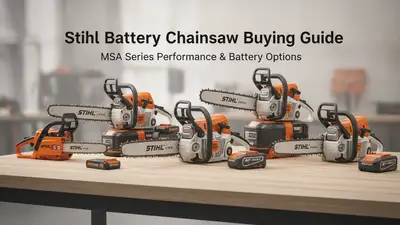
When the answer genuinely splits down the middle, our STIHL battery lineup guide shows exactly what the MSA family does and does not replace.
Common First-Stihl Mistakes and How to Skip Them
Three mistakes show up over and over, and all three are avoidable before the credit card leaves the wallet.
The first is buying an MS 180 for cordwood. That saw cuts firewood beautifully, once it is green softwood in half-cut rounds and you are patient. Ask it to spend a fall on dry oak with a 16-inch bar and it burns out its useful life in one season while its owner buys a bigger saw anyway. If firewood is even half your plan, start at the MS 271.
The second is buying bar length too long. A 20-inch bar on a first saw makes a light saw nose-heavy, slow to sharpen, and more prone to kicks that bite you during learning. Start one size smaller than your ambition and move up when you can name the job that needs the extra teeth.
The third is ignoring the service network. STIHL dealers are the brand’s real advantage, and two dealers can stock the same model with very different service queues. Ask which of your nearby shops does warranty work for STIHL, then buy from that shop even if it costs $30 more, because the first time you need a quick filter and tune before a storm you will understand the premium.
Accessories Worth Budgeting With the Saw
A first saw bought naked is a first saw used unsafely, so count these into the budget at the same time.
- Chaps and a helmet, typically $90 to $200 combined; nobody smarter than you has found a substitute for these.
- A filing kit matched to your chain pitch, typically $25 to $40; the saw sharpens at the lunch table, not the dealer.
- A sealed fuel can and bar oil jug for gas saws, or an extra pack slot for battery saws.
- Safety glasses and a spare chain before a big cleanup day, since storm wood eats loops.
- Work gloves with grip, cheap to replace and kinder to your palms than the bar handle.
None of this is upsell. Chaps and files are why the second season goes the way the first one was supposed to.
Bottom line: most bad first-STIHL purchases are sizing mistakes and dealer mistakes, not model mistakes, which is why this guide spends its space on use case rather than spec sheet worship.
Which STIHL Chainsaw Should You Buy First?
Three honest picks to end the guide, matching the decision rule that opened it.
- Light use in a quiet neighborhood: the MSA 220 C with two AP 300 batteries, or the MSA 140 if your list is pruning only. Our battery lineup guide walks that choice in detail.
- Real firewood, real property, gas side: the MS 271 Farm Boss, with an 18-inch bar, two spare chains and a fuel can that seals. Farm-class value is the sweet spot of the entire STIHL catalog.
- Minimal budget, occasional use: the MS 170 and a sharp 16-inch bar, with the understanding that it is a trimming saw you are borrowing past its comfort zone every time you buck oak.
From there, stack a sharp spare chain, safety glasses, chaps, and a bar oil jug against the saw’s price, and you arrive at the total true cost of a first STIHL, which is what your dealer actually quotes you as the saw-and-supports bundle. When you want to compare this orange wall against the whole market in one place, our best chainsaws of 2026 roundup puts every tier head to head.
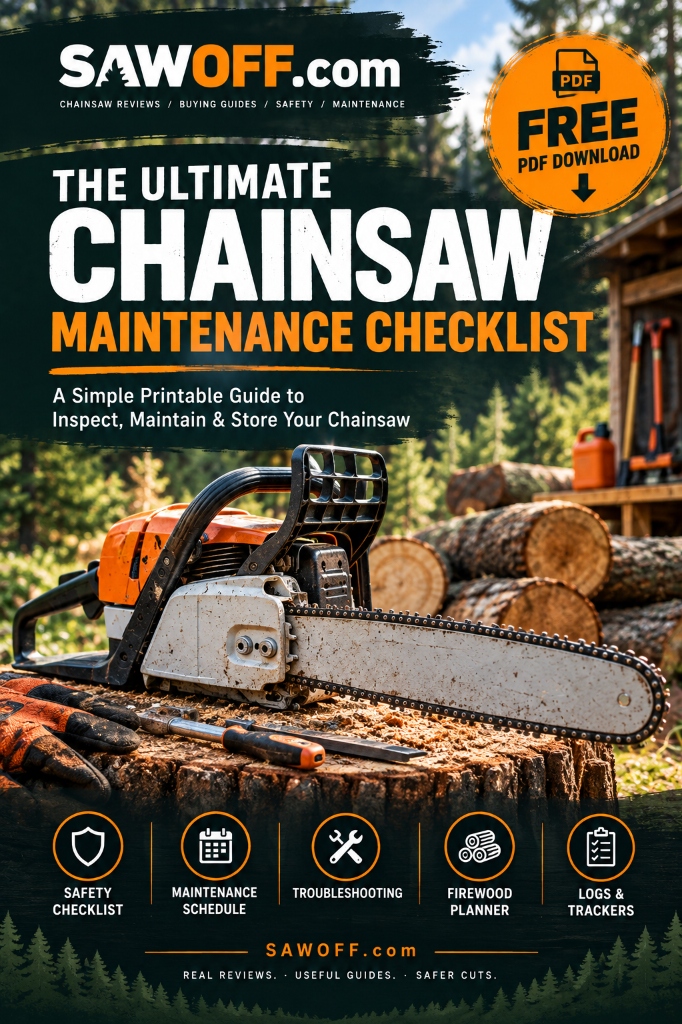
The Ultimate Chainsaw Maintenance Field Toolkit
The complete 96-page printable manual. Avoid costly $400 repairs, master 30°/35°/10° chain sharpening angles, and clear flooded engines in 30 seconds.
- ✓12 In-Depth Modules: Safety checks, service schedules & winterizing
- ✓Chain Sharpening Angles: 30° / 35° / 10° filing charts & raker depth specs
- ✓15 Free Bonus Templates: Angle cheat-sheets, logs & laminated pocket cards
Frequently Asked Questions
What STIHL chainsaw should I buy first?
Match the saw to the wood, not the day. The MS 170 or MS 180 suits pruning and light yard cleanup, the MS 271 Farm Boss handles real firewood and storm work, and the MSA 220 C with two AP 300 batteries covers homeowners who cut in noise-sensitive neighborhoods. Allocating extra budget to a sharp spare chain beats stepping up a size for most first-time buyers.
What do STIHL model numbers mean?
The digits size the engine class while the prefix sorts the fuel and duty type. MS marks a gas model, MSA marks the 36-volt battery line, and the number roughly traces to displacement: 170–291 homeowner, 311–391 farm and 400-series and up professional. Letter suffixes add feature detail; STIHL's letter-and-digit decoder explains every stamp in order.
Is the STIHL MS 170 enough for firewood?
For burning a half cord of softwood or the occasional oak split, it is, and its ~$189 street price is why it outsells everything else in the line. For a multi-cord hardwood habit it frustrates: 30cc-class power and a 16-inch bar ceiling turn an evening into a weekend. The MS 271 is the real firewood floor.
How much does a good STIHL chainsaw cost?
Street prices typically run about $189–$239 for the MS 170 and MS 180 homeowner set, $400-plus for the MS 250, $500–$600 for the farm-class MS 271 and MS 291, and $700 and up once you reach pro models like the MS 261. Battery kits add $200 to $300 of battery and charger on top of the bare saw.
Should a first-time buyer choose a STIHL battery or gas saw?
Choose battery if your cutting is pruning, storm limbs, and stop-and-go cleanup, where the MSA line is quieter, cleaner and easier to maintain. Choose gas if runtime defines the session, such as bucking cords of hardwood each fall. The honest tiebreaker is dealer service for whichever line, since both are built well.