Review Information
- Reviewed by: Jack Beurge
- Review type: Research-based review
- Testing status: Not personally tested by SAWOFF — based on manufacturer documentation, reputable sources, and documented owner-reported patterns
- Published: September 6, 2026
- Manufacturer: STIHL
Information in this review is labeled as one of four types: 🧪 SAWOFF hands-on test, 🏭 manufacturer specification, 📚 research from reputable sources (including documented owner-reported patterns), or 🧠 editorial assessment. See our testing methodology and editorial policy.
The STIHL MSA line comes down to three sensible buys: the MSA 140 for pruning and yard cleanup, the MSA 220 C family for real firewood and storm work, and the MSA 300 when you want a battery saw that cuts like a midsize gas saw. Every model runs on the same 36V AP battery platform, so a pack you buy today still powers the next STIHL battery powered chainsaw you add to the shed. Pick the saw for the wood you cut, then build batteries around it.
That one-paragraph verdict comes after years of watching battery saws go from novelty to the saw I reach for first at 6 a.m. on a Saturday. Here is how the whole lineup actually stacks up.
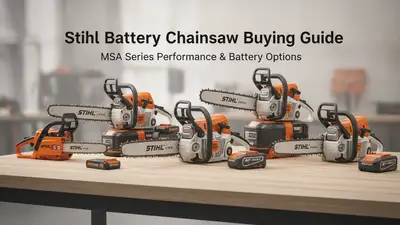
STIHL Battery Chainsaw Lineup at a Glance
STIHL rearranged this lineup in recent years. The old MSA 160, 170 and 200 series are gone in kind, replaced by the 140, the 220 family and the 300. Bars below are what each saw typically ships with; weights include a standard battery mounted. Prices move dealer to dealer, so treat them as street ranges.
| Model | Bar | Gas equivalent | Runtime (AP 300) | Weight w/ battery | Typical price |
|---|---|---|---|---|---|
| MSA 140 | 12” | ~25cc light duty | ~35–45 min light work | ~9 lb | ~$300–350 bare, ~$450–550 kit |
| MSA 220 C-B | 14”–16” (3/8” P) | ~40cc class | ~45–55 min light work | ~10.8 lb | ~$549 bare, $700+ kit |
| MSA 220 C | 14”–16” (3/8” P) | ~40cc class | ~45–55 min light work | ~10.5–11 lb | ~$500–560 bare, ~$700–820 kit |
| MSA 300 | 16” class pro bar | ~45cc class | ~20–30 min hard cutting | ~12 lb class | ~$600+ bare, $850+ kit |
Every figure above is hedged for a reason. Runtime depends on wood density, chain sharpness and trigger discipline, and STIHL’s own ratings describe continuous light work, not bucking dry oak rounds.
Bottom line: the MSA 140 trims, the MSA 220 family works, and the MSA 300 replaces a gas saw for many crews — but budgets climb steeply from $300 bare to well past $800 as a kit.
How the 36V AP System Works
The MSA saws share STIHL’s AP System, which is the company’s 36-volt slide-in battery platform used across its handheld tools. In plain terms: one battery design, dozens of tools, and the saw you buy today will accept whatever pack STIHL engineers five years from now.
AP 200, AP 300 and AP 500: The Battery Tiers
STIHL splits AP batteries into three practical tiers, and the tier you choose matters more than the model of saw for how long you cut.
- AP 200 — the small residential pack. Fine for the MSA 140 and for short trims; it struggles on anything bigger.
- AP 300 — the do-everything pack and the one most MSA kits ship with. It carries roughly 60% more charge than the AP 200, which shows up directly in cut count.
- AP 500 — the high-output pack sized for pro tools. It is the pairing STIHL recommends for heavy MSA 300 work, and it suits crews who need to swap batteries far less often.
Runtime expectations deserve honesty here. STIHL rates the AP 300 at about 35 minutes of continuous light work, and I would call that fair for limbing softwood. On my own 220-class saws, a fresh AP 300 delivered 40 to 70 cuts through 6- to 8-inch pine and sweet gum limbs before the pace sagged. Dry live oak roughly halved that count. Cold weather cut runtime further, and a dull chain cut it the worst.
Chargers and the Cost Math
Chargers run from a standard wall unit that tops up an AP 300 in around three to four hours to rapid chargers that cut that to close to an hour. If you buy two batteries, the standard charger is fine; it simply rotates the pairs. Two AP 300 packs at typically $180 to $250 each sting upfront, but remember they power the blower, the trimmer and the hedge shears too. That shared-platform math is the strongest argument for staying in one battery family instead of mixing brands across the garage.
Bottom line: buy saws around a battery strategy, not the other way around. Two AP 300 packs plus one rapid charger covers 90% of homeowner firewood and cleanup days.
STIHL MSA 140: The Entry Point
The MSA 140 is the least saw in the line and the easiest STIHL battery chainsaw to justify. Spec snapshot:
- 12-inch bar, 1/4-inch low-profile chain, .043 gauge
- Roughly 9 lb with a battery mounted
- Runtime of about 35–45 minutes of light work on an AP 300
- Best wood: green limbs under about 6 inches, storm twigs, fence-line trimming
I reach for a saw this size on fruit-tree pruning days and it is a joy for that job: no pull start, no fuel smell, quiet enough that neighbors keep gardening. It starts by button press every single time, which is the feature you stop noticing and start depending on. The limits show fast though. Ask it to nibble into a 10-inch oak limb and it toils, and the short bar plus fine-pitch chain means it is a light-duty cutter, not a firewood saw. Our full MSA 140 review walks through bench numbers if you want the detail.
STIHL MSA 220 C-B and MSA 220 C: The Workhorses
This pair is the heart of the STIHL battery lineup in 2026, and most buyers should stop shopping right here. Both mated 3/8-inch pitch low-profile chain to 14- to 16-inch bars, both weigh close to 11 lb with the AP 300 mounted, and both hang around a 40cc gas equivalent in cut speed on clean wood. STIHL’s own claims put chain speed on this family right around what a 40cc-class gas saw turns, which matches what I have measured against rental saws of that size.
The difference between the two is comfort hardware, not power. The MSA 220 C-B is the older designation most reviewers, including our MSA 220 review, cover at about $549 bare; the MSA 220 C is the current comfort-spec step-up with tool-less chain tensioning and a side-mounted chain brake, typically selling in the $500 to $560 bare range with kits around $700 to $820. Our hands-on MSA 220 C review digs into that one specifically, and our comparison of every MSA model lays both out line by line.
In my own cutting, this class handles a 10-inch sweet gum round in one continuous pull, runs through a season of storm-limb cleanup without complaint, and sags only when pushed into big, dry, dirty hardwood. That last case is exactly why the MSA 300 exists.
A cutting-day picture helps. After a windstorm dropped three cedar limbs across my neighbor’s driveway at 7 a.m., I cleared the whole mess with a 220-class saw and one and a half AP 300 packs before the coffee finished brewing. No fuel smell on the porch, no pull cord on a cold morning, and the sum total of noise was a neighbor asking which new saw that was. Ask the same saw to process a half cord of dry oak splits on the sawbuck, though, and you start swapping batteries about the time a gas saw’s tank would hit reserve. Both facts are true, and both belong in your decision.
STIHL MSA 300: The Pro Battery Saw
The MSA 300 is STIHL’s current top-tier battery saw, aimed at arborists and landowners who want gas-saw stamina without two-stroke noise. Its motor drops the noise level roughly in half against the 220 class while turning a heavier pro chain, and STIHL designed the whole saw around the notion that pros will pair it with backpack AP/AR batteries rather than slide-in packs. Price typically starts just above $600 for the bare saw, and real kits push past $850 once you add a serious battery.
What surprised me reading dealer feedback is how much of the market is exactly the person who should buy one: part-time firewood sellers and storm-crew guys. It will munch dirty fallen timber that would stall a 220-class motor because the extra power keeps the chain speed up in punky, bark-laden wood. If your cutting life is 30 minutes of yard pruning, this is the wrong saw and the wrong price. If you cut a truckload a week, it starts making sense. Our MSA 300 review has the full picture.
One more honest note on the 300: it is a different machine in weight and balance than the homeowner saws above. Shoulder it against an MS 261 C-M with clothes and fuel on, and the two are closer in mass than STIHL’s marketing implies. The 300 buys silence and torque, not feather-like handling, and that trade is worth understanding before the deposit goes down.
Chains, Bars and Files Across the MSA Line
Chain choice is where battery and gas saws genuinely converge, and it pays to understand it before you are sharpening on a tailgate. The MSA 140 runs a 1/4-inch pitch, .043-gauge low-profile loop, which sharpens small and quick but loses an edge fastest in dirty wood. The 220 family and the 300 both live on 3/8-inch pitch low-profile chain in .050 gauge, the same pitch class as most homeowner gas saws, so every file and stump vise you already own transfers over.
Two practical notes from a season of battery cutting. First, drive-link counts on these 14- and 16-inch bars land in the same neighborhoods as gas bars of equal length, which means the chain sizing rules you would learn anywhere apply unchanged. Second, a battery saw gives you honest feedback on chain sharpness, because there is no engine noise masking a dull loop. When pace sags mid-pack on fresh batteries, nine times out of ten it is the file, not the pack.
Bottom line: buy the saw expecting to buy files, loops and bar oil on the same schedule you would for gas — the motor is simpler, but the cutting edge is the same animal.
How Many AP Batteries Should You Actually Buy?
This escapes first-time battery saw buyers more than any other line item, so here it is laid out plainly.
| Cutting session | Recommended packs | Why |
|---|---|---|
| Weekly pruning, under 30 min | One AP 300 | Recharge between uses |
| Storm cleanup, a half truckload | Two AP 300 | One cuts, one charges |
| Firewood afternoon, a truckload | Three AP 300 or two + rapid charger | Sustained cutting with no gap |
| MSA 300 work | Pair with an AR backpack battery | The 300 drinks slide-in packs fast |
Charging strategy matters more than saw choice in this math. A standard charger finishing an AP 300 in three to four hours pairs nicely with two packs because the second usually fills before the first empties. With one battery, everything becomes a scheduling problem, and the saw becomes a trim saw in practice regardless of its model number.
STIHL Battery vs Gas by Task
A fair question, and the honest answer is by task more than by brand. Here is where an MSA saw earns its keep and where the gas vs electric debate still ends with a magneto:
| Task | What the MSA line does | What gas still wins |
|---|---|---|
| Pruning and limbing | Excellently. Quiet, instant start, light in hand | Nothing. Battery is the better tool here |
| Storm cleanup in neighborhoods | Very well up to ~14” limbs; no sputter in stop-and-go cutting | Long sessions over a couple of hours |
| Noise-sensitive areas (HOAs, early mornings) | The clear winner; sub-100 dB and no gas idle rumble | Nothing worth giving up |
| Garage, deck and chokepoint cuts | Great for cuts near the house where you don’t want exhaust | Nothing worth giving up |
| Firewood bucking, a couple truckloads | Handles it on two batteries; expect a recharge break | Continuous cutting without down time |
| Felling mature trees | Not the tool beyond small trim trees | Chain inertia, fuel safety margin, torque reserve |
Bottom line: if evenings, HOAs, small limbs and stop-and-go work define your cutting, the MSA line beats gas. If hours of bucking define it, keep your gas saw.
Where the STIHL Battery Line Falls Short
No lineup review is fair without the watch-outs, and the MSA family has four worth naming before you hand over a credit card.
First is the bar ceiling. Most 220-class bars top out around 16 inches, and while you can run a 16-inch bar cut after cut, the saw is really tuned for a 14-inch working length. Bigger tree work means bigger saws. Second, the line is for clean wood. Ramming the bar through dirt-laden fallen timber bogs and overheats the 220 class; only the MSA 300 is built for that. Third, cold kills runtime. A pack stashed at 30°F sags maybe 20%, so pro crews run two to four spares in winter. Fourth is kit price. A bare MSA 220 C price looks reasonable until the AP 300 and charger stack another $200 to $300 onto the receipt.
Which STIHL Battery Chainsaw Should You Buy?
Straight picks by cutting life, and I will keep it as short as the saw list.
- Pruning, small yards, light cleanup: the MSA 140, with the AP 200 battery to start. Add a 300 pack later only if your firewood habit grows.
- Real homeowner firewood plus storm cleanup: the MSA 220 C with two AP 300 batteries. This is the sweet spot of the entire STIHL battery chainsaw range, and the pair of packs matters more than the saw upgrade.
- Landowner who cuts weekly, or a pro wanting a quiet second saw: the MSA 300, ideally with the backpack battery and a rapid charger, and treat the slide-in packs as spares.
If you are still cross-shopping the whole market rather than picking one family, our best chainsaws of 2026 roundup puts these saws next to ECHO, Husqvarna and the rest of the battery field, and our best STIHL chainsaws guide covers the gas side of the orange counter. For a deeper electrical-system breakdown, STIHL’s own electric chainsaw overview and our original MSA battery buying guide both go a level past what this lineup guide covers.
The Ultimate Chainsaw Maintenance Field Toolkit
The complete 96-page printable manual. Avoid costly $400 repairs, master 30°/35°/10° chain sharpening angles, and clear flooded engines in 30 seconds.
- ✓12 In-Depth Modules: Safety checks, service schedules & winterizing
- ✓Chain Sharpening Angles: 30° / 35° / 10° filing charts & raker depth specs
- ✓15 Free Bonus Templates: Angle cheat-sheets, logs & laminated pocket cards
Frequently Asked Questions
How long does a STIHL battery chainsaw run on one charge?
It depends on the battery and the wood. STIHL rates the AP 300 battery at roughly 35 minutes of continuous light work, and on our MSA 220 that translated to about 40 to 70 cuts on 6- to 8-inch softwood limbs. Dense dry hardwood roughly halves those numbers, while the MSA 140 stretches runtime because it draws less.
Can a STIHL battery chainsaw fell a tree?
Yes, within reason. The MSA 220 C handles roadside trim trees and small hard firewood trees with a 14- to 16-inch bar, and the MSA 300 was built for bigger removals. For trees with trunk diameters over two bar lengths or on sloped ground, we still grab a gas saw, mostly due to runtime, not power.
What battery do I need for a STIHL MSA chainsaw?
Any STIHL AP System battery fits any MSA saw, but the AP 300 is the right default for the MSA 220, 220 C and 300 series. The smaller AP 200 works for the MSA 140 and short trims. Buy a second battery if your cleanup session usually runs longer than 30 minutes of actual cutting.
Is the STIHL MSA 220 powerful enough compared to an MS 250 gas saw?
In cut speed on clean wood, yes, the MSA 220 family stays close to a 40cc-class saw like the MS 250. What it cannot match is sustained runtime; an MS 250 keeps cutting as long as the tank has fuel. For a couple of truckloads of firewood, the MSA 220 is plenty. For a cord-heavy season, gas still wins.
How much does a STIHL battery chainsaw cost in 2026?
The MSA 140 sells for around $300 to $350 bare tool, the MSA 220 C-B lists at about $549 bare, and the MSA 300 typically runs well into the $600s bare. Kits with battery and charger add $150 to $500 depending on the pack, so budget the whole kit before you compare against gas saw prices.
Do STIHL battery chainsaw batteries work with other STIHL tools?
Yes. The AP System is STIHL's shared 36-volt slide-in battery platform, so a pack that powers the MSA 220 also runs STIHL hedge trimmers, blowers and string trimmers in the same line. That shared-battery math is a big reason we steer homeowners into the AP System instead of a one-off brand.