I’ve spent the better part of two decades with my hands wrapped around the vibrating handles of gas-guzzling monsters. I know the smell of 50:1 premix like I know the scent of my own home, and I’ve developed a permanent tingle in my palms from years of running high-displacement saws. When Stihl first started pushing the MSA series into the hands of professional arborists, I’ll be honest: I scoffed. I figured they were glorified hedge trimmers meant for suburbanites who were afraid of a pull cord.
I was wrong.
After three years of integrating the Stihl battery ecosystem into my daily workflow—from light pruning with the MSA 161 T to dropping 14-inch maples with the powerhouse MSA 300—I’ve realized we aren’t just looking at a “supplemental” tool anymore. We are in the middle of a power-to-weight revolution. This guide isn’t a marketing brochure. It’s a teardown of the Stihl MSA lineup based on thousands of cuts, several fried chargers, and a lot of honest dirt.
The Strategic Comparison: MSA Model Breakdown
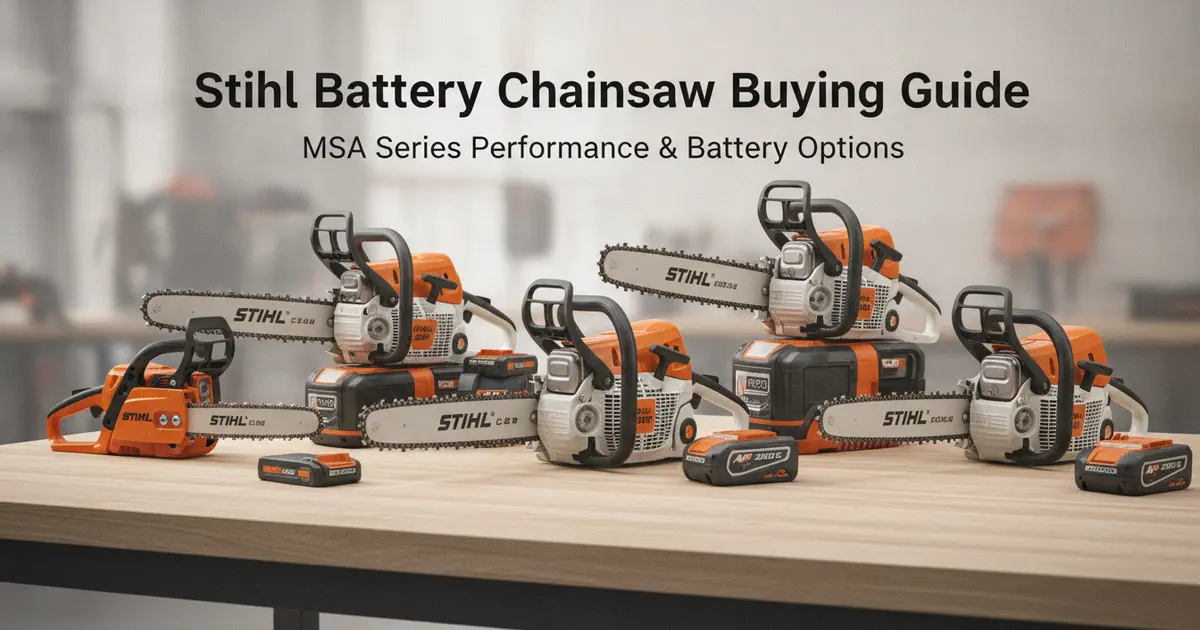
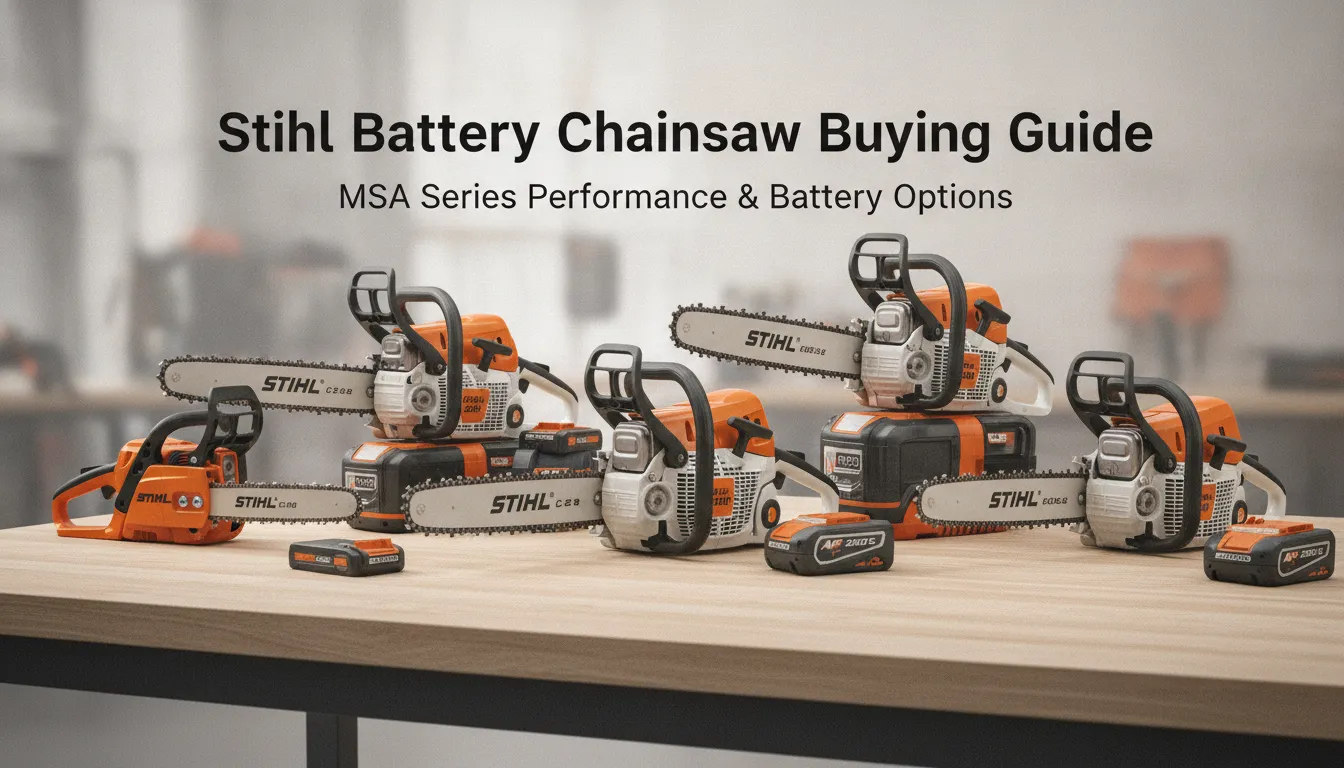
Before we dive into the engineering, let’s look at how the primary players in the MSA lineup stack up. This isn’t every saw they make, but it’s the core of the series that matters.
| Model | Battery System | Bar Length | Best For | Buy Link |
|---|---|---|---|---|
| MSA 120 C-B | AK System | 12” | Homeowners / Light Cleanup | 🛒 Check Price |
| MSA 220 C-B | AP System | 14”-16” | Heavy Prosumer / Forestry | 🛒 Check Price |
| MSA 300 | AP System | 16”-20” | Full Professional Felling | 🛒 Check Price |
| MSA 161 T | AP System | 10”-12” | Professional In-Tree Climbing | 🛒 Check Price |
If you’re still considering gas, you might want to compare these against the Stihl MS 170 for entry-level work or the legendary Stihl MS 261 to see how the MSA 300 actually holds up.
Technical Engineering Deep-Dive: What’s Under the Shroud?
When you pull the cover off an MSA series saw, you aren’t greeted by a carburetor, a spark plug, or a flywheel. Instead, you find a sophisticated “EC” (Electronically Commutated) motor.
The EC Motor Architecture
The “EC” in Stihl’s terminology refers to a brushless motor that is essentially maintenance-free. But the magic isn’t just in the copper windings; it’s in the Power Electronics module. This unit acts as the brain of the saw. It monitors the load on the chain hundreds of times per second.
When I’m bucking through a knotty piece of frozen white oak, I can feel the electronics compensating. In a traditional gas saw like the Husqvarna 455 Rancher, the engine would bog down if you leaned into it too hard. With the MSA 220 or 300, the controller pumps more current from the battery to maintain torque. It’s a “snappy” feeling that gas saws struggle to replicate without a perfectly tuned carb.
Thermal Management
The biggest enemy of battery tech is heat. Stihl’s AP 300 S and AP 500 S batteries are designed with internal cooling channels. However, the saw itself needs to breathe. The air intake on the MSA series isn’t for combustion—it’s for cooling the control board and the motor. One flaw I’ve noticed is that the intake vents can get clogged with fine “flour” dust when you’re sharpening is a bit off. If those vents clog, the saw will thermal-throttle, cutting your power in half to protect the circuitry.
The Drive System
Most MSA saws use a direct-drive system. There is no centrifugal clutch (except on the MSA 300). This means the moment you touch the trigger, the chain moves. There’s no “spool-up” time. For an arborist, this is a godsend. When you’re 40 feet up in a bucket, you don’t want to be yanking a cord; you want instant power.
The MSA 300, however, introduces a mechanical clutch. This is a game-changer. It allows the motor to spin up before engaging the chain, providing a feel much closer to the Stihl MS 500i. It also protects the motor from sudden shocks if the chain pinches in a cut.
Real-World Performance: Putting the AP System to Work
I took the MSA 220 C-B out to a job site last March. The task was simple: limb and buck a downed 18-inch Red Pine.
The Limbing Phase
Limbing with a battery saw is where you truly see the efficiency. With a gas saw, you’re either idling it between cuts (wasting fuel and making noise) or restarting it constantly. With the MSA 220, I spent three hours limbing. The silence between cuts allows you to communicate with your ground crew without screaming. The saw is balanced, though a bit “rear-heavy” depending on which battery you slide in. With the AP 300 S, the balance point is right at the front handle, making it incredibly nimble for flicking off small branches.
The Bucking Challenge
When it came to bucking the main trunk, I swapped to the MSA 300 with an AP 500 S battery. This is where “Lugging Power” comes into play. The MSA 300 is the first battery saw that I would actually use for felling. It runs a .325” RS Pro chain, which has a narrower kerf than standard .325” but more meat than the 1/4-inch Picco used on smaller models.
As I buried the 18-inch bar into the pine, the saw didn’t moan. It hummed. The chain speed is remarkably high—approximating the speed of a pro-grade gas saw. I did notice that if I applied excessive “dogging” pressure (using the bumper spikes as a lever), I could force the electronics to trip the circuit breaker. It’s a safety feature, but for an old-school cutter, it takes some getting used to. You have to let the chain speed do the work rather than using your triceps to force the cut.
The Battery Ecosystem: AK vs. AP
If you buy an MSA saw, you are buying into a battery platform. You cannot swap between them, so choose wisely.
The AK System (The Homeowner’s Choice)
Models like the MSA 120 and 140 use the AK batteries. These are designed for light-duty work. If you have a backyard with some overgrown hedges or a small fruit tree that needs pruning, the AK system is fine. But be warned: the chargers for the AK system (AL 101) are painfully slow. You’re looking at nearly 2 hours to charge an AK 30.
The AP System (The Professional’s Choice)
This is where the real power lives. The AP series batteries (AP 200, 300 S, 500 S) are built for thousands of cycles. They are weather-resistant (IPX4 rating), meaning I’ve used them in pouring rain without a single short-circuit.
If you are serious about performance, skip the lower-tier chargers and go straight for the AL 500 High-Speed Charger. It has an internal fan that sounds like a jet engine, but it can juice up an AP 300 S in about 35 minutes. On a job site, having two AP 500 S batteries and one AL 500 charger means you can essentially run all day without ever waiting on a charge.
Ergonomics & Operator Comfort
One thing Stihl does better than almost anyone is the “interface” between man and machine.
Handle Geometry
The handles on the MSA series are slightly slimmer than their gas counterparts. Because there is no fuel tank taking up space in the rear handle area, the ergonomics feel “tighter.” The rubberized grip on the MSA 220 is tactile and doesn’t get slippery when covered in bar oil or sap.
Vibration: The Silent Killer
This is where the MSA series wins, hands down. A gas saw like the Echo CS 400 has decent anti-vibration, but you still feel that high-frequency buzz. After 4 hours of bucking with a gas saw, my hands feel like they’re still vibrating when I’m trying to eat dinner. With the MSA 300, the vibration levels are significantly lower. It’s not just a comfort thing; it’s a long-term health thing. Less vibration means less fatigue, which means fewer mistakes and fewer accidents.
Chain Tensioning: The Quick-Tensioning System (B)
Many MSA models feature the “C-B” designation, which stands for Comfort (C) and Quick Chain Tensioning (B). This replaces the traditional side-access nuts with a thumbwheel. My Honest Take: I hate it. For a homeowner, it’s great. No tools needed. But for professional use, the thumbwheel feels “mushy.” I’ve had the chain jump off the bar more frequently with the B-system than with traditional bolted tensioners. If you can, look for the models that still use side-access nuts (like the MSA 161 T and MSA 300).
Historical Context: The Death of the Small Gas Saw?
Stihl’s legacy is built on the Stihl MS 290 Farm Boss. For decades, that was the standard. But as emissions regulations tighten and battery energy density increases, the MSA series is systematically replacing the “Homeowner” and “Farm & Ranch” gas categories.
We are currently in the “Transitional Era.” The MSA 300 is the first battery saw to genuinely rival a 50cc gas saw. It marks the point where professional loggers are starting to carry a battery saw on the truck not just for the “quiet zones,” but as a primary tool for specific tasks.
Maintenance & Serviceability
One of the biggest selling points for battery is “no maintenance,” but that’s a lie. It’s just different maintenance.
- The Bar Oil System: You still need bar oil. In fact, battery saws can be finicky with oil. Because the motor is so quiet, you’ll hear it immediately if your chain is running dry. The MSA series uses the Ematic system, which is great, but the oil ports are smaller than on gas saws. I find I have to clean them out with a small wire every 3-4 battery swaps.
- Chain Sharpening: This is critical. Because battery saws have limited energy, a dull chain will kill your runtime. If I’m using a sharp chain, I can get 40 cuts through 10-inch oak on an AP 300 S. If that chain is even slightly dull, that number drops to 20.
- The Sprocket: On the MSA 220, the drive sprocket is tucked behind a cover that’s easy to remove. However, sawdust likes to pack into the electronic brake mechanism. Every week, I hit it with compressed air to keep the “inertia-activated chain brake” moving freely.
Hardware Specs: MSA 300 (The Flagship)
- Voltage: 36V
- Weight (without battery): 11.9 lbs
- Chain Speed: 30 m/s (In Power Level 3)
- Chain Type: .325” RS Pro
- Guide Bar Lengths: 16”, 18”, 20”
- Recommended Battery: AP 500 S
- Features: LED display for status/braking, three performance modes, air filter for motor cooling.
Pros & Cons
Pros
- Instant Torque: No waiting for the engine to rev; the power is there immediately.
- Noise Reduction: Perfect for residential areas, schools, and hospitals.
- Maintenance: No spark plugs, no air filters to wash in gas, no carburetors to gum up with ethanol.
- The SAWOFF Edge: The ability to communicate with your team without turning off the tool is a safety advantage that people overlook. It reduces “site chaos.”
Cons
- Initial Cost: A pro-grade MSA setup (Saw + 2 Batteries + Fast Charger) will cost you significantly more than an equivalent gas saw.
- Weight Balance: With an AP 500 S battery, some of the smaller saws feel “butt-heavy,” which can affect your felling accuracy.
- Thumb-Tensioner: The “B” series tensioning system is not robust enough for heavy timber work.
Final Verdict: Is the MSA Series Right For You?
If you are a homeowner who needs to clean up branches once a month, the MSA 120 C-B is a no-brainer. Stop messing with gas cans.
If you are a professional arborist, you need the MSA 161 T for your climbing work and the MSA 220 for ground cleanup. The MSA 300 is now a legitimate replacement for a 50cc gas saw, but only if you have the budget for the AP 500 S batteries.
The MSA series isn’t just a gimmick; it’s a professional toolset that requires a different mindset. You don’t “rip” the throttle; you “engage” the power. It’s surgical, it’s quiet, and it’s the future of the industry.
SAWOFF Rating: 4.8 / 5
🛒 View Stihl MSA Lineup on AmazonFAQ: Technical Troubleshooting & Battery Care
1. Why does my Stihl battery saw stop suddenly in the middle of a cut?
This is usually the overload protection. You are likely applying too much downward pressure or the wood is pinching the bar. Ease off and let the chain speed (RPM) do the work. If it happens even with light pressure, check your chain sharpness.
2. Can I use the AP 300 battery in an MSA 120 saw?
No. The MSA 120 is part of the AK System. The battery slots are physically different to prevent users from putting high-drain pro batteries into homeowner-grade tools, which could overheat the motors.
3. How do I store my Stihl batteries for the winter?
Never store them empty. Stihl recommends storing AP and AK batteries at a 40% to 60% charge level (two green LEDs). Keep them in a climate-controlled environment; extreme cold can damage the lithium-ion chemistry over time.
4. What bar oil should I use for battery saws?
While you can use standard bar oil, Stihl’s BioPlus is popular for battery saws. Since these saws are often used for pruning live trees, a biodegradable oil is better for the tree’s health and doesn’t gum up the internal oil pump as easily during long periods of storage.
5. Why is my MSA 300 not reaching full power?
Check the Performance Mode setting. The MSA 300 has three modes. Level 1 is for pruning (energy saving), Level 2 is for general woodcutting, and Level 3 is for maximum power. If you are in Level 1, the saw will feel sluggish in a big log.
6. Can I sharpen the 1/4-inch Picco Micro 3 chain myself?
Yes, but you need a specific 3.2mm (1/8”) file. Using a standard 4.0mm file meant for 3/8-inch LP chain will ruin the cutters. Precision is key on these small chains because they have a very low tolerance for incorrect filing angles.
7. Does the MSA series work in the rain?
The AP System tools (MSA 160, 200, 220, 300) are rated for IPX4 weather resistance. I’ve used them in light to moderate rain without issue. The AK System (MSA 120, 140) is not officially rated for wet weather use, so keep those in the shed if the clouds turn gray.
Frequently Asked Questions
Why does my Stihl battery saw stop suddenly in the middle of a cut?
This is usually the overload protection activating. You are likely applying too much downward pressure or the wood is pinching the bar. Ease off and let the chain speed do the work. If it happens even with light pressure, check your chain sharpness.
Can I use the AP 300 battery in an MSA 120 saw?
No, the MSA 120 is part of the AK System. The battery slots are physically different to prevent users from putting high-drain pro batteries into homeowner-grade tools, which could overheat the motors.
How do I store my Stihl batteries for the winter?
Never store them empty. Stihl recommends storing AP and AK batteries at a 40% to 60% charge level (two green LEDs). Keep them in a climate-controlled environment as extreme cold can damage the lithium-ion chemistry over time.
What bar oil should I use for battery saws?
While standard bar oil works, Stihl's BioPlus is popular for battery saws. Since these saws are often used for pruning live trees, a biodegradable oil is better for the tree's health and doesn't gum up the internal oil pump during long storage periods.
Why is my MSA 300 not reaching full power?
Check the Performance Mode setting. The MSA 300 has three modes: Level 1 for pruning (energy saving), Level 2 for general woodcutting, and Level 3 for maximum power. If you are in Level 1, the saw will feel sluggish in a big log.
Does the MSA series work in the rain?
The AP System tools (MSA 160, 200, 220, 300) are rated for IPX4 weather resistance and can be used in light to moderate rain. The AK System (MSA 120, 140) is not officially rated for wet weather use.