Review Information
- Reviewed by: Jack Beurge
- Review type: Research-based review
- Testing status: Not personally tested by SAWOFF — based on manufacturer documentation, reputable sources, and documented owner-reported patterns
- Published: July 28, 2026
Information in this review is labeled as one of four types: 🧪 SAWOFF hands-on test, 🏭 manufacturer specification, 📚 research from reputable sources (including documented owner-reported patterns), or 🧠 editorial assessment. See our testing methodology and editorial policy.
Introduction
From the old-school grunt of the 044 to the high-tech, fuel-injected scream of the MS 500i, one thing holds true across the lineup: Stihl doesn’t just name their saws; they code them.
To the uninitiated, walking into a dealership and seeing rows of orange and white units labeled “MS 261 C-M” or “MSA 220 C-B” looks like a bowl of alphanumeric soup. But for those of us who make a living in the canopy or on the log pile, those letters are a shorthand for engine architecture, weight distribution, and lugging power. If you don’t know your “M” from your “E,” you might end up with a saw that’s either too weak for the oak you’re bucking or too complex for the casual maintenance you’re prepared to do.
In this deep-dive, we aren’t just skimming the surface. We’re tearing down the Stihl nomenclature system to the crankcase. Whether you’re a prosumer looking for that perfect balance of power and weight, or a weekend warrior trying to understand why your neighbor’s saw has more “snap,” this guide is your Rosetta Stone.
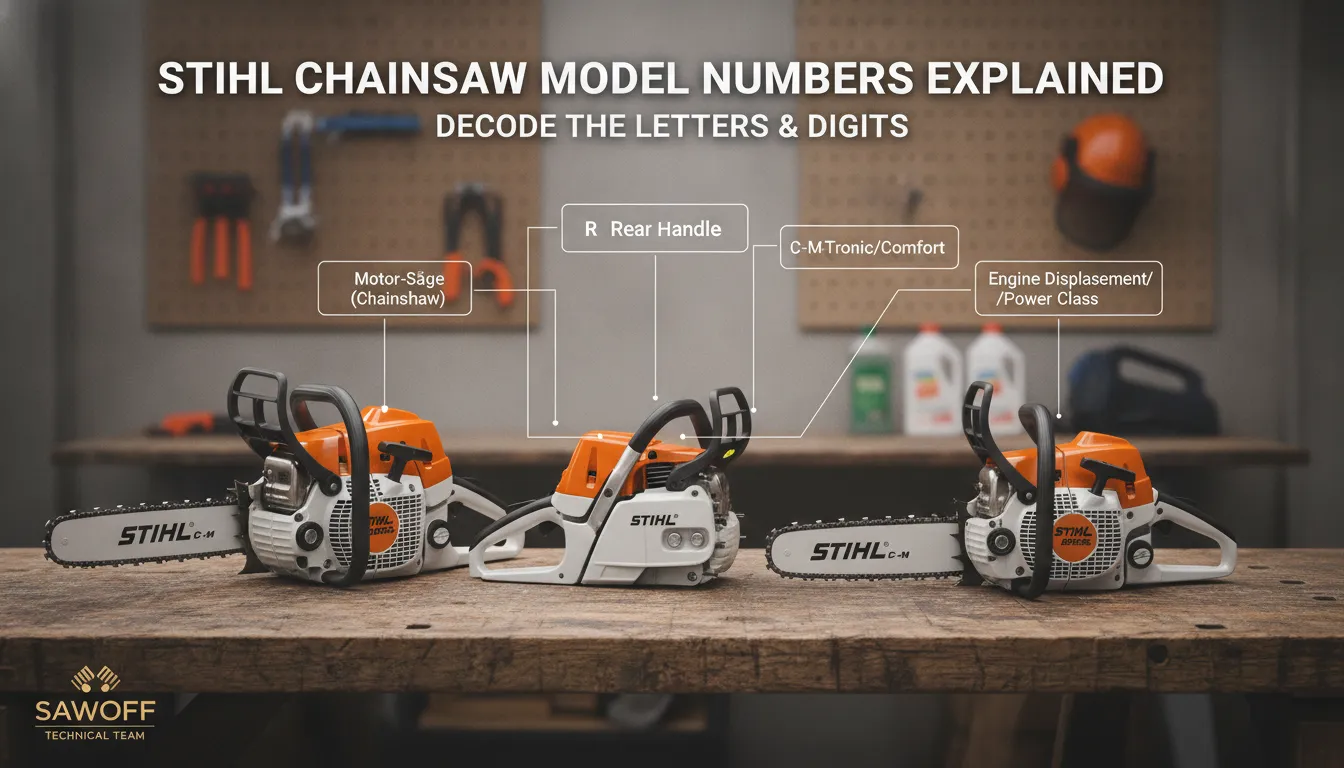
Strategic Comparison: Navigating the Stihl Tiers
Before we dissect the digits, let’s look at how these models stack up across different user categories. This isn’t just about displacement; it’s about the engineering philosophy behind the plastic.
| Model | Classification | Key Feature | Best For | Link |
|---|---|---|---|---|
| Stihl MS 170 | Homeowner | Lightweight / 30.1cc | Light Pruning | View Review |
| Stihl MS 271 Farm Boss | Mid-Range | High Torque / 50.2cc | Firewood & Fencing | View Review |
| Stihl MS 261 C-M | Professional | M-Tronic / Mag Crankcase | Daily Arborist Work | View Review |
| Stihl MS 500i | Professional | Fuel Injection | Heavy Timber / Milling | View Review |
Technical Engineering Deep-Dive: What’s Under the Hood?
When I talk about Stihl engineering, I’m talking about a legacy of stratified scavenging and obsessive weight management. Let’s break down the core components that differentiate a “homeowner” saw from a “professional” beast.
The Heart: 2-MIX vs. 4-MIX Technology
Stihl’s 2-MIX engine is the gold standard for their gasoline saws. Unlike a traditional two-stroke that lets unburnt fuel escape through the exhaust port, the 2-MIX system uses a layer of fuel-free air to push out the exhaust gases. This results in up to 20% less fuel consumption and a massive 70% reduction in emissions. When I’m bucking a 20-inch hickory log, I can feel that extra “grunt” because the scavenging process is more efficient, keeping the torque curve flatter for longer.
The Brain: M-Tronic (The “M” Suffix)
The “M” in a model like the MS 362 C-M stands for M-Tronic. This is a fully electronic engine management system. It automatically adjusts the ignition timing and fuel metering in all operating modes. Think of it as a tiny computer that constantly reads the temperature, altitude, and fuel quality. In the old days, I’d have to pull out a screwdriver to tune my carb when moving from the valley to the ridge. With M-Tronic, the saw does it for me in microseconds. You can feel the difference in the “snap”—the throttle response is instantaneous, regardless of whether you just cold-started it or have been running it for four hours straight.
The Chassis: Magnesium vs. Polymer
This is where the model numbers often hide the biggest secret. Pro-grade saws (like the MS 261 and above) use magnesium alloy crankcases. These are designed to withstand the heat and mechanical stress of 8-hour workdays. They are also lighter than the high-tech polymers used in the homeowner series (like the MS 180). While the polymer is incredibly durable for occasional use, the magnesium chassis allows for better heat dissipation and higher RPM ceilings. When you’re bore-cutting a leaning maple, that chassis rigidity is what prevents the bar from wandering.
Filtration: The HD2 System
If you see a saw with a high-end air filtration system, you’re likely looking at a professional model. The HD2 filter, made of polyethylene filter material, has pores that are up to 70% finer than fabric or foam filters. It’s also water and oil-repellent. I’ve run an MS 462 through dry, dusty pine all day, and the intake was still spotless by quitting time. This long-term reliability is baked into the “Pro” designation within the model numbering.
Decoding the Prefix: MS, MSA, and MSE
The first part of the code tells you the power source. This is the simplest part of the puzzle, but it’s critical for setting expectations.
- MS (Motorsäge): This is the German word for “Motor Saw” (Chainsaw). These are your classic gasoline-powered units.
- MSA: The “A” stands for Akku (Battery). These run on Stihl’s AP or AK battery systems. Don’t sleep on these—the Stihl MSA 220 has enough torque to surprise most gas-purists.
- MSE: The “E” stands for Elektrisch (Electric). These are corded saws, perfect for indoor woodshops or carving where noise and fumes are a “no-go.”
Decoding the Digits: Performance and Generation
The numbers following the prefix (e.g., 170, 261, 881) are the most misunderstood part of the Stihl branding. Here is the insider logic:
The Displacement/Power Bracket
Generally, the first one or two digits tell you the size of the saw.
- 100s (e.g., MS 170, MS 180): Small, entry-level saws for limb work and light yard cleanup.
- 200s (e.g., MS 250, MS 271, MS 291): The “Farm and Ranch” or “Mid-Range” saws. These are the versatile workhorses for people with acreage.
- 300s to 800s: These are professional saws. As the numbers go up, so does the displacement (cc) and the bar length capability. An MS 500i is a massive step up in “lugging power” compared to an MS 362.
The History of the “0”
You’ll notice older saws were labeled 026, 044, or 066. In the early 2000s, Stihl flipped the “0” to the end (e.g., 026 became MS 260). The current generation often ends in a “1” (e.g., MS 261), signaling a more modern engine with better emissions and power-to-weight ratios.
🛒 Shop Professional Stihl AccessoriesDecoding the Suffixes: The Secret Sauce
This is where most buyers get tripped up. The letters following the numbers describe the specific “add-ons” or features of that specific unit.
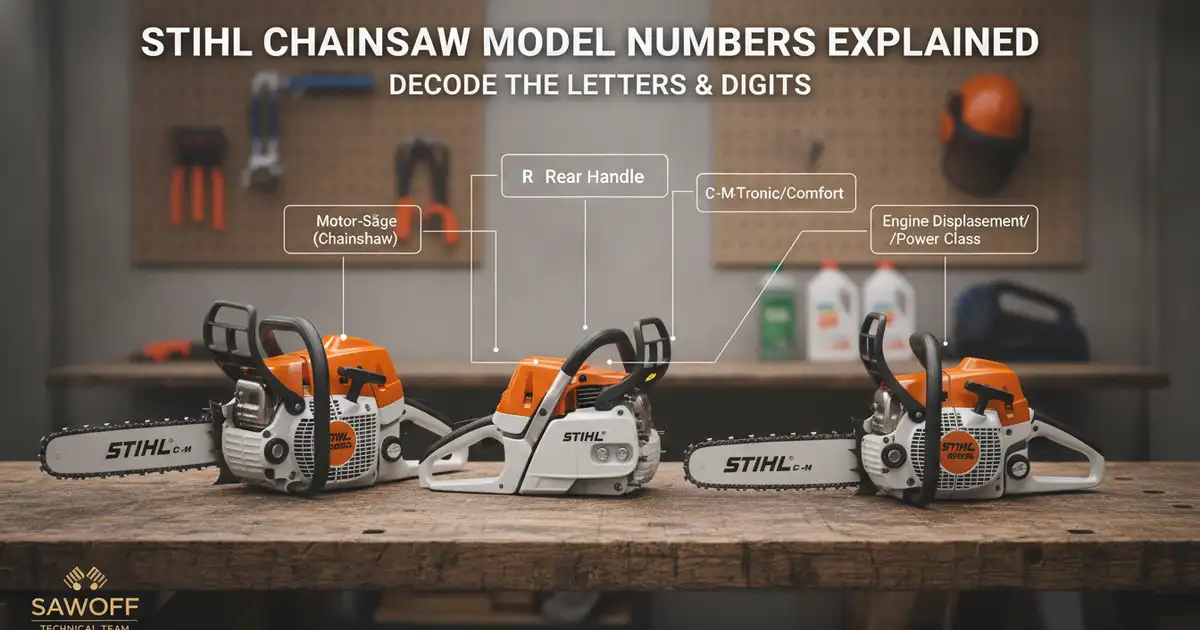
- C (Comfort): This is an umbrella designation. If a saw has a “C,” it means it has at least one comfort feature. You have to look at the subsequent letters to know which ones.
- B (Quick Chain Tensioner): No tools required. You just flip a wingnut and turn a thumbwheel. Personally, I prefer the traditional side-access tensioner for its robustness, but for a homeowner, the “B” feature is a godsend.
- E (ErgoStart): A spring-assisted starter. Instead of a sharp, jerky pull, you give it a steady pull, and the spring does the work of turning the engine over. It’s perfect for those with shoulder issues or those who hate the “snap” of a high-compression engine.
- M (M-Tronic): As discussed, this is the electronic engine management. If you see an “M,” you’re getting a top-tier, self-tuning saw.
- R (Wrap Handle): Usually found on pro saws like the MS 462 R C-M. The handle wraps all the way around the side of the saw, allowing for better ergonomics when felling at awkward angles.
- T (Top Handle): Specifically for arborists. The handle is on top of the saw instead of the rear, allowing for one-handed use (by trained pros only!) while climbing.
- V (Carburetor Heating): Essential for those of us working in the dead of winter. It prevents the carb from icing up in sub-zero temps.
- W (Handle Heating): Pure luxury. In frozen conditions, heated handles keep your hands warm and responsive, which is actually a safety feature when you think about it.
- i (Injection): Currently exclusive to the MS 500i. It denotes electronically controlled fuel injection—no carburetor at all.
Real-World Performance Analysis
I took an MS 261 C-M (Pro saw with M-Tronic) and an MS 271 Farm Boss (Mid-range saw) into a stand of dead-standing White Oak to see how these numbers translate to the “cut.”
The MS 271 is a fantastic saw, but you can feel the polymer chassis absorbing some of the energy that should be going into the chain. It’s “prosumer”—capable, but it lacks the surgical precision of the 261. The 261 C-M, on the other hand, felt like an extension of my arms. The M-Tronic system adjusted the fuel mix the second the bar hit the wood, maintaining high RPMs even when I leaned into the cut.
In a bore-cut (where you plunge the nose of the bar into the tree), the professional-grade MS models show their heritage. The anti-vibration system (often denoted by the lack of “shaking” in the palms after a 4-hour stint) is vastly superior on the pro models. Stihl uses steel springs for vibration dampening on their pro saws, whereas many entry-level models use rubber buffers which can degrade and feel “mushy” over time.
Maintenance & Serviceability: The “Pro” Advantage
One thing you won’t find on a spec sheet is how much easier it is to fix a saw that has certain letters in its name.
- Air Filter Access: On pro models, the shroud is usually held on by quick-release toggles. You can have the filter out and cleaned in 30 seconds without a tool.
- Captive Nuts: Saws like the MS 261 and MS 462 have captive bar nuts. They don’t fall off and get lost in the leaf litter when you’re swapping chains. This is a small detail that saves hours of frustration.
- Spark Plug Access: On the “C” (Comfort) models, access is usually streamlined, though some of the ErgoStart shrouds can be a bit bulkier to navigate.
Hardware Specs: A Comparative Snapshot
| Feature | Homeowner (MS 170) | Mid-Range (MS 271) | Pro (MS 362 C-M) |
|---|---|---|---|
| Displacement | 30.1 cc | 50.2 cc | 59.0 cc |
| Power Output | 1.3 kW (1.7 bhp) | 2.6 kW (3.5 bhp) | 3.5 kW (4.7 bhp) |
| Weight (Powerhead) | 8.6 lbs | 12.3 lbs | 12.3 lbs |
| Crankcase | Polymer | Polymer | Magnesium |
| Chain Tensioner | Front-access | Side-access | Side-access (Captive) |
Pros & Cons of the Stihl Naming Convention
Pros:
- Highly Descriptive: Once you know the code, you know exactly what the saw’s capabilities are.
- Consistency: The “MS” and “C” designations have remained consistent across many model generations.
- Granular Options: You can buy the exact level of tech you need (e.g., getting an MS 261 with or without M-Tronic in some markets).
Cons:
- Steep Learning Curve: For a first-time buyer, the difference between an MS 250 and an MS 251 C-BE is confusing.
- The “C” Trap: Sometimes “Comfort” features add weight and complexity that pro users might find unnecessary.
- Model Overlap: The lines between the top-end Farm Boss and the entry-level Pro saws can be blurry in terms of raw power specs, even if the internals differ wildly.
The SAWOFF Edge: Our Professional Take
Here’s the “dirty secret” from the field: The letters matter more than the numbers.
I’ve seen guys buy an MS 391 (high displacement, but a “Farm and Ranch” build) thinking they were getting a professional felling saw. They were disappointed by the weight and the plastic-heavy build. Conversely, a smaller professional saw like the MS 241 C-M will outwork and outlast a larger consumer saw any day of the week.
If you are serious about wood, look for the Magnesium Crankcase and the M-Tronic (M) designation. These two factors are the true indicators of a “lifetime” saw.
SAWOFF Rating: 4.8 / 5 (Stihl’s system is logical once mastered, but unnecessarily opaque for beginners).
For related reviews, see our Stihl MS 271, DeWalt 20V XR chainsaw, Greenworks 60V chainsaw.
FAQ: Decoding Your Stihl
1. What does the “Boss” in Wood Boss or Farm Boss mean?
These are marketing names for specific mid-range models. The Stihl MS 251 Wood Boss and the MS 271 Farm Boss are designed for high-torque tasks on private property. They aren’t “Pro” saws, but they are built significantly tougher than the base MS 170.
2. Is M-Tronic (the “M” suffix) reliable in the long run?
Yes. I was a skeptic at first, but after running M-Tronic saws for years, I’ve had fewer issues than with traditional carbs. It prevents the engine from running too lean or too rich, which actually extends the life of the piston and cylinder.
3. Can I upgrade my saw to include “C” features later?
Generally, no. Features like ErgoStart (E) or Quick Chain Tensioning (B) require different crankcases or side covers that aren’t easily retrofitted to a standard model. It’s best to buy the features you want upfront.
4. What is the “Easy2Start” system actually like?
It’s a different feel. Instead of a “rip,” it’s a “draw.” If you have arthritis or just hate the kickback of a high-compression pull, it’s worth the extra weight. For pros, it’s just another thing to potentially break.
5. Why do some Stihl saws have a green or yellow label on the bar?
This is a safety code. Green signifies low-kickback components, ideal for beginners. Yellow warns of a higher risk of kickback, intended for experienced users. This isn’t part of the model number, but it’s part of the “Stihl code.”
6. Does the MS 500i require a special oil mixture?
It still uses a standard 50:1 mix (Stihl MotoMix or high-quality 2-stroke oil and 89+ octane gas), but because it’s fuel-injected, the cleanliness of your fuel is even more critical. I always recommend using a dedicated fuel filter funnel when filling an “i” model.
7. What is the difference between MS 261 and MS 261 C-M?
The base MS 261 (if you can find it) has a manual carburetor. The MS 261 C-M has the M-Tronic electronic ignition. In the modern market, almost all 261s sold in the US are the C-M version.
8. My saw says “MS 251 C-BE.” What does that mean?
It’s a Motorsäge (Gas), model 251, with a Comfort package (C) that includes the ErgoStart (E) and the Quick Chain Tensioner (B). It’s the ultimate “convenience” saw in the mid-range category.
The Ultimate Chainsaw Maintenance Field Toolkit
The complete 96-page printable manual. Avoid costly $400 repairs, master 30°/35°/10° chain sharpening angles, and clear flooded engines in 30 seconds.
- ✓12 In-Depth Modules: Safety checks, service schedules & winterizing
- ✓Chain Sharpening Angles: 30° / 35° / 10° filing charts & raker depth specs
- ✓15 Free Bonus Templates: Angle cheat-sheets, logs & laminated pocket cards
Frequently Asked Questions
What does the Boss in Wood Boss or Farm Boss mean?
These are marketing names for specific mid-range models. The Stihl MS 251 Wood Boss and MS 271 Farm Boss are designed for high-torque tasks on private property. They aren't pro saws, but they are built significantly tougher than the base MS 170.
Is M-Tronic (the M suffix) reliable in the long run?
Yes. After running M-Tronic saws for years, there have been fewer issues than with traditional carbs. It prevents the engine from running too lean or too rich, which actually extends the life of the piston and cylinder.
Can I upgrade my saw to include C features later?
Generally no. Features like ErgoStart (E) or Quick Chain Tensioning (B) require different crankcases or side covers that aren't easily retrofitted to a standard model. It's best to buy the features you want upfront.
What is the Easy2Start system actually like?
Instead of a rip, it's a draw. If you have arthritis or hate the kickback of a high-compression pull, it's worth the extra weight. For pros, it's just another component that could potentially break in the field.
Why do some Stihl saws have a green or yellow label on the bar?
This is a safety code. Green signifies low-kickback components ideal for beginners. Yellow warns of a higher risk of kickback, intended for experienced users. This isn't part of the model number but is part of the Stihl coding system.
What is the difference between MS 261 and MS 261 C-M?
The base MS 261 has a manual carburetor. The MS 261 C-M has the M-Tronic electronic ignition that automatically adjusts for temperature, altitude, and fuel quality. In the modern market, almost all 261s sold in the US are the C-M version.