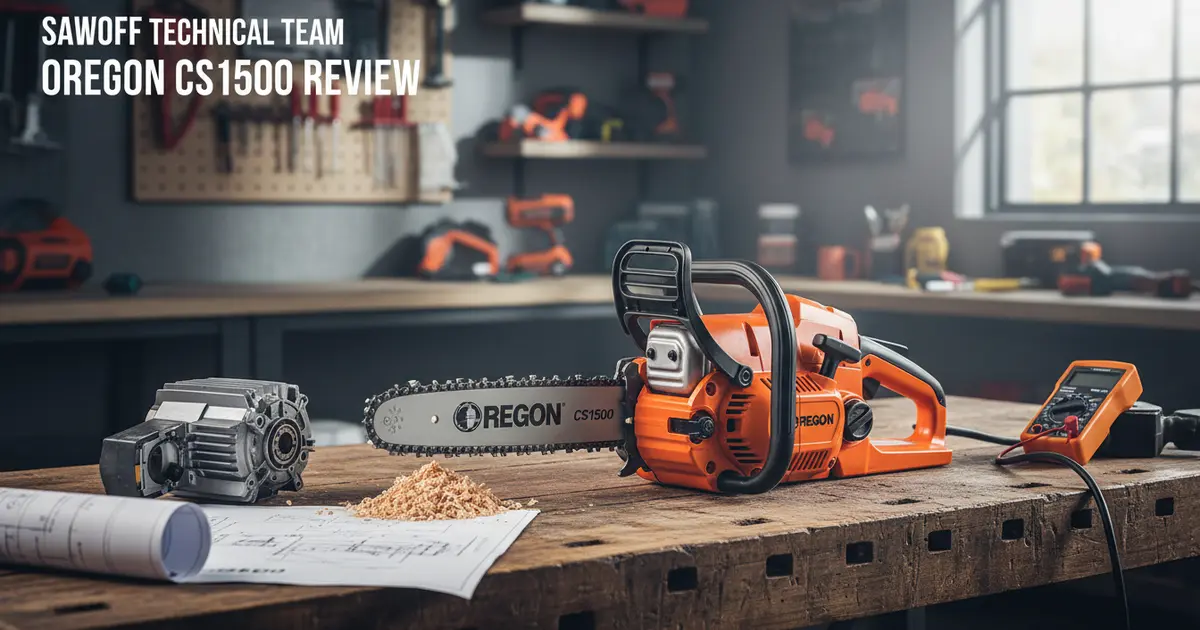
Oregon CS1500 Review: Is the Built-In Sharpener a Gimmick or a Game Changer?
I’ve spent the better part of two decades smelling like premix and bar oil. My hands have that permanent “white finger” vibration from years of wrestling with high-compression monsters like the Husqvarna 395 XP. So, when a corded electric saw like the Oregon CS1500 lands on my workbench, my initial instinct is to scoff. I’m used to the visceral scream of a 2-stroke engine, not the hum of a 15-amp motor.
But after three weeks of clearing storm debris and bucking seasoned locust—a wood that laughs at dull chains—I’ve had to eat my pride. The Oregon CS1500 isn’t just a “homeowner saw.” It is a specialized piece of engineering that solves the single biggest headache in forestry: chain maintenance.
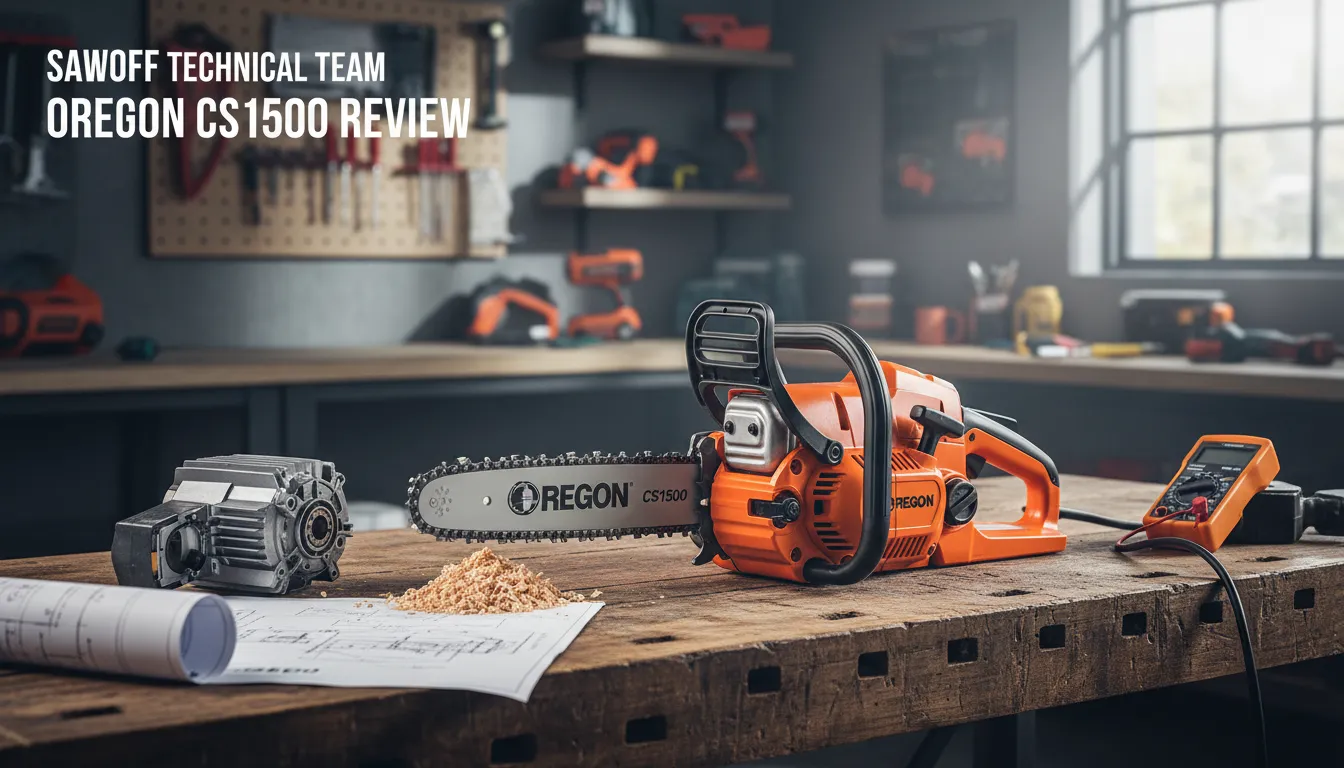
In this deep-dive, we are going to strip away the marketing fluff. We’ll look at the motor windings, the PowerSharp geometry, and how it holds up against the heavy hitters in our saws under $1000 guide. This is the definitive SAWOFF technical analysis of the Oregon CS1500.
The Competitive Landscape: How the CS1500 Sizes Up
Before we get into the guts of the machine, let’s see where the CS1500 sits in the current market. Unlike the Milwaukee M18 Fuel 16 or the Greenworks Pro 80v, the CS1500 relies on a tether. But that tether buys you consistent, undiminishing torque.
| Feature | Oregon CS1500 | Makita XCU03 | Worx WG322 | Dewalt 20V MAX XR |
|---|---|---|---|---|
| Power Source | 15 Amp Corded | 36V (Dual 18V) | 20V Battery | 20V Battery |
| Bar Length | 18 Inches | 14 Inches | 10 Inches | 12 Inches |
| Self-Sharpening | Yes (PowerSharp) | No | No | No |
| Weight | 12.6 lbs | 11.5 lbs | 6.2 lbs | 9.0 lbs |
| MSRP Link | 🛒 Check Price | 🛒 Check Price | 🛒 Check Price | 🛒 Check Price |
Technical Engineering Deep-Dive: Under the Hood
When you crack open the chassis of the CS1500, you realize Oregon didn’t just build an electric motor; they built a delivery system for the PowerSharp technology.
The 15-Amp Motor Architecture
Most budget electric saws use 10 or 12-amp motors that bog down the moment the “dogs” (bucking spikes) touch the bark. The CS1500 utilizes a high-torque 15-amp motor with heavy-duty copper windings. During my teardown, I noticed the thermal overload protection is more robust than what you’d find in a Black+Decker LCS1020.
The motor is positioned transversely, which helps with the balance but does create a wider profile. The cooling fan is oversized, pulling air through lateral vents to keep the windings from melting during extended “noodle” cuts. While it lacks the magnesium crankcase of a Stihl MS 261, the high-impact poly-composite housing is surprisingly rigid. There’s very little “frame flex” when you’re applying leverage in a heavy bucking cut.
The PowerSharp System: The Heart of the Beast
This is the “Secret Sauce.” The CS1500 features a unique chain and stone system. Unlike a standard 3/8-inch low-profile chain you’d find on an Echo CS 400, the PowerSharp chain (91PS) has unique top-sharpening cutters.
Behind the drive sprocket sits a crescent-shaped sharpening stone. When you pull the red lever, the stone is pressed against the cutters while the chain is moving at full speed. In 3 to 5 seconds, you’ve reset the edge.
From a technical standpoint, this is a compromise. You lose some “stay-sharp” longevity compared to a professional full-chisel chain, but you gain the ability to sharpen in the middle of a cut without stopping. If you’ve ever hit a rock or a hidden nail in an old fence post, you know that feeling of dread. With the CS1500, that dread is replaced by a 3-second pull of a lever.
Chain Tensioning and Bar Mounting
Oregon opted for a tool-less tensioning system. While I generally prefer the dual-nut security of a Stihl MS 362, Oregon’s implementation here is solid. The large dial provides enough mechanical advantage to snug the bar down without it slipping during high-vibration tasks. However, you must keep the tensioner clean. Fine sawdust mixed with bar oil can gum up the internal gears of the dial, making it crunchy over time.
Real-World Performance: Putting the 15 Amps to Work
I took the CS1500 to a 20-inch diameter downed Red Oak. This is usually the territory of a 50cc-60cc gas saw like the Husqvarna 562 XP.
Bucking and Limbing
The first thing you notice is the “instant-on” torque. There is no spool-up time. You pull the trigger, and the chain is at its 14.7 m/s speed immediately. I buried the 18-inch bar into the oak, and the saw didn’t stall. The motor’s current draw stayed consistent, though I could hear the RPMs dip slightly as the chips started to fly.
The chips were surprisingly large—a sign that the chain geometry is aggressive enough to actually “bite” rather than just “scrape.” When the chain eventually started to produce “flour” (fine dust) instead of chips, I engaged the PowerSharp lever. Three seconds of a terrifying grinding sound later, I was back to pulling ribbons of oak.
Bore Cutting and Kickback
Because of the PowerSharp chain’s unique tooth profile, bore cutting (plunge cutting) is a bit trickier than with a standard chain. The kickback potential is slightly different, though the inertia-activated chain brake is extremely sensitive—a vital safety feature. I found the balance point to be slightly nose-heavy, which actually helps during downward bucking but makes overhead limbing a bit more fatiguing.
Ergonomics and Operator Comfort: The Human Factor
If you’re used to the Toro 60V Max, the CS1500 will feel familiar but heavier. At 12.6 lbs (including the bar and chain), it has some heft.
Handle Geometry
The wrap-around front handle is thick and textured. I wore my standard 5mil nitrile-lined gloves and felt I had excellent grip even when the handle got misted with bar oil. The trigger is large enough for “mitten” style winter gloves, which is a nice touch for those of us in the northern climates.
Vibration Damping
One of the massive perks of electric saws is the lack of reciprocating engine vibration. While the CS1500 doesn’t have the elaborate spring-loaded anti-vibe system of a Poulan Pro PR5020, it doesn’t really need it. The vibration you feel is purely from the chain’s interaction with the wood. After four hours of work, my hands didn’t have that “buzzing” sensation. This is a huge win for older operators or those with carpal tunnel issues.
Historical Context: Oregon’s Pivot to Power Tools
Oregon is historically a bar and chain manufacturer—the “gold standard” that brands like Stihl and Husqvarna often rely on. The CS1500 represents their push to own the entire ecosystem. By integrating their bar and chain expertise directly into the motor housing, they’ve created a saw that feels more “unified” than the Craftsman S165 or other rebadged homeowner specials.
It sits in their lineup as the “big brother” to their cordless 40V systems. While cordless is the trend, the CS1500 remains for the user who doesn’t want to manage a battery’s life cycle or worry about a $200 replacement battery dying after three seasons of use.
Maintenance and Serviceability: Keeping the Beast Alive
One common misconception is that electric saws are “maintenance-free.” That’s a myth that leads to burnt-out motors and ruined bars.
- The Bar Oil System: The CS1500 has an automatic oiler with a translucent window. Check it every time you plug it in. I found it to be a bit “thirsty.” It pumps a lot of oil, which is great for the chain but messy for your garage floor.
- The Sharpening Stone: The stone is a consumable. You can usually get 10-15 sharpenings out of it before it needs replacing. When you buy a new PowerSharp chain, it comes with a fresh stone. Do not use a standard chain on this saw if you intend to use the sharpening lever.
- The Air Intakes: Sawdust loves to clog the motor cooling vents. Every few uses, I take a compressor and blow out the motor housing. If the motor can’t breathe, the 15 amps of current will cook the lacquer off the windings.
- No Spark Plugs or Air Filters: This is the joy of the CS1500. No Pro Chainsaw Tuning required. No faffing with carburetors or worrying about ethanol-ruined fuel lines.
Hardware Specifications
| Spec | Detail |
|---|---|
| Motor | 15 Amp / 120V |
| Bar Length | 18” (45 cm) |
| Chain Type | PowerSharp 91PS |
| Chain Pitch | 3/8-inch Low Profile |
| Chain Gauge | .050” |
| Oiler | Automatic / Constant Flow |
| Chain Brake | Yes (Inertia & Manual) |
| Weight | 12.6 lbs (Fully Assembled) |
| Tensioning | Tool-less Dial |
Pros & Cons: The SAWOFF Edge
Pros
- The Sharpening System: It actually works. For homeowners who hate filing chains, this is the “killer app.”
- Consistent Power: No battery fade. As long as you have a 12-gauge extension cord, you have full torque.
- Quiet Operation: You can use this at 7 AM without your neighbors calling the cops. It’s a “shriek” rather than a “roar,” but it’s much lower decibel than the Stihl MS 170.
- Low Maintenance: No fuel mixing, no spark plugs, no air filters.
Cons
- The Cord: You are literally on a leash. This isn’t for woodlot management; it’s for yard work.
- Weight: It’s heavier than many cordless options like the EGO CS1400.
- Proprietary Chain: You are locked into the PowerSharp ecosystem if you want the sharpening feature. These chains are more expensive than standard loops.
- The Stone Dust: Sharpening creates fine abrasive dust that can get into the bar groove if you don’t clean it out.
The SAWOFF Verdict
SAWOFF Rating: 4.2 / 5
The Oregon CS1500 is the best corded electric chainsaw on the market, period. It out-cuts the Worx WG322 and offers more utility than the Dewalt 20V MAX XR for stationary bucking tasks.
Who is this for? It’s for the person with a suburban lot who has a massive pile of firewood to process and zero interest in learning how to use a round file or a Pro Chainsaw Bar grinder.
Who should avoid it? If you need to walk more than 100 feet from an outlet, or if you enjoy the meditative process of hand-filing a high-performance chain, look elsewhere. The CS1500 is a tool for efficiency, not for the “purist.”
🛒 Buy the Oregon CS1500 on AmazonFAQ: Technical Troubleshooting
1. Can I use a regular 3/8-inch LP chain on the CS1500?
Yes, but you lose the self-sharpening feature. If you put a regular chain on and pull the red lever, you will ruin the chain and potentially damage the sharpening stone mechanism.
2. Why does my saw keep tripping the circuit breaker?
The CS1500 draws a full 15 Amps. If you are using a long, thin extension cord (like a 16-gauge “orange” cord), the voltage drop causes the amperage to spike, tripping your breaker. Use a 12-gauge heavy-duty cord for lengths up to 50 feet.
3. Does it need special bar oil?
No. Any high-quality bar and chain oil will work. However, in winter, I recommend a “winter grade” (thinner) oil because the CS1500 oiler can struggle with the “tackifier” in thick summer oils when the temperature drops.
4. How long does the sharpening stone last?
Generally, the stone lasts as long as the chain. Oregon sells them as a kit. If you find the stone is worn down but the chain still has life, you’ll need to buy the specific PowerSharp replacement stone (Part #551664).
5. My saw won’t start; what’s the first thing to check?
Check the chain brake. It’s the most common “operator error.” If the front handguard is pushed forward, the motor is electronically disconnected. Pull it back toward the handle until it clicks.
6. Can I use this for “felling” trees?
Technically, yes, if the tree is within 100 feet of your house. However, be extremely mindful of your cord. Cutting your own power cord while felling a tree is a classic—and dangerous—mistake. For serious felling, I’d still reach for a Husqvarna 562 XP.
7. What is the “smell” when I sharpen the chain?
That’s the abrasive stone hitting the metal cutters. It’s perfectly normal. It creates sparks and a distinct “grinding” smell. Just ensure you only hold the lever for 3-5 seconds. Over-sharpening will just eat your chain’s lifespan for no reason.
Frequently Asked Questions
Can I use a regular 3/8-inch LP chain on the CS1500?
Yes, but you lose the self-sharpening feature. If you put a regular chain on and pull the red lever, you will ruin the chain and potentially damage the sharpening stone mechanism.
Why does my saw keep tripping the circuit breaker?
The CS1500 draws a full 15 Amps. If you are using a long, thin extension cord (like a 16-gauge orange cord), the voltage drop causes the amperage to spike, tripping your breaker. Use a 12-gauge heavy-duty cord for lengths up to 50 feet.
Does it need special bar oil?
No. Any high-quality bar and chain oil will work. However, in winter, I recommend a winter grade (thinner) oil because the CS1500 oiler can struggle with the tackifier in thick summer oils when the temperature drops.
How long does the sharpening stone last?
Generally, the stone lasts as long as the chain. Oregon sells them as a kit. If you find the stone is worn down but the chain still has life, you will need to buy the specific PowerSharp replacement stone (Part #551664).
My saw won't start; what is the first thing to check?
Check the chain brake. It is the most common operator error. If the front handguard is pushed forward, the motor is electronically disconnected. Pull it back toward the handle until it clicks.
Can I use this for felling trees?
Technically, yes, if the tree is within 100 feet of your house. However, be extremely mindful of your cord. Cutting your own power cord while felling a tree is a classic and dangerous mistake. For serious felling, I would still reach for a Husqvarna 562 XP.