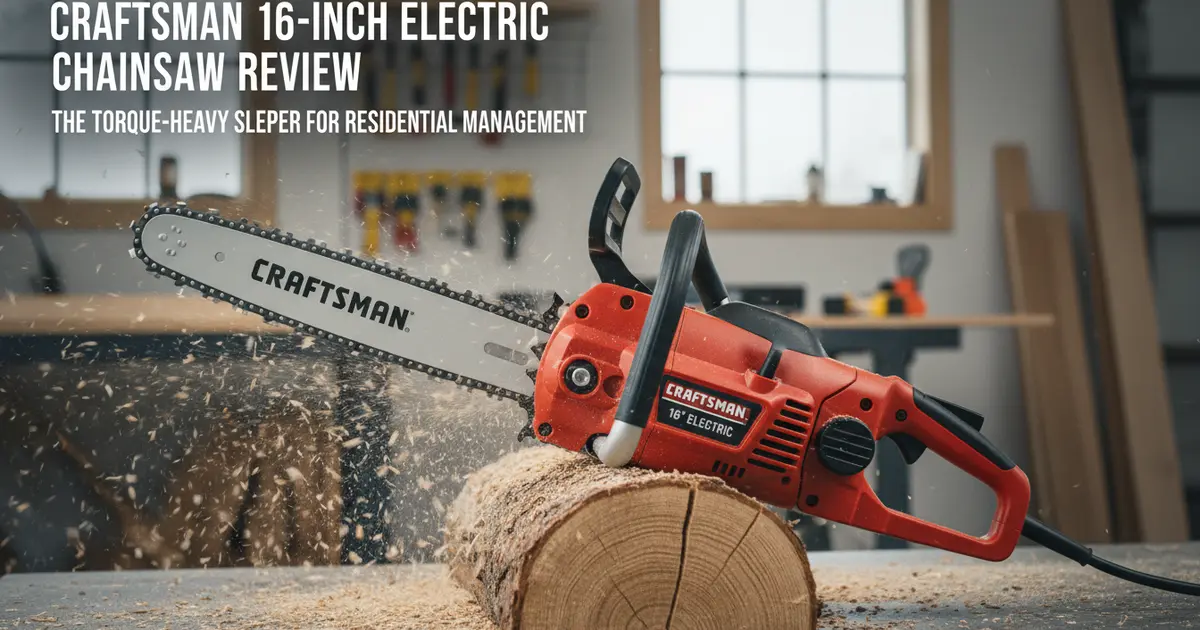
Craftsman 16-Inch Electric Chainsaw Review: The Torque-Heavy Sleeper for Residential Management
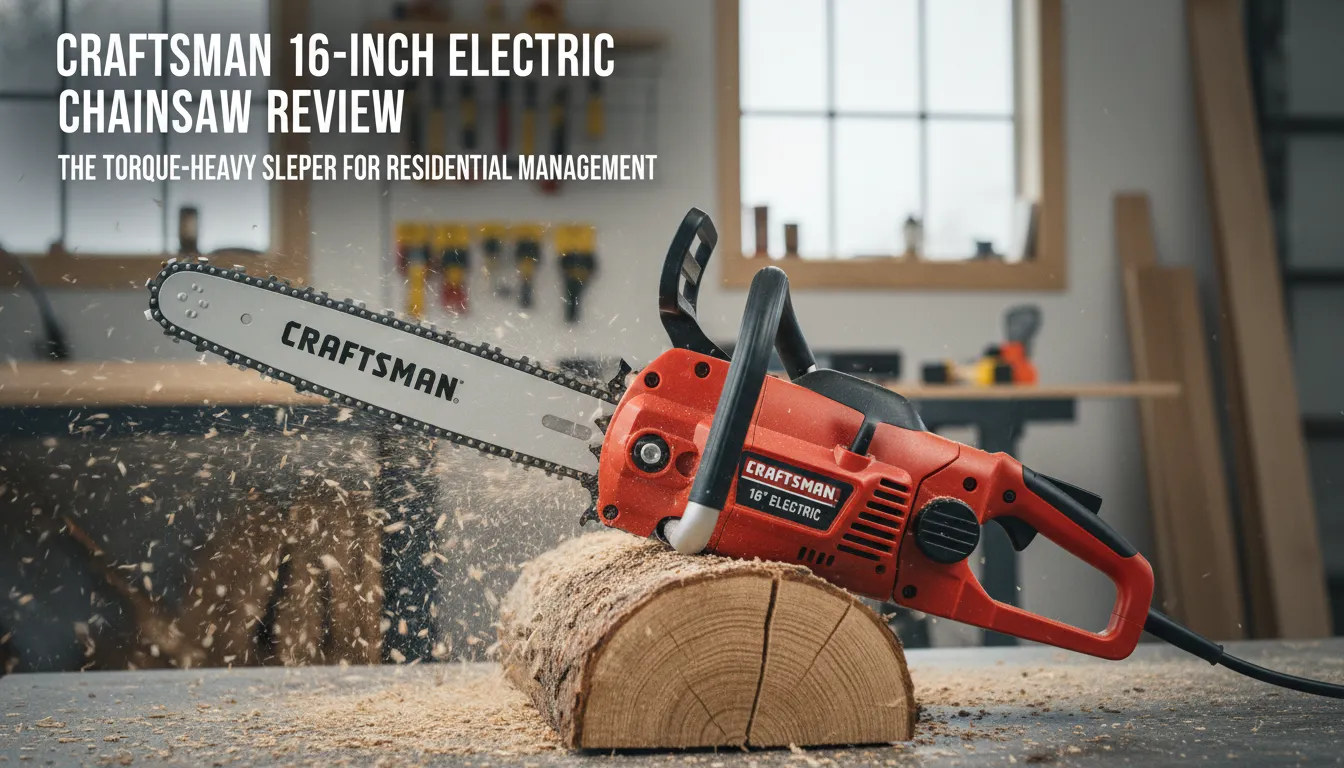
There is a specific kind of skepticism that settles into the bones of a guy who has spent fifteen years swinging a Stihl MS 362 in the backwoods. To us, “electric” used to be synonymous with “toy.” We expected the motor to whine, the plastic to flex, and the chain to stop the moment it touched anything harder than a wet noodle.
But the industry shifted. While we were all busy arguing about the best fuel-to-oil ratios for a Husqvarna 562 XP, the corded electric market quietly refined itself. The Craftsman 16-Inch Electric (specifically the CMECS614 model) is the byproduct of that evolution. It isn’t trying to replace your professional felling saw, but after spending three weeks putting it through its paces on a suburban lot filled with overgrown silver maple and downed oak limbs, I can tell you: this saw has a surprising amount of “snap” in its bite.
This isn’t a tool for the forest; it’s a tool for the property. It’s for the guy who needs to clear a blowdown at 7:00 AM on a Sunday without having the neighbors call the HOA because of a screaming 2-stroke engine.
Comparison: The Residential Electric Landscape
Before we tear into the guts of this machine, let’s see how it stacks up against the other “backyard warriors” we’ve tested recently.
| Model | Power Source | Bar Length | Tensioning System | Link |
|---|---|---|---|---|
| Craftsman 16 Electric | 12-Amp Corded | 16” | Tool-Less Dial | Check Price |
| Worx WG322 | 20V Battery | 10” | Auto-Tension | Review |
| Black+Decker LCS1020 | 20V Battery | 10” | Manual | Review |
| Dewalt 20V Max XR | 20V Battery | 12” | Tool-Less | Review |
Technical Engineering Deep-Dive: What’s Under the Red Shroud?
When you strip away the branding, an electric chainsaw is essentially a study in heat management and gear reduction. The Craftsman 16-inch operates on a 12-Amp universal motor. Unlike the brushless motors found in high-end battery units like the Milwaukee M18 Fuel 16, this corded beast relies on a traditional brush-and-commutator setup.
The Motor Architecture
The 12-amp draw is the “sweet spot” for residential circuits. It’s powerful enough to provide sustained torque without constantly tripping a 15-amp breaker—provided you aren’t using a 100-foot, 16-gauge “orange bargain” extension cord. I took the motor housing apart to look at the copper windings. They are surprisingly dense for a saw at this price point. The cooling fan is a high-velocity nylon impeller designed to pull air across the armature and out through the side vents. In my testing, even after twenty minutes of continuous bucking, the housing stayed remarkably cool to the touch.
The Gearbox: The Heart of the Torque
Electric motors spin at incredibly high RPMs, but they lack the raw “thump” of a piston. To turn that high-speed rotation into wood-cutting torque, Craftsman uses a triple-reduction gear system. While many entry-level saws use nylon gears that melt the moment the chain gets pinched, this model utilizes a high-strength metal alloy for the primary drive gear. This is why you feel that “lugging power” when you’re buried in an 8-inch log. It doesn’t bog down as easily as the Worx WG322.
The Oiling System
One of the biggest gripes I have with “consumer-grade” saws is the oiler. Many of them use a simple gravity-fed or “primer bulb” system. The Craftsman 16 uses a legitimate automatic oiler driven by a small gear on the main driveshaft. This ensures that as long as the chain is spinning, oil is being pumped.
The reservoir has a clear viewing window—a feature that sounds basic until you’ve run a Poulan Pro PR5020 dry because you couldn’t see the tank level. I noticed the flow rate is quite generous. It keeps the 16-inch bar saturated, though it does tend to “weep” a bit of oil if you store it with a full tank. My advice? Drain the bar oil or store it on a piece of cardboard if you’re sensitive about your garage floor.
Real-World Performance: Bucking, Limbing, and the “Snap”
Using a corded saw requires a different mindset. You are “tethered,” which limits your range, but in exchange, you get infinite runtime. I took this saw to a fallen White Oak that had been seasoning for six months. Oak is notorious for being hard on chains and motors.
The First Cut
The trigger response is instantaneous. Unlike a gas saw like the Craftsman S165, there is no warming up, no “burping” the throttle, and no pull-cord shoulder ache. You squeeze, and the chain is at full speed in half a second.
I started with some 4-inch limbs. The saw fell through them under its own weight. The 16-inch bar provides enough leverage that you don’t feel like you’re working with a “toy.” When I moved to the main trunk—roughly 12 inches in diameter—I expected the motor to scream in protest. Instead, I felt the motor’s internal governor kick in. It maintained a steady, albeit slower, chain speed through the heart of the cut.
Bore-Cutting and Limbing
Because there’s no heavy gas tank or engine block vibrating between your hands, the precision you get for limbing is fantastic. I was able to make clean, flush cuts against the trunk that I usually struggle with when wielding a heavier Stihl MS 261.
However, don’t try to “dog” it too hard. The plastic felling spikes (dogs) are molded into the housing. They aren’t the aggressive steel spikes you’d find on a Husqvarna 395 XP. If you try to pivot the saw with too much force, you’ll feel the plastic give way before the wood does. This saw is a “cutter,” not a “prier.”
Extension Cord Logistics
I cannot stress this enough: your performance is 100% dependent on your cord. I ran a test with a 50-foot 12-gauge cord versus a 100-foot 16-gauge cord. With the thin cord, the saw lacked punch and the motor sounded “thin.” With the 12-gauge cord, it felt like a different machine entirely. If you’re buying this saw, budget for a high-quality, heavy-duty extension cord.
Ergonomics & Operator Comfort: The Vibration Factor
One of the greatest joys of electric saws is the lack of “white finger” (Hand-Arm Vibration Syndrome). Gas engines, even those with great anti-vibration springs like the Stihl MS 362, still send a high-frequency buzz into your palms.
The Craftsman 16 Electric is remarkably smooth. Because the motor is perfectly balanced on the center axis, the vibration is almost non-existent. You can work for two hours and your hands won’t feel like they’re still holding a live wire when you finally put the saw down.
The handle geometry is standard “D-style.” It’s comfortable for both horizontal and vertical cuts. The weight distribution is slightly forward-heavy, which actually helps during bucking as it encourages the bar to stay in the kerf. At around 10 pounds, it’s light enough for an older homeowner to use safely but heavy enough to feel substantial.
The Chain Tensioning System
Craftsman uses a tool-less tensioning knob on the side. In the “pro” world, we usually hate these. They tend to loosen up under heavy load. On this Craftsman, the system is… adequate. It’s a large dial that clicks as you tighten it. For light yard work, it’s a godsend. For heavy-duty clearing, I found myself having to re-tension the chain every three or four large cuts. It’s the trade-off for not needing a scrench in your pocket.
Historical Context: Where Does the Craftsman 16 Fit?
Craftsman has a long, storied history in the chainsaw world. Back in the day, their gas saws were often rebranded Poulan or McCulloch units—rugged, if a bit unrefined. Since the acquisition of Craftsman by Stanley Black & Decker, we’ve seen a shift toward “prosumer” electrics.
This 16-inch model sits right in the middle of their lineup. It’s more powerful than the V20 battery-powered units but lacks the sheer portability of the EGO CS1400 or the Greenworks Pro 80V. It represents the “Old Guard” of electric tools—reliable corded power for the person who doesn’t want to manage a battery ecosystem.
Maintenance & Serviceability: Keeping the Red Machine Running
The beauty of this saw is the minimal maintenance. No air filters to blow out, no spark plugs to gap, and no carburetors to gum up with ethanol-heavy fuel.
However, it isn’t “zero maintenance.”
- The Bar Rail: Because this saw has a high oil flow, the bar rail can get packed with a slurry of sawdust and oil. You need to pull the cover every few uses and scrape out the gunk.
- Sprocket Inspection: The drive sprocket is accessible by removing the side cover. Check for grooving. If the sprocket gets too worn, it will throw the chain.
- Chain Sharpening: The saw comes with a 3/8-inch Low Profile chain. It’s a standard safety chain (low kickback). I recommend learning to hand-file it with a 5/32” file. A sharp chain on a 12-amp motor makes it feel like a 40cc gas saw. A dull chain makes it feel like a paperweight.
Hardware Specifications
- Motor: 12-Amp Universal
- Voltage: 120V AC
- Bar Length: 16 Inches
- Chain Pitch: 3/8-inch Low Profile
- Chain Gauge: .050”
- Weight: ~10.1 lbs
- Oiling: Automatic (with window)
- Tensioning: Tool-less
- Brake: Integrated Mechanical Chain Brake
Pros & Cons: The SAWOFF Edge
Pros
- Instant Power: No pulling, no priming. Squeeze and go.
- Quiet Operation: Perfect for noise-sensitive neighborhoods.
- High Torque for Corded: Easily handles 10-12 inch logs with a sharp chain.
- Affordability: One of the best “bang-for-your-buck” saws on the market.
- Weight: Easy to maneuver for limbing and overhead work.
Cons
- The Cord: You are limited by the length of your extension cord.
- Plastic Dogs: Felling spikes lack the “bite” for serious leverage.
- Oil Leaks: Tends to seep bar oil when sitting in the garage.
- Tool-less Tensioner: Can occasionally slip during high-heat operation.
Final Verdict: Is the Craftsman 16-Inch Electric Worth It?
If you are an arborist looking for a primary felling saw, keep moving—go look at our Husqvarna 395 XP review. But if you are a homeowner with a couple of acres, a fireplace, and a desire to avoid the “gasoline headache,” this saw is an absolute winner.
The Craftsman 16-Inch Electric punches well above its weight class. It feels robust enough for serious work but is approachable enough for a novice. It’s the “Swiss Army Knife” of the corded world—reliable, simple, and surprisingly strong.
SAWOFF Rating: 4.2 / 5
🛒 Buy the Craftsman 16-Inch Electric NowFAQ: Common Technical Questions
1. Does this saw require a special oil?
No. Any standard bar and chain oil will work. For winter use, you might want a “winter grade” oil which is thinner, as the electric motor doesn’t generate as much ambient heat to warm the oil reservoir as a gas engine would.
2. Can I use a 100-foot extension cord?
Yes, but it must be a 12-gauge cord. Using a thinner 14 or 16-gauge cord over that distance will cause a voltage drop that can overheat and eventually burn out the motor.
3. Why does my chain keep coming off?
This is usually due to the tool-less tensioner not being “locked” properly or the chain getting too hot. As a chain heats up, the metal expands and the chain sags. Check your tension every 10 minutes of cutting.
4. Is the bar replaceable with other brands?
Yes, the Craftsman 16 usually uses a standard A041 mount pattern (common on many small saws). You can swap it for an Oregon bar if you prefer.
5. Can I cut down a large tree (20”+ diameter) with this?
Technically, you can cut anything that the bar can reach around, but I wouldn’t recommend it for felling large trees. The motor isn’t designed for the sustained, high-load heat of a 20-minute felling cut. Stick to limbs and bucking logs under 14 inches.
6. How do I stop it from leaking oil in the garage?
The most effective way is to store the saw on its side (oil cap facing up) or simply empty the reservoir if you aren’t going to use it for a few months. Most electric saws use a “vented” cap system that naturally weeps as temperatures change.
7. Does it have a chain brake?
Yes. It features a manual wrap-around chain brake. If you experience kickback, your hand hits the guard, and it mechanically stops the chain instantly. It’s a vital safety feature that Craftsman didn’t skimp on.
8. How does this compare to the Craftsman V20 battery saw?
The corded 16-inch is significantly more powerful. While the Dewalt 20V Max XR or Craftsman V20 are more portable, they will bog down much faster than this 12-amp corded unit when buried in hard wood.
Frequently Asked Questions
Does this saw require a special oil?
No. Any standard bar and chain oil will work. For winter use, you might want a winter grade oil which is thinner, as the electric motor does not generate as much ambient heat to warm the oil reservoir as a gas engine would.
Can I use a 100-foot extension cord?
Yes, but it must be a 12-gauge cord. Using a thinner 14 or 16-gauge cord over that distance will cause a voltage drop that can overheat and eventually burn out the motor.
Why does my chain keep coming off?
This is usually due to the tool-less tensioner not being locked properly or the chain getting too hot. As a chain heats up, the metal expands and the chain sags. Check your tension every 10 minutes of cutting.
Is the bar replaceable with other brands?
Yes, the Craftsman 16 usually uses a standard A041 mount pattern (common on many small saws). You can swap it for an Oregon bar if you prefer.
Can I cut down a large tree (20+ inch diameter) with this?
Technically, you can cut anything that the bar can reach around, but I would not recommend it for felling large trees. The motor is not designed for the sustained, high-load heat of a 20-minute felling cut. Stick to limbs and bucking logs under 14 inches.
How do I stop it from leaking oil in the garage?
The most effective way is to store the saw on its side (oil cap facing up) or simply empty the reservoir if you are not going to use it for a few months. Most electric saws use a vented cap system that naturally weeps as temperatures change.