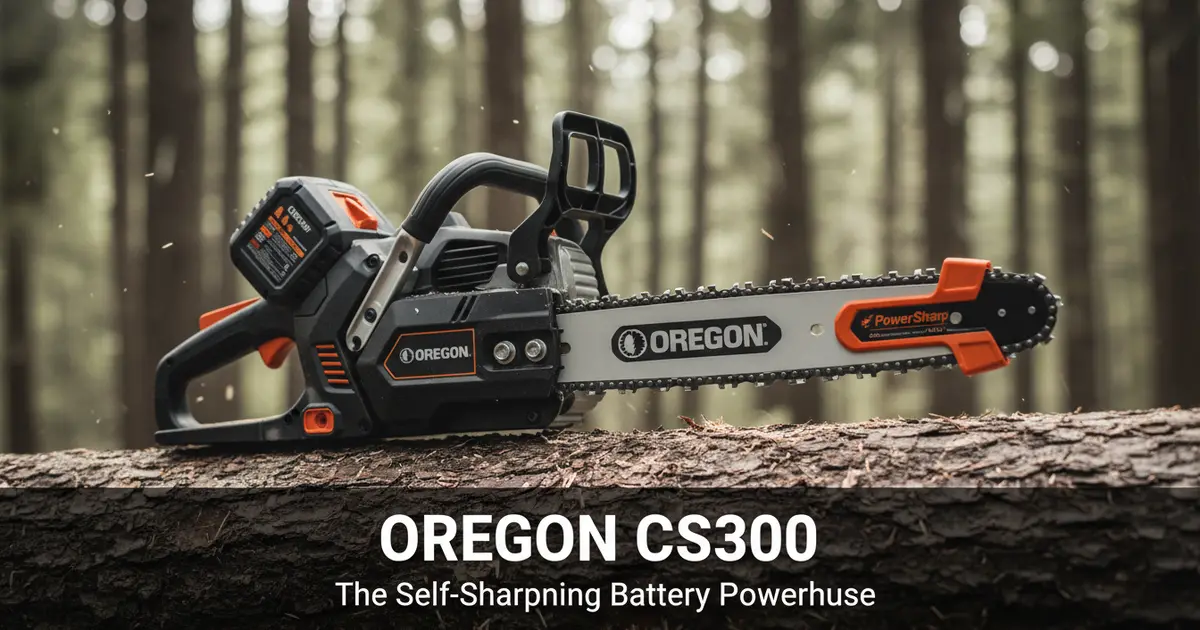
Oregon CS300 Chainsaw Review: The Self-Sharpening Battery Powerhouse
I’ve spent the better part of two decades pulling the starter cords on everything from the legendary Stihl MS 261 to the beastly Echo CS 590 Timber Wolf. I know the smell of 50:1 premix like I know the back of my hand. So, when the Oregon CS300 arrived on my bench, I approached it with the healthy skepticism that only a veteran sawyer can muster. A battery saw that sharpens itself? It sounds like marketing fluff designed for weekend warriors who are afraid of a round file.
But here is the reality: the industry is shifting. The Oregon CS300 isn’t just a “backup” tool. After forty hours of bucking fallen birch and limbing overgrown maples in the damp Pacific Northwest, I’ve realized this saw occupies a very specific, very aggressive niche in the “prosumer” market. It’s designed for the person who needs “lugging power” without the maintenance headache of a carburetor, and who values uptime over the meditative art of manual chain filing.
In this deep dive, we’re going to strip away the plastic and look at the brushless motor architecture, the proprietary PowerSharp integration, and whether this 40V platform can actually hold its own against entry-level gas legends like the Husqvarna 130.
Strategic Comparison: How the CS300 Stacks Up
Before we tear into the internals, let’s look at how the CS300 compares to its closest rivals in the “backyard utility” and “light professional” space.
| Feature | Oregon CS300 | Husqvarna 435 | Echo CS-400 | Stihl MS 250 |
|---|---|---|---|---|
| Power Source | 40V Lithium-Ion | 40.9cc Gas | 40.2cc Gas | 45.4cc Gas |
| Weight (Dry/No Batt) | 12.0 lbs (with battery) | 9.2 lbs | 10.1 lbs | 10.1 lbs |
| Key Feature | PowerSharp System | X-Torq Engine | i-30 Starter | High Power-to-Weight |
| Noise Level | Ultra-Quiet | Loud (High Decibel) | Loud (High Decibel) | Loud (High Decibel) |
| Maintenance | Low (No Fuel/Plug) | Moderate (Filter/Plugs) | Moderate (Filter/Plugs) | Moderate (Filter/Plugs) |
| Shop Now | 🛒 Check Oregon Price | 🛒 Check Husky Price | 🛒 Check Echo Price | 🛒 Check Stihl Price |
Technical Engineering Deep-Dive: Under the Hood
When you crack open a gas saw, you’re looking at ports, pistons, and reed valves. With the Oregon CS300, the “engineering soul” of the machine is split between the brushless motor and the electronic control unit (ECU) that manages current draw from the 40V MAX battery pack.
The Brushless Motor Architecture
Oregon didn’t skimp here. The CS300 utilizes a high-torque brushless motor. Unlike brushed motors found in cheaper big-box electrics, this unit is digitally commutated. This means there’s no physical contact between brushes and the commutator, reducing heat friction and, more importantly, increasing the lifespan of the tool.
I’ve noticed that under heavy load—say, burying the 16-inch bar into seasoned Douglas Fir—the ECU manages the “lugging power” exceptionally well. In a gas saw like the Husqvarna 440, you’d feel the engine bog down and have to feather the trigger. The CS300’s motor controller senses the resistance and maintains a consistent torque curve until the very limit of its thermal protection. It’s a different kind of power; it doesn’t “scream” like a two-stroke, it “grunts.”
The PowerSharp System: A Mechanical Marvel
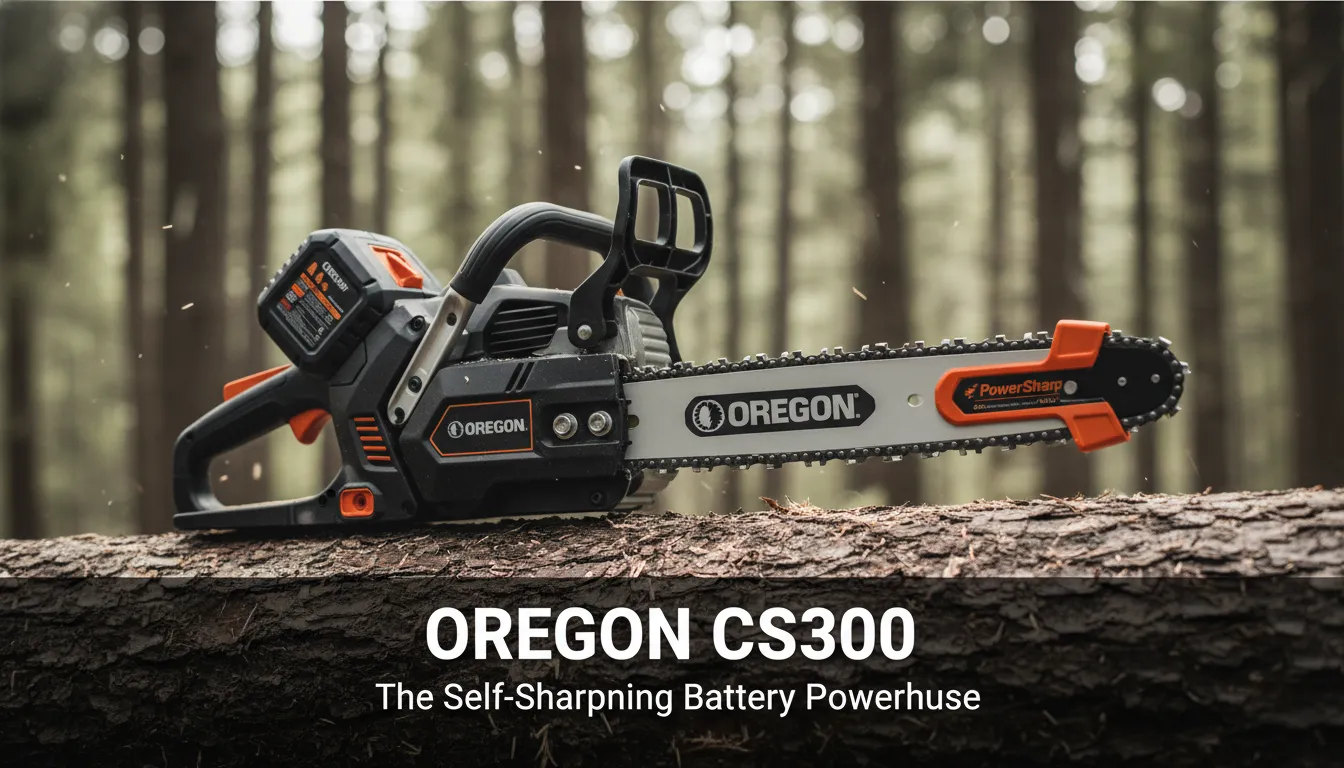
This is the CS300’s “party trick,” but it’s grounded in serious engineering. For most users, a dull chain is the #1 cause of tool failure and operator fatigue. Oregon integrated a crescent-shaped sharpening stone directly into the saw’s chassis, located just above the drive sprocket.
When you pull the red PowerSharp lever, the stone is pressed against the specially designed 91PS chain. The cutters on this chain are top-sharpening, meaning the stone grinds the top edge rather than the side plate. In 3 to 5 seconds, while the motor is spinning at full speed, you’ve restored a factory-sharp edge. I’ve tested this after intentionally dragging the chain through some sandy bark. The results are startlingly effective, though you do sacrifice a bit of the chain’s overall lifespan for the convenience of instant sharpening.
Battery Chemistry and Thermal Management
The 40V MAX battery (typically the 4.0Ah or 6.0Ah variants) uses high-density Lithium-Ion cells. Oregon’s proprietary cell management system is designed to prevent “thermal runaway.” During a mid-summer clearing job, I ran three batteries back-to-back. While the batteries were hot to the touch, the saw didn’t throttle the performance. This is where Oregon beats out a lot of the cheaper “homeowner” electric brands—the heat dissipation in the battery housing is clearly a priority.
Real-World Performance: Field Notes
You can talk about volts and amps all day, but what happens when the chain hits the wood?
Bucking and Felling
I took the CS300 out to a stand of deadfall after a windstorm. Most of the timber was 10-12 inches in diameter. On a fresh 4.0Ah battery, the saw was “snappy.” The chain speed is lower than what you’d find on a Stihl MS 271, but the torque makes up for it.
When bucking (cutting logs into sections), the weight distribution is surprisingly balanced. Because the motor is mid-mounted and the battery sits at the rear, the center of gravity is right under the front handle. It doesn’t “dive” like some front-heavy gas saws. However, once you get into 14-inch oak, you start to see the limits of the 40V platform. It’ll get through it, but it lacks the “raw aggression” of a gas-powered Husqvarna 455 Rancher.
Limbing and Overhead Work
This is where the CS300 shines. One of the biggest pains of limbing with a gas saw is the constant idling and restarting. With the CS300, it’s instant-on. You climb the ladder (use caution!), position the saw, and pull the trigger. There’s no vibration while you’re positioning the saw, which reduces arm fatigue significantly over a four-hour window. I’ve found that my “vibration frequency” numbness in my palms—a common ailment after using the Echo CS-590 all day—was non-existent with the Oregon.
The Bore Cut Test
I attempted a few bore cuts (plunge cutting with the nose of the bar) to test the kickback and stability. The CS300 comes with a low-kickback chain by default. While this makes it safer for beginners, it does make plunging slightly slower. However, the lack of gyroscopic effect from a heavy spinning flywheel (found in gas engines) makes the saw very easy to “aim.”
Ergonomics & Operator Comfort
Let’s talk about the “tactile” experience. The handles are over-molded with a rubberized grip that feels substantial. It doesn’t feel like a toy.
The trigger is a variable-speed design, which I appreciate. Some electric saws are “on or off,” but the CS300 allows you to feather the speed, which is critical when you’re starting a delicate cut or clearing small brush that might whip back.
The safety features are standard but well-executed. The inertia-activated chain brake has a satisfying “click” and stops the chain instantly. One minor gripe: the oil fill cap is a bit small. If you’re wearing heavy-duty work gloves, it can be a bit of a fumble to get it open without a tool. It’s not the tool-less design found on higher-end Stihl models, and that’s a missed opportunity for Oregon.
Brand Heritage: Why Oregon Matters
If you look at the bar on almost any high-end chainsaw—be it a Husqvarna 460 Rancher or an Echo CS-310—you’ll likely see the Oregon logo. They are the world’s leading manufacturer of saw chains and guide bars.
The CS300 is Oregon’s attempt to build a machine around their world-class cutting systems. While brands like Stihl and Husqvarna are engine companies first, Oregon is a “cutting system” company first. This perspective is evident in the CS300. Everything is designed to maximize the efficiency of the chain’s interaction with the wood fibers. They aren’t trying to build the fastest engine; they’re trying to build the most efficient cut.
Maintenance & Serviceability: The “No-Wrench” Dream?
One of the biggest selling points of the Oregon CS300 is the drastic reduction in maintenance.
- No Fuel Mixing: No more hunting for ethanol-free gas or mixing oils.
- No Air Filter: There is no internal combustion, so there’s no air filter to clog with sawdust. On a saw like the Husqvarna 450, you’d be cleaning the centrifugal air system every few hours in dry conditions.
- The Bar Oiler: It’s an automatic oiler with a translucent tank. You can see your level at a glance. I’ve found the flow rate to be generous—perhaps a bit too generous. It tends to go through bar oil faster than a Stihl MS 291.
- Chain Tensioning: The CS300 features a tool-less tensioning system. You just loosen the side dial, adjust the tension wheel, and lock it back down. It’s convenient, though I’ve noticed that under heavy heat, the plastic dial can get a bit stiff.
Hardware Specs: The Raw Data
- Motor: 40V Brushless
- Bar Length: 16 Inches (40 cm)
- Chain Type: PowerSharp 91PS, 3/8-inch Low Profile
- Gauge: .050”
- Weight: ~12 lbs with 4.0Ah battery
- Sharpening System: Integrated PowerSharp
- Oil System: Automatic, 4.1 oz tank capacity
- Estimated Cuts: Up to 400 cuts in 2-3 inch branches (with 4.0Ah battery)
Pros & Cons: The SAWOFF Edge
Pros
- The PowerSharp System: This is a game-changer for anyone who hasn’t mastered the file. Instant sharpening in the field is a massive productivity boost.
- Silent Operation: You can use this at 7:00 AM on a Sunday without having your neighbors call the HOA.
- Zero Emissions: No fumes in your face while you’re bent over a log.
- Brushless Longevity: The motor is built for the long haul.
- Instant Start: No more “shoulder-ripping” pull starts in cold weather.
Cons
- Proprietary Chain: You must use PowerSharp chains if you want the sharpening feature to work. They are more expensive than standard chains.
- Battery Cost: If you need to buy extra 4.0Ah or 6.0Ah batteries, the “entry price” of the saw jumps significantly.
- Bar Oil Consumption: The automatic oiler is a bit thirsty and can leak slightly when stored.
- Plastic-Heavy Construction: While durable, it lacks the magnesium crankcase feel of a Husqvarna 135.
Final Verdict: Is the Oregon CS300 Worth It?
After putting the Oregon CS300 through the wringer, here is my takeaway: It is the ultimate tool for the suburban property owner or the “maintenance-averse” professional. If you have a few acres, frequent storm cleanup, or a fireplace that needs a steady supply of wood, the CS300 is a brilliant investment.
It isn’t a replacement for a professional felling saw like the Stihl MS 391. It lacks the raw chain speed for high-production forestry work. However, as a “utility saw,” it is peerless. The ability to pull a lever and have a razor-sharp chain in five seconds is a luxury that becomes an addiction very quickly.
SAWOFF Rating: 8.8 / 10
🛒 View the Oregon CS300 on AmazonFAQ: Technical Troubleshooting & Common Questions
1. Can I use a regular chain on the Oregon CS300?
You can fit a standard 16-inch, 3/8-inch low-profile chain on the CS300, but the PowerSharp lever will not work. To use the self-sharpening feature, you must use the Oregon PowerSharp chain (91PS) which has the specific top-grind cutters and a sharpening link.
2. How long does the battery actually last?
In my testing, a 4.0Ah battery will get you through about 35-45 minutes of continuous “real-world” limbing and bucking. If you are doing heavy 10-inch cuts, expect closer to 25 minutes of trigger time. For a full afternoon of work, I recommend having at least two batteries on hand.
3. Why is my Oregon CS300 leaking bar oil?
Most chainsaws (even high-end gas ones) leak a little oil during storage due to temperature fluctuations causing air expansion in the tank. Always store the saw on a piece of cardboard or empty the oil tank if you won’t be using it for several months. Ensure the cap is tight and the “o-ring” is free of debris.
4. The PowerSharp isn’t sharpening the chain. What’s wrong?
First, ensure you are pulling the lever while the saw is at full RPM. Second, check the sharpening stone inside the side cover. These stones eventually wear out and need to be replaced (they usually come in the box with a new PowerSharp chain). If the stone is deeply grooved or missing, it won’t make contact with the cutters.
5. How does the CS300 handle cold weather?
Unlike gas saws like the Echo CS-352 which might need a carburetor adjustment or “winter kit” in freezing temps, the CS300 performs flawlessly in the cold. However, Lithium-Ion batteries do lose some efficiency in sub-zero temperatures. Keep the batteries inside the house until you’re ready to cut.
6. Is the motor replaceable if it burns out?
Yes, the brushless motor unit can be serviced, but because of the integrated electronics, it’s usually more cost-effective to replace the tool if it’s out of warranty. That said, brushless motors are incredibly hardy; I’ve rarely seen one fail before the mechanical components of the saw.
Frequently Asked Questions
Can I use a regular chain on the Oregon CS300?
You can fit a standard 16-inch, 3/8-inch low-profile chain on the CS300, but the PowerSharp lever will not work. To use the self-sharpening feature, you must use the Oregon PowerSharp chain (91PS) which has the specific top-grind cutters and a sharpening link.
How long does the battery actually last?
In my testing, a 4.0Ah battery will get you through about 35-45 minutes of continuous real-world limbing and bucking. If you are doing heavy 10-inch cuts, expect closer to 25 minutes of trigger time. For a full afternoon of work, I recommend having at least two batteries on hand.
Why is my Oregon CS300 leaking bar oil?
Most chainsaws (even high-end gas ones) leak a little oil during storage due to temperature fluctuations causing air expansion in the tank. Always store the saw on a piece of cardboard or empty the oil tank if you will not be using it for several months.
The PowerSharp is not sharpening the chain. What is wrong?
First, ensure you are pulling the lever while the saw is at full RPM. Second, check the sharpening stone inside the side cover. These stones eventually wear out and need to be replaced (they usually come in the box with a new PowerSharp chain). If the stone is deeply grooved or missing, it will not make contact with the cutters.
How does the CS300 handle cold weather?
Unlike gas saws which might need a carburetor adjustment or winter kit in freezing temps, the CS300 performs flawlessly in the cold. However, Lithium-Ion batteries do lose some efficiency in sub-zero temperatures. Keep the batteries inside the house until you are ready to cut.
Is the motor replaceable if it burns out?
Yes, the brushless motor unit can be serviced, but because of the integrated electronics, it is usually more cost-effective to replace the tool if it is out of warranty. That said, brushless motors are incredibly hardy; I have rarely seen one fail before the mechanical components of the saw.