Review Information
- Reviewed by: Jack Beurge
- Review type: Research-based review
- Testing status: Not personally tested by SAWOFF — based on manufacturer documentation, reputable sources, and documented owner-reported patterns
- Published: September 19, 2026
- Manufacturer: Black+Decker
Information in this review is labeled as one of four types: 🧪 SAWOFF hands-on test, 🏭 manufacturer specification, 📚 research from reputable sources (including documented owner-reported patterns), or 🧠 editorial assessment. See our testing methodology and editorial policy.
A Black and Decker chainsaw is a light-duty yard tool first and everything else second: the 20V MAX LCS1020 with its 10-inch bar is the pick for pruning and limbing, the 40V MAX 16-inch is the only one worth considering for bucking, and neither one is a firewood saw. Ranked honestly, this is a house-brand lineup for homeowners whose biggest annual job is a storm-broken branch, not a woodlot. That is a real use case, and Black+Decker serves it well — this review ranks every current model, then draws the limits in ink.
I should set the frame before the rankings. Black+Decker is the value side of the Stanley Black & Decker house, price-tiered below DEWALT the way a store brand sits below the nameplate. In our best chainsaws of 2026 rankings the brand does not appear, and that is the correct placement. It appears here because millions of these saws are sold, and because “is a Black and Decker chainsaw enough for my yard” is a question worth answering precisely rather than with a shrug.
Black+Decker chainsaw lineup at a glance
One caveat governs this whole review: the current 2026 lineup varies by retailer and region, because Black+Decker reshuffles its yard line seasonally and bundles differ between hardware chains. The shape of the range stays stable, though — one 20V platform entry, one 40V mid-sizer, and occasional larger trims that never quite leave the 16-to-18-inch class.
| Model | Voltage | Bar | Best task | Realistic limits |
|---|---|---|---|---|
| LCS1020 | 20V MAX | 10 in | Pruning, limbing, patio cleanup | Fast to ~4 in branches; hardwood past ~6 in bogs the motor |
| 40V MAX 16 in | 40V | 16 in | Suburban bucking, stormwood cleanup | Green oak to ~10 in rounds; roughly 25–35 min mixed cutting on a 2Ah pack |
| Largest corded and 40V trims (varies by retailer) | 40V / corded | 16–18 in | Big branch removal, stormwood | Same chain-speed and oiling ceiling as the family below |
Bottom line: three tiers, one philosophy — every Black+Decker saw is built around a price, and the engineering lives just under it.
Ranked #1 — Black+Decker 20V MAX LCS1020 review: the 10-inch that earns its place
The 20V MAX LCS1020 is the model that defines the brand’s chainsaw reputation, and in its weight class it earns a genuine recommendation. Our full Black+Decker LCS1020 review covers the saw alone; here is how it ranks against its own family. Reason to rank it first: it does exactly one job — quick pruning cuts — and does it without drama.
Spec-wise, this is about a 10-inch bar and chain on a bare tool around 4.5 lb, with a 20V MAX pack doing the pushing. Two features surprise people at this price. There is an automatic oiler, rare on a saw that typically streets under $100 bare tool, and there is tool-free chain tensioning, which means twelfth-scale thumb adjustment instead of hunting a screwdriver mid-job. Startup is a trigger press. Noise is low enough that your neighbors hear the thumbnail-sized compressor, not a chain saw.
Cuts per pack need honest numbers. On a 2Ah-class pack the LCS1020 delivers on the order of 25 to 35 cuts through 4-inch dry branches; expect noticeably fewer in green hardwood. That is 20 minutes of real cutting, maybe 30 of an average yard session. A second pack removes most of the frustration for about the price of a movie ticket.
Chain speed is the soft spot. Under load in dense wood the 20V motor leans on its reserves, and anything past about 6 inches of seasoned hardwood gets slow enough to feel like work. Branch collars, dead limbs still attached to a trunk, and any punky log all cut better than the diameter alone suggests. Keep a hand pruning saw for finish work and treat the LCS1020 as your reach tool.
The auto-oiler carries a real caveat, and it is on the owner: flow is not adjustable, the reservoir is small, and oil starves quietly. Top it off before every session. Pop the bar off mid-season and confirm oil actually circulates. A dry bar on a cheap saw is how orange steel turns blue, and Black+Decker will not warn you — that discipline has to be yours.
Bottom line: as a pruning and limbing saw the LCS1020 is correctly sized, correctly priced, and the only Black+Decker chainsaw I would put my name on without conditions.
Ranked #2 — the 40V MAX 16-inch: suburban bucking in bounds
At 40 volts, the 16-inch MAX is the biggest saw most retailers stock in this brand during any given season, and it fills the middle of the lineup honestly. Published street price typically lands in a $180–$250 band bare tool, sometimes bundled with a lawn platform pack, which undercuts the 40V competition by a modest but real margin.
What it does well: green stormwood, softwood rounds, and bucking the suburban windfall that lands after every derecho season. Green oak to about 10 inches of diameter is within its genuine ability, with the saw working the cut rather than the cut working the saw. Fir, pine, and poplar cut faster than the diameter suggests. Sixteen inches of bar is enough reach for a typical one-acre lot’s needs.
Where it stops: seasoned dense hardwood. A 12-inch red oak round on the ground, dry all summer, is at the boundary of what this motor handles with grace, and it will not be fast. The 16-inch bar demands more torque than 40V delivers through it in dense wood, and the tiny oiler reservoir from the 20V carries up to this model too — same caveat, bigger consequence, since a 16-inch bar cooking dry does real damage before you notice.
Battery ecosystem logic matters here more than saw logic. If your property already runs a Black+Decker 40V mower or blower, the shared packs make this the rational choice even at slightly worse saw quality. If you are buying into 40V from zero, the competition comparison below deserves your ten minutes first.
Charging behavior fits suburban rhythms as well. A drained pack returns to work inside the time it takes to reorganize the truck bed and drag the brush to the curb, and the same pack cycles between the saw and the yard tools all day. That interleave is the quiet reason neighborhood homeowners stay in a single-voltage family — one charger, one shelf of packs, no dead saw on the fiftieth job of the season.
Ranked #3 — the bigger corded and 40V trims: what to expect, not a model-by-model rundown
Here honesty matters more than catalog precision. Black+Decker’s larger current offerings shift year to year — some seasons bring an 18-inch corded electric, some a re-badged 40V platform variant, and availability genuinely differs by retailer — so I will rank the class rather than pretend every SKU is verifiable. The biggest model in the brand stays in the 16-to-18-inch class. That has been true for a decade and remains true in 2026.
What to expect if you buy one: corded models trade total mobility for relentless runtime, so they suit homeowners cutting near an outlet and near patience with the extension cord. Chain speed sits in the same modest band as the battery models. Oiling is automatic with the same small-reservoir caveat. Weight stays manageable; build refinement does not climb meaningfully beyond the 40V model. Treat the whole tier as a storm-hand backup tool, not a primary firewood engine.
Bottom line: the third tier is a price-point filler — functional, cheap, and never the saw that changes your weekend.
Care habits that stretch these saws’ lives
Cheap saws fail from neglect more often than from engineering, and the neglect compounds faster at this class because tolerances are tight. Four habits change the math. Use quality bar oil, not motor oil a neighbor recommended — the bar rails on these small pumps score quickly on poor oil. Re-tension the chain after the first handful of cuts of every session, because a warm chain stretched on a cold bar is how throw-off happens. Store the saw dry, out of the weather, with the bar wiped; these packages live on garage shelves rather than log decks. And manage the pack itself: avoid storing batteries flat-dead for months, charge partially for off-season storage, and expect consumer-grade cells to retire after a few hundred cycles regardless of care.
None of this is unique advice — it applies to any battery saw — but it matters more here, where replacement is cheaper than repair and the brand will not dealer-service deep internals. A homeowner who follows these four habits can reasonably expect several seasons of pruning service from an LCS1020 and rather fewer from anything bigger, because the bigger saws run closer to their limits every session. The care you give matters in direct proportion to how hard the saw works.
What Black and Decker chainsaws will not do
This section is the reason the review exists, because the marketing photographs suggest capabilities the motors do not have. Five limits frame the family.
First, firewood. Beyond green oak at about 10-inch rounds on the 40V model, the brand taps out, and “gloss oak rounds” on the 10-inch LCS1020 is a fantasy the pricing does not support. Firewood production on any scale wants our dedicated best chainsaw for firewood class instead, starting at gas Ranchers or heavy 60V-plus platforms.
Second, chain speed. These are low-speed chain saws by design. Cost savings come from a modest motor feeding a mechanical ceiling, and the ceiling shows up as work-in-dense-wood rather than as failure. Budget 40V competitors such as the SKIL PWRCORE 40 get further per tooth before feeling strained. When a brand-family limit is the deciding factor, our gas vs electric chainsaw breakdown lays the tradeoff out plainly.
Third, cuts per pack. The 20V tier delivers around 25 to 35 real cuts on a 2Ah-class battery. A firewood afternoon wants six to ten packs of margin, which erases the price advantage entirely — do the math before you buy by brand loyalty.
Fourth, oil discipline. Every saw in the line shares the small auto-oiler with no adjustment. That is a maintenance item the owner owns, not a defect, but it is a reason to check this brand’s saws more carefully than a homeowner instinct would suggest.
Fifth, service depth. These are consumer tools with consumer-grade parts. Blade and chain replacement are straightforward, internal repairs are not, and the resale value is essentially zero. Plan to buy, use hard, and recycle rather than treat one as a lifetime platform — quite unlike the landowner-class saws covered in our best chainsaws for homeowners guide.
How they compare against the backyard competition
Against the wider cordless 40V field, the trade-off is blunt: Black+Decker typically undercuts on street price and loses on torque per tooth, oiling capacity, chain speed, and build refinement. The Greenworks 40V 16-inch, a comparable 40cc-equivalent homeowner saw, runs close in price in some seasons and pulls harder in dense wood. WORX’s WG384 splits the same field from another angle. In the 20V tier, nothing at the LCS1020’s price matches its auto-oiler, and few homeowners will ever notice the torque shortfall it carries.
There is one more comparison worth naming: the pruning tier. Homeowners whose actual jobs are rose bushes, hydrangeas, and saplings should first consider a mini chainsaw for small trees yard cleanup instead of any 10-inch bar, because a 6-inch handheld cuts limb wood faster than a full-size electric on a ladder does. Our electric chainsaw guide walks the whole voltage ladder from those handhelds up through the corded and 40V classes.
Bottom line: pick Black+Decker to save money on light weekly yard work; pick anything else in the class to cut hard wood on a schedule.
Which one should you buy?
Buy the 20V MAX LCS1020 if your chainsaw jobs are pruning, limbing, and storm-branch triage — it is the correct tool, priced to disappear into the tool box, and the best value in the entire lineup. Buy the 40V MAX 16-inch only if you already own Black+Decker 40V yard gear, or if your cutting is strictly suburban soft-and-green wood. Buy the larger corded trims only as a storm-hand backup within extension-cord reach of your garage door.
Pick something else — a Greenworks, EGO, SKIL, or a budget gas Rancher — if you plan to manufacture firewood. Black+Decker is not built to out-cut a season; it is built to survive a decade of Saturday mornings, which is a different and honorable engineering goal.
As a light-duty house brand, the verdict is easy to state and easy to live with: right tool, right size, wrong family for real firewood. Know that going in, and the Black+Decker 20V and 40V saws will serve the suburban yard exactly as promised.
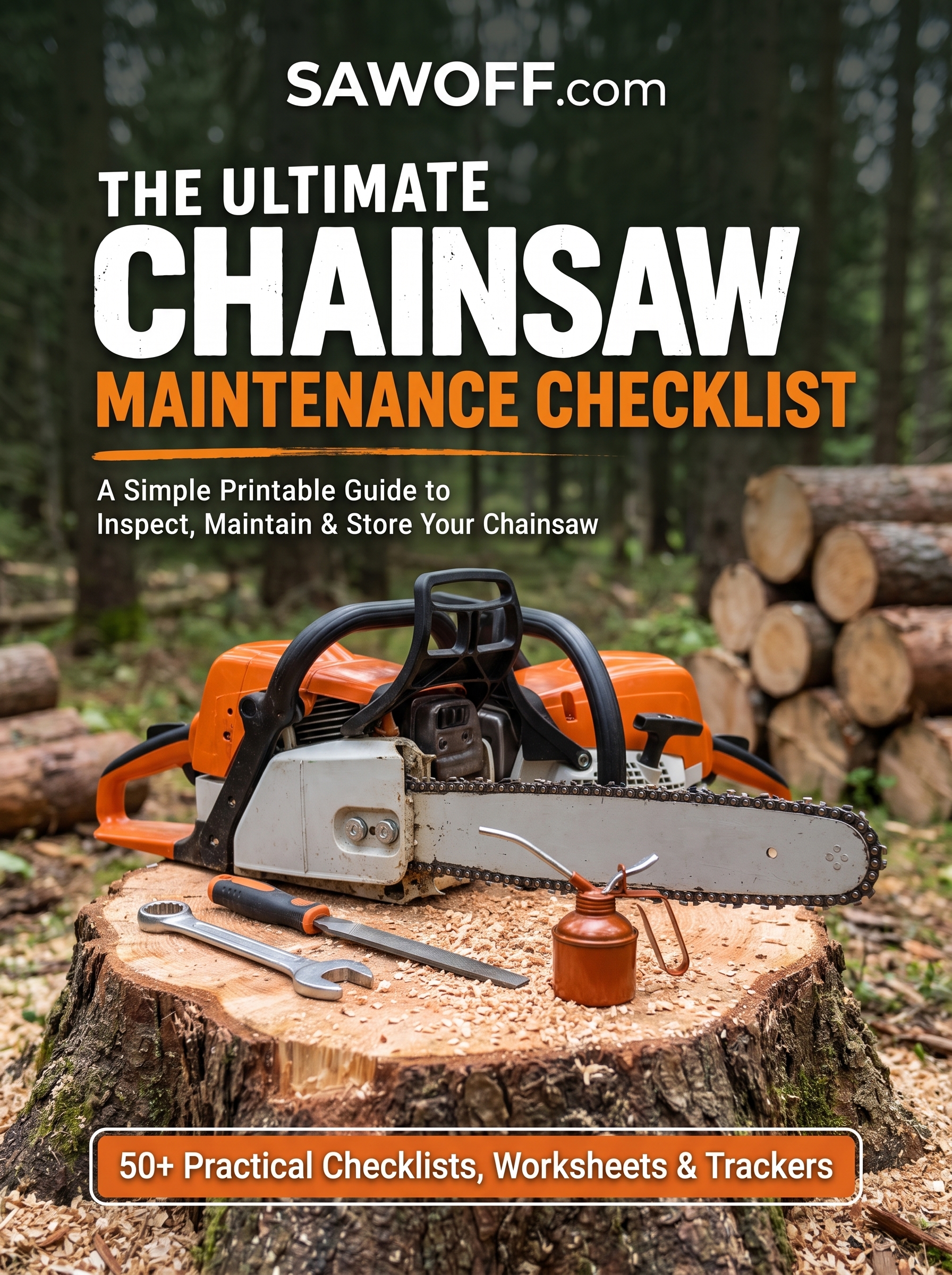
The Ultimate Chainsaw Maintenance Field Toolkit
The complete 96-page printable manual. Avoid costly $400 repairs, master 30°/35°/10° chain sharpening angles, and clear flooded engines in 30 seconds.
- ✓12 In-Depth Modules: Safety checks, service schedules & winterizing
- ✓Chain Sharpening Angles: 30° / 35° / 10° filing charts & raker depth specs
- ✓15 Free Bonus Templates: Angle cheat-sheets, logs & laminated pocket cards
Frequently Asked Questions
Is a Black and Decker chainsaw good for cutting firewood?
Only in small doses. The 40V MAX 16-inch handles occasional green oak rounds up to about 10 inches, and the 20V MAX LCS1020 tops out near 6-inch hardwood branches on its 10-inch bar. For regular cordwood production from seasoned oak, a gas Rancher-class saw or a serious 40V-plus platform is the honest recommendation.
How long does the Black+Decker LCS1020 run on one battery?
Expect on the order of 25 to 35 cuts through 4-inch dry branches on a 2Ah-class pack, less in hardwood or wet wood. That is enough for a morning of pruning an average suburban yard, not enough for a day of bucking. Buy a second pack if you plan sessions longer than an hour.
What is the biggest Black+Decker chainsaw?
The largest current models stay in the 16-to-18-inch class, led by the 40V MAX 16-inch, with an occasional larger corded trim at big-box retailers. Black+Decker reshuffles its yard lineup seasonally, so availability varies, but the brand has never offered a true 20-inch-plus firewood-class DIY saw.
Does the LCS1020 oil the chain automatically?
Yes, the LCS1020 has an automatic oiler, which is rare at its price. The catch is that flow cannot be adjusted and the small reservoir empties quickly, so the owner must still top it off with bar oil and confirm oil is actually reaching the bar before and during every session.
Is Black+Decker a good chainsaw brand compared with Ryobi or Greenworks?
As a light-duty house brand it is decent value for pruning and small cleanup, and typically undercuts the competition at street level. It is not built for firewood season. If your jobs regularly exceed about 8 inches of hardwood, Ryobi, Greenworks, EGO, or SKIL 40V-class platforms hold up better.