Review Information
- Reviewed by: Jack Beurge
- Review type: Research-based review
- Testing status: Not personally tested by SAWOFF — based on manufacturer documentation, reputable sources, and documented owner-reported patterns
- Published: November 4, 2026
- Sources: ANSI B7.1 abrasive wheel requirements · OSHA 29 CFR 1910.243 and 1910.212 machinery guarding · Manufacturer documentation: bandsaw, chop saw, cold saw and cut-off lines
Information in this review is labeled as one of four types: 🧪 SAWOFF hands-on test, 🏭 manufacturer specification, 📚 research from reputable sources (including documented owner-reported patterns), or 🧠 editorial assessment. See our testing methodology and editorial policy.
Compare Live Chainsaws Deals & Market Pricing
Compare current listings for complete chainsaws, OEM-compatible powerheads, guide bars, chains, and arborist safety equipment from sellers worldwide.
- ✓Buyer Protection: Full order & payment protection
- ✓Competitive Prices: Compare sellers side by side
- ✓Fast Shipping: Ready-to-ship inventory & tracked delivery
Affiliate Disclaimer: SAWOFF earns commissions from qualifying purchases made through our affiliate links at no extra cost to you.
The right metal cutting saw depends on three questions: how big is the metal, how clean must the cut be, and how repeatable is it — abrasive chop saws for fast rough cuts, bandsaws for clean versatile ones, dry-cut cold saws for weld-ready precision, and circular/reciprocating saws for on-site in-place work. No single tool covers it all; this guide maps every mainstream machine to the jobs it actually owns.
QUICK DECISION TREE
- Stock bigger than 4×4 or railings for clients? → Dry-cut cold saw or horizontal bandsaw.
- Overhead / installed pipe / rebar in concrete? → Portable deep-cut bandsaw.
- Flat bar, angle iron ≤ 2.5 in, weekly? → 14-inch abrasive chop saw.
- Sheet metal, corrugated, occasional bracket? → Circular saw + metal TCT blade, or angle grinder + cut-off disc.
- Curved or notched cutouts (aircraft, exhaust, brackets)? → Vertical bandsaw (contour saw).
- Demolition, bolts, in-place cuts? → Reciprocating saw with bi-metal blade.
The Metal Cutting Saw Family, Ranked by Job
Abrasive Chop Saw (14 in)
- Cuts: carbon steel angle, flat bar, pipe, rebar, masonry with masonry discs.
- Finish: hot, rough, heavy burr; wheel wears to scrap.
- Best for: cheap, fast, rough work where finish comes from a file afterward.
- See metal cutting chop saws for picks.
Dry-Cut (Cold) Saw
- Cuts: steel, stainless, aluminum; low RPM TCT blade; no sparks or HAZ.
- Finish: weld-ready, minimal burr, cool parts.
- Best for: railings, frames, furniture — anything that must fit the first time.
Horizontal Bandsaw (Shop Saw)
- Cuts: stock up to 6×12 in and beyond; straight-line capacity wins.
- Finish: clean, cool, thin kerf, minimal waste.
- Best for: cutting bar stock to length — the metalworking counterpart to a miter saw.
Vertical Bandsaw (Contour/Toolroom)
- Cuts: curves, notches, cutouts in sheet and plate.
- Finish: smooth enough to weld/grind directly; blade follows a layout line.
- Best for: exhaust work, brackets, aircraft ribs, artistic metalwork.
Portable Deep-Cut Bandsaw
- Cuts: overhead, in-place, one-handed; thick rebar and structural members.
- Finish: straighter, cooler, burr-minimal cuts vs grinders.
- Best for: demolition, MEP installs, field fabrication.
Circular Saw + Metal Blade
- Cuts: sheet, decking, corrugated, aluminum extrusion.
- Blade: cermet/TCT rated for the material and saw RPM — non-negotiable.
- Best for: in-place straight cuts where a chop saw can’t reach.
- See metal cutting blades for circular saws.
Reciprocating Saw
- Cuts: bolts, nails-embedded stock, installed anything; aggressive and inelegant.
- Best for: demolition and rescue; not for accuracy.
- See our best reciprocating saws guide.
Miter / Chop Saw Lineage
- Non-ferrous only on miter saws with TCG blades; ferrous needs ferrous-rated blades and lower RPM — see chop saw vs miter saw.
Cutting Capacity by Material
| Material | Best machine | Watch-out |
|---|---|---|
| Mild steel angle/flat | Abrasive → dry-cut | Hot parts — handle with tongs |
| Stainless tube | Dry-cut / bandsaw | INOX discs only if abrasive |
| Aluminum extrusion | Miter or circular w/ TCG | Chip load — no ATB wood blades |
| Sheet (≤ 1/8 in) | Circular + TCT / shears | Burrs — deburr religiously |
| Rebar | Abrasive / bandsaw | Kickback — clamp everything |
| Galvanized | Bandsaw/dry-cut outdoors | Zinc fumes — P100 + airflow |
| Cast iron | Bandsaw/abrasive | Graphite dust — mask always |
| Pipe in place | Portable bandsaw | Support both sides |
Blade Technology in 60 Seconds
- Abrasive (aluminum oxide / zirconia): bonded disc, cuts by friction; wears thinner; cheapest; spark discipline required.
- Carbide TCT (cermet): brazed teeth; lasts 30–100× abrasive life; needs correct feed pressure and RPM.
- Bi-metal HSS: bandsaw blades; flex fatigue lives measured in thousands of linear inches; tooth pitch by material thickness (3 TPI structural, 10–14 TPI sheet).
- Carbide-tipped bandsaw: for hardened steels and abrasive stock; expensive, unmatched life.
The Safety Stack (Metal Is Not Wood)
- Sparks travel 10+ feet and find solvents, oily rags, and skin — clear a 3-meter cone, no exceptions.
- Hot parts: angle iron glows dull red — tongs, gloves, no hand-testing (learned twice).
- Galvanized/coated: zinc and paint fumes — cut outdoors or P100 + extraction; never in closed spaces.
- Eyes: Z87.1 full coverage; sparks ricochet off walls and back into unmasked eyes.
- Abrasive wheels: ring-test before mounting; guard always; no side-load grinding; disc storage dry.
- Hearing: abrasive cuts exceed 100 dB — protect or accept tinnitus.
- Clamp everything — never “hold” metal with bare hands near a blade; gloves are for handling, not guiding.
- OSHA 1910.243 / ANSI B7.1 — the documents behind these rules; read them once, remember them forever.
Maintenance per Machine
| Machine | Weekly | Monthly |
|---|---|---|
| Abrasive | Guard spring check, pivot lube | Flange flatness, cord inspection |
| Bandsaw (horizontal) | Blade tracking, coolant level | Vise alignment, gearbox oil |
| Bandsaw (portable) | Blade direction, shoe pad | Battery health, wheel brushes |
| Cold saw | TCT tooth inspection | Chip tray cleanout, brake test |
| Circular + metal blade | Bolt torque, blade plate flat | Arbor flange clean |
FAQ (Quick Answers)
One saw covers everything? No saw does. The closest thing: a 14-inch abrasive chop for rough, a portable bandsaw for everything awkward — buy both before any specialty machine.
Horizontal vs vertical bandsaw? Horizontal = stock prep (lengths); vertical = shaped parts (curves, notches). They answer different questions.
Do cold saws cut aluminum cleanly? Beautifully — with a non-ferrous TCG blade. Burr-free, cool, and repeatable for window and door fabrication.
Bottom Line
Match the machine to the cut: abrasive for fast and rough, bandsaw for versatile and clean, cold saw for precise and weld-ready, portable for everywhere-else. Respect sparks, fumes and hot steel with the same liturgy every time, and your cuts will be straight, safe and warranty-free. Next steps: metal cutting chop saw picks, circular saw metal blades, DoALL industrial saws and reciprocating saws.
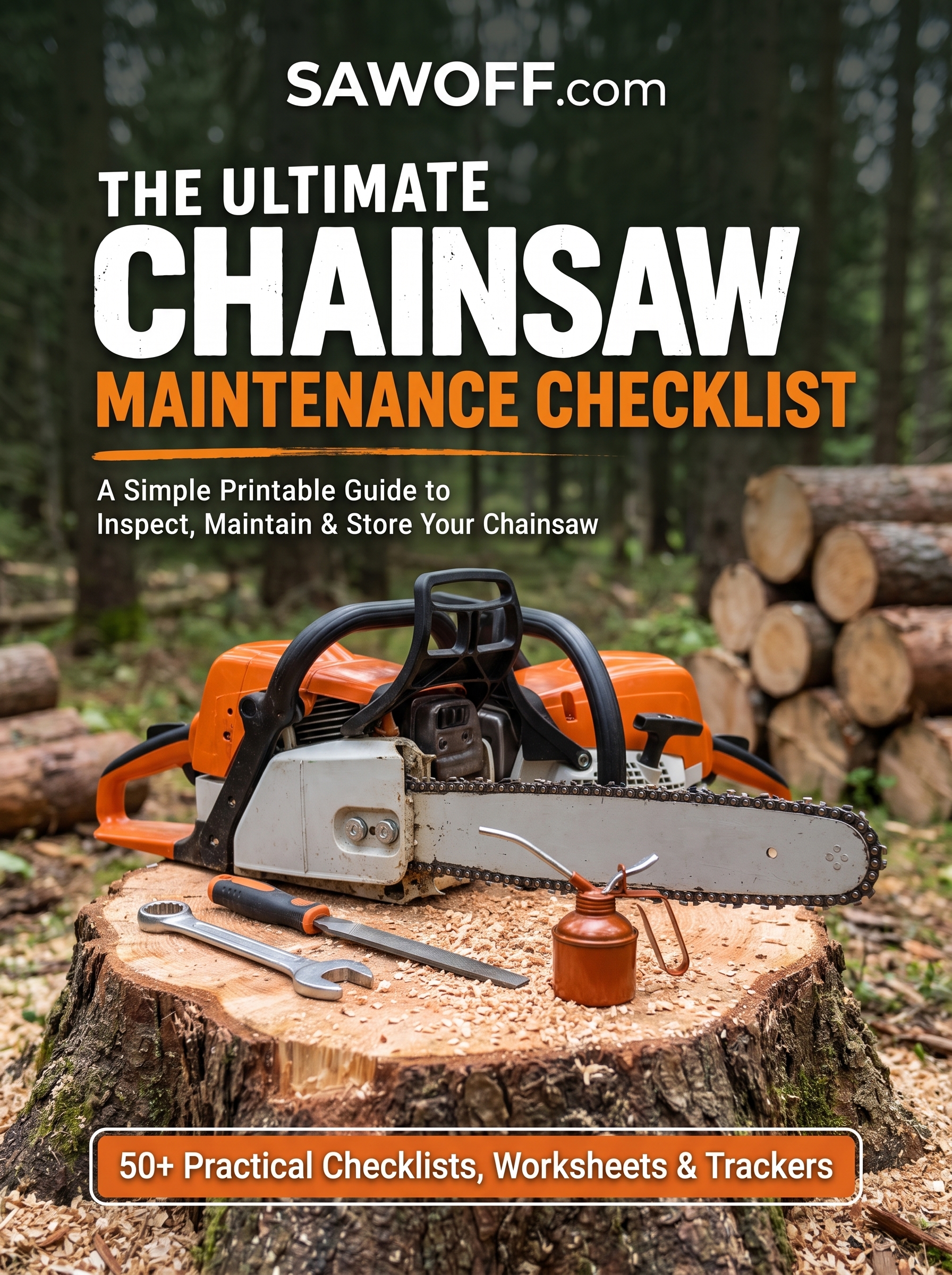
The Ultimate Chainsaw Maintenance Field Toolkit
The complete 96-page printable manual. Avoid costly $400 repairs, master 30°/35°/10° chain sharpening angles, and clear flooded engines in 30 seconds.
- ✓12 In-Depth Modules: Safety checks, service schedules & winterizing
- ✓Chain Sharpening Angles: 30° / 35° / 10° filing charts & raker depth specs
- ✓15 Free Bonus Templates: Angle cheat-sheets, logs & laminated pocket cards
Frequently Asked Questions
What is the best saw for cutting metal at home?
An angle grinder with cut-off discs covers 90% of home metal cutting - but for repeat straight cuts, a 14-inch abrasive chop saw is the answer. For clean edges on furniture and railings, step up to a dry-cut or bandsaw.
Abrasive chop saw or portable bandsaw?
Bandsaw for anything you can't feed through a fixed saw — overhead cuts, rebar in concrete, installed pipe — and for clean, cool, burr-minimal cuts. Abrasive chop for fast flat work on a bench. Portable bandsaws track straighter and waste less wheel than grinders.
Can I cut metal with a regular circular saw?
Yes — with a ferrous-rated cermet/TCT metal cutting blade and the saw's RPM within the blade's rating. Never use a wood ATB blade on steel; teeth strip and chunks eject. Aluminum cuts fine with non-ferrous TCG blades and low RPM.
Is cutting galvanized steel dangerous?
Yes — zinc oxide fumes cause metal fume fever (flu-like illness). Cut galvanized outdoors or with forced extraction and a P100 respirator; never in a closed garage. The same applies to painted or coated stock — paint pyrolysis products are noxious.
Cold saw vs bandsaw for angle iron?
Cold saw wins on finish, repeatability and silence; bandsaw wins on capacity-per-dollar, curvable work and larger sections (6+ inch). Fabrication shops run both; hobby shops usually start with an abrasive chop and add a bandsaw for everything curved.
How do I stop burrs on cut tube?
Use a dry-cut or bandsaw with a sharp blade, let the saw finish the cut without forcing, and knock the feather-edge with a mill bastard file — 60 seconds per end. Deburring tools beat grinders for control every time.
What PPE is mandatory for metal cutting?
Z87 full-seal eye protection, hearing protection, leather gloves (abrasive work only - never near rotating saw blades without a cut-resistant gauntlet), long sleeves, fire-resistant boots, and a face shield when sparks fly. Respirator for coated steels, always.