Review Information
- Reviewed by: Jack Beurge
- Review type: Research-based review
- Testing status: Not personally tested by SAWOFF — based on manufacturer documentation, reputable sources, and documented owner-reported patterns
- Published: November 4, 2026
- Sources: DoALL Sawing Products product literature and catalog · OSHA 29 CFR 1910.212 machinery guarding · Bandsaw blade manufacturer engineering data (tooth form and set selection)
Information in this review is labeled as one of four types: 🧪 SAWOFF hands-on test, 🏭 manufacturer specification, 📚 research from reputable sources (including documented owner-reported patterns), or 🧠 editorial assessment. See our testing methodology and editorial policy.
Compare Live Chainsaws Deals & Market Pricing
Compare current listings for complete chainsaws, OEM-compatible powerheads, guide bars, chains, and arborist safety equipment from sellers worldwide.
- ✓Buyer Protection: Full order & payment protection
- ✓Competitive Prices: Compare sellers side by side
- ✓Fast Shipping: Ready-to-ship inventory & tracked delivery
Affiliate Disclaimer: SAWOFF earns commissions from qualifying purchases made through our affiliate links at no extra cost to you.
DoALL Sawing Products builds American industrial bandsaws — vertical contour machines for toolrooms and horizontals for production cutoff — plus the blades and application engineering that make them sing. If you need curves, notches and die-plate work, look at DoALL verticals; for bar and tube cut-to-length, their horizontals; and always buy blades matched to the alloy you cut. This overview covers what they make, how to choose, what to inspect on used machines, and how DoALL stacks against the other industrial names you will meet in every fabrication shop.
QUICK ANSWER
- DoALL = industrial bandsaw builder (West Allis, Wisconsin), vertical contour + horizontal production saws, blades, service.
- Vertical → curves/notches/internal profiles; Horizontal → straight cutoff of bar, tube, structural shapes.
- Blades: carbon, bi-metal (M42 class), carbide-tipped — tooth form by material (hook/raker/wavy).
- Used market: strong if castings are straight and guides aren’t worn oval; budget for blade and guide refresh.
- Competes with: Amada, Behringer, Hyd-Mech, Marvel, Starrett — different strengths, same ecosystem.
What DoALL Makes (Product Families)
Vertical Contour Bandsaws
- Toolroom class (small): molds, dies, small plates, jewelry-to-aerospace brackets; table tilts, rises, articulates.
- Production verticals: dual-column or C-frame with powered vise, faster blade speeds, material handling for repetitive work.
- Blade guidance: carbide or roller-bearing guides; tilting tables for bevel cutouts.
Horizontal Bandsaws
- Pivot-bow class: light-to-medium cutoff; economical; manual or semi-auto.
- Dual-column class: rigid saw frame, straight cuts in big structural sections; production feeds and automatic bar feeds available.
- Bundle/structural cutting: wide throats for stacks of bar — the “metal service center” machine.
Blades and Consumables
- Carbon steel loops: economical, softer materials, general maintenance.
- Bi-metal (M42/M51 class): the production workhorse; tooth tips harder than the backer; fatigue life far beyond carbon.
- Carbide-tipped: hardened steels, abrasive stainless and nickel alloys; priciest, longest life.
- Tooth forms: hook (fast ripping), raker (general purpose, balanced), wavy (thin sections, sheet, tube walls).
- Set patterns: regular/raker/wave — determines chip clearance vs finish quality.
Support Ecosystem
- Blade selection engineering (material × section × rate) — the real reason shops standardize on DoALL.
- Weld-up loops to exact lengths; resharpening/resetting negotiated through service.
- Parts for legacy machines — DoALL’s long tail of installed machines keeps parts demand alive.
Where DoALL Fits vs the Other Names
| Maker | Strength | Typical buyer |
|---|---|---|
| DoALL | Toolroom verticals, blade engineering, US service | Mold shops, aerospace, job shops |
| Amada | High-production horizontals, automation | Structural steel, service centers |
| Behringer | German rigidity, bundle cutting | Heavy plate, structural |
| Hyd-Mech | Dual-column value | General fabrication |
| Marvel | Horizontal mid-range value | Maintenance shops |
| Starrett | Blades + metrology | Mixed; blade supplier everywhere |
The honest summary: if your cuts are curves in dies and plates, DoALL verticals are the default; if your cuts are 40-foot structural members hourly, Amada/Behringer territory; if you are a maintenance shop cutting bar to length, used DoALL horizontals are ubiquitous and sensible.
How to Choose a DoALL Machine
- Section size — measure your largest regular cut; throat/frame capacity must exceed it by ≥25%.
- Material — carbon steel vs stainless vs nickel alloys dictate blade class (carbon/bi-metal/carbide).
- Volume — prototype toolroom vs lights-out production; vise automation and bar feed change the equation.
- Blade economy — price per 100 cuts, not price per blade; DoALL’s blade engineering often wins here.
- Service radius — DoALL’s US support network favors domestic buyers; export buyers should confirm parts channels first.
Blade Selection Quick Table
| Material / section | Blade | Tooth form |
|---|---|---|
| Mild steel ≤ 3 in round | Bi-metal M42, 6–10 TPI | Raker |
| Stainless tube/plate | Bi-metal M42, 8–14 TPI | Wavy |
| Hardened tool steel | Carbide-tipped | Hook |
| Aluminum | Bi-metal, 4–6 TPI | Hook/raker |
| Structural packs | High TPI hook | Hook |
| Thin sheet (< 1/4 in) | Fine 14–18 TPI | Wavy |
Buying Used: The 9-Point Inspection
- Frame/castings straight — no welds on the bow; cracks = walk away.
- Wheel runout — dial indicator; more than a hair’s drift means blade wander and guide destruction.
- Blade guides — oval wear = budget for replacements; check all four (vertical) or both (horizontal).
- Table flatness — straightedge; for contour work, flatness is everything.
- Vise squareness — 90° to blade both axes; packing shim stock fixes minor drift.
- Blade tracking — tension a blade; it should ride centered without guide contact at cruise.
- Electrical — contactor pitting, E-stop function, limit switches; budget a control refresh if ancient.
- Hydraulics/coolant — pumps prime, lines soft, no leaks; coolant tank not solid sludge.
- Blade order history — ask what blades, what life; a shop that can answer knows the machine.
Safety on DoALL Machines
- Guards always — vertical saw guides shield teeth; horizontal bows guard fully closed before stroke.
- Speed — match SFM to material (chart on the machine or in the manual): too fast work-hardens stainless blades; too slow stalls cuts and snaps teeth.
- Hands never in the cutting envelope; use pushers for thin sections.
- E-stop within reach; brake performance verified on every shift.
- Chip housekeeping — hot, sharp swarf; chips ignite rags; bins marked and emptied.
- OSHA 1910.212 general guarding and press-brake-adjacent discipline applies; DoALL manuals carry machine-specific interlocks — use them.
Common Failure Modes (and the Fixes)
- Blade drift (curves tighten) — guides worn; wheel misalignment; wrong blade width.
- Premature tooth strip — SFM too high, wrong pitch (too coarse for thin wall), or rubbing at gullets.
- Bow vibration/noise — resonance at speed; drop RPM one step; check wheel balance.
- Vise slip — burr cleanup; vise jaw dressing; clamp force re-set.
FAQ (Quick Answers)
Do parts exist for 1980s DoALL verticals? Often yes — castings and many mechanicals still ship; electronics are the weak link. Ask before buying.
Can a DoALL vertical cut aluminum plate? Yes, with the right blade and SFM discipline — aluminum loads gullets; higher TPI and coolant helps.
Are DoALL blades proprietary? No — weld length, width, pitch and hole pattern are all standard; any competent blade welder can supply loops.
Bottom Line
DoALL = bandsaws with an engineering soul: vertical contour machines that toolrooms swear by, horizontals that eat bar stock, and blades that outlast the machines sold with them. Buy the capacity with 25% headroom, blades matched to the alloy, and used castings over shiny paint — and the machine will outlive your lease. Related reading: metal cutting saws guide and metal cutting chop saws.
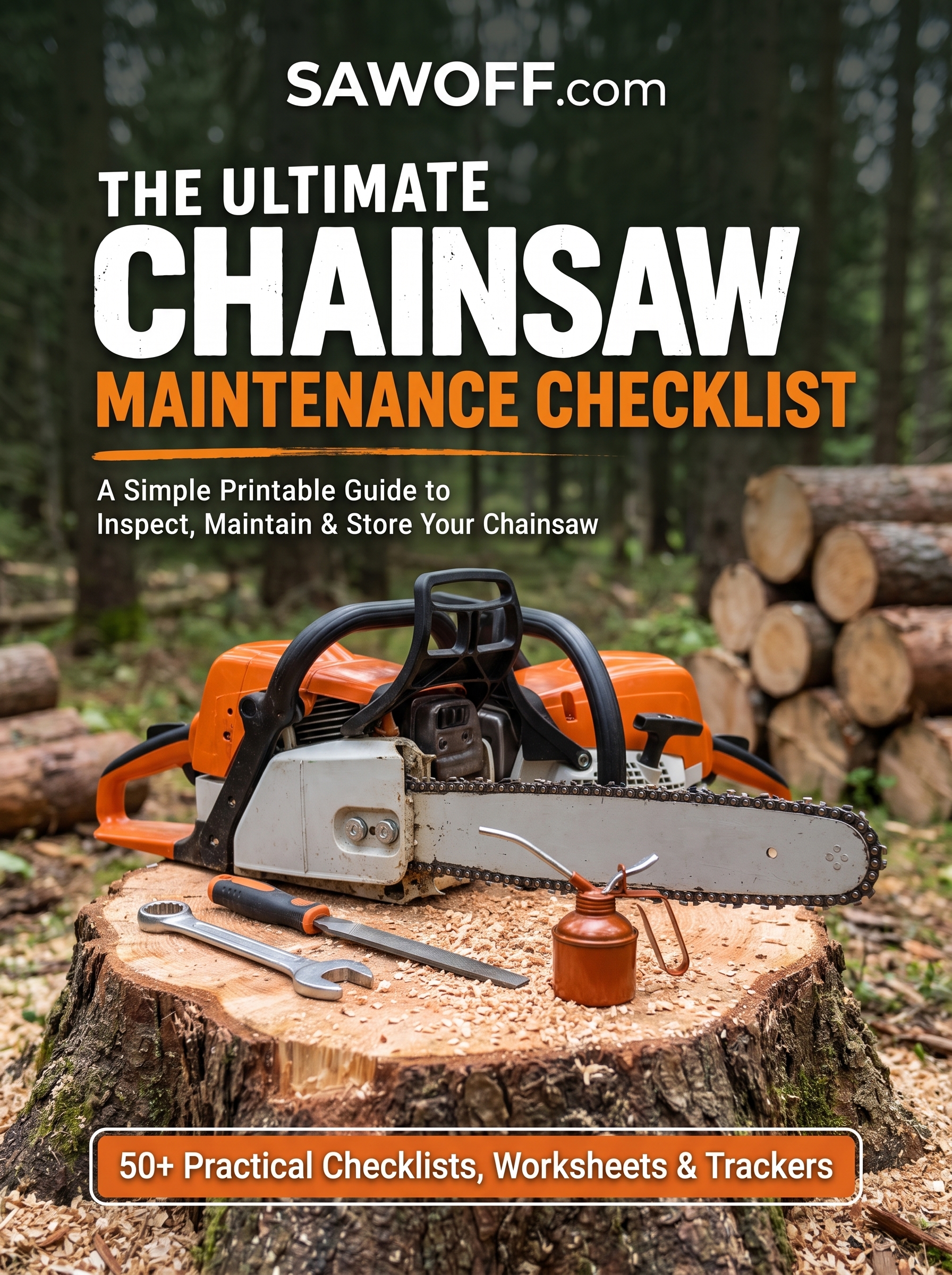
The Ultimate Chainsaw Maintenance Field Toolkit
The complete 96-page printable manual. Avoid costly $400 repairs, master 30°/35°/10° chain sharpening angles, and clear flooded engines in 30 seconds.
- ✓12 In-Depth Modules: Safety checks, service schedules & winterizing
- ✓Chain Sharpening Angles: 30° / 35° / 10° filing charts & raker depth specs
- ✓15 Free Bonus Templates: Angle cheat-sheets, logs & laminated pocket cards
Frequently Asked Questions
What does DoALL Sawing Products make?
Industrial bandsaws - vertical contour saws for toolrooms and mold shops, horizontal saws for production cutoff, and the blades that run in them. DoALL also supports blade selection, weld-up services and parts/service for its installed base across North America.
Is DoALL the same as Starrett?
No. They are separate companies in the same industrial sawing ecosystem - Starrett is best known for blade manufacturing and metrology tools, DoALL for saw machinery and application engineering. Many shops run DoALL machines with Starrett or DoALL blades; blades interchange across brands if length, width and hole pattern match.
Vertical vs horizontal DoALL saws - which do I need?
Vertical contour saws cut curves, notches and internal profiles in molds, die plates and aerospace parts - the blade is stationary, the table tilts/articulates. Horizontal saws cut bar/tube to length in production - the bow pivots down onto fixed material. Toolrooms lean vertical; production cutoff leans horizontal.
Can I run Wood-cutting blades in a DoALL metal saw?
No. Blade alloy, tooth pitch and set differ by material class. Metal blades use bi-metal or carbide with positive-rake TCG-ish forms and tighter set; wood blades have much wider set and different pitch. Wrong blade = stripped teeth at best, ejected fragments at worst.
How do I size a replacement DoALL blade?
Length (weld length in inches), width, thickness and tooth pitch - all printed on the blade backer or in the saw's data plate. Match the original weld length exactly; a blade 1/2 in short will not tension correctly, and blade guides must match the width.
Is buying a used DoALL a good idea?
Often yes - DoALL castings outlive electronics by decades. Inspect wheel runout, guide wear, table flatness, blade tracking, vise alignment and electrical cabinet health. Budget for a re-bore of guides and a blade starter kit; skip anything with a cracked weld seam on the frame.