Review Information
- Reviewed by: Jack Beurge
- Review type: Research-based review
- Testing status: Not personally tested by SAWOFF — based on manufacturer documentation, reputable sources, and documented owner-reported patterns
- Published: November 4, 2026
- Sources: ANSI B7.1 abrasive wheel safety requirements · DeWalt, Makita and Evolution metal cutting product documentation · OSHA 29 CFR 1910.243 abrasive wheel machinery requirements
Information in this review is labeled as one of four types: 🧪 SAWOFF hands-on test, 🏭 manufacturer specification, 📚 research from reputable sources (including documented owner-reported patterns), or 🧠 editorial assessment. See our testing methodology and editorial policy.
Compare Live Chainsaws Deals & Market Pricing
Compare current listings for complete chainsaws, OEM-compatible powerheads, guide bars, chains, and arborist safety equipment from sellers worldwide.
- ✓Buyer Protection: Full order & payment protection
- ✓Competitive Prices: Compare sellers side by side
- ✓Fast Shipping: Ready-to-ship inventory & tracked delivery
Affiliate Disclaimer: SAWOFF earns commissions from qualifying purchases made through our affiliate links at no extra cost to you.
Best metal cutting chop saw overall: the DeWalt D28715 (14-inch abrasive) for most garages, and the Makita LC1230 (12-inch dry-cut) when edges must come off weld-ready and spark-free. Abrasive wins on price and brute force; dry-cut wins on finish, cool cuts and blade life. Pick by what you cut weekly — not by the flyer — and your angles will come out square and burr-free.
QUICK PICKS
| # | Saw | Type | Wheel/Blade | Best for |
|---|---|---|---|---|
| 1 | DeWalt D28715 | Abrasive 14” | 14×1/8×1 in disc | Best overall abrasive |
| 2 | Makita LW1401 | Abrasive 14” | 14×1/8×1 in disc | Best abrasive value |
| 3 | Makita LC1230 | Dry-cut 12” | TCT ~68T | Best clean-cut pick |
| 4 | Evolution EVOSAW line | Dry-cut 14” class | Multi-material TCT | Best carbide value |
| 5 | Hercules/Central Machinery 14” | Abrasive budget | 14 in disc | Occasional fabrication |
Abrasive vs Dry-Cut: The 60-Second Decision
| Abrasive | Dry-cut (cold) | |
|---|---|---|
| Upfront cost | Low (~$110–180) | High (~$350–600) |
| Cost per cut | Disc-dependent | Near-zero at scale |
| Finish | Rough, hot, burr | Cold, clean, weld-ready |
| HAZ | Yes — heat tint | None effectively |
| Stainless-safe | With INOX discs | Yes |
| Noise | 95–105 dB | 85–95 dB |
| Spark/fire risk | Extreme — clear combustibles | Low |
| Disc life | ~Cuts dozens–hundreds of inches | Thousands of inches |
Rule: carbon steel occasionally → abrasive. Carbon steel daily → dry-cut. Stainless often → dry-cut (or INOX abrasive, segregated).
1. DeWalt D28715 (14”) — The Abrasive Standard
- 15-amp class motor; 14-inch wheel; spindle lock; tool-free wheel change
- Spark deflector; adjustable miter? (D28715 is fixed 90° — verify your exact variant’s miter range)
- ~38 lb; no-frills, workshop-proof casting
Why it wins: DeWalt’s guard geometry and deflector are the reference design for spark management; the head pivot stays tight for years with basic bushing maintenance; wheels are commodity 14×1/8×1 in discs found at every industrial supplier for ~$6–9 each.
Watch-outs: it is a grinder on a stand — no bevel stops, no detents, accuracy = your layout lines; chips hot and loud; check guard return spring monthly.
2. Makita LW1401 (14”) — The Value Abrasive
- 15-amp class motor; 14-inch disc; quick-change spindle
- Built-in fence extensions; tool-less adjustment on many variants
- Solid balance between power and portability
Why it merits #2: Makita’s pivot tolerances hold longer than budget imports; replacement parts availability is genuine; the saw survives being dragged to jobsites. If your DeWalt dollar stretches further elsewhere, this is the machine.
Watch-outs: wheel deflector direction — always orient sparks away from walls and solvents; no dust/fume extraction — cut outdoors or with a respirator for painted stock.
3. Makita LC1230 (12”) — The Dry-Cut Precision Pick
- 12-inch TCT blade; low RPM (~1,300 class); electric brake-class stopping
- Clean, cold cuts in mild steel; minimal burr; weld-ready edges
Why pros step up to it: rails, gates, railings and furniture — joints that must land square the first time. No re-cutting red-hot angle iron, no grinding 45° cleanup, no HAZ cracking in stainless. The LC1230 pays for itself in one cancelled remake.
Watch-outs: price 3–4× abrasive; blade quality is the spec — buy Makita-brand or reputable TCT only; capacity smaller than 14 in class (check your largest section).
4. Evolution EVOSAW Line (14” class) — Carbide for the Masses
- 14-inch multi-material TCT blades; low-RPM dry cutting
- Steel, aluminum, corrugated and even masonry-class materials with correct blades
- The “one-saw workshop” marketing line — and honestly the best carbide per dollar
Why it makes the cut: Evolution’s blade engineering genuinely spans ferrous/non-ferrous with the same arbor; for a hobbyist who cuts angle iron Monday and aluminum tube Saturday, the blade flexibility beats abrasive or LC1230-class exclusivity.
Watch-outs: multi-material marketing ≠ universal blade — ferrous and non-ferrous blades differ; feed pressure is mandatory-gentle; verify actual max section capacity for square tube.
5. Hercules / Central Machinery 14” (Budget Abrasive) — Occasional Duty
- 14-inch disc; basic guard; basic fence
- Fine for once-a-month brackets and flat bar
Honest framing: it cuts. The pivot wobbles on day one, the fence is decorative, guard springs tire. For quarterly repairs it is acceptable; weekly fabrication will burn it out and eat discs. Buy it to finish a project; don’t buy it to start a trade.
Watch-outs: insist the guard fully encloses; add a better clamp; eye protection religious; hearing protection as well.
Abrasive Discs — the Consumable That Makes or Breaks the Tool
| Use | Disc spec | Note |
|---|---|---|
| General carbon steel | 14×1/8×1 in, Type 1 flat | Standard commodity |
| Stainless (INOX) | INOX-rated, iron-free | Prevent rust spotting |
| Masonry/abrasive | 14×1/8 in masonry | Separate rack — never steel |
| Aluminum | INOX or aluminum-rated | Minimize loading/clogging |
Never mount: Type 27 depressed-center discs on a Type 1 flange; any disc with cracks; any disc older than the smell of the solvent it sat in. Ring-test, always.
10-Point Buying Checklist
- Wheel size fits your largest stock section?
- Guard clears max disc diameter and returns by spring?
- Spindle lock for one-wrench changes?
- Fence extends both directions for tube support?
- Base mounts to a bench/stand — never freehand on the floor?
- Sparks deflect away from you?
- Pivot bushings adjustable for wear?
- Wheels/blades locally stocked?
- Noise level acceptable for your shop hours?
- If dry-cut: blade geometry verified for ferrous OR non-ferrous (they differ)?
Maintenance Minimums
- Clean pivot weekly; grease bushings per manual (light grease, no oil baths).
- Inspect cord — sparks love insulation weak spots; repair or retire.
- Keep disc flanges flat and clean; a warped flange = wobble = cracks.
- Test guard return weekly — it must snap closed unassisted.
FAQ (Quick Answers)
Can I use a dry-cut saw on pipe outdoors? Yes — best of all worlds: cold cut, no sparks, no neighbors complaining.
How do I know when to retire a disc? Below rated diameter (guard exposes it), any visible crack, or when you catch yourself pushing harder. Refusal to push is not weakness, it’s data.
Chop saw vs angle grinder with cut-off disc? Chop saw = straight repeatable cuts, hands safe; grinder = freeform. Different tools, different cuts — both are “metal saws,” neither replaces the other.
Bottom Line
Abrasive for brute force on a budget, dry-cut for craftsmanship and cold, clean edges — both are honest tools when matched to the job. Buy the DeWalt or Makita for spark life, the LC1230 or Evolution for finish, and always, always the right disc for the metal. Related: chop saw vs miter saw, metal cutting saws guide and circular saw metal cutting blades.
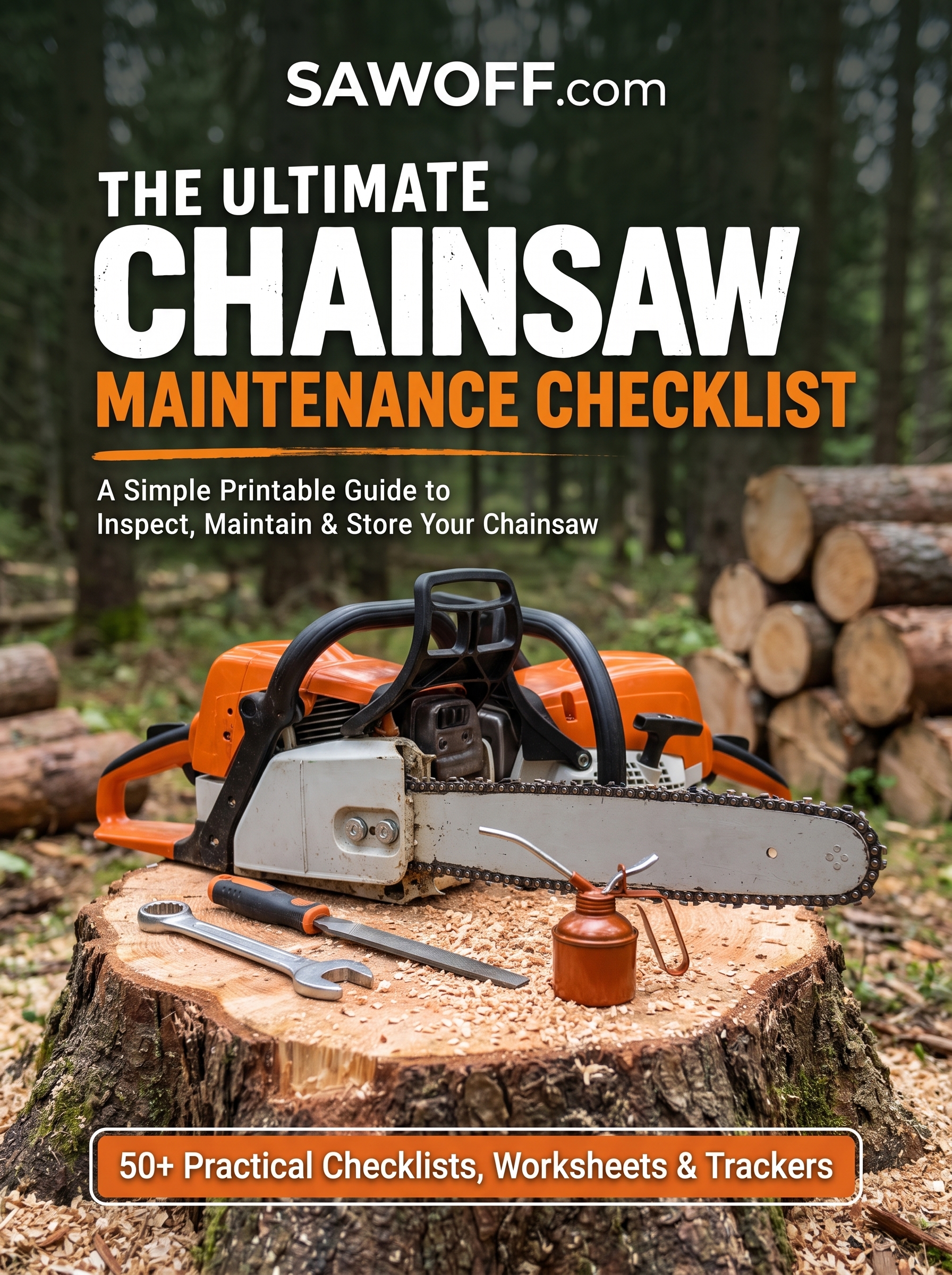
The Ultimate Chainsaw Maintenance Field Toolkit
The complete 96-page printable manual. Avoid costly $400 repairs, master 30°/35°/10° chain sharpening angles, and clear flooded engines in 30 seconds.
- ✓12 In-Depth Modules: Safety checks, service schedules & winterizing
- ✓Chain Sharpening Angles: 30° / 35° / 10° filing charts & raker depth specs
- ✓15 Free Bonus Templates: Angle cheat-sheets, logs & laminated pocket cards
Frequently Asked Questions
Which is better - abrasive or dry-cut metal chop saw?
Abrasive for cheap, fast, spark-tolerant work in carbon steel; dry-cut when cut quality, cold parts, minimal burrs or stainless heat-tint matter. Dry-cut costs 3-4x upfront but the blade lasts far longer and leaves weld-ready edges. Budget fabricators buy one of each.
What size abrasive wheel do I need?
14 inches is the workshop standard (1/8 in thick, 1 in bore). It bisects 5 in round stock or ~4.5 in square tube. Chop depth drops as the wheel wears - a worn wheel cuts shallower, so stop when the guard scrapes.
Can I cut stainless with an abrasive saw?
Yes, with INOX-rated wheels and light pressure. Standard aluminum-oxide wheels contaminate stainless surfaces (embedded iron → rust spots). Grind stainless with dedicated stainless-only discs and keep them segregated in your rack.
Why does my chop saw wander mid-cut?
Either the wheel wore a groove (replace or dress it), or the pivot has side play (adjust the pivot bushings per manual). Never compensate by wiggling the head - that cracks the wheel. Let the disc cut; your job is to hold, not to steer.
How loud are these saws?
Abrasive: 95 to 105 dB at the ear - double protection recommended, neighbors deserve warning. Dry-cut: markedly quieter with TCT blades, roughly 85 to 95 dB depending on stock hardness.
How do I store abrasive wheels?
Flat or hung on a peg, dry, away from oil/solvents, never in a cold truck bed in freezing rain. Moisture degrades the bond - a cracked wheel at 4,000 RPM is shrapnel. Ring-test every wheel before mounting.