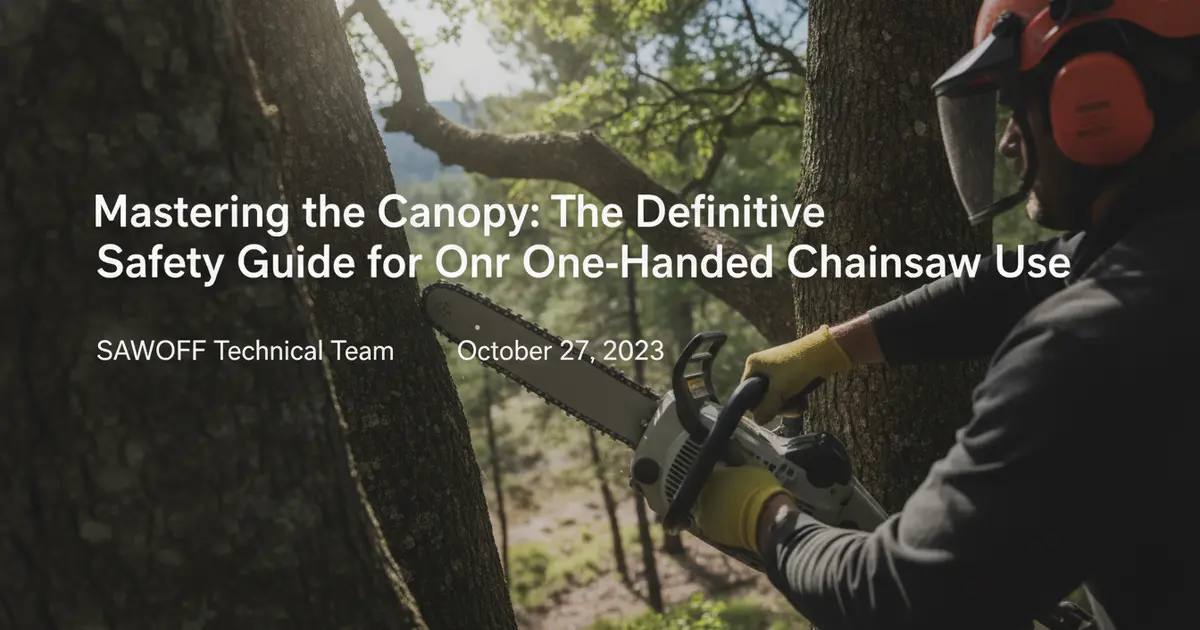
Mastering the Canopy: The Definitive Safety Guide for One-Handed Chainsaw Use
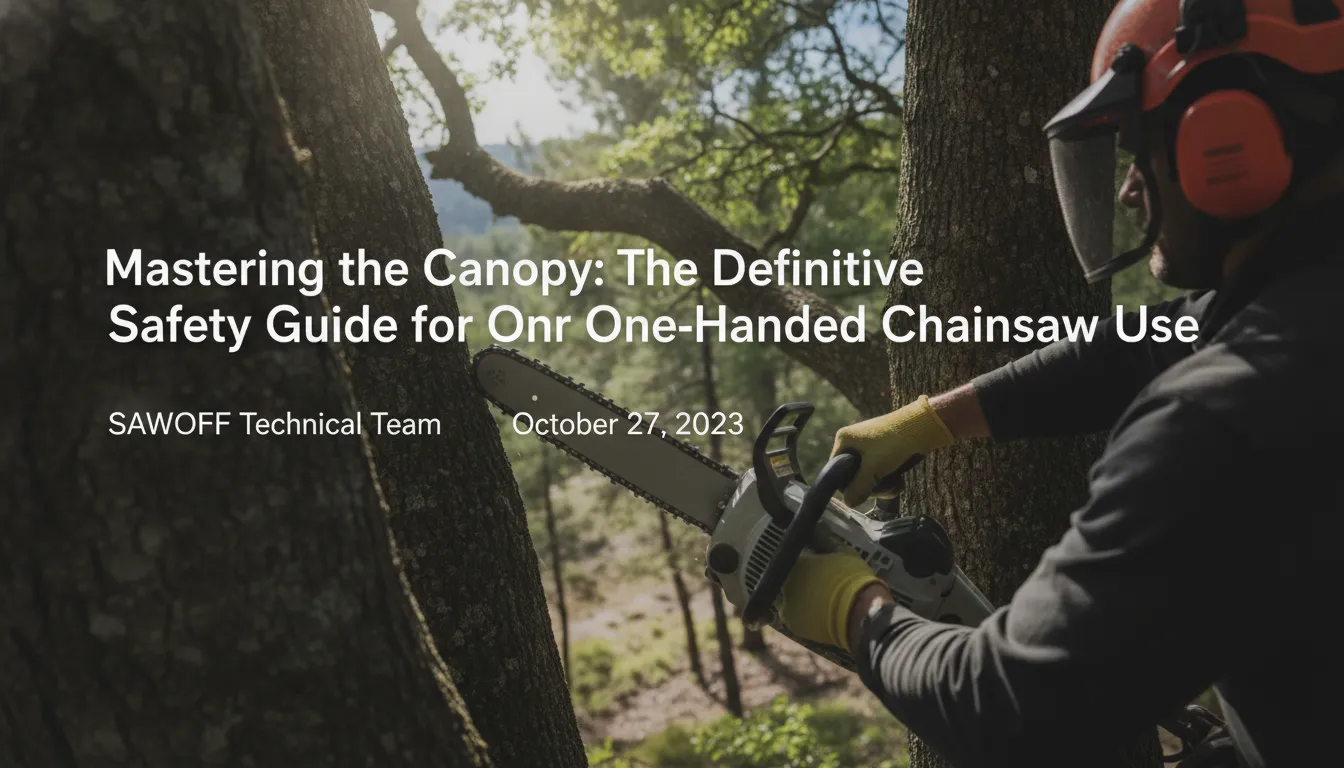
I’ve spent the better part of two decades tethered to a climbing harness, dangling sixty feet above the hard deck with a screaming engine inches from my thigh. If there’s one thing I’ve learned, it’s that the term “one-handed chainsaw” is a bit of a misnomer—it’s an invitation to a disaster if you don’t respect the physics involved.
In the world of professional arboriculture, “top-handle” saws are the scalpel of the industry. They are designed for one specific purpose: working in the confined, awkward spaces of a tree canopy where a traditional rear-handle saw like the Stihl MS 250 would be too unwieldy. But let’s be crystal clear before we pull the starter cord: just because you can operate these saws with one hand doesn’t always mean you should.
This guide isn’t your typical “wear your goggles” pamphlet. We are going deep into the mechanical engineering, the centrifugal forces of a spinning chain, and the brutal reality of what happens when a 35cc engine decides to kick back while your off-hand is busy holding a limb.
The Top-Handle Landscape: Strategic Comparison
When you’re looking for a saw designed for precision and one-handed capability, you aren’t looking at “homeowner” models. You’re looking at professional-grade arborist equipment. Here is how the heavy hitters stack up against the standard ground saws.
| Model | Type | Weight (Powerhead) | Displacement | Best Application | Price Link |
|---|---|---|---|---|---|
| Echo CS-2511T | Top-Handle | 5.2 lbs | 25.1 cc | Extreme Portability | 🛒 Check Echo Price |
| Husqvarna T540 XP II | Top-Handle | 8.6 lbs | 37.7 cc | High-Power Climbing | 🛒 Check Husky Price |
| Stihl MS 201 T C-M | Top-Handle | 8.16 lbs | 35.2 cc | The Industry Standard | 🛒 Check Stihl Price |
| Husqvarna 120 | Rear-Handle | 9.3 lbs | 38.2 cc | Ground Use/Limbing | 🛒 Check Husky 120 |
Technical Engineering Deep-Dive: Why Top-Handles Are Different
To understand the safety of one-handed use, you have to understand the architecture of the tool. A standard saw, like the Husqvarna 435, places the handles far apart to give the operator maximum leverage. This creates a long “moment arm,” making it easier to resist the saw’s desire to rotate during a kickback.
The Center of Gravity (CoG) Paradox
In a top-handle saw, the throttle and the main handle are located directly over the center of gravity. This is a deliberate engineering choice. It allows the saw to balance perfectly on one finger if held by the top handle. This “neutral balance” is what makes one-handed operation possible for an arborist who needs to reach out and prune a lateral branch while holding onto a trunk for stability.
However, this proximity of the hand to the center of gravity significantly reduces your mechanical advantage. When the tip of the bar hits a knot or gets pinched, the saw wants to pivot around your wrist. In a rear-handle saw, your two hands are spaced out, creating a stable platform. In a top-handle saw, your wrist is the only thing standing between the spinning teeth and your face.
Engine Architecture and Torque Profiles
Most top-handle saws are high-revving, two-stroke machines. Take the Echo CS-2511T—it’s the lightest gas saw in the world. Its magnesium crankcase is shaved down to the absolute minimum to save weight. This creates a very “snappy” power delivery. Unlike the “lugging power” you find in a Stihl MS 311, top-handle saws rely on chain speed.
The air filtration systems are also specialized. Because these saws operate in a cloud of fine dust within the canopy, manufacturers like Husqvarna use centrifugal air cleaning (Air Injection). This uses the cooling fan to throw heavier dust particles away from the filter, extending the runtime between cleanings. When you’re sixty feet up, the last thing you want to do is climb down because your filter is choked.
The Inertia-Activated Chain Brake
On a one-handed saw, the chain brake is your best friend and your only real safety net. Unlike ground saws where you might manually trip the brake with your left wrist, top-handle saws rely heavily on inertia activation. If the saw kicks upward violently, the physical “jerk” of the movement triggers the brake mechanism, stopping the chain in milliseconds. I’ve had this save my skin more than once when bucking a heavy limb that had more internal tension than I anticipated.
Real-World Performance: The “One-Handed” Reality
In my fifteen years of doing this, I’ve seen guys treat top-handle saws like toys because they are small. That is a fatal mistake. When we talk about “performance,” we’re talking about how the saw behaves under “reactive forces.”
Bucking and Limbing in the Air
When you use a saw like the Echo CS-490 on the ground, gravity is usually your friend. In a tree, you’re often cutting at odd angles. One-handed use is technically against the “Safety Manual” for most manufacturers, but the industry recognizes its necessity in specific climbing scenarios.
The trick is the “Three-Point Contact” rule. If you are using one hand on the saw, your other three points (two feet and a flip-line, or one foot and two lanyards) must be rock solid. I never engage a one-handed cut if I’m not braced against the trunk. The moment that chain bites, it’s going to pull you or push you. If you’re dangling, the saw will win that wrestling match every time.
The “Snap” of the Pull Cord
There’s a tactile satisfaction in starting a well-tuned top-handle. Because you’re often starting these saws “in the air,” they usually feature a “Easy Start” spring-assist mechanism. You don’t “drop-start” these (which is dangerous anyway); you hold the handle and give a short, sharp pull. The compression release valves in models like the Stihl MS 201 T make this a breeze, preventing that jerky recoil that can throw off your balance when you’re perched on a limb.
Ergonomics & Operator Comfort: The Vibration Factor
If you use a Stihl MS 170 for an hour, your hands might tingle. Use a cheap, poorly balanced “mini-chainsaw” one-handed for four hours, and you’ll lose feeling in your fingers. This is “Hand-Arm Vibration Syndrome” (HAVS), and it’s a serious professional hazard.
High-end top-handle saws use sophisticated anti-vibration systems—usually steel springs or high-density rubber bushings that decouple the engine from the handle. When I’m bucking white oak, I can feel the “growl” of the engine through the saw, but the actual high-frequency oscillation is dampened. This is crucial for one-handed use because a vibrating saw is a saw that is harder to grip firmly.
Handle Geometry
The grip on a pro-grade top-handle is contoured for a “pistol grip” feel. The trigger is usually wide enough for two fingers, allowing for better modulation. You aren’t just “on” or “off” with the throttle; you’re “feathering” it as you enter a delicate pruning cut. This level of control is what separates a professional tool from the $90 “one-handed” clones you see on discount sites.
Brand Heritage: The Legacy of the T-Saw
The “T” (Top-handle) designation in the chainsaw world is a badge of honor. Husqvarna and Stihl have been fighting for dominance in this space for decades. The Stihl 020T was the legendary grandfather of the modern MS 201 T. It was the saw that proved you could have pro-grade power in a package the size of a lunchbox.
Husqvarna countered with the XP (Extra Performance) line, focusing on extreme chain speed and “AutoTune” carburetors that adjust to altitude and fuel quality on the fly. If you’re an arborist in Denver, you want that AutoTune. If you’re a traditionalist in the Northeast, you might prefer the raw, adjustable carb of an older Echo.
Maintenance & Serviceability: Keeping the Scalpel Sharp
A dull saw is a dangerous saw, especially when used one-handed. A dull chain requires you to push harder. Pushing harder leads to “slips.” Slips lead to the emergency room.
- Chain Tensioning: Most top-handles now have side-access chain tensioners. Don’t be lazy—check the tension every time you refuel. If the chain is sagging, it can “throw” off the bar, which is a nightmare scenario when you’re sixty feet up.
- The Air Filter: As I mentioned, these saws live in the “dust zone.” I clean my filter every single day after work. On the Stihl models, the shroud is usually held on by a single captive screw—easy to do in the back of the truck.
- The Spark Plug: Because these engines are small, they are sensitive to “foul.” Use high-octane fuel and a quality 50:1 mix (like Stihl MotoMix) to keep the carbon deposits down.
Technical Hardware Specs (Pro-Level)
If you’re looking for the “Holy Grail” of one-handed specs, here is what the professional “Golden Standard” looks like:
- Displacement: 25cc (Ultra-light) to 36cc (Power-house)
- Power Output: 1.1 hp to 2.5 hp
- Dry Weight: 5.2 lbs to 8.5 lbs
- Chain Pitch: 1/4-inch P or 3/8-inch P (Low Profile)
- Oil System: Automatic, adjustable (Very important for longer bars)
- Crankcase: Magnesium (Accept no plastic substitutes for pro use)
Pros & Cons of One-Handed Operation
Pros:
- Incredible Maneuverability: Get into crotches and tight angles that are impossible with a rear-handle saw.
- Reduced Fatigue: When properly balanced, the saw does the work, not your shoulder.
- Efficiency: Allows the climber to hold a branch with one hand and cut with the other, controlling the “fall” of the debris.
Cons:
- Extreme Kickback Risk: Without a second hand to stabilize the saw, a kickback is much harder to control.
- Limited Leverage: You cannot “muscle” a cut; you must rely entirely on the sharpness of the chain.
- Legal/Safety Standards: In many jurisdictions, one-handed operation is technically a safety violation unless no other method is possible.
The SAWOFF Edge: Our Professional Take
Here is the “brutally honest” part: Most people who want a “one-handed chainsaw” shouldn’t have one. If you are a homeowner looking to clear some brush in the backyard, get a Husqvarna 120 or a specialized electric chainsaw. The risk of a top-handle saw for an untrained user is astronomically high.
However, if you are a professional climber or a serious “prosumer” who understands the physics of wood tension and the mechanics of a chainsaw, the top-handle is an indispensable tool. It’s the difference between fighting the tree and working with it.
SAWOFF Rating: 4.8 / 5 (For Professional Use Only)
🛒 Shop Top-Handle Chainsaws on AmazonFAQ: Critical Questions for One-Handed Use
1. Is it legal to use a chainsaw one-handed?
According to OSHA and ANSI Z133 standards in the US, chainsaws are generally required to be operated with two hands. However, there is an exception for professional arborists when two-handed operation is unsafe (e.g., when the climber needs to maintain a stable position). For the average user, the answer is “No, it’s not recommended and technically a violation of safety guidelines.”
2. What is the best fuel mix for these small engines?
Most high-end top-handle saws require a 50:1 ratio of high-octane gasoline (91 or higher) to high-quality 2-cycle oil. I personally recommend using pre-mixed fuels like Stihl MotoMix or Husqvarna XP+. They have no ethanol, which is the #1 killer of small engine carburetors.
3. Why does my top-handle saw stall when I tilt it?
This is usually a fuel-pickup issue. These saws are designed to run at all angles, but if the “fuel flop” (the weighted filter in the tank) gets stuck or the fuel line has a pinhole leak, gravity will starve the engine when tilted. Check your fuel line and filter.
4. Can I put a 16-inch bar on a top-handle saw?
Just because it fits doesn’t mean you should. Most top-handles are optimized for 12-inch or 14-inch bars. Putting a 16-inch bar on a 25cc saw like the Echo CS-2511T will make it nose-heavy, ruining the “one-handed” balance and straining the oiler.
5. What should I do if the saw kicks back while I’m using it one-handed?
If you have properly engaged your “Three-Point Contact” and the chain brake is functioning, the brake should trip via inertia. Your best defense is to never have your body in the “kickback plane”—the imaginary line extending from the bar. Always stand to the side of the cut.
6. Are battery-powered one-handed saws any good?
Absolutely. The instant torque of a brushless motor is incredible for pruning. The Husqvarna T540i XP is a beast that rivals gas-powered performance without the noise or the pull-start. For more on battery options, check our Electric Chainsaw Guide.
7. How often should I sharpen the chain?
Every time you refuel. A quick “touch up” with a file takes two minutes. If you wait until it’s throwing “flour” instead of “chips,” you’ve waited too long. In one-handed use, a sharp chain is your primary safety feature.
8. What PPE is mandatory for one-handed use?
Chainsaw chaps or trousers, a climbing helmet with integrated ear protection and a face shield, and most importantly, cut-resistant gloves. When using a saw one-handed, your off-hand is often in the “danger zone”—protect it.
Frequently Asked Questions
Is it legal to use a chainsaw one-handed?
According to OSHA and ANSI Z133 standards in the US, chainsaws are generally required to be operated with two hands. However, professional arborists have an exception when two-handed operation is unsafe, such as when the climber needs to maintain a stable position. For average users, one-handed use is not recommended and technically a violation of safety guidelines.
What is the best fuel mix for top-handle chainsaw engines?
Most high-end top-handle saws require a 50:1 ratio of high-octane gasoline (91 or higher) to high-quality 2-cycle oil. Pre-mixed fuels like Stihl MotoMix or Husqvarna XP+ are recommended because they contain no ethanol, which is the number one killer of small engine carburetors.
Why does my top-handle saw stall when I tilt it?
This is usually a fuel-pickup issue. These saws are designed to run at all angles, but if the weighted fuel filter in the tank gets stuck or the fuel line has a pinhole leak, gravity will starve the engine when tilted. Check your fuel line and filter to resolve the issue.
Can I put a 16-inch bar on a top-handle saw?
Just because it fits doesn't mean you should. Most top-handles are optimized for 12-inch or 14-inch bars. Putting a 16-inch bar on a 25cc saw like the Echo CS-2511T will make it nose-heavy, ruining the one-handed balance and straining the oiler.
What should I do if the saw kicks back while using it one-handed?
If you have properly engaged your three-point contact and the chain brake is functioning, the brake should trip via inertia. Your best defense is to never have your body in the kickback plane—the imaginary line extending from the bar. Always stand to the side of the cut.
What PPE is mandatory for one-handed chainsaw use?
Chainsaw chaps or trousers, a climbing helmet with integrated ear protection and a face shield, and cut-resistant gloves are mandatory. When using a saw one-handed, your off-hand is often in the danger zone and needs protection.