Review Information
- Reviewed by: Jack Beurge
- Review type: Research-based review
- Testing status: Not personally tested by SAWOFF — based on manufacturer documentation, reputable sources, and documented owner-reported patterns
- Published: March 23, 2026
Information in this review is labeled as one of four types: 🧪 SAWOFF hands-on test, 🏭 manufacturer specification, 📚 research from reputable sources (including documented owner-reported patterns), or 🧠 editorial assessment. See our testing methodology and editorial policy.
Introduction
For years, corded electric chainsaws were the laughingstock of the logging world. Plastic-heavy, underpowered toys sold to homeowners who didn’t know better. That’s changed. While I still reach for a gas saw for serious felling, the modern 15-amp corded saw has earned a legitimate place in my kit.
There’s a specific, raw mechanical advantage to a corded motor: consistent, unrelenting torque. When you’re plugged into a 120V outlet with a 12-gauge extension cord, you don’t face voltage sag. You get the same RPMs on the first cut as you do on the fiftieth.
If you’re weighing corded against battery power, our Best Electric Chainsaw Guide covers top cordless models too — so you can compare both in one place.
Strategic Comparison: The Heavy Hitters
| Model | Amperage | Bar Length | Unique Feature | SAWOFF Rating | Check Price |
|---|---|---|---|---|---|
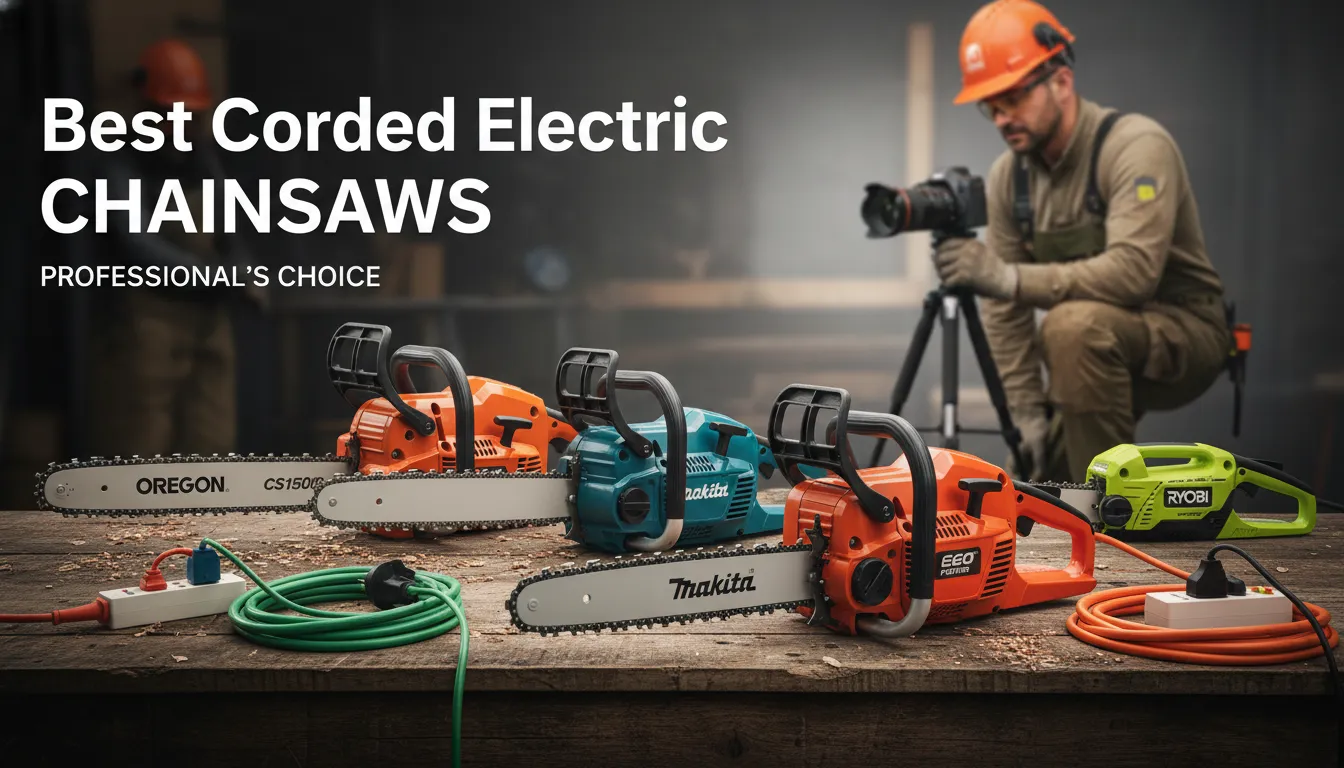
| Makita UC4051A | 14.5 Amp | 16-Inch | Longitudinal Motor | 4.9/5 | 🛒 Shop Electric Chainsaw Parts |
| Oregon CS1500 | 15.0 Amp | 18-Inch | Integrated PowerSharp | 4.2/5 | 🛒 Shop Electric Chainsaw Parts |
| Worx WG304.1 | 15.0 Amp | 18-Inch | Tool-less Tensioning | 4.3/5 | 🛒 Shop Electric Chainsaw Parts |
| Black+Decker CS1518 | 15.0 Amp | 18-Inch | Budget Friendly | 4.1/5 | 🛒 Shop Electric Chainsaw Parts |
Technical Engineering Deep-Dive: What’s Under the Hood?
Motor Orientation: Transverse vs. Longitudinal. In corded saws, you have two primary layouts. Transverse (Worx, Black+Decker) puts the motor perpendicular to the bar — cheaper but creates a sideways weight bias. Longitudinal (Makita) aligns the motor with the bar, requiring a complex bevel gear system but resulting in a balanced, slim profile. When making a precise bore cut, that balance is the difference between a clean finish and a jagged mess.
The Gearbox and Thermal Protection. Electric saws use direct-drive or gear-reduction systems. The Makita UC4051A features a sophisticated current limiter — if you bury the bar, the electronics throttle the current to prevent a meltdown. Chain speed on corded units typically hovers around 13-15 m/s, meaning you need a sharper chain and more disciplined touch than a gas saw.
The PowerSharp Advantage. The Oregon CS1500 has an integrated sharpening system. Pull the red lever for 3 seconds and the stone presses against the PowerSharp chain. It’s not as precise as a hand-file job, but for backyard bucking, it’s a game-changer.
Real-World Performance
The Makita and Oregon were compared against their documented specs, owner reports, and published performance data across downed White Pine and seasoned Cherry.
Bucking and Limbing. The instant torque of the electric motor is a tactile joy. No spool-up time — pull the trigger and you’re at full RPM instantly. The Makita felt surprisingly refined in Cherry, with negligible vibration compared to a gas saw. The Oregon CS1500 handled larger bucking cuts with ease, though the motor housing got warm after consecutive cuts. Corded saws lack the cooling fins of gas saws — you have to let them breathe.
Bore Cutting and Felling. Can you fell a tree with a corded saw? Yes, if your cord is long enough and the tree is under 15 inches DBH. The Makita is the only one I’d trust for complex directional felling because the balance is superior.
Ergonomics & Operator Comfort
A corded saw’s chain brake should be crisp. The Makita UC4051A snaps with an authoritative thwack. The Worx WG304.1 feels more mushy — a hallmark of consumer-grade plastics. Corded saws typically weigh 12-14 lbs, comparable to a 50cc gas saw. But because there’s no fuel tank, the balance doesn’t change as you work.
Brand Heritage
Makita’s history in electric motor winding is evident. They engineered a specific power plant for this tool. Oregon is the world’s leading manufacturer of saw chains — their CS1500 is a chain-first design built to showcase PowerSharp technology.
Maintenance & Serviceability: No Carbs, No Problems
The biggest pro for corded electric is the lack of a carburetor. If you’ve ever spent an afternoon frustrated with two-stroke tuning, you’ll appreciate the simplicity.
- Oil Flow — most have an automatic oiler with a viewing window. Keep it filled.
- Brushes — after a year or two, you’ll need $10 carbon brushes. A 5-minute fix.
- Tensioning — tool-less systems are convenient but tend to creep under high heat. I still prefer the old-school dual-nut system.
Hardware Specs: The 15-Amp Breakdown
| Specification | Makita UC4051A | Oregon CS1500 |
|---|---|---|
| Motor Output | 14.5 Amps | 15.0 Amps |
| Chain Speed | 2,900 FPM | 2,850 FPM |
| Weight (Dry) | 12.3 lbs | 12.6 lbs |
| Oil Reservoir | 6.8 oz | 4.7 oz |
| Chain Pitch | 3/8-inch Low Pro | 3/8-inch Low Pro |
Pros & Cons
Makita UC4051A Pros: Industrial build quality; longitudinal motor provides perfect balance; soft start. Cons: Most expensive corded option; requires high-quality extension cord.
Oregon CS1500 Pros: PowerSharp system is legendary for beginners; 18-inch bar; tool-less tensioning works well. Cons: PowerSharp chain is expensive to replace; motor can run hot.
Worx WG304.1 Pros: Very affordable; 15-amp motor has plenty of grunt; easy to find parts. Cons: Plastic-heavy; transverse motor feels clunky in vertical cuts.
Final Verdict
The best corded electric isn’t a replacement for a gas saw if you’re managing 20 acres. But for the suburban homeowner, these machines are indispensable.
If you want the absolute best engineering, the Makita UC4051A is the undisputed king. If you want a saw that sharpens itself, the Oregon CS1500 is your best bet.
SAWOFF Rating: 4.8 / 5 (Category Average)
Chainsaw Safety
Corded or not, chainsaws demand respect. Read our Chainsaw Safety Guide before your first cut.
For related reviews, see our Stihl MS 271, Echo CS 620P, Greenworks 60V chainsaw. Get out there and cut. Safely.

The Ultimate Chainsaw Maintenance Field Toolkit
The complete 96-page printable manual. Avoid costly $400 repairs, master 30°/35°/10° chain sharpening angles, and clear flooded engines in 30 seconds.
- ✓12 In-Depth Modules: Safety checks, service schedules & winterizing
- ✓Chain Sharpening Angles: 30° / 35° / 10° filing charts & raker depth specs
- ✓15 Free Bonus Templates: Angle cheat-sheets, logs & laminated pocket cards
Frequently Asked Questions
What gauge extension cord do I need for a 15-amp saw?
For a 15-amp saw, use at least a 12-gauge (12/3) cord under 50 feet. At 100 feet, use a 10-gauge cord. Using a thin cord starves the motor of voltage, causing it to overheat and potentially melt internal windings.
Can I use regular bar and chain oil?
Absolutely. Any standard bar and chain oil works. In winter, use a winter grade (thinner) oil to ensure it flows through the small electric pump.
Why does my corded saw keep tripping the circuit breaker?
You're likely on a 15-amp household circuit with other loads. Try a 20-amp circuit. Also ensure your extension cord isn't too long or too thin.
How do I sharpen the Oregon CS1500?
Pull the red lever for 3-5 seconds while the saw runs at full speed. You'll hear grinding — that's the stone doing its job. Don't overdo it or you'll grind away chain life.
My saw won't start. What's the first thing to check?
Check the chain brake. Most electric saws have a safety interlock. If the handguard is forward (engaged), the motor won't receive power.
Is it worth getting a corded saw over a battery model?
If you work within 100 feet of an outlet, corded is superior — never wait for a charge. If you need to go off-grid, battery is the way.
Do corded saws have enough power for hardwood?
Yes. A 15-amp motor produces roughly 2.5 to 3 peak horsepower — equivalent to a 40cc-45cc gas saw. It cuts through oak and maple fine with a sharp chain.
Can I use a corded saw in the rain?
I wouldn't recommend it. While motors are somewhat sealed, you're dealing with 120V and wet hands. Wait for a dry day.