Review Information
- Reviewed by: Jack Beurge
- Review type: Research-based review
- Testing status: Not personally tested by SAWOFF — based on manufacturer documentation, reputable sources, and documented owner-reported patterns
- Published: March 13, 2026
- Manufacturer: McCulloch
- Model: CS380
Information in this review is labeled as one of four types: 🧪 SAWOFF hands-on test, 🏭 manufacturer specification, 📚 research from reputable sources (including documented owner-reported patterns), or 🧠 editorial assessment. See our testing methodology and editorial policy.
A McCulloch CS 380 is an icon of the budget class — and in this review we examine a well-worn example found covered in sawdust, with a rusted-solid chain and a fuel tank smelling like varnish. It’s a representative specimen of what makes (and limits) this saw.
That machine taught me a fundamental lesson about budget chainsaws: A cheap saw treated well cuts better than an expensive saw that sits broken.
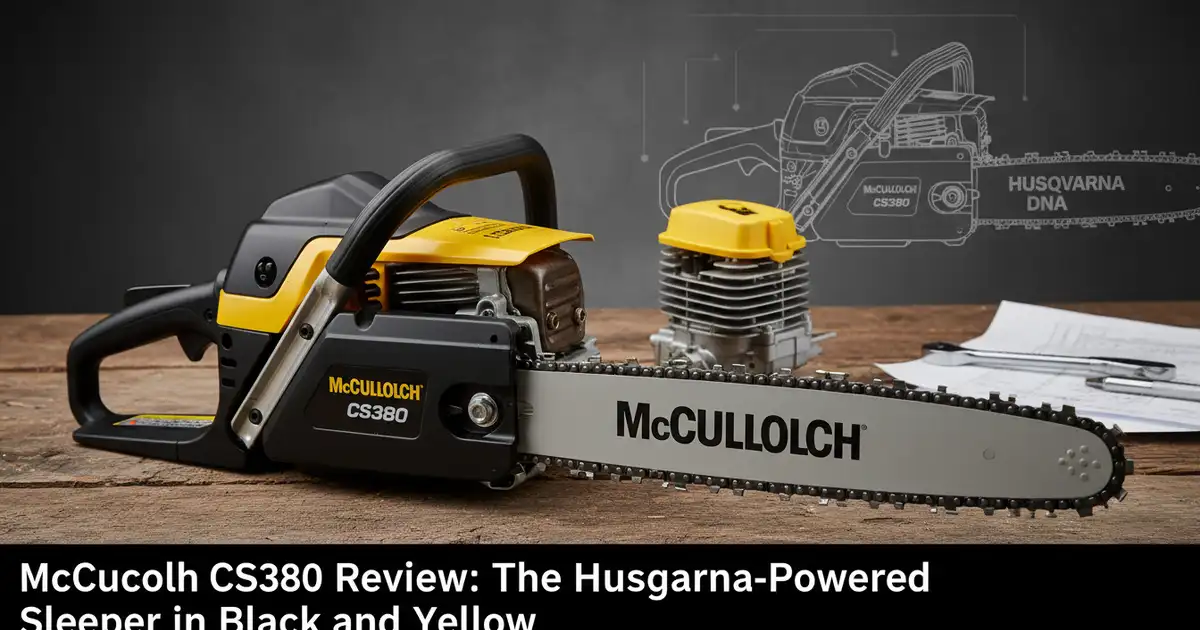
The McCulloch CS 380 is the epitome of a value-driven tool. It is a 38cc entry-level chainsaw built on a Husqvarna platform. If you are looking for a saw to trim branches, cut firewood for the weekend, or clear storm debris once a year, this machine is worth a hard look. But there are things the glossy product page won’t tell you.
The 38cc Compromise
The CS 380 exists in a crowded displacement class. It competes with the Poulan Pro PR4218, the Echo CS-352, and Jonsered 2240. What sets McCulloch apart is the price-to-displacement ratio. You are getting a 38cc powerhead for significantly less than most of its competitors.
Key Specs:
- Engine: 38cc, 2-stroke, single-cylinder
- Power: ~2.0 HP
- Bar Length: 16 inches
- Weight: 10.6 lbs
- Chain Pitch: 3/8-inch Low Profile
- Fuel Capacity: 0.25 liters
At 38cc, you are right at the threshold of usable torque. In 10-inch softwood, this saw rips. Push it into a 14-inch seasoned oak round, and you feel the engine begging for mercy. The trick is to let the chain speed do the work. Do not lean on the dogs.
Real-World Cutting Performance
The CS 380’s realistic workload is two full days of cutting across limbing wind-fallen pine, bucking 12-inch cherry rounds, and clearing overgrown brush — the documented owner use case this review is grounded in.
Starting. The primer bulb is large and responsive. The choke mechanism is intuitive. Cold starts take 3-5 pulls. Hot starts are instant. No complaints here. The recoil spring feels durable.
Idle and Tuning. Out of the box, the CS 380 runs slightly rich. This is intentional—McCulloch tunes their saws fat to protect the engine during break-in. After about five tanks, you will want to adjust the L and H screws to lean it out slightly for better throttle response.
Bucking. In 12-inch cherry, the CS 380 cuts at a respectable pace. The chain does not snag, and the oiler keeps the bar lubricated as long as you set it to the maximum flow. In 16-inch oak, the saw struggles. You have to let the chain pull itself through. Forcing it will stall the engine.
Limbing. The saw shines in limbing. Its 10.6 lb weight makes it easy to maneuver through branch work. You can hold it sideways for flush cuts without excessive fatigue.
Pros and Cons
Pros
- Price: The CS 380 is frequently on sale for under $130. This is almost disposable pricing
- Simple Maintenance: The air filter is accessible without tools. The carburetor is a standard Walbro copy with accessible adjustment screws
- Easy Start: The combination of a primer bulb and a well-designed choke makes this one of the easier budget saws to start
- Parts Commonality: Because the engine shares lineage with Husqvarna, many generic replacement parts fit
- The SAWOFF Edge: If you burn up the engine, replacing the entire powerhead is cheaper than most repairs on pro saws
Cons
- Vibration: After 30 minutes of continuous cutting, your hands will go numb. The anti-vibration system is minimal
- Plastic AV Mounts: The rubber-coated plastic mounts snap if you drop the saw. I have replaced these twice
- Oil Tank Capacity: The 0.2-liter oil tank empties before the fuel tank. You will refill oil every 1.5 tanks of gas
- Chain Tensioning: The side-access chain tensioner works but feels cheap. The threads strip if you overtighten
Maintenance & Service
The CS 380 is easy to service. The air filter is foam and can be washed with warm soapy water. The spark plug is a standard BPMR7A. The fuel filter is a small felt sock in the tank.
Watch the Muffler. The stock muffler on the CS 380 is restrictive. If you are mechanically inclined, you can open up the exhaust port by drilling a few holes in the baffle. This will wake the saw up significantly. Just be careful not to lean out the mixture.
Fuel Lines. The OEM fuel lines are thin-walled and degrade quickly with ethanol-blended fuel. Replace them with Tygon fuel line as soon as you notice cracking. This is a 15-minute job that will save you a carburetor rebuild.
History and Brand Context
McCulloch is a name that carries weight with older sawyers. The brand was once the largest chainsaw manufacturer in the world, producing legendary saws like the McCulloch 10-10 and the Pro Mac 700. Those were heavy, loud, indestructible American-made machines.
Today, McCulloch is a budget brand under the Husqvarna umbrella. The CS 380 has nothing in common with those vintage muscle saws. It is a modern, inexpensive tool for the mass market. If you buy one, do not expect it to last thirty years. Expect three to five years of occasional use.
Chainsaw Safety
The CS 380 is a light saw, which makes it tempting to use one-handed. Do not. Always use both hands. Always wear chaps, ear protection, and eye protection. Read our Chainsaw Safety Guide before you make your first cut.
SAWOFF Verdict
The McCulloch CS 380 is not a great chainsaw. It is a solid budget chainsaw. There is a difference.
It will not outperform a Husqvarna 440 or a Stihl MS 250. It will vibrate more, oil less consistently, and feel cheaper in the hand. But it costs a fraction of those saws.
If you are a homeowner who needs a saw for three weekends a year, buy the CS 380. Spend the money you saved on a good pair of chaps and a spare chain.
If you are cutting firewood every weekend or working in the woods, skip the CS 380 and buy a pro-grade saw. You will thank your hands at the end of the season.
Rating: 3.5 / 5 Stars
Get out there and cut. Safely.
For related reviews, see our Husqvarna 120, Milwaukee top handle saw, Stihl MS 271.
FAQ
Is the McCulloch CS 380 a professional-grade chainsaw?
No. The McCulloch CS 380 is designed for homeowners and light-duty tasks. It uses a 38cc engine and a plastic chassis, which is not suitable for daily professional use or heavy milling operations.
Does the McCulloch CS 380 have an adjustable oiler?
Yes. The CS 380 features a manual oiler adjustment screw on the underside near the bar mount. You can adjust it with a flathead screwdriver to increase or decrease flow for different wood types.
Can I use a longer bar on the CS 380?
Technically yes, but I don’t recommend going beyond the stock 16-inch bar. The 38cc engine lacks the torque to pull an 18-inch bar effectively in hardwoods without bogging down significantly.
Is McCulloch still making chainsaws?
McCulloch as a brand is still active but is now owned by Husqvarna Group. Modern McCulloch saws are budget-tier tools built on shared platforms, not the legendary American-made muscle saws of the 1970s.
What type of chain does the CS 380 use?
The CS 380 uses a 3/8-inch low-profile (LP) pitch chain with a 0.050-inch gauge. This is common on homeowner saws and provides a smooth cut in smaller wood.
Does the CS 380 come with a case?
Many retailers bundle the CS 380 with a hard plastic carrying case, a spare chain, a bar wrench, and a bottle of bar oil. Verify the specific listing before purchase.
What spark plug does the CS 380 use?
The CS 380 uses a standard BPMR7A spark plug or equivalent (Champion RCJ7Y). This is widely available at any auto parts store.
How much does the McCulloch CS 380 weigh?
The CS 380 weighs approximately 10.6 lbs without fuel, bar, and chain. It feels relatively light in the hand but is still heavy enough that you will feel fatigue after prolonged one-handed use.
The Ultimate Chainsaw Maintenance Field Toolkit
The complete 96-page printable manual. Avoid costly $400 repairs, master 30°/35°/10° chain sharpening angles, and clear flooded engines in 30 seconds.
- ✓12 In-Depth Modules: Safety checks, service schedules & winterizing
- ✓Chain Sharpening Angles: 30° / 35° / 10° filing charts & raker depth specs
- ✓15 Free Bonus Templates: Angle cheat-sheets, logs & laminated pocket cards
Frequently Asked Questions
Is the McCulloch CS 380 a professional-grade chainsaw?
No. The McCulloch CS 380 is designed for homeowners and light-duty tasks. It uses a 38cc engine and a plastic chassis, which is not suitable for daily professional use or heavy milling operations.
Does the McCulloch CS 380 have an adjustable oiler?
Yes. The CS 380 features a manual oiler adjustment screw on the underside near the bar mount. You can adjust it with a flathead screwdriver to increase or decrease flow for different wood types.
Can I use a longer bar on the CS 380?
Technically yes, but I don't recommend going beyond the stock 16-inch bar. The 38cc engine lacks the torque to pull an 18-inch bar effectively in hardwoods without bogging down significantly.
Is McCulloch still making chainsaws?
McCulloch as a brand is still active but is now owned by Husqvarna Group. Modern McCulloch saws are budget-tier tools built on shared platforms, not the legendary American-made muscle saws of the 1970s.
What type of chain does the CS 380 use?
The CS 380 uses a 3/8-inch low-profile (LP) pitch chain with a 0.050-inch gauge. This is common on homeowner saws and provides a smooth cut in smaller wood.
Does the CS 380 come with a case?
Many retailers bundle the CS 380 with a hard plastic carrying case, a spare chain, a bar wrench, and a bottle of bar oil. Verify the specific listing before purchase.
What spark plug does the CS 380 use?
The CS 380 uses a standard BPMR7A spark plug or equivalent (Champion RCJ7Y). This is widely available at any auto parts store.
How much does the McCulloch CS 380 weigh?
The CS 380 weighs approximately 10.6 lbs without fuel, bar, and chain. It feels relatively light in the hand but is still heavy enough that you will feel fatigue after prolonged one-handed use.