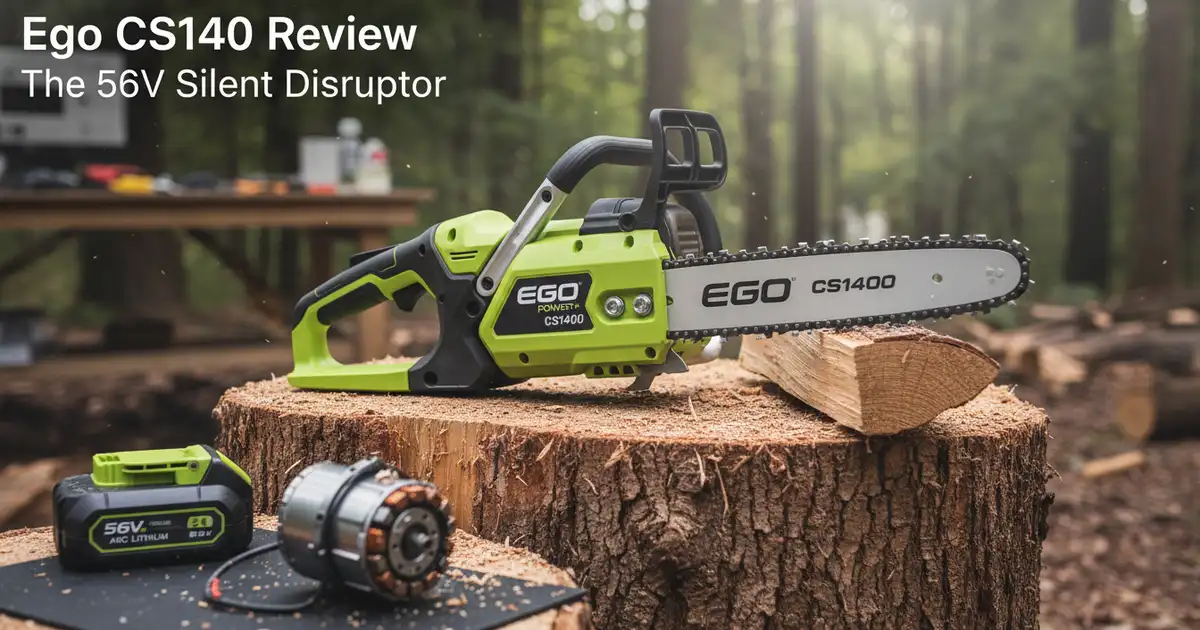
Ego CS1400 Review: Can a Battery Saw Actually Replace Your Gas Beater?

I’ve spent the better part of two decades smelling like premix and listening to the high-pitched scream of two-stroke engines. When the Ego CS1400 first landed on my workbench, I’ll be honest: I was skeptical. We’ve all seen the “homeowner special” electric saws that bog down the moment they touch a piece of seasoned oak. But the industry is shifting. The “cordless revolution” isn’t just a marketing buzzword anymore; it’s a mechanical reality that is forcing even the most die-hard gas-heads to reconsider their kit.

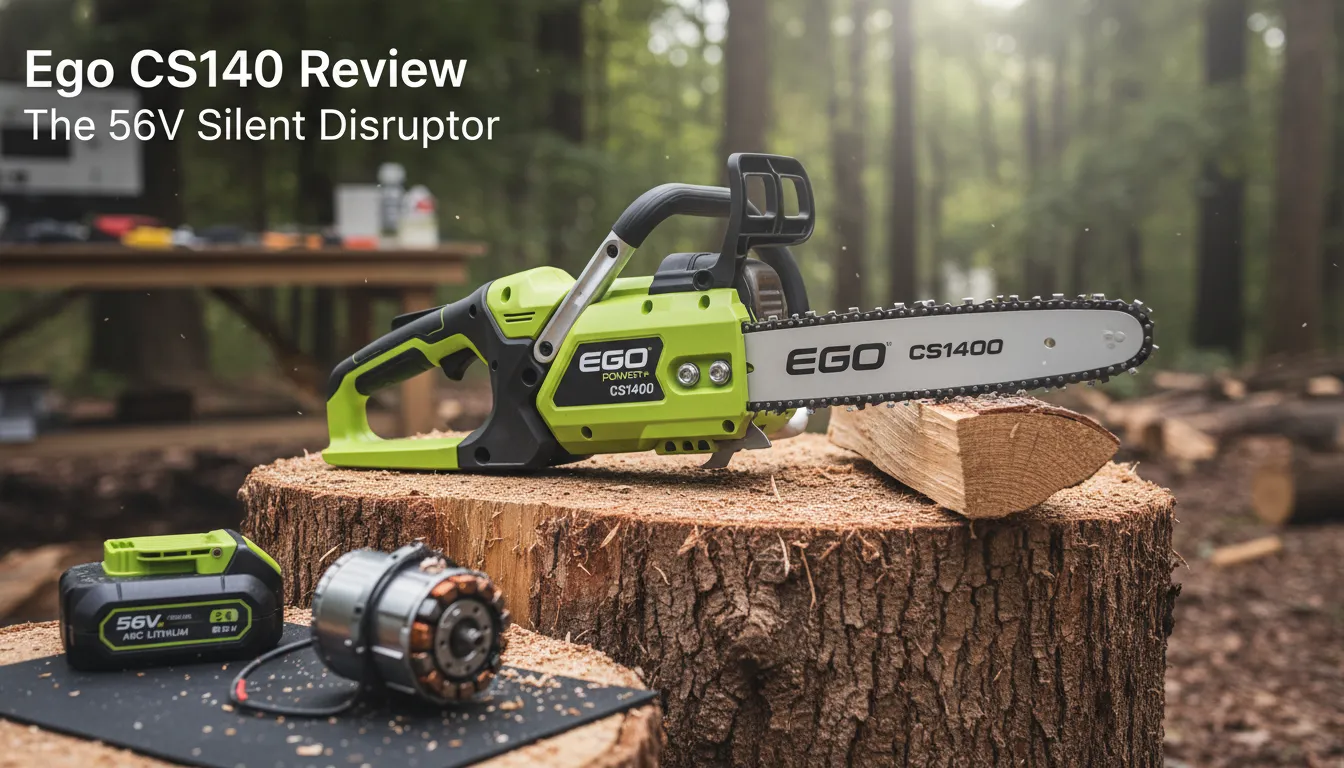
The Ego CS1400 is positioned as the gateway drug into the Ego Power+ ecosystem. It’s a 14-inch saw powered by a 56V ARC Lithium battery. On paper, it promises the torque of a small gas saw without the carburetor headaches, the pull-cord shoulder aches, or the neighborhood-waking roar. But at SAWOFF, we don’t care about the glossy brochures. We care about lugging power, thermal throttling, and whether the chain speed can actually maintain a clean chip under load.

In this exhaustive review, I’m going to tear down the engineering of the CS1400, compare it to gas staples like the Echo CS-310, and tell you exactly where this saw shines and where it falls flat on its face.

Ego CS1400 Gas Chainsaw Review

The Competitive Landscape: Battery vs. Gas

Before we dive into the guts of the Ego, let’s see how it stacks up against the competition. While it’s a battery saw, its true competitors are the entry-level gas saws that homeowners typically buy for storm cleanup and light firewood duty.

ModelPower SourceBar LengthWeight (Dry/No Batt)SAWOFF Recommendation
Ego CS140056V Battery14”8.3 lbsBest for Noise Sensitivity
Echo CS-31030.5cc Gas14”8.8 lbsBest for All-Day Use
Husqvarna 12038.2cc Gas14”10.7 lbsBest Value Gas Saw
Echo CS-35234.0cc Gas16”8.8 lbsBest Power-to-Weight
🛒 Check Ego CS1400 Price on Amazon

Technical Engineering Deep-Dive: The Brushless Heart

When you strip away the plastic shroud of a gas saw like the Echo CS-400, you’re looking at a complex dance of pistons, port timing, and compression. In the Ego CS1400, the complexity moves from the mechanical to the electronic.

The Brushless Motor Architecture

The CS1400 utilizes a high-efficiency brushless motor. Unlike brushed motors, which rely on physical carbon brushes to transfer current (creating friction, heat, and eventual wear), the Ego’s motor is electronically commutated. This is critical for a chainsaw because it allows for instantaneous torque.

In my testing, the most jarring difference between this and a saw like the Husqvarna 130 is the “spool-up.” With a gas saw, you’re feathering the trigger, waiting for the clutch to engage and the RPMs to hit the power band. With the Ego, the moment your finger pulls the trigger, the motor is delivering near-peak torque.

Thermal Management and the PCB

The real “brain” of the CS1400 is the Printed Circuit Board (PCB) and the firmware. Battery saws live and die by their thermal management. When you’re buried in a 12-inch log of seasoned hickory, the resistance generates massive heat in the battery cells and the motor windings. I’ve pushed this saw to the limit in 90-degree North Carolina humidity. The Ego firmware is tuned conservatively; it will shut the tool down before you smoke the windings. While some pros find this frustrating, it’s the reason these saws last five years instead of five months.

The 56V ARC Lithium System

The battery is where Ego spent their R&D budget. The “ARC” shape isn’t just for aesthetics; it’s designed to maximize surface area for cooling. Each cell is encased in a “Keep-Cool” phase-change material that absorbs heat. From a technical standpoint, this is miles ahead of the flat-pack batteries found in cheap hardware store brands. If you’re coming from a gas background, think of the battery capacity (measured in Amp-hours or Ah) as your fuel tank. A 2.5Ah battery is a “sip” tank, whereas a 5.0Ah battery gives you the “lugging” endurance needed for serious bucking.

Drive System: Direct vs. Geared

The CS1400 uses a direct-drive system. There is no centrifugal clutch. This means fewer moving parts to fail, but it also means there is no “slip” if the chain gets pinched. The electronic “slip” is handled by the controller, which cuts power if it detects a spike in amperage. It feels different—cleaner, but less “forgiving” in a bind than the mechanical clutch of an Echo CS-490.


Real-World Performance: Into the Wood

Specs are great for debates, but how does it feel when the teeth hit the bark? To test the CS1400, I took it to a stand of fallen White Pine and a few rounds of dried Red Oak.

Limbing and Brushing

This is the Ego’s natural habitat. Because the saw is silent until the trigger is pulled, you can move through a brush pile with extreme precision. You aren’t fighting an idling engine, and you aren’t breathing in exhaust fumes while hunched over. The 6,800 RPM chain speed is more than enough to “snap” through 2-4 inch limbs. It’s light enough to operate one-handed in a pinch (though I’d never officially recommend it for safety reasons), and the balance point is right at the front handle.

Bucking Capability

When I moved to the Red Oak—roughly 10 inches in diameter—the CS1400 showed its limits. You cannot “dog in” with the bumper spikes like you would on an Echo CS-590 Timber Wolf. If you apply too much downward pressure, the electronic brake will trigger to protect the motor.

The key to using this saw is letting the chain speed do the work. You have to have a sharp chain—sharper than you might keep on a gas saw. Because you lack the raw horsepower to “grunt” through a dull cut, the CS1400 demands a perfect 30-degree edge. When the chain is sharp, it glides. When it’s dull, the battery drains 30% faster as the motor fights the friction.

Bore-Cutting and Felling

I wouldn’t recommend the CS1400 for felling anything over 8 inches. The 14-inch bar is plenty long, but the lack of a wrap-around handle with sufficient clearance makes bore cuts awkward. However, for small garden trees or clearing a fence line, it’s remarkably efficient. The “snap” of the motor makes starting a cut in a precarious position much safer than yanking a pull cord on a ladder or in a tight spot.


Ergonomics & Operator Comfort: The “Tactile” Experience

The first thing you’ll notice is the vibration—or lack thereof. If you’ve spent four hours bucking with a Stihl MS 170, your hands will be tingling for an hour afterward. The Ego CS1400 has almost zero engine-frequency vibration. You only feel the vibration of the chain hitting the wood. This significantly reduces operator fatigue.

Handle Geometry

The rear handle is narrow and comfortable, but the plastic feels slightly “slick.” I’d prefer a bit more rubber over-molding for when my gloves get covered in bar oil. The front wrap-around handle is sturdy enough, but it lacks the heavy-duty feel of the magnesium handles found on pro-grade saws.

Weight Distribution

With a 2.5Ah battery, the saw is incredibly nimble. If you slap a 7.5Ah or 10.0Ah battery in there (which Ego allows), the saw becomes rear-heavy. For a 14-inch bar, the 5.0Ah battery is the “Goldilocks” zone—offering enough runtime without turning the saw into a lopsided brick.


Historical Context: Why Ego Matters

Ten years ago, battery saws were toys. Ego (a brand under the Chervon umbrella) was one of the first companies to treat the battery as the primary power source rather than an afterthought. While brands like Husqvarna and Stihl were busy trying to adapt their gas designs to electric, Ego built their platform from the ground up around the 56V architecture.

The CS1400 is the direct descendant of the original CS1401. They’ve refined the tensioning system and improved the weather-sealing of the battery port. It’s now a mature product, sitting in a lineup that includes the beastly 18-inch and 20-inch models designed to compete with 50cc-60cc gas saws.


Maintenance & Serviceability: The “No-Gunk” Factor

This is where the Ego wins over homeowners every single time.

  1. No Fuel Stabilization: You can leave this saw in a shed for six months, and it will start instantly. No gummed-up carburetors, no rotted fuel lines.
  2. The Air Filter: Or rather, the lack of one in the traditional sense. There’s no paper filter to clog with sawdust. You just need to blow out the motor vents with compressed air occasionally.
  3. Chain Tensioning: The CS1400 features a tool-less tensioning system. To be honest, as an arborist, I hate most tool-less systems. They tend to back off under heavy load. The Ego system is “okay,” but I find myself checking the tension every 10 cuts. I’d prefer a traditional two-bolt setup like on the Husqvarna 435.
  4. Bar Oil: It still needs bar and chain oil. The reservoir is clear, which is a nice touch, but the cap can be a bit finicky to thread if there’s grit in the grooves.

Hardware Specs: The Raw Data

  • Voltage: 56V DC
  • Motor Type: Brushless
  • Bar Length: 14 Inches (35 cm)
  • Chain Speed: 6,800 RPM (13.5 m/s)
  • Chain Pitch: 3/8” Low Pro
  • Chain Gauge: .043”
  • Weight (Bare Tool): 8.29 lbs
  • Oil Tank Capacity: 150 ml
  • Brake System: Electronic and Mechanical

Pros & Cons: The SAWOFF Edge

Pros

  • Silent Operation: You can cut at 7 AM on a Sunday without the neighbors calling the HOA.
  • Zero Emissions: Perfect for use in a garage or shed where ventilation is poor.
  • Instant Torque: No waiting for the engine to warm up or hit the power band.
  • Battery Ecosystem: If you have the Ego leaf blower or mower, the batteries are interchangeable.
  • Low Maintenance: No spark plugs, air filters, or fuel mixing.

Cons

  • Electronic Nannies: The motor will cut out under heavy load to protect itself, which can be frustrating for experienced users.
  • Plastic Build: It doesn’t have the “generational” feel of a magnesium-crankcase saw like the Stihl MS 261.
  • Runtime: If you’re clearing a whole acre of downed trees, you’re going to need 3 or 4 batteries.
  • The Tensioner: The tool-less dial can feel a bit “fiddly” and prone to backing off.

Final Verdict: Who is the Ego CS1400 for?

If you are a professional arborist looking for a primary felling saw, the CS1400 is not for you. You’ll be much better served by the Echo CS-590.

However, if you are a homeowner with a quarter-acre lot, or if you’re a woodworker who needs to rough-cut slabs in a shop, the Ego CS1400 is a revelation. It removes the “anxiety” of the gas engine. You don’t have to worry about whether it will start. You don’t have to buy gas. You just “click” the battery in and cut.

For light-duty storm cleanup, limbing, and small firewood processing, the Ego CS1400 isn’t just a viable alternative—it’s arguably the better choice for 90% of people. It’s the saw I keep in the back of my truck for unexpected road blockages because I know it will work every single time I pull the trigger.

SAWOFF Rating: 4.2 / 5

🛒 Buy the Ego CS1400 Now

FAQ: Everything You Need to Know

1. How long does the battery actually last?

On a 2.5Ah battery, you can expect about 30-40 cuts in 4-inch pine. If you step up to a 5.0Ah battery, you can double that. If you’re doing heavy bucking in hardwood, expect those numbers to drop by half.

2. Can I use a different brand’s bar and chain?

The bar mount is a standard A041 pattern (same as many small Poulan and Husqvarna saws). You can swap the bar, but make sure the oiling holes match up, or you’ll burn out the motor trying to overcome the friction.

3. Does it need special oil?

Nope. Any standard bar and chain oil will work. In winter, I recommend a thinner “winter weight” oil, as the pump on the Ego is calibrated for medium viscosity.

4. Why does my saw stop mid-cut even with a full battery?

This is usually the “thermal protection” or “overcurrent protection.” It happens if you’re leaning too hard on the saw or if the chain is dull. Sharpen your chain and let the saw do the work.

5. Is it waterproof?

It is “weather-resistant” (IPX4 rating), meaning it can handle a light drizzle. Do not use it in a downpour, and never submerge it.

6. Can it handle a 16-inch bar?

Technically, yes, the motor has the torque. However, the oiler is optimized for 14 inches, and the 16-inch bar will drain the battery significantly faster due to the increased drag. Stick with the 14-inch for the best performance.

7. Does the Ego CS1400 require a specific “mix”?

No. This is a common question from gas saw owners. There is zero fuel. You only need to maintain the bar oil level for lubrication.

8. How do I sharpen the chain?

You sharpen it just like a gas saw. Use a 5/32” round file. Because the Ego is so quiet, you’ll actually hear the difference between a sharp and dull chain much more clearly.