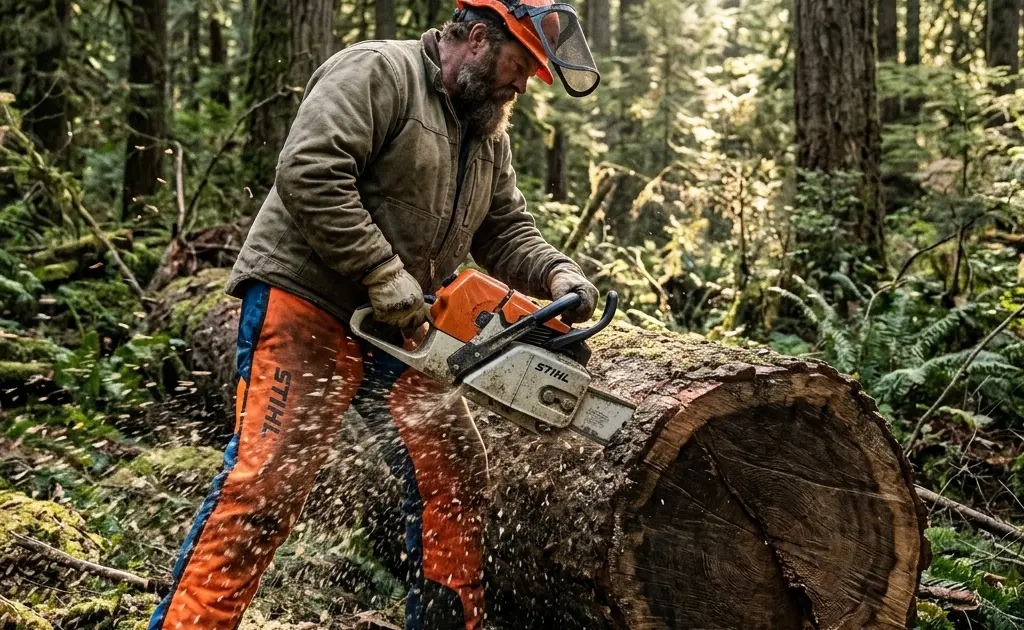
The Best Logging Chainsaws: Engineering, Power, and Professional Field Tests
When you’re standing at the base of a 40-inch white oak in a remote corner of the Appalachians, you aren’t looking for a homeowner tool. You need a logging saw — a high-displacement, high-torque beast designed to run a 28-to-36-inch bar all day without thermal thinning or RPM sag.
In the logging world, we don’t measure performance by how clean the plastic stays. We measure it by stump-to-truck speed and how much feeling is left in our fingers at the end of a ten-hour shift. We’ve spent decades in the brush, feeling the specific bite of a full-chisel chain in frozen maple and the high-pitched scream of a saw tuned perfectly for 3,000 feet of elevation.
The Top Contenders: Side-by-Side Professional Specs
| Model | Displacement | Power Output | Weight (Powerhead) | Best For | Check Price |
|---|---|---|---|---|---|
| Husqvarna 592 XP | 92.7 cc | 7.6 hp | 16.3 lbs | Massive Felling | 🛒 View on Amazon |
| Stihl MS 661 C-M | 91.1 cc | 7.2 hp | 16.5 lbs | High-Production Logging | 🛒 View on Amazon |
| Echo CS-7310P | 73.5 cc | 5.4 hp | 14.8 lbs | Mid-Range Felling/Bucking | 🛒 View on Amazon |
| Husqvarna 572 XP | 70.6 cc | 5.8 hp | 14.5 lbs | Versatile Logging Workhorse | 🛒 View on Amazon |
Technical Engineering Deep-Dive: What Makes a Logging Saw?
Magnesium vs. Plastic Crankcases. Professional logging saws use magnesium alloy crankcases. Under the immense heat of a 90cc engine running at 13,000 RPM, plastic would warp and suffer structural fatigue. Magnesium provides rigidity to hold the crankshaft in perfect alignment while dissipating heat faster than any polymer.
The Transfer Port Revolution. Stratified scavenging (Stihl’s 2-MIX, Husqvarna’s X-Torq) uses a layer of fresh air to push out exhaust gases before the new fuel-air mix enters the combustion chamber. This achieves massive fuel savings (up to 20%) and significantly lower emissions.
Electronic Carburetion (AutoTune & M-Tronic). The days of carrying a tiny screwdriver to adjust H/L needles every time humidity changes are over. These systems use a microprocessor to monitor engine temperature, altitude, and fuel quality, adjusting the solenoid valve in real-time. I’ve taken an MS 462 from sea level to 5,000 feet in a single day and the throttle response stayed crisp.
Filtration Systems. Professional saws use centrifugal air cleaning. Heavy dust particles are thrown outward by centrifugal force before they ever reach the filter. This extends intervals between cleanings from every few hours to once every several days.
Real-World Performance
Bucking Large Diameter Hardwoods. I recently spent a week clearing downed Red Oaks after a storm. Once the diameter crossed 30 inches, I switched to a Husqvarna 592 XP. A pro saw has a flat torque curve — even as you apply pressure, the RPMs don’t drop off a cliff. Jumping from a mid-range saw to a 70cc+ logging saw feels like trading a sedan for a diesel truck.
Limbing and Maneuverability. Logging isn’t all felling. Half your time is spent limbing out the tree. Saws like the Husqvarna 572 XP are flickable — you can move the bar with precision, snipping limbs with a quick blip of the trigger.
Ergonomics & Operator Comfort
Anti-vibration systems on modern pro saws use heavy-duty steel springs instead of rubber bushings. Rubber breaks down; steel doesn’t. Wrap handles allow felling at various angles without contorting your wrists. A well-designed logging saw balances perfectly with its intended bar length.
Brand Heritage
Stihl — the gold standard for reliability. Parts network is unrivaled. Husqvarna — faster saws with higher revs and better power-to-weight ratios. Echo — the dark horse. Saws like the CS-7310P prove Echo can play in the big leagues at $200-$300 less than the European counterparts.
Maintenance & Serviceability
- Captive Bar Nuts — modern pro saws keep nuts attached to the clutch cover. Game-changer.
- Spark Plug Access — you should access the plug and air filter without tools.
- The Clutch — professional saws have an outboard clutch. Makes rim sprocket changes easier and keeps clutch heat away from the crankcase.
- Oiler Performance — look for an adjustable oiler. Running a 36-inch bar in dry hickory means you need to crank up the juice.
Pros & Cons
Pros: Unmatched power for the largest timber; built to last 1,000+ hours; modern fuel management saves money; inertia-activated chain brakes tuned for professional reaction times. Cons: $900 to $1,500 price tag; heavy — not for pruning apple trees; electronic carburetors need dealer diagnostics; require high-octane fuel and quality oil.
Final Verdict
If I had to pick one saw for a professional logging site, it would be the Husqvarna 592 XP. The power-to-weight ratio is unbeatable, and AutoTune 3.0 is the most refined electronic carb system I’ve tested.
If you want a saw that lasts 30 years with nothing but a wrench, look at the Echo CS-7310P — raw displacement and heavy-duty components without fancy electronics.
SAWOFF Rating: 4.9 / 5
Chainsaw Safety
Logging is inherently dangerous. Never work alone. Read our Chainsaw Safety Guide and understand Gas vs Electric Chainsaw trade-offs before you buy.
Get out there and cut. Safely.
Frequently Asked Questions
What fuel mix should I use for a logging chainsaw?
Always use 50:1, but fuel quality matters more. Use 91+ octane non-ethanol fuel. Ethanol attracts water and runs hotter, which can lean out a high-performance logging engine and cause a piston seize.
How often should I sharpen my chain when logging?
In clean wood, touch up the cutters every time you refill the gas tank. Three strokes with a round file per tooth keeps the saw self-feeding. If you hit dirt or a rock, stop immediately and file.
Can I run a 36-inch bar on a 60cc saw?
It might fit, but don't do it. A 60cc saw doesn't have the oil pump capacity or torque to pull that much chain. You'll burn up the clutch and bar. Stick to the manufacturer's recommended max length.
Why does my logging saw flood so easily?
High-compression engines are sensitive. If you don't follow the starting procedure (choke → pull until it pops → half-throttle), you'll soak the plug. If flooded, hold the throttle wide open and pull 10-15 times.
What's the difference between full chisel and semi-chisel chain?
Loggers almost always use full chisel. It has square-cornered teeth that cut significantly faster. Semi-chisel has rounded corners — it stays sharp longer in dirty wood but is much slower.
Is it worth getting a heated handle?
If you live in the Pacific Northwest or Northeast, yes. Models with a G suffix have internal generators that heat the handles. It prevents vibration-related injuries and keeps hands responsive in cold weather.
How do I know when my logging saw needs a top-end rebuild?
First sign is loss of snap and difficulty starting when hot. Check compression — anything under 120 PSI indicates blow-by on the piston rings. Most pro saws push 150+ PSI.
Should I muffler mod my new logging saw?
It can increase power, but it voids your warranty and can cause the engine to run too lean. With modern AutoTune and M-Tronic saws, the computer tries to compensate, but leave it stock until the warranty expires.