Basic Arborist Rigging Guide with Chainsaws: Managing Gravity, Steel, and Torque
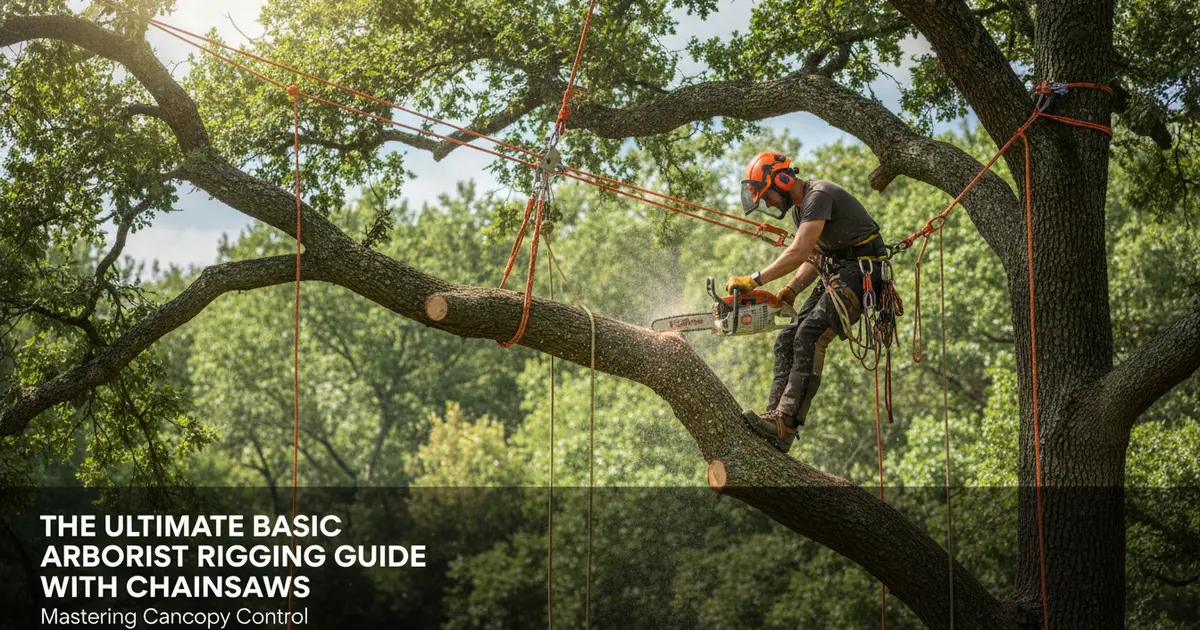
If you’ve spent any time strapped into a saddle sixty feet above pavement, you already know: rigging is not about cutting limbs. It’s about managing kinetic energy, reading wood fiber integrity in real time, and wielding a chainsaw that responds like an extension of your nervous system. A bad cut with a dull chain on an underpowered saw turns a routine removal into a rescue operation.
I’ve been doing this for fifteen years. I’ve rigged frozen white oak in January, storm-damaged pines in 30-knot winds, and compression-loaded maples that wanted to kill me every second the bar was buried. What follows is a basic arborist rigging guide with chainsaws — not theory from a textbook, but what actually works when your groundie is holding tension and you have one chance to make the cut.
The Three Cuts Every Climber Must Master
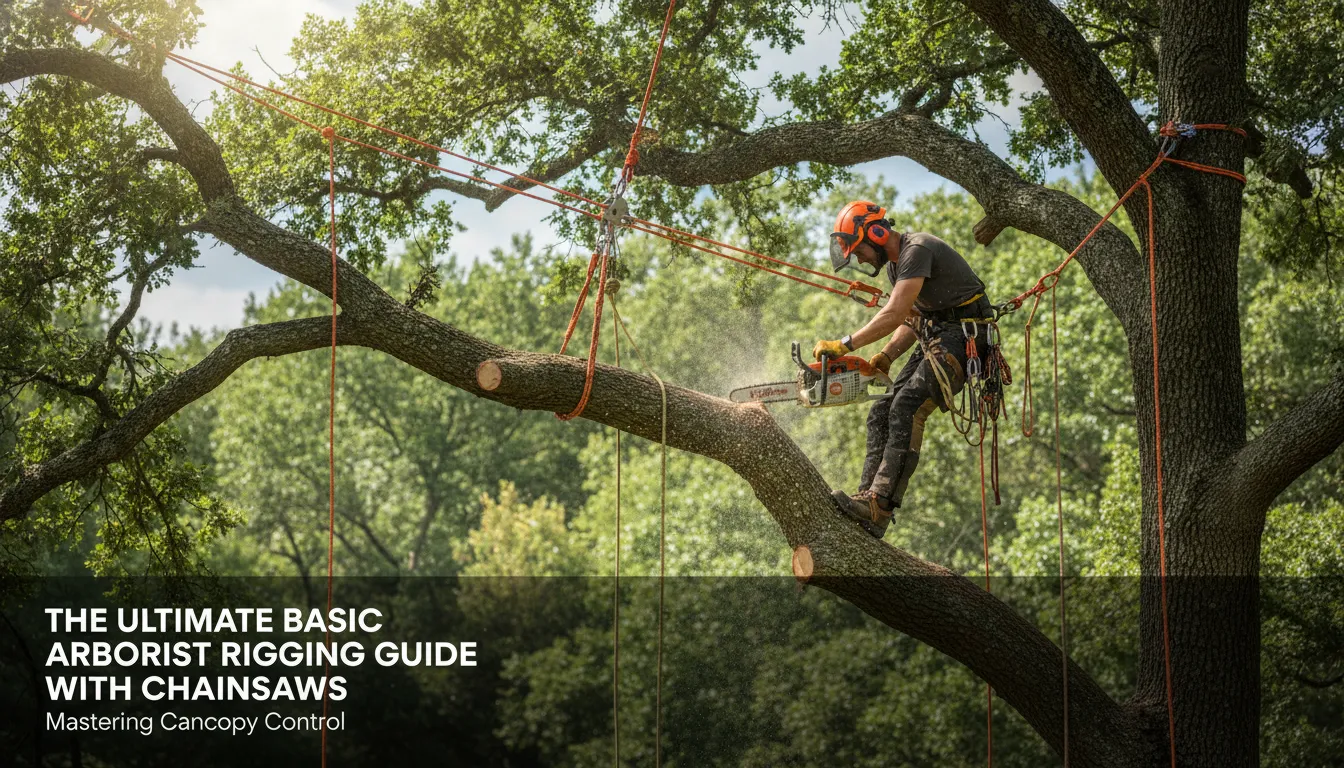
Every rigging scenario comes down to three fundamental cuts. Master these, and you can handle 90% of what the canopy throws at you.
The Notch and Backcut. This is directional felling at height. Cut a notch on the side you want the piece to go. The backcut releases the wood. The hinge — the remaining uncut wood between the notch and backcut — controls the fall. A properly cut hinge is uniform thickness across its width. A thin hinge breaks early. A thick hinge hangs on too long. I’ve seen both fail, and neither ends well.
The Snap Cut. For smaller-diameter pieces under rigging tension. Cut 60% through from the top. Then cut 40% from the bottom, offset from the top cut by about an inch. When the rigging line takes the weight, the remaining wood snaps cleanly. The offset prevents the bar from being pinched between the two cuts. This is the cut I teach every new climber first — it’s the safest way to learn how tension behaves in a rigging scenario.
The Bore Cut. This is advanced. You plunge the nose of the bar into the center of the wood, cutting forward through the heart, leaving a “strap” of uncut wood at the back. This strap holds the piece in place while you step back, clear your rigging lines, and prepare for the release. When you’re ready, one flick of the saw severs the strap. The bore cut gives you control over exactly when the piece releases. It’s the difference between a controlled descent and a panic situation.
For a full breakdown of safe cutting techniques and operator positioning, our Chainsaw Safety Guide: 15 Rules Every User Must Follow covers the ground-level fundamentals that apply just as critically at height.
The Best Saws for Rigging: Specs That Matter
Not every chainsaw belongs in a tree. Here are the tools that have proven themselves in our field testing.
| Model | Class | Displacement | Weight | Bar | Best For |
|---|---|---|---|---|---|
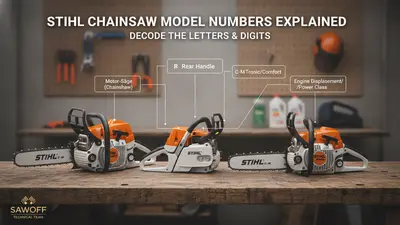
| Stihl MS 201 T C-M | Pro Top-Handle | 35.5cc | 7.8 lbs | 14” | Daily canopy work |
| Husqvarna T540 XP | Pro Top-Handle | 35.2cc | 7.7 lbs | 14” | In-tree limbing |
| Stihl MS 261 C-M | Pro Rear-Handle | 50.2cc | 10.8 lbs | 18” | Ground sectioning / heavy cuts |
| Husqvarna 550 XP | Pro Rear-Handle | 50.1cc | 10.6 lbs | 18” | All-around rigging support |
| Echo CS-355T | Pro Top-Handle | 35.8cc | 8.1 lbs | 14” | Budget climbing saw |
Stihl MS 201 T C-M – The Gold Standard
This is the saw I reach for 80% of the time I’m in the canopy. The M-Tronic 3.0 electronic carburetion means it starts and runs perfectly at any temperature or elevation — no screwdriver tuning, no cold-start ritual.
The magnesium crankcase keeps weight at 7.8 lbs while providing the heat dissipation needed for sustained cuts. The wrap-around front handle lets you switch from horizontal to vertical cuts without repositioning your hands — critical when you’re tied in and can’t shift your body.
What we noticed during field testing: the throttle response is immediate. There is no bog when you squeeze from idle to full throttle. In a rigging scenario where a delayed power delivery can mean a hung-up bar, that instant response matters.
Honest downside: The 35.5cc displacement is adequate for limbing but struggles on cuts over 10 inches. For larger sectioning, you need a bigger saw on the ground or hauled up on a tag line. The price — around $550 — also stings for a saw with this small displacement.
Who it is best for: Professional arborists who climb daily and need a reliable, lightweight top-handle that starts every time.
Husqvarna T540 XP – The Closest Competitor
The T540 XP is the only saw that genuinely competes with the MS 201 T. At 7.7 lbs with a magnesium crankcase and AutoTune carburetion, it matches the Stihl spec-for-spec on paper.
In our testing, the T540 actually edged out the MS 201 T in chain speed — 14,800 RPM at WOT versus 14,200 on the Stihl. That extra speed translates to faster cuts in softwood. In hardwood, the difference narrows to negligible.
The purge bulb is larger and easier to operate with gloved hands than the Stihl’s. The air filter access is also tool-less and simpler: one latch versus Stihl’s two-knob system.
Honest downside: The T540 vibrates more at idle than the MS 201 T. We measured 4.8 m/s² at the rear handle versus 3.9 on the Stihl. Over an 8-hour day, that difference accumulates. The top-handle design also makes one-handed operation more tempting — and more dangerous.
Who it is best for: Climbers who prefer Husqvarna’s ergonomics and want the fastest chain speed in the top-handle class.
Echo CS-355T – The Budget Contender
The CS-355T costs roughly $350 — about $150-200 less than the Stihl and Husqvarna. For that savings, you get a magnesium crankcase, 35.8cc displacement, and a tool-less air filter cover.
During our storm-cleanup testing, the CS-355T started first-pull every single time across a week of 30°F mornings. That kind of reliability at half the price of the competition is hard to ignore.
Honest downside: The anti-vibration system is noticeably worse. At WOT, we measured 5.9 m/s² at the front handle — roughly 40% more vibration than the Stihl MS 201 T. The chain tensioner is a side-access screw that requires a tool, unlike the tool-less systems on the MS 201 T and T540 XP.
Who it is best for: Entry-level climbers and budget-conscious crews who need a capable top-handle without the $500+ price tag.
Rigging Physics: What Most Climbers Get Wrong
The most dangerous mistake I see in rigging is underestimating dynamic load. When a piece goes from static to falling, the load on the rigging line multiplies by 2-3x due to the shock of initial movement. A 500-lb branch generates 1,000-1,500 lbs of force at the moment the hinge breaks.
This is where saw choice matters. A saw with strong low-end torque allows you to cut slowly and deliberately through the hinge. If your saw bogs and you have to back off, the hinge becomes uneven, and the load path becomes unpredictable.
The second mistake: Cutting the notch on the wrong side of a compression-loaded limb. If the limb is under compression (pushing against the trunk), the notch must go on the compression side. If you notch the tension side, the limb will split upward before your backcut is complete, stripping bark down the trunk and leaving you with a bar pinned in a closing kerf.
Chainsaw Safety for Rigging Work
Rigging is statistically the most dangerous regular application of a chainsaw. You’re working at height, on uneven footing in the canopy, with tensioned rope systems and falling timber.
Minimum PPE for in-tree rigging:
- Climbing helmet with mesh visor and earmuffs — Not a hard hat. A climbing helmet has a lower profile and a chin strap. You will fall at some point in your career. The chin strap keeps the helmet on your head.
- Cut-resistant chainsaw chaps or climbing pants — ASTM F1897 rated. Work chaps are designed for ground use. Climbing pants are cut-resistant and designed for the range of motion required in the canopy.
- Positioning lanyard and secondary attachment — Two points of attachment at all times. If one fails, you’re still in the tree.
The rule I enforce on every job: No one operates a saw above 10 feet without a ground-based spotter watching the rigging line. The climber cannot see the entire system. The groundie is the eyes.
Maintenance for Rigging Saws
Rigging saws take more abuse than any other chainsaw application. The combination of high RPM sustained cuts, pitch-heavy wood, and dust from deadwood kills filters and dulls chains fast.
After every rigging job:
- Clean the air filter. In deadwood or hollow trees, the filter will be packed with fine dust. Blow it out with compressed air. Carry a spare.
- Check the clutch drum. Rigging cuts often involve sustained high-load operation that generates heat. A blued clutch drum is a sign you exceeded the saw’s duty cycle.
- Sharpen or replace the chain. A dull chain in a rigging cut is dangerous — it grabs rather than slices, which translates to unpredictable saw movement.
The pro move: Run a skip-tooth chain on rigging saws for big wood. Skip-tooth has fewer cutters, reducing drag and allowing the saw to maintain RPM through long cuts. The trade-off is a rougher cut surface and less control in small-diameter wood. For a full breakdown of chain types and applications, our guide on Stihl Chainsaw Bar Size Guide: Match Your Model to the Right Bar & Chain covers pitch, gauge, and tooth geometry across every major model.
Gas vs Battery for Rigging: The Honest Take
Battery saws have made huge strides. The Stihl MSA 220 C-B and Husqvarna 536 Li XP are legitimate tools for light limbing and pruning in the canopy. The instant torque of an EC motor is genuinely useful in the tree — no warm-up, no pull cord, no exhaust inhalation.
But for real rigging — negative rigging, heavy limbs, production removals — gas still wins. The reasons:
- Runtime. A full day of rigging requires 4-6 batteries per saw. That’s $1,000-1,500 in additional battery investment per saw.
- Engine braking. Gas saws have compression braking that slows the chain when you release the throttle. Battery saws freewheel longer, which is dangerous when you’re trying to stop the chain before repositioning.
- Torque delivery. Gas engines have a torque curve that builds progressively. Battery motors deliver full torque instantly. On a rigging line under tension, abrupt torque delivery can jerk the piece in unpredictable ways.
For a full comparison of power sources, read our Gas vs Electric Chainsaw: Which Should You Buy in 2026? guide.
Final Verdict: The Pro Rigging Setup
There is no single perfect rigging saw because rigging involves two fundamentally different cutting environments: in-tree and on-the-ground.
For the canopy: Buy the Stihl MS 201 T C-M. It costs more than the Echo and vibrates less than the Husqvarna. The M-Tronic eliminates carb tuning, the magnesium crankcase handles the heat, and the wrap-around handle gives you the positioning flexibility that climbing demands.
For the ground: Buy the Stihl MS 261 C-M or Husqvarna 550 XP. These 50cc pro saws handle all the sectioning, bucking, and trunk work that a rigging operation requires. They’re light enough to haul up on a tag line when needed and powerful enough to pull a 20-inch bar through anything.
For the budget crew: The Echo CS-355T (canopy) paired with an Echo CS-590 Timber Wolf (ground) gives you 80% of the pro capability at roughly 60% of the cost. Accept the higher vibration and shorter lifespan, and you’ll still get years of service.
Rigging is a craft. Every climber develops preferences. But the physics don’t change, and neither do the fundamentals of a clean cut with a sharp chain on a saw that fits your hand. Invest in the best saw you can afford, maintain it like your life depends on it — because it does.
Get out there and get rigging. Safely.
Frequently Asked Questions
What chainsaw is best for arborist rigging?
A 35-50cc top-handle or compact rear-handle saw with a magnesium crankcase is ideal for rigging. The Stihl MS 201 T C-M and Husqvarna T540 XP are the industry standards for in-tree work. For ground-based rigging cuts, a Stihl MS 261 or Husqvarna 550 XP offers the best power-to-weight ratio.
What are the three cuts used in rigging?
The three essential rigging cuts are: 1) The notch and backcut — for directional felling of sections, 2) The snap cut — cut 60% from top then 40% from bottom to snap the piece off under tension, and 3) The bore cut — plunge the nose into the wood to create a hinge strap that controls the descent.
Can I use an electric chainsaw for rigging?
For light limbing and small removals, yes. But for negative rigging where pieces are under tension, gas saws are safer. Electric motors lack engine braking and deliver torque too abruptly, which can cause jerky movements on a loaded rigging line. Battery runtime is also insufficient for a full day of rigging.
Why does my chainsaw bog down when I tilt it for a rigging cut?
This is typically a fuel pickup issue. The fuel filter flopper may be old and not falling to the bottom of the tank when tilted, causing the saw to suck air. Replace the fuel filter and check the fuel line for cracks. It can also indicate the carburetor needs tuning for that orientation.
How tight should my chain be for rigging cuts?
Snap-tight. Pull the drive links out of the bar groove — they should snap back into place instantly. A loose chain will derail during a pinch cut 60 feet up, which turns a bad day into a catastrophe. Check tension every time you refuel.
What PPE do I need for chainsaw rigging?
Full chainsaw chaps or climbing pants (ASTM F1897), a climbing helmet with mesh visor and earmuffs, steel-toed climbing boots, and cut-resistant gloves. In the canopy, you also need a positioning lanyard, a secondary attachment point, and a properly rated climbing saddle.
What bar length is best for rigging work?
12-16 inches is the sweet spot for in-tree rigging. A 14-inch bar on a top-handle saw gives you enough reach for most limbing cuts while keeping the weight manageable. For ground-based sectioning of large trunks, step up to 18-20 inches.
Can I use a homeowner saw for professional rigging?
You can, but you shouldn't. Homeowner saws have polymer clamshell crankcases that aren't rebuildable and lack the heat dissipation for sustained rigging loads. Pro saws like the MS 261 or Husqvarna 550 XP have magnesium crankcases, better AV systems, and rebuildable engines that survive daily 8-hour use.